

How to read this page
This page tries to keep three kinds of knowledge apart, because readers deserve to know which is which.
What Scripture says. The four Gospels (Matthew, Mark, Luke and John) are our main sources for the life of Jesus. Paul's letters, written in the 50s AD, are older still, and they repeat traditions about Jesus that Paul says he "received" (1 Corinthians 15:3). When we say "the Gospels report," that is what we mean, and we link the passage so you can read it for yourself.
What early church tradition says. Writers such as Papias (early 2nd century), Irenaeus (late 2nd century) and Eusebius of Caesarea (early 4th century) passed on memories and traditions about the apostles and the writing of the Gospels. These are valuable and very old, but they are not Scripture, and sometimes they disagree with each other. We mark them as tradition.
What historians conclude. Historians, believing and unbelieving, work with the Gospels alongside Jewish, Roman and archaeological evidence. Almost all of them agree that Jesus was a real Jewish teacher from Galilee who was baptized by John and crucified under Pontius Pilate. Beyond that, scholars debate many details. Where they differ, we say so.
We write as a Christian ministry. We believe that Jesus is who the Gospels say he is. We also want this page to be honest and useful for any reader, whatever you believe, so we have tried to be careful with the evidence and fair to people who see things differently.
The world he was born into
A small land between empires
Jesus was born in a narrow strip of land between the Mediterranean Sea and the Jordan River, about the size of the state of New Jersey. It had been fought over for a thousand years. Assyrians, Babylonians, Persians, Greeks and Egyptians had all ruled it. In 63 BC the Roman general Pompey marched into Jerusalem, and from then on the land belonged, in one form or another, to Rome.
Rome did not always rule directly. It preferred to work through local kings who kept order and sent taxes. The most famous of these was Herod the Great, who ruled Judea from 37 BC until his death in 4 BC. Herod was a builder of genius and a ruler of frightening suspicion. He built the port city of Caesarea, the fortress of Masada, and a vast new Temple in Jerusalem. He also murdered his own wife and several of his sons when he feared they plotted against him. The Gospel of Matthew's account of a king who ordered the killing of baby boys in Bethlehem (Matthew 2:16-18) fits what we know of his last, paranoid years, although no other ancient source records that event.
When Herod died, Rome divided his kingdom among three sons. Herod Archelaus received Judea and Samaria, ruled so badly that Rome removed him in AD 6, and put Judea under a Roman governor. Herod Antipas received Galilee and Perea, where Jesus would grow up and do most of his work; this is the "Herod" who later beheaded John the Baptist and whom Jesus called "that fox" (Luke 13:32). Philip received the lands north and east of the Sea of Galilee.
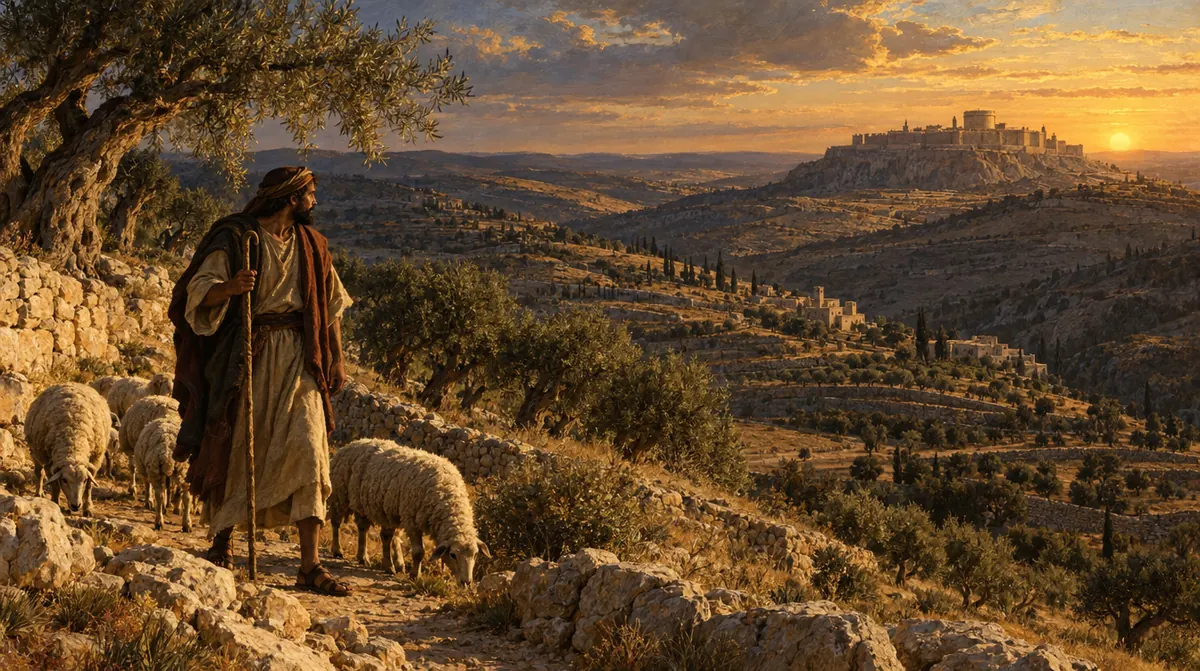
So the political map of Jesus' adult life looked like this: in Galilee, a Jewish client king, Antipas; in Judea and Jerusalem, a Roman prefect, from AD 26 to 36 a man named Pontius Pilate; and over them all, the emperor in Rome, first Augustus (until AD 14) and then Tiberius. Luke dates the start of John the Baptist's preaching to "the fifteenth year of the reign of Tiberius Caesar" (Luke 3:1), which points to about AD 28-29.
Rome's peace and Rome's price
Romans spoke proudly of the Pax Romana, the Roman peace. Roads, trade and a common market made travel easier than ever before. A man could walk from Galilee to Rome on paved roads and sail across a sea cleared of pirates. That same network would later carry the message about Jesus across the empire in a single generation.
But the peace had a price. Rome collected a tribute tax on land and on people. Local rulers added their own taxes. Toll collectors, the "tax collectors" of the Gospels, bought the right to collect customs at bridges, ports and town gates, and they made their living by charging more than they passed on. That is why the Gospels list them alongside "sinners," and why it was shocking when Jesus called one of them, Levi or Matthew, to follow him (Matthew 9:9-13).
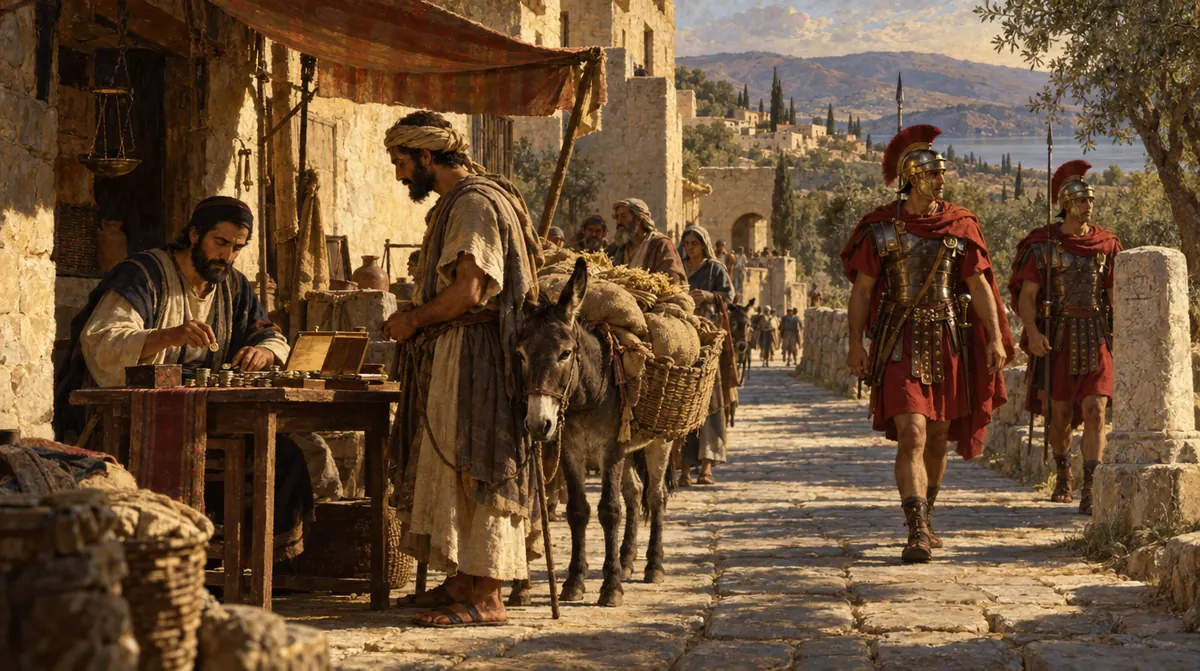
Rome's peace was also kept by force. When a Galilean named Judas led a revolt against the census of AD 6, the Romans crushed it. Crucifixion, the most public and shameful form of execution Rome had, was used on rebels and slaves to make an example of them. Every adult in Jesus' world knew what a cross meant.
The faith of Israel
The people of Judea and Galilee were Jews, heirs of the covenant God made with Abraham, Isaac and Jacob, and of the Law given through Moses. Their faith had a few great centers.
One God. Twice a day faithful Jews prayed the Shema: "Hear, Israel: Yahweh is our God. Yahweh is one" (Deuteronomy 6:4-5). When someone asked Jesus which commandment was greatest, he began right here (Mark 12:29-30).
The Temple. Herod's Temple in Jerusalem was one of the wonders of the ancient world, its white stone and gold visible for miles. Rebuilding began around 20 BC and was still going on in Jesus' day; John records that it had been under construction for forty-six years (John 2:20). Here priests offered sacrifices every day, and here hundreds of thousands of pilgrims came for the great feasts of Passover, Pentecost and Tabernacles.
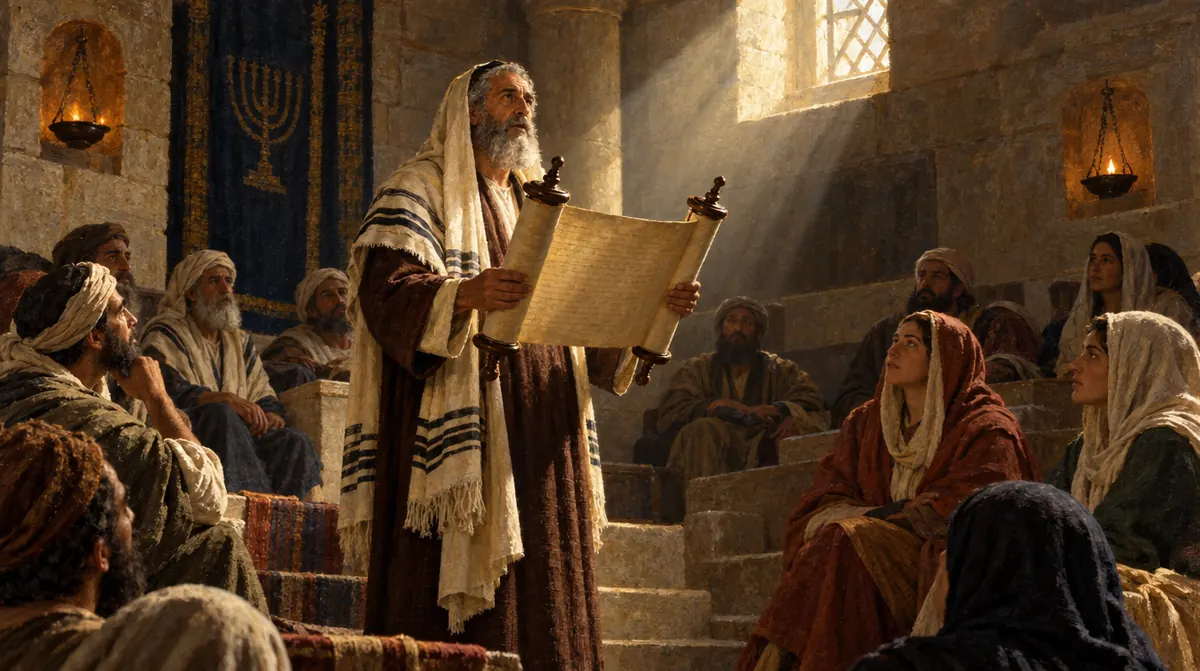
The synagogue. In every town, Jews gathered on the Sabbath to pray and read the Law and the Prophets. Any qualified man could be invited to read and to teach. Jesus did exactly this in Nazareth and Capernaum (Luke 4:16-21; Mark 1:21-22).
The Law. The Torah, the five books of Moses, shaped daily life: the Sabbath rest, food laws, purity rules, festivals, and care for the poor, the widow, the orphan and the stranger.
The hope of a Messiah. The prophets had promised that God would one day act again, sending a king from the line of David (Isaiah 9:6-7; Micah 5:2), a servant who would suffer for others (Isaiah 53:4-6), and "one like a son of man" who would receive an everlasting kingdom (Daniel 7:13-14). By the first century, many Jews longed for this hope to come true, although they pictured the Messiah in different ways. Some expected a warrior king who would throw out Rome. Others expected a priestly figure, or a prophet like Moses.
The groups of his day
Jewish life in the first century was not one thing. The Jewish historian Josephus, writing in the 90s AD, describes several "schools of thought."
- Pharisees were lay teachers devoted to keeping the Law carefully in everyday life, including traditions handed down by earlier teachers. They believed in the resurrection of the dead. They were respected by ordinary people. Jesus argued with them often, sometimes sharply, but he also ate at their tables, and some of them, like Nicodemus, came to him seriously (John 3:1-2).
- Sadducees were the priestly aristocracy connected with the Temple. They accepted only the written Law, and they did not believe in a resurrection (Mark 12:18). The high priest Caiaphas, who held office from about AD 18 to 36, came from this circle.
- Essenes withdrew from what they saw as a corrupt Temple and lived in disciplined communities. The Dead Sea Scrolls, found at Qumran from 1947, most likely came from a group like this. They are never named in the New Testament.
- Revolutionaries, whom Josephus calls the "fourth philosophy," believed that God alone was king and that paying tribute to Caesar was a betrayal. Their movement grew until it exploded in the great revolt of AD 66-70. One of Jesus' disciples was known as "Simon the Zealot" (Luke 6:15).
- Herodians supported the Herod family's rule (Mark 3:6).
- Samaritans lived between Judea and Galilee and worshiped on Mount Gerizim instead of in Jerusalem. Jews and Samaritans mistrusted each other deeply (John 4:9), which is what gives Jesus' parable of the good Samaritan its sting (Luke 10:30-37).
Daily life in Galilee
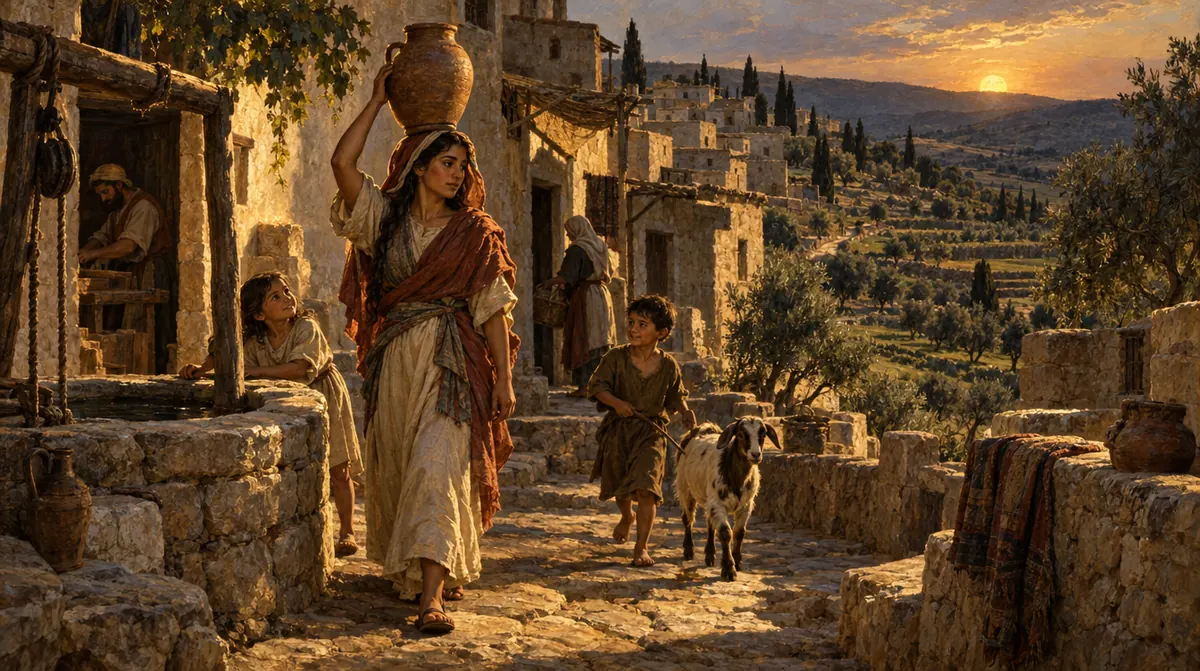
Most people in Jesus' world were farmers, fishermen, herders and craftsmen. They lived in small villages of stone houses built around shared courtyards. They ate bread made from wheat or barley, olives and olive oil, lentils, figs, dates and fish, and drank water and wine. Meat was for feast days. A day's wage for a laborer was a denarius, a silver coin (Matthew 20:2).
Life was close to the edge. One poor harvest, one sickness, one unpaid debt could push a family into selling its land or its children's labor. Jesus' stories are full of this world: sowers scattering seed on rocky soil, day laborers waiting to be hired, a woman sweeping her house for one lost coin, a shepherd searching for one lost sheep, a servant crushed by a debt he could never repay, a widow who keeps knocking on a judge's door. He told stories about the lives his hearers actually lived.
Nazareth itself was tiny, a village of perhaps a few hundred people in the hills of lower Galilee. Archaeologists have found houses, cisterns, wine presses and tombs from the period, but no grand buildings. When Nathanael first heard of Jesus he asked, "Can any good thing come out of Nazareth?" (John 1:46). About four miles away stood Sepphoris, the city Herod Antipas rebuilt as his capital during Jesus' childhood. Some historians think Joseph and Jesus may have found work there; the Gospels never say so.
Religious life shaped the week and the year. Families rested on the Sabbath from Friday sunset to Saturday sunset. Boys learned the Scriptures by heart. Pilgrims walked to Jerusalem for the feasts, often in large groups of relatives and neighbors, which is how the twelve-year-old Jesus could be left behind for a day before anyone noticed (Luke 2:41-45).
The sources: how we know about Jesus
The Gospels
The four Gospels are the main record. They are not modern biographies, but they belong to the broad family of ancient "lives" (Greek bioi), which focused on a person's character, teaching and death more than on childhood or inner feelings. Each writer arranged his material with a purpose. John says so plainly: "these are written that you may believe that Jesus is the Christ, the Son of God, and that believing you may have life in his name" (John 20:31).
Most scholars date Mark to the late 60s or around AD 70, Matthew and Luke to the 70s or 80s, and John to the 90s, though some date all of them earlier. Matthew, Mark and Luke share so much material, often word for word, that they are called the "Synoptic" Gospels ("seen together"). Most scholars think Matthew and Luke used Mark, along with other sources.
When the New Testament sources were written (most scholars)
Early church tradition tells us about the authors. Papias, a bishop in Asia Minor in the early 2nd century, said that Mark "became the interpreter of Peter" and wrote down accurately what Peter remembered of the Lord's words and deeds; Eusebius preserves this quotation in his Church History (Book 3, chapter 39). Irenaeus, around AD 180, names all four Gospel writers. Luke, a companion of Paul, tells us himself that he "traced the course of all things accurately from the first" and drew on eyewitnesses (Luke 1:1-4). The Gospel of John claims to rest on the testimony of "the disciple whom Jesus loved" (John 21:24).
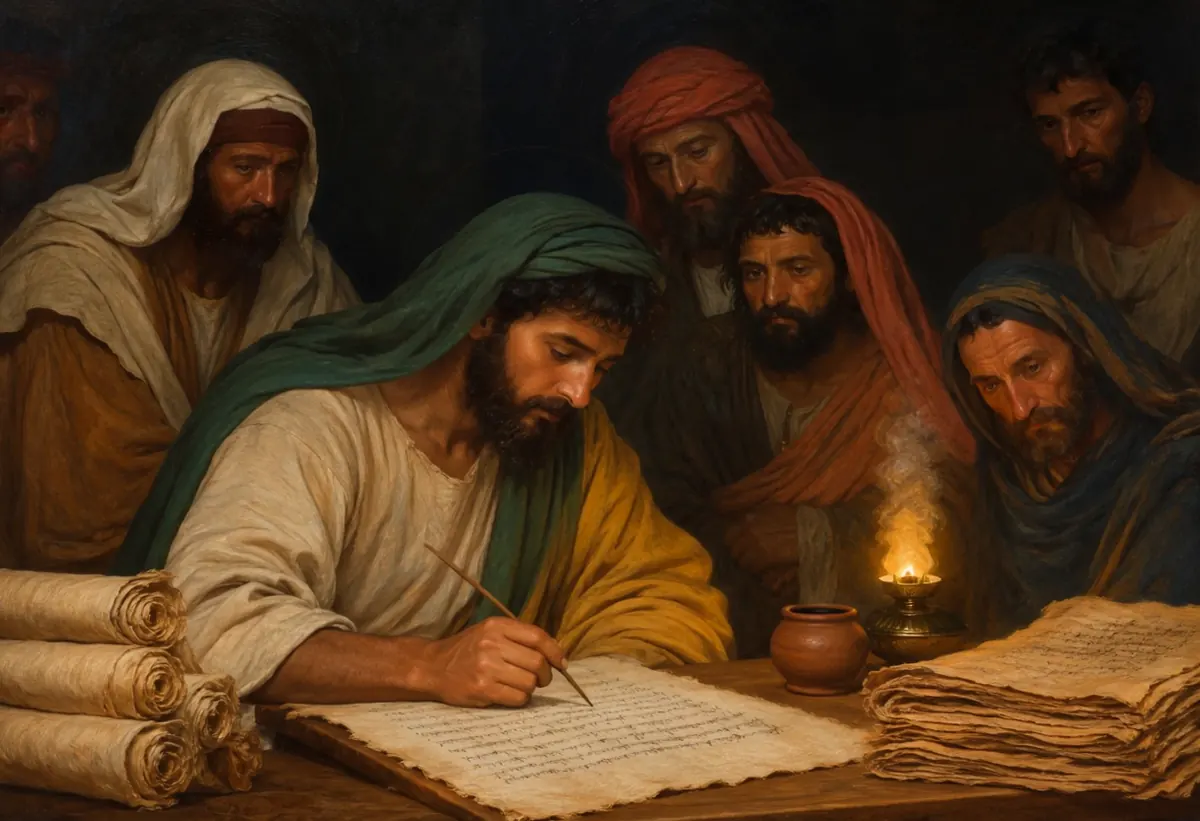
Paul
The apostle Paul wrote his letters between about AD 48 and the early 60s, earlier than any of the Gospels. He did not write a life of Jesus, but he assumes that his readers know about it. He mentions Jesus' descent from David (Romans 1:3), his brother James (Galatians 1:19), the Last Supper "on the night in which he was betrayed" (1 Corinthians 11:23-25), his crucifixion, burial and resurrection, and a list of people who saw him alive afterward, "most of whom remain until now" (1 Corinthians 15:3-8). Many scholars think this creed was handed to Paul within a few years of the crucifixion.
Writers outside the church
A handful of non-Christian writers mention Jesus or his followers within a century of his death.
- Josephus, a Jewish historian, wrote Antiquities of the Jews in the 90s AD. In Book 20 he describes the execution of "James, the brother of Jesus, who was called Christ" in AD 62. In Book 18 there is a longer passage about Jesus, now called the Testimonium Flavianum. Most scholars think Josephus did write about Jesus there, but that later Christian copyists added phrases a non-Christian Jew would not have written, such as "he was the Messiah."
- Tacitus, the Roman historian, writing around AD 116, explains that the Christians Nero blamed for the great fire of Rome took their name from "Christus," who "suffered the extreme penalty during the reign of Tiberius at the hands of one of our procurators, Pontius Pilatus" (Annals 15.44).
- Pliny the Younger, governor of Bithynia around AD 112, wrote to the emperor Trajan that Christians met before dawn on a fixed day and sang "a hymn to Christ as to a god" (Letters 10.96).
Writers outside the church who mention Jesus or his followers
These writers add little detail, but they confirm the outline: a real man named Jesus, called Christ, executed under Pilate in the reign of Tiberius, whose followers were spreading through the empire and worshiping him within a few decades.
His life, in chapters
1. Promise and birth
Luke opens with an old priest named Zechariah serving in the Temple, and an angel announcing that his wife Elizabeth, long childless, will bear a son, John (Luke 1:5-17). Six months later the same angel, Gabriel, comes to a young woman in Nazareth named Mary, who is engaged to Joseph, a descendant of David. "You will conceive in your womb and give birth to a son, and shall name him Jesus," the angel says. "He will be great and will be called the Son of the Most High" (Luke 1:31-32). Mary's answer has been treasured by Christians ever since: "Behold, the servant of the Lord; let it be done to me according to your word" (Luke 1:38).
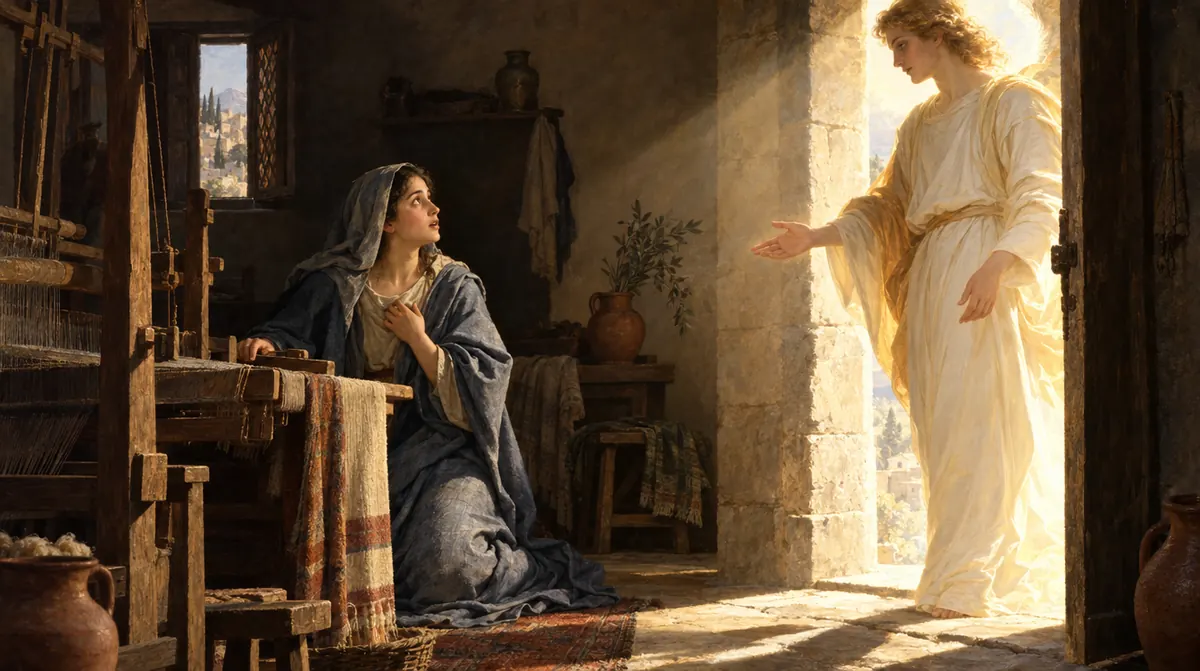
Matthew tells the story from Joseph's side. Finding Mary pregnant, he plans to end the engagement quietly, until an angel tells him in a dream that "that which is conceived in her is of the Holy Spirit" and that he must name him Jesus, "for it is he who shall save his people from their sins" (Matthew 1:18-21). Both Gospels teach that Jesus was conceived without a human father, which Christians call the virgin birth.
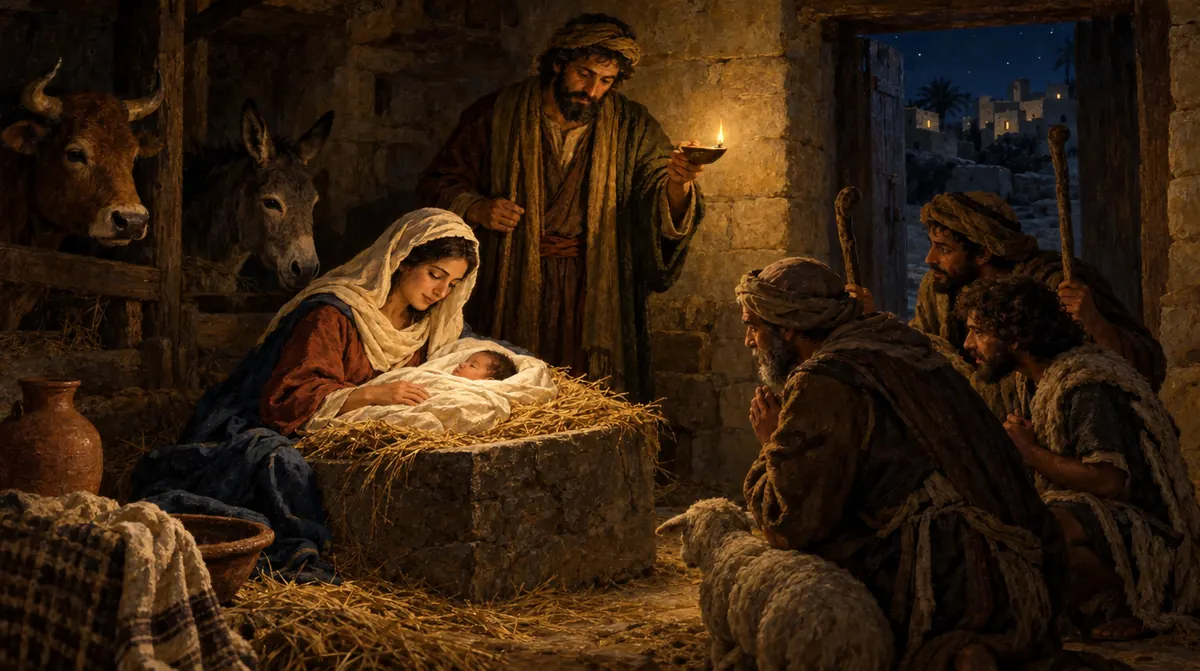
Luke says that a decree from Caesar Augustus required a registration, so Joseph took Mary to Bethlehem, the town of David, where she gave birth and laid the baby in a feeding trough "because there was no room for them in the inn" (Luke 2:1-7). The Greek word often translated "inn" can also mean a guest room; many scholars picture a crowded family house with the animals kept on a lower level, rather than a hotel with a heartless innkeeper. Shepherds, people near the bottom of the social ladder, were the first visitors, sent by angels who sang, "Glory to God in the highest, on earth peace, good will toward men" (Luke 2:8-20).
Matthew tells of magi, astrologer-scholars "from the east," who followed a star to Jerusalem and then to Bethlehem, and brought gold, frankincense and myrrh (Matthew 2:1-12). Warned in a dream, Joseph fled with Mary and the child to Egypt until Herod died, then settled in Nazareth (Matthew 2:13-23).
A note on dates. Our calendar was set in the 6th century by a monk named Dionysius Exiguus, who miscalculated slightly. Since Matthew places Jesus' birth before Herod's death, which Josephus dates to 4 BC, most historians place the birth around 6-4 BC. Luke links the birth to a census when "Quirinius was governor of Syria" (Luke 2:2); Josephus dates Quirinius' census to AD 6. Scholars have proposed several solutions, such as an earlier registration or a different reading of Luke's Greek, and none has settled the question. December 25 as the date of celebration comes from later church tradition, first attested in the 4th century; the Gospels give no day or season.
2. The hidden years
After the birth stories, the Gospels fall almost silent for thirty years. Luke gives one scene. When Jesus was twelve, his family went up to Jerusalem for Passover. On the way home his parents discovered he was missing, and after three days found him in the Temple, "sitting in the middle of the teachers, both listening to them, and asking them questions." To his anxious mother he answered, "Didn't you know that I must be in my Father's house?" (Luke 2:41-49). Then he went home with them "and was subject to them," and he "increased in wisdom and stature, and in favor with God and men" (Luke 2:51-52).
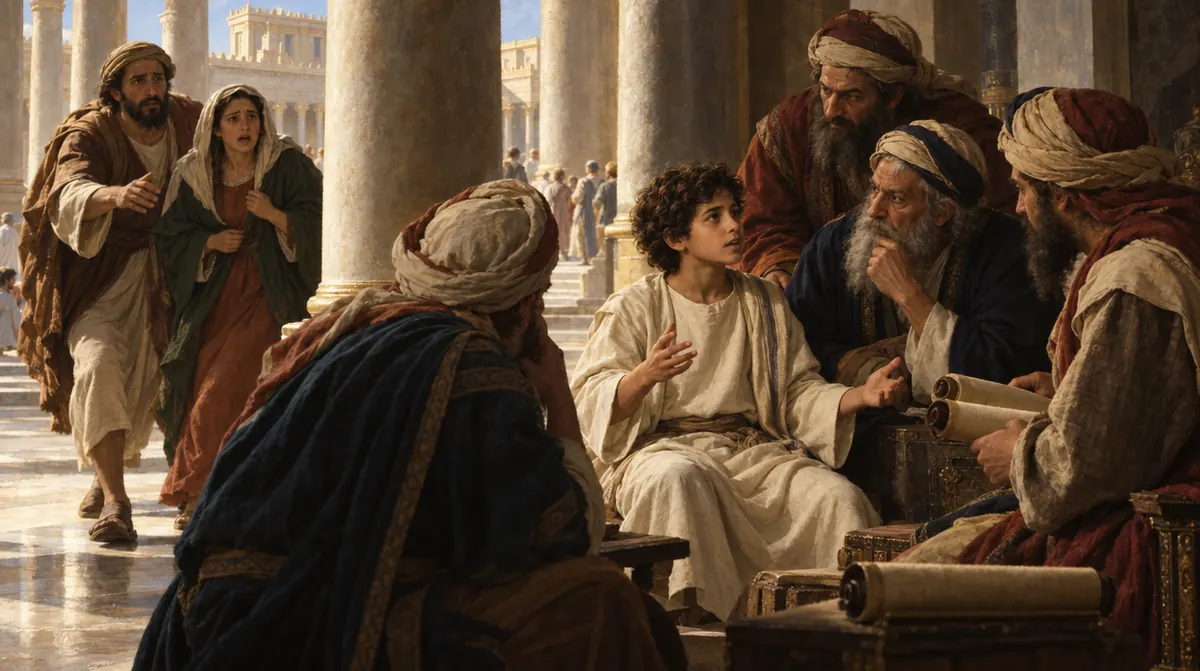
That is all Scripture says. Later writings, such as the Infancy Gospel of Thomas from the 2nd century, filled the gap with stories of a boy Jesus working miracles. The early church did not accept these as reliable, and historians agree with that judgment.
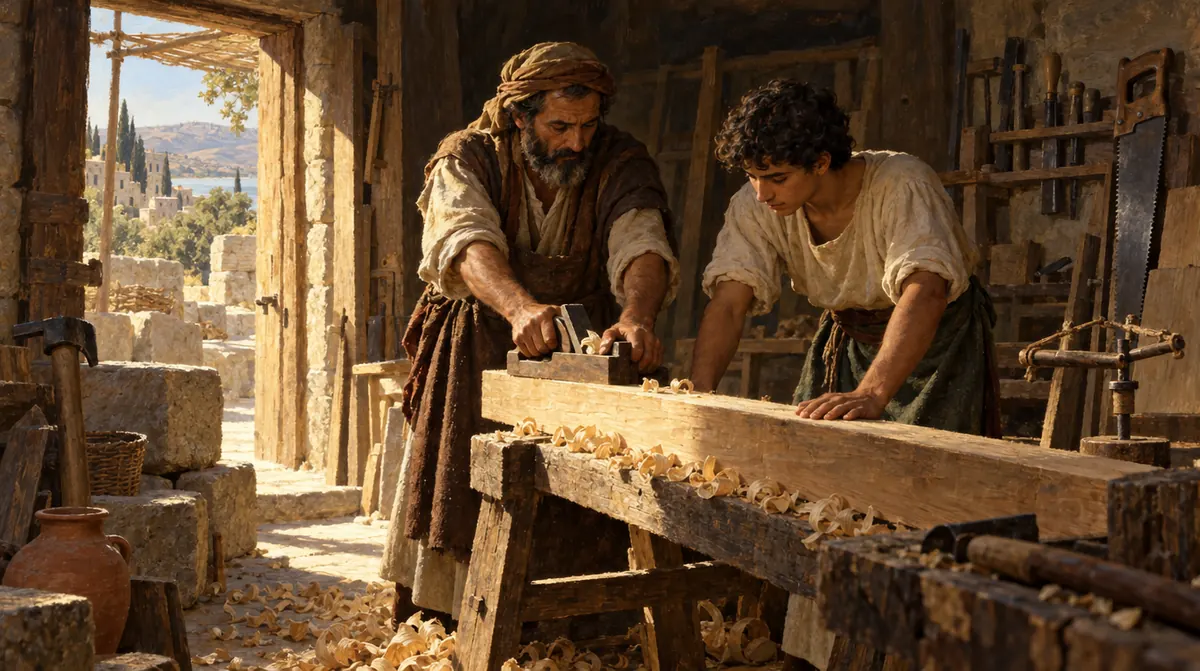
What we can say is ordinary and important. Jesus grew up in a working family in a small village. His neighbors knew him as "the carpenter, the son of Mary" (Mark 6:3). He learned a trade, worked with his hands, kept the Sabbath, went to synagogue, learned the Scriptures and walked to Jerusalem for the feasts. Joseph is not mentioned during Jesus' ministry, and most interpreters conclude that he had died by then. For roughly eighteen years the one Christians call the Son of God lived a quiet, unremarkable life that almost nobody wrote down.
3. John the Baptist and the baptism
Around AD 28, a prophet appeared in the wilderness near the Jordan River. John, the son of Zechariah and Elizabeth, dressed like the prophet Elijah in camel's hair and a leather belt, ate locusts and wild honey, and called the nation to repentance. "Repent, for the Kingdom of Heaven is at hand!" (Matthew 3:1-6). Crowds came from Jerusalem and all Judea to be baptized by him in the river, confessing their sins. Josephus also writes about John, calling him "a good man" whom Herod Antipas executed because he feared John's influence over the people (Antiquities 18.5.2).
Jesus came from Galilee to be baptized. John objected: "I need to be baptized by you, and you come to me?" Jesus answered that it was fitting "to fulfill all righteousness" (Matthew 3:13-15). As he came up out of the water, the Gospels say, the heavens opened, the Spirit descended on him like a dove, and a voice from heaven said, "This is my beloved Son, with whom I am well pleased" (Matthew 3:16-17).
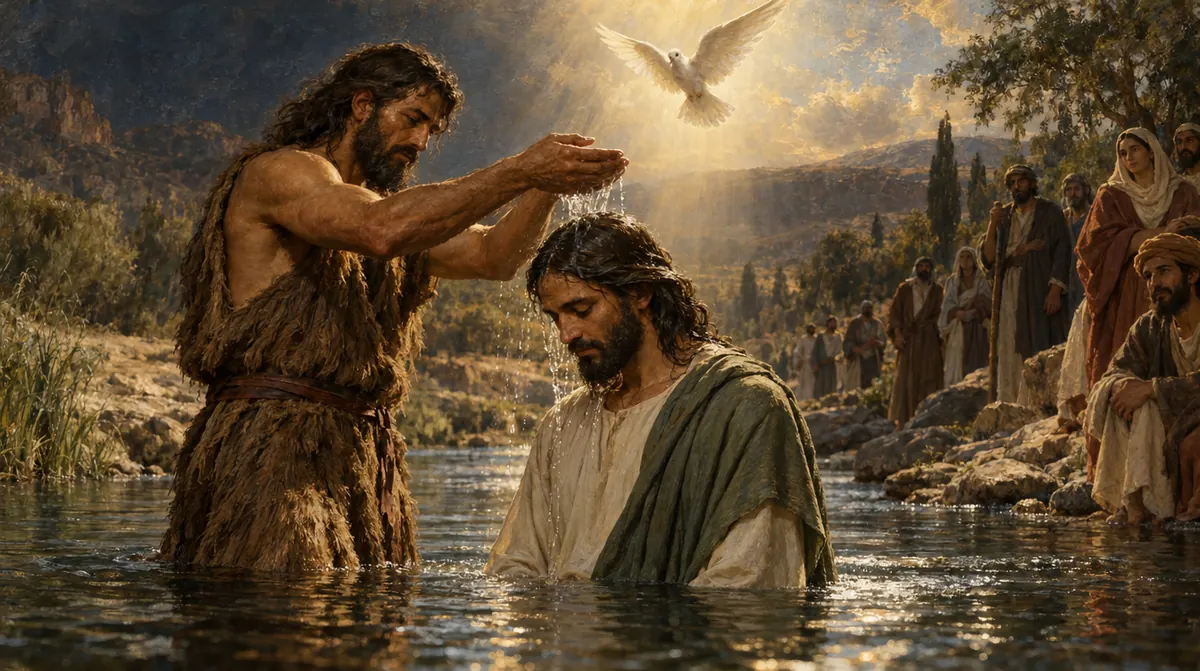
Historians count the baptism as one of the most certain events of Jesus' life, partly because it was awkward for the early church. Why would the sinless Messiah submit to a baptism of repentance from a lesser man? Christians would hardly invent such a story. The Gospels answer that Jesus was standing with his people, taking his place among sinners from the very start.
4. Temptation in the wilderness
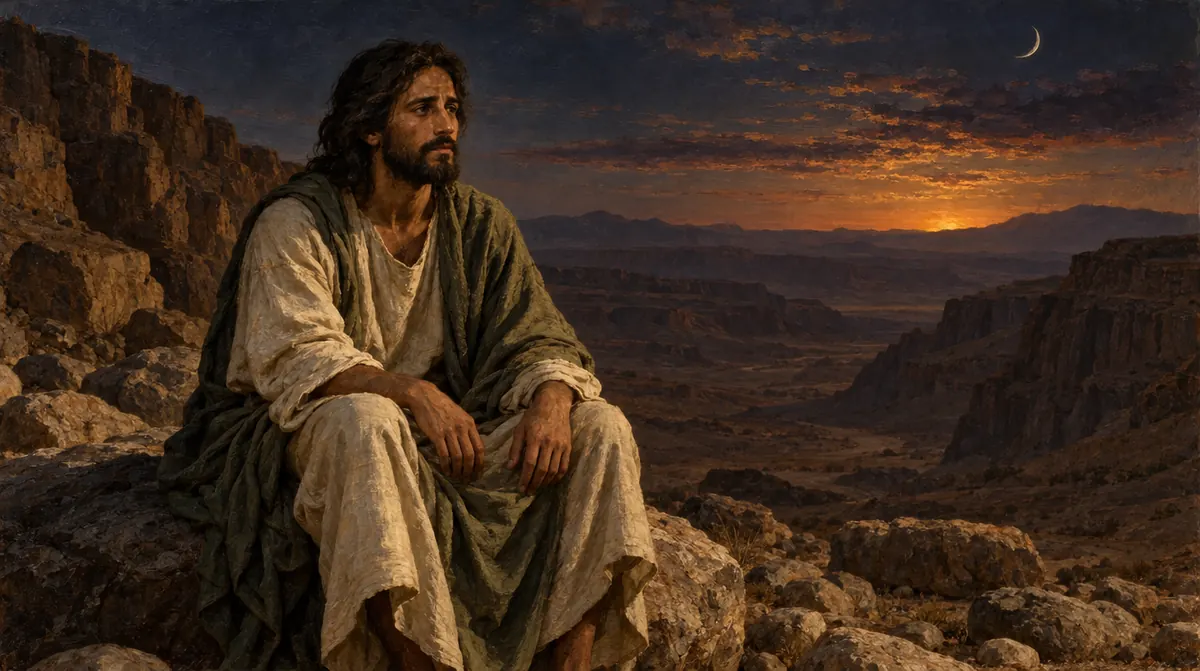
Immediately afterward, the Spirit led Jesus into the Judean desert, where he fasted forty days and was tempted by the devil (Matthew 4:1-11; Luke 4:1-13). The three temptations go to the heart of what kind of Messiah he would be: turn stones into bread and satisfy your own hunger; throw yourself from the Temple and force God to prove himself; bow to me and receive all the kingdoms of the world without a cross. Each time Jesus answered with words from Deuteronomy, the book of Israel's own forty years in the wilderness. Where Israel had failed, he stood firm. The writer of Hebrews later draws comfort from this: he "has been in all points tempted like we are, yet without sin" (Hebrews 4:15).
5. "The time is fulfilled": the ministry begins
After John was arrested, Jesus came into Galilee "preaching the Good News of the Kingdom of God, and saying, 'The time is fulfilled, and the Kingdom of God is at hand! Repent, and believe in the Good News'" (Mark 1:14-15).
Luke places a defining moment in the synagogue of his hometown. Handed the scroll of Isaiah, Jesus read: "The Spirit of the Lord is on me, because he has anointed me to preach good news to the poor. He has sent me to heal the broken hearted, to proclaim release to the captives, recovering of sight to the blind, to deliver those who are crushed, and to proclaim the acceptable year of the Lord." Then he sat down and said, "Today, this Scripture has been fulfilled in your hearing" (Luke 4:16-21). The mood turned quickly. When he reminded them that God's prophets had blessed foreigners, the townspeople tried to throw him off a cliff (Luke 4:24-30).
He made his base in Capernaum, a fishing town on the northwest shore of the Sea of Galilee (Matthew 4:13). Archaeologists have uncovered its basalt houses and the foundations of a synagogue beneath a later white limestone one. Under a 5th-century church there they found a house that had been honored as a meeting place since the 1st century; many believe it was the home of Peter.
6. Calling the Twelve
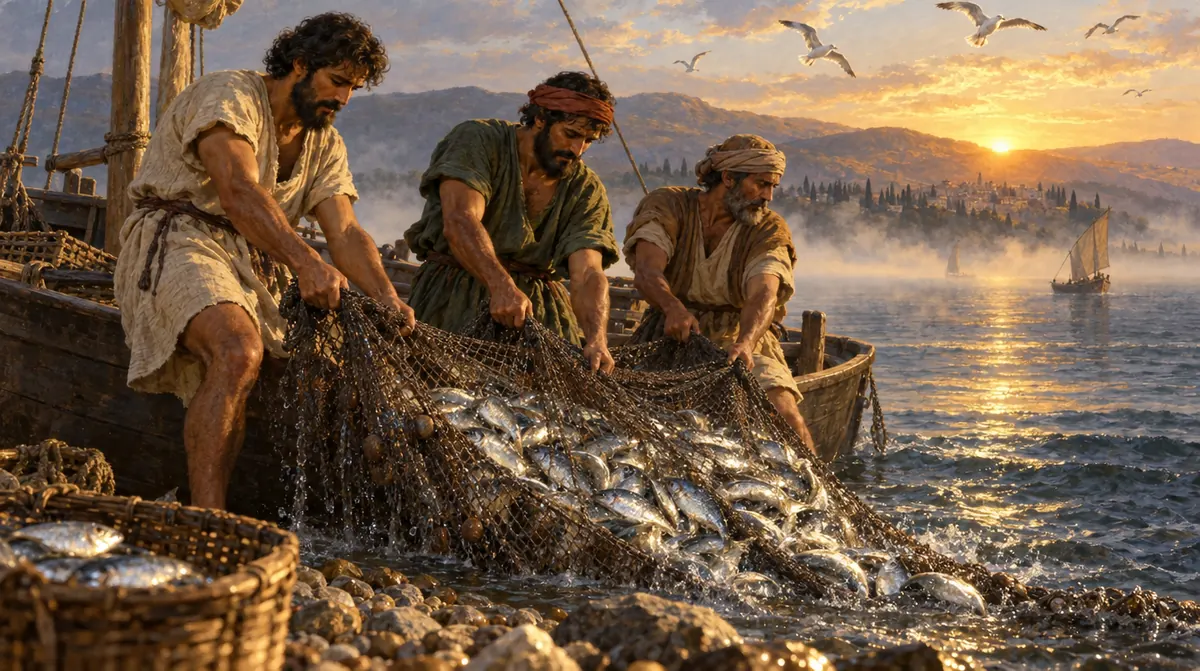
Walking by the lake, Jesus saw two pairs of brothers at work: Simon (whom he would name Peter, "rock") and Andrew, casting a net; and James and John, the sons of Zebedee, mending nets in a boat. "Come after me," he said, "and I will make you into fishers for men." They left their nets and followed him (Mark 1:16-20).
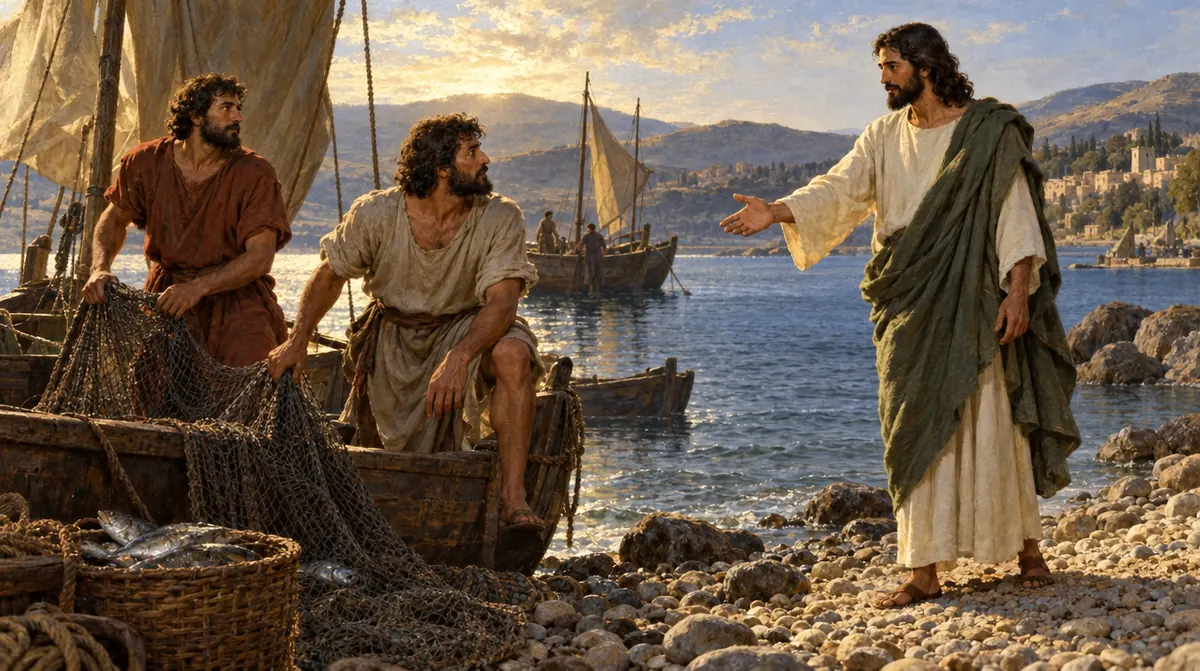
Teachers in Jesus' day did not usually go looking for students; students sought out teachers. Jesus reversed this. He called people, and the people he called were surprising: fishermen, a toll collector, a revolutionary. After a night of prayer on a mountain, he chose twelve from among his followers and named them apostles, "sent ones" (Luke 6:12-16). The number was a sign. Israel had twelve tribes, and Jesus was gathering a renewed people of God around himself. You can read about each of them on our page about the Twelve Apostles.
The Twelve were not the only disciples. Luke names women who traveled with Jesus and supported the group "from their possessions": Mary Magdalene, from whom seven demons had gone out; Joanna, the wife of Herod's household manager Chuza; Susanna; "and many others" (Luke 8:1-3). For a Jewish teacher of the time this was unusual, and these same women would be the first witnesses of the empty tomb.
7. A teacher like no other
The crowds were "astonished at his teaching, for he taught them as having authority, and not as the scribes" (Mark 1:22). Other teachers quoted earlier authorities. Jesus said, "You have heard that it was said... but I tell you" (Matthew 5:43-44).
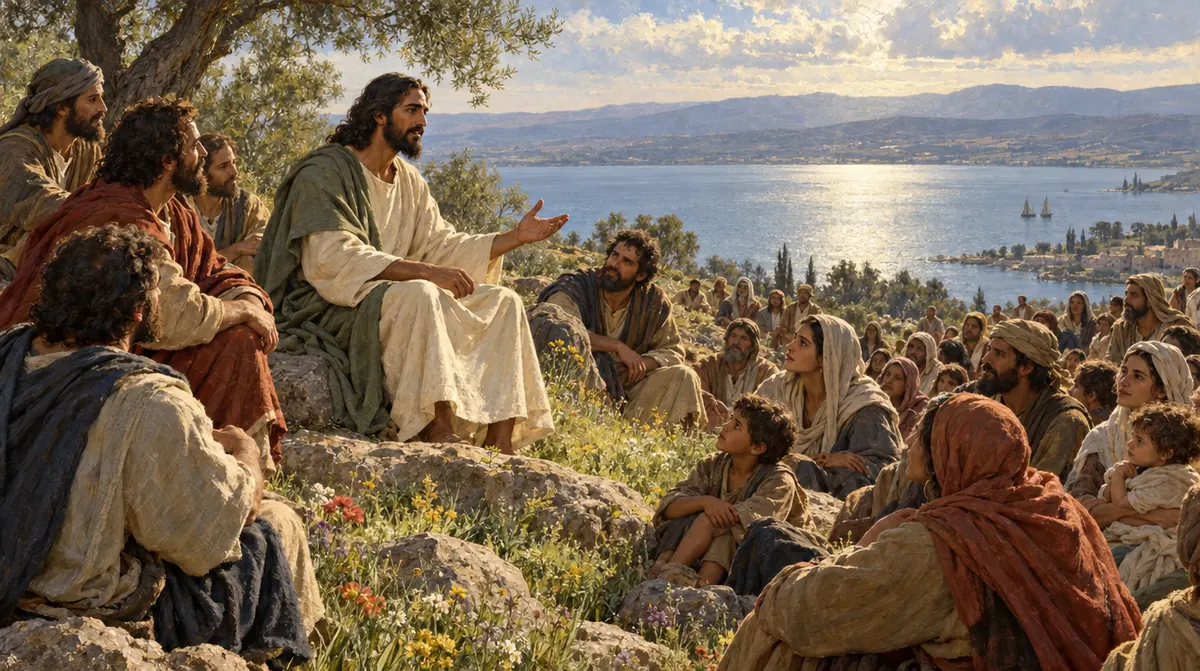
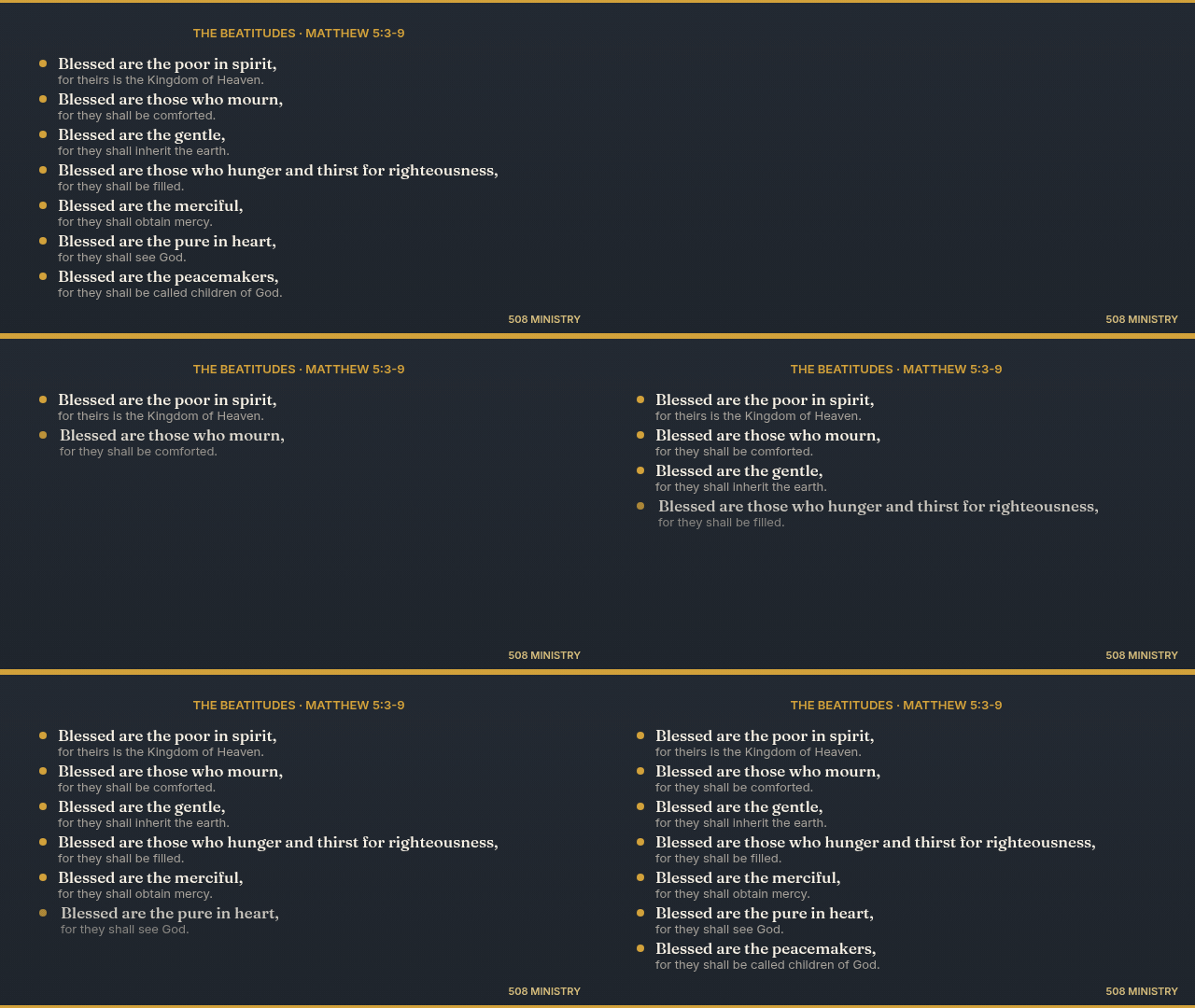
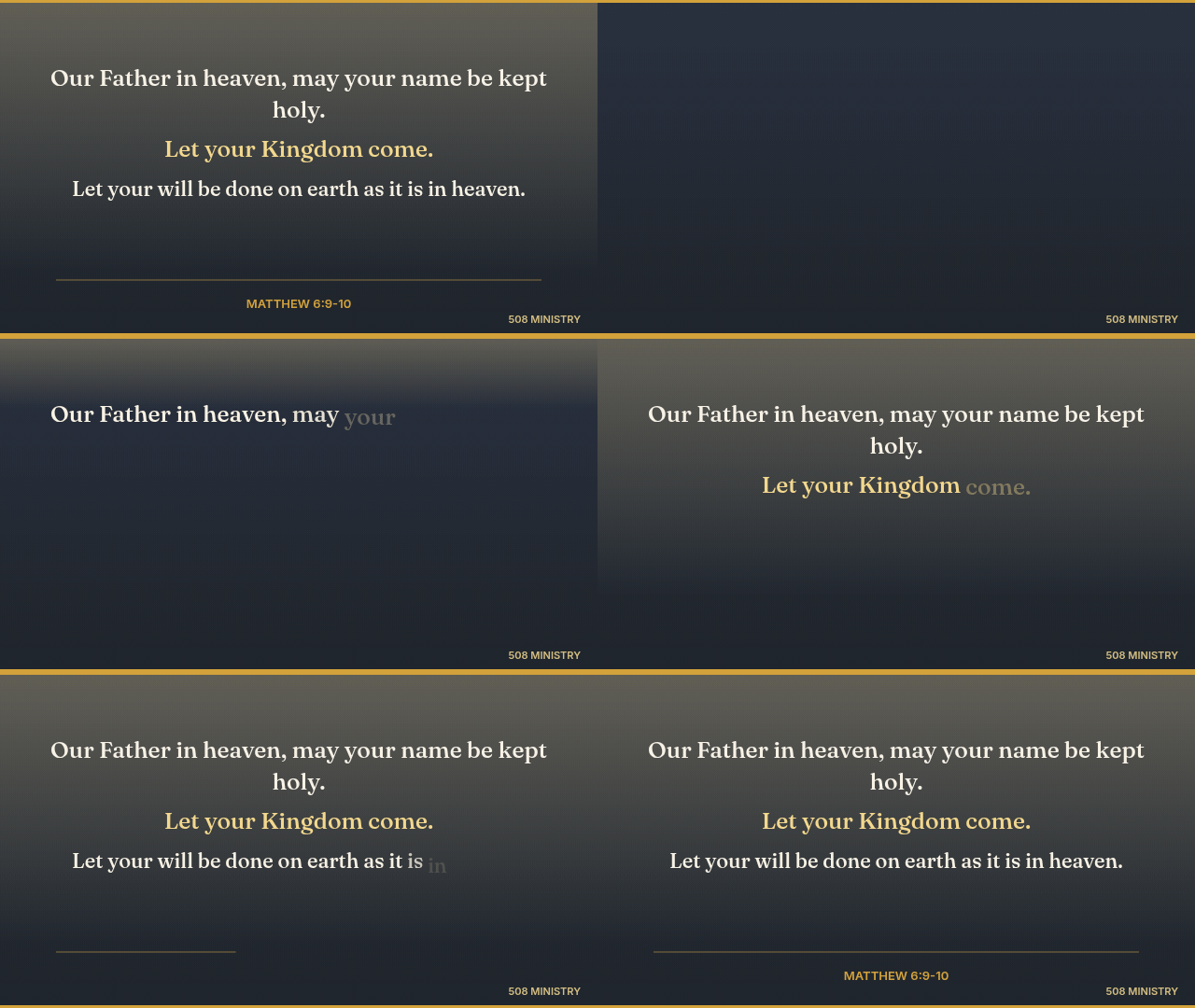
His most famous teaching is gathered in the Sermon on the Mount (Matthew 5-7), with a shorter version in Luke's Sermon on the Plain (Luke 6:17-49). It opens with the Beatitudes, blessings on people the world overlooks: the poor in spirit, those who mourn, the gentle, the hungry for righteousness, the merciful, the pure in heart, the peacemakers, the persecuted (Matthew 5:3-10). It calls his followers salt and light (Matthew 5:13-14). It goes beneath outward rules to the heart: anger as well as murder, lust as well as adultery (Matthew 5:21-28). It commands love for enemies (Matthew 5:44). It teaches a simple, trusting prayer that begins "Our Father in heaven" (Matthew 6:9-13). It warns against storing up treasure on earth and against worry, pointing to the birds of the air and the lilies of the field (Matthew 6:19-34). It sums up the Law and the Prophets in one line: "whatever you desire for men to do to you, you shall also do to them" (Matthew 7:12). And it ends with a choice between two houses, one built on rock and one on sand (Matthew 7:24-27).
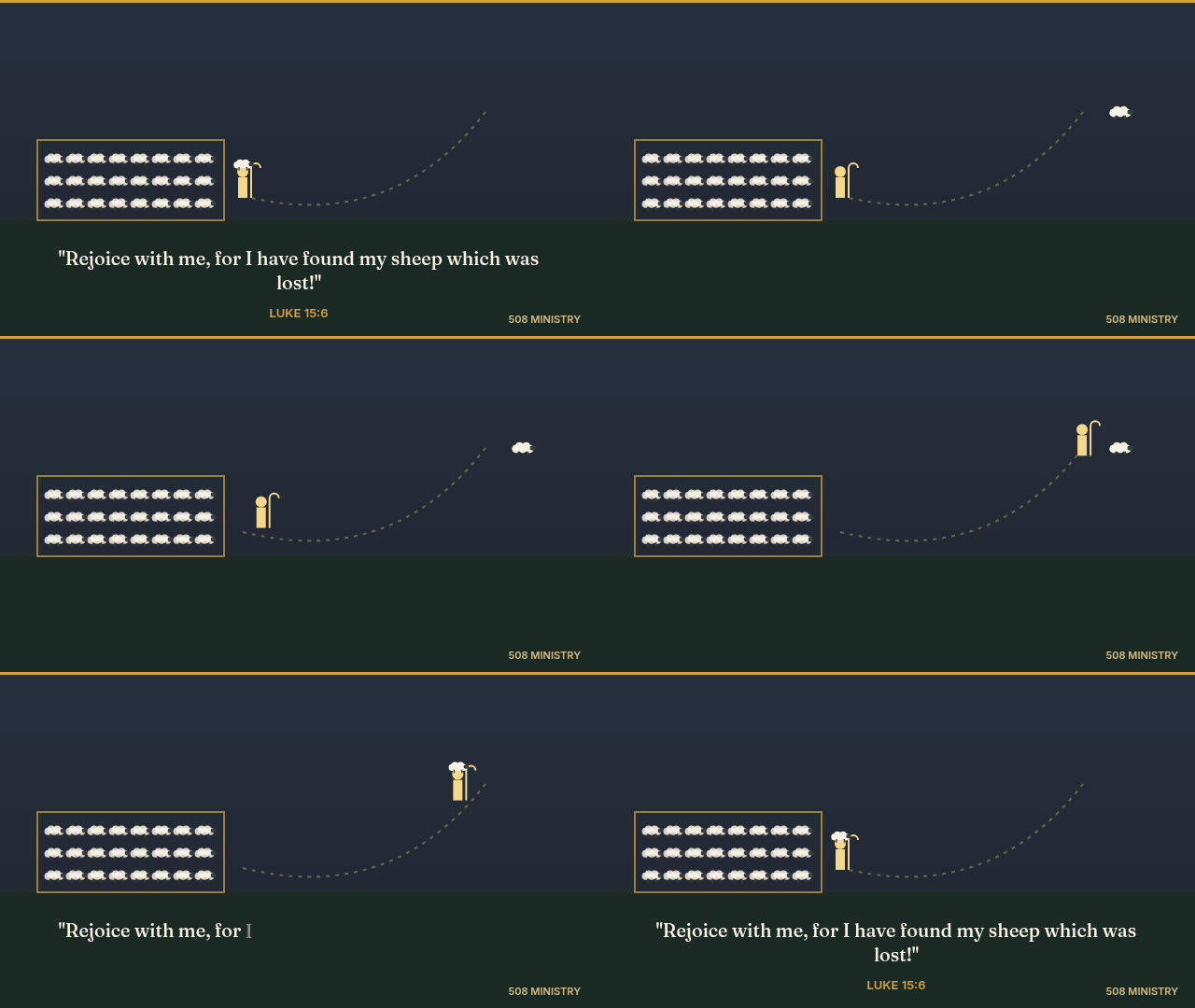
Parables. Jesus' favorite way of teaching was the parable, a short story from everyday life with a twist that leaves the hearer thinking. About a third of his recorded teaching comes in this form. A sower whose seed lands on four kinds of ground (Mark 4:1-20). A mustard seed that grows into a tree (Matthew 13:31-32). Treasure hidden in a field, a merchant who sells everything for one pearl (Matthew 13:44-46). A Samaritan, the despised outsider, who stops for a wounded man when a priest and a Levite pass by (Luke 10:25-37). A shepherd who leaves ninety-nine sheep to find one, a woman who searches for one coin, and a father who runs to embrace a son who had wasted everything (Luke 15). Parables invite people in, but they also divide: those who want to understand lean closer, and those who do not walk away (Mark 4:10-12).
The Kingdom of God. The center of everything Jesus taught was the Kingdom (or reign) of God: God acting as king to put the world right. Sometimes he spoke of it as future, something to pray for ("Let your Kingdom come," Matthew 6:10). Sometimes he spoke of it as already arriving in his own work: "if I by the finger of God cast out demons, then God's Kingdom has come to you" (Luke 11:20). Christians have often summed this up as "already, and not yet."
"Kingdom of God" or "kingdom of heaven" in each Gospel
God as Father. Jesus spoke to God with startling closeness. In Gethsemane he prayed, "Abba, Father" (Mark 14:36), using the Aramaic word a child used at home. He taught his followers to call God "Father" too, and to trust him as children trust a good parent (Matthew 7:9-11).
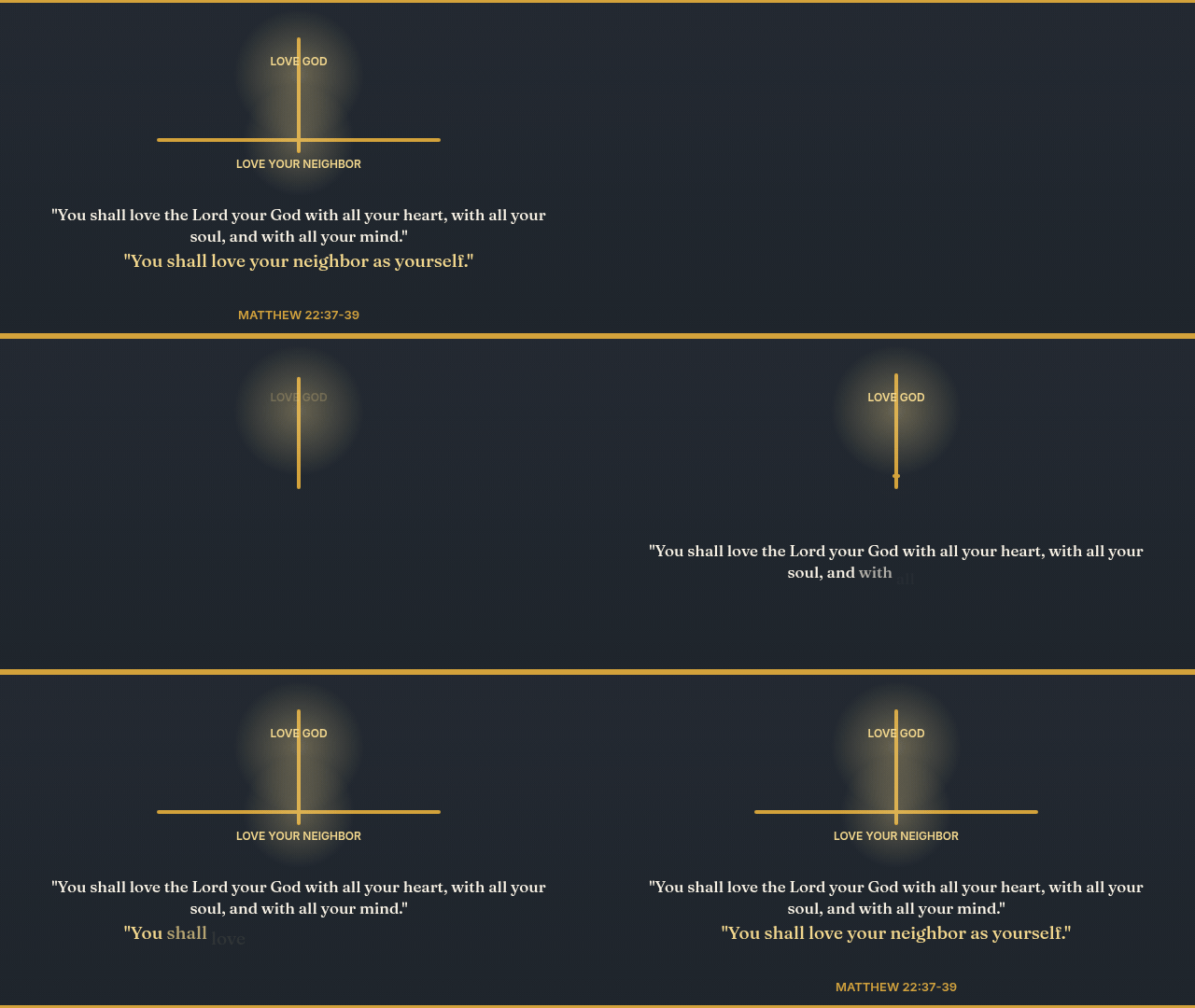
The greatest commandment. Asked which commandment was greatest, Jesus joined two from the Law of Moses: love God with all your heart, soul and mind, and love your neighbor as yourself (Matthew 22:37-39). On the night before he died, he gave a new one: "Just as I have loved you, you also love one another" (John 13:34-35).
8. Signs of the Kingdom: healings and miracles
All four Gospels describe Jesus healing the sick, driving out demons and doing other mighty works. John calls them "signs," pointing beyond themselves to who Jesus is. He turned water into wine at a wedding in Cana (John 2:1-11). He healed a paralyzed man let down through a roof, and forgave his sins first (Mark 2:1-12). He touched a man with leprosy, whom no one would touch (Mark 1:40-42). He healed a woman who had been bleeding for twelve years and called her "Daughter" (Mark 5:25-34). He raised the daughter of Jairus, a synagogue leader (Mark 5:35-43), the son of a widow at Nain (Luke 7:11-17), and his friend Lazarus (John 11:1-44). He calmed a storm with a word: "Peace! Be still!" (Mark 4:39). He fed five thousand men, besides women and children, with five loaves and two fish, the only miracle besides the resurrection recorded in all four Gospels (Mark 6:30-44; John 6:1-14). He walked on the water to his frightened disciples: "Cheer up! It is I! Don't be afraid" (Matthew 14:22-33).
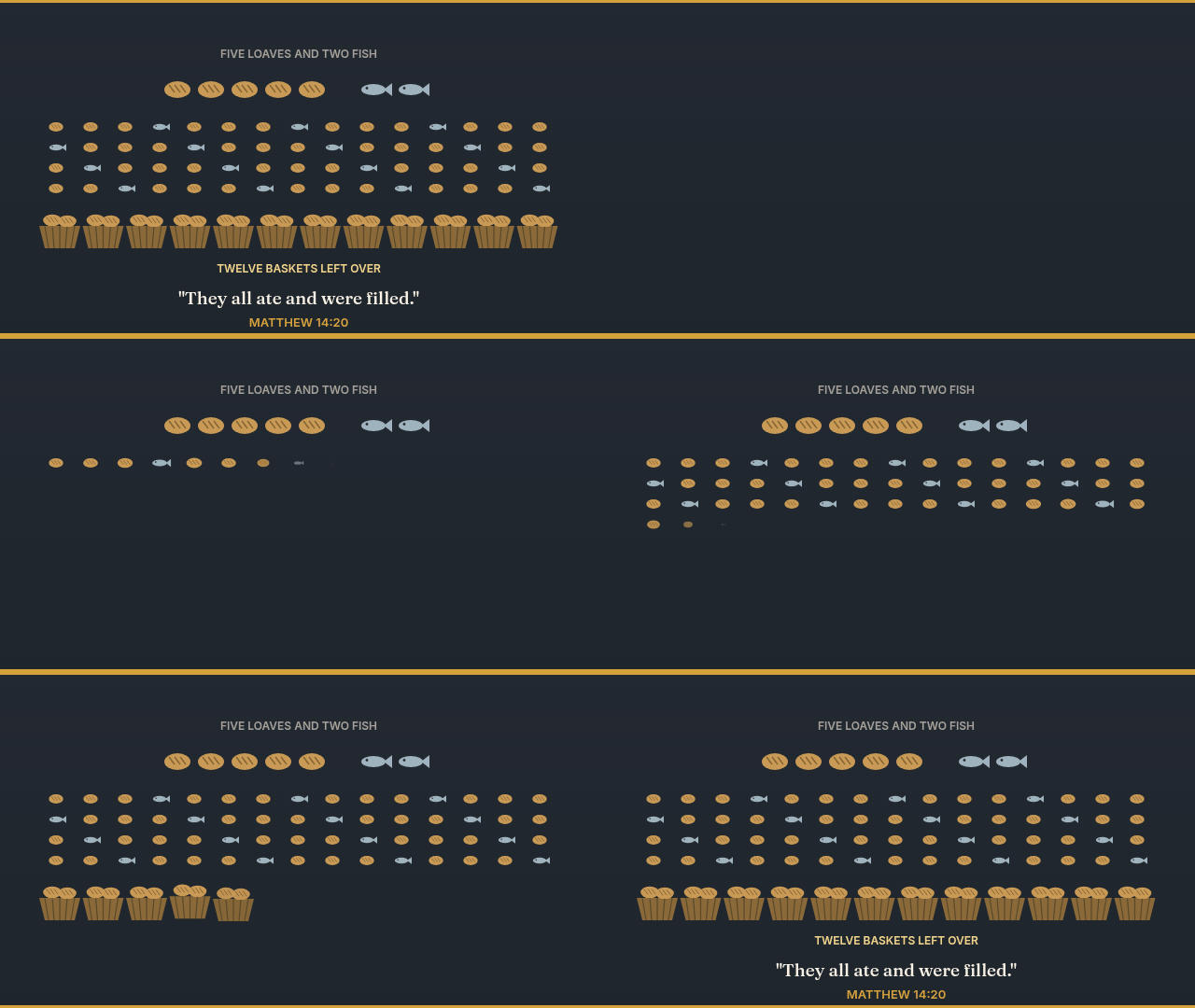
Historians cannot test miracles by their methods, and they come to the question with different beliefs about whether miracles happen. But many, including skeptical scholars, agree that Jesus was widely known in his own lifetime as a healer and exorcist. Even his opponents did not deny that remarkable things happened; they argued about the power behind them (Mark 3:22). Later Jewish writings, too, remember him as one who practiced "sorcery," a hostile way of admitting the same reputation.
What stands out in the Gospel accounts is the kind of person Jesus healed. Again and again they are people pushed to the edge: lepers, the blind, the unclean, foreigners, women, children, the demon-possessed. Healing them often restored them to their families and to worship. The miracles were not tricks to win an audience. Jesus refused to perform signs on demand (Mark 8:11-12). They were, in his words, signs that the Kingdom of God had come near.
9. Friend of sinners
Few things angered Jesus' critics more than the company he kept. He ate with tax collectors and "sinners," people whose way of life or work put them outside respectable religion. When the critics complained, he said, "Those who are healthy have no need for a physician, but those who are sick do. I came not to call the righteous, but sinners to repentance" (Mark 2:17).
He let a woman known as a sinner wash his feet with her tears at a Pharisee's dinner, and told her, "Your sins are forgiven... Your faith has saved you. Go in peace" (Luke 7:36-50). He spoke with a Samaritan woman at a well in the heat of the day, breaking two social rules at once, and she became a messenger to her whole town (John 4:4-42). He invited himself to the house of Zacchaeus, the chief tax collector of Jericho, who responded by giving half his goods to the poor; "the Son of Man came to seek and to save that which was lost," Jesus said (Luke 19:1-10). He welcomed little children when his disciples tried to send them away (Mark 10:13-16).
In a world where sharing a meal meant accepting a person, his table was a picture of God's welcome. That welcome was not approval of sin. He told the forgiven to "go, and sin no more" (John 8:11). But it began with mercy.
10. Conflict and the turning point
Jesus' popularity in Galilee came with growing conflict. He healed on the Sabbath and said, "The Sabbath was made for man, not man for the Sabbath" (Mark 2:27). He declared people's sins forgiven, something only God could do (Mark 2:7). He criticized religious leaders who tithed their herbs but neglected "justice and the love of God" (Luke 11:42). Mark reports that early on, Pharisees and Herodians began plotting against him (Mark 3:6).
The turning point came near Caesarea Philippi, a city at the foot of Mount Hermon, home to a shrine of the Greek god Pan. There Jesus asked his disciples, "Who do men say that I am?" They reported the rumors: John the Baptist, Elijah, one of the prophets. "But who do you say that I am?" Peter answered, "You are the Christ, the Son of the living God" (Matthew 16:13-16).
From then on, the Gospels say, Jesus began to teach plainly that "the Son of Man must suffer many things, and be rejected... and be killed, and after three days rise again" (Mark 8:31). Peter protested, and Jesus rebuked him. Then he told the crowd, "If anyone desires to come after me, let him deny himself, take up his cross daily, and follow me" (Luke 9:23).
Son of Man. This was the title Jesus used for himself most often, about eighty times in the Gospels. It could simply mean "a human being," but it also echoed the vision in Daniel 7 of "one like a son of man" coming with the clouds to receive everlasting dominion. The title let Jesus speak of both his humility and his authority, and it did not carry the political baggage of "Messiah."
"Son of Man" in each Gospel
A week later, Jesus took Peter, James and John up a high mountain, and was transfigured before them: "his face shone like the sun, and his garments became as white as the light." Moses and Elijah appeared, talking with him, and the voice from heaven spoke again: "This is my beloved Son... Listen to him" (Matthew 17:1-8). Tradition later placed this event on Mount Tabor in Galilee; some scholars prefer Mount Hermon, closer to Caesarea Philippi.
11. The road to Jerusalem
Luke says that Jesus "intently set his face to go to Jerusalem" (Luke 9:51). The long journey south, much of it through Perea on the east side of the Jordan, carried some of his best-known teaching: the good Samaritan, Mary and Martha (Luke 10:38-42), the Lord's Prayer (Luke 11:1-4), the rich fool (Luke 12:13-21), the lost sheep, the lost coin and the lost son (Luke 15). Three times he told his disciples what waited for him in Jerusalem, and three times they failed to understand. When James and John asked for the best seats in his kingdom, he answered with words that sum up his whole life: "the Son of Man also came not to be served but to serve, and to give his life as a ransom for many" (Mark 10:45).
In Bethany, a village just over the Mount of Olives from Jerusalem, lived his close friends Martha, Mary and Lazarus. When Lazarus died, Jesus came four days later. Meeting Martha, he said, "I am the resurrection and the life. He who believes in me will still live, even if he dies" (John 11:25). At the tomb, the shortest verse in the English Bible records that "Jesus wept" (John 11:35). Then he called Lazarus out of the grave. John says this sign was what finally convinced the high priest Caiaphas that Jesus must die: "it is advantageous for us that one man should die for the people, and that the whole nation not perish" (John 11:49-53).
12. The last week
Sunday: the King on a donkey. Days before Passover, Jesus rode into Jerusalem on a young donkey, fulfilling the words of Zechariah: "Behold, your King comes to you... humble, and riding on a donkey" (Zechariah 9:9). Crowds spread their cloaks and palm branches on the road and shouted "Hosanna!" ("Save us!") (Matthew 21:1-11; John 12:12-15). It was a royal entry, but not the kind anyone expected: no war horse, no army.
Share of each Gospel given to the last week
Monday: the Temple. Jesus entered the Temple courts and drove out the money changers and those selling animals for sacrifice, quoting Isaiah and Jeremiah: "My house shall be called a house of prayer for all the nations, but you have made it a den of robbers" (Mark 11:15-17). For the Temple leaders this was a public challenge to their authority at the busiest and most nervous time of the year.
Tuesday and Wednesday: questions and warnings. The leaders tried to trap him. Should Jews pay taxes to Caesar? "Give to Caesar the things that are Caesar's, and to God the things that are God's" (Mark 12:13-17). Whose wife would a woman married seven times be in the resurrection? The Sadducees' riddle failed, because "he is not the God of the dead, but of the living" (Mark 12:18-27). He watched a poor widow drop two tiny coins into the Temple treasury and said she had given more than all the rich (Mark 12:41-44). On the Mount of Olives he warned his disciples that the Temple would be destroyed, not one stone left on another (Mark 13:1-2). That happened in AD 70, when Roman legions burned the city. Meanwhile, Judas Iscariot, one of the Twelve, went to the chief priests and agreed to hand Jesus over for thirty pieces of silver (Matthew 26:14-16).
Thursday: the Last Supper. Jesus shared a final meal with the Twelve in an upper room in Jerusalem. The Synoptic Gospels present it as a Passover meal; John places the crucifixion on the day the Passover lambs were sacrificed, so that the supper came the evening before. Scholars still discuss how to fit the two accounts together. During the meal Jesus took bread, gave thanks, broke it and said, "Take, eat; this is my body." Then he took a cup: "this is my blood of the new covenant, which is poured out for many for the remission of sins" (Matthew 26:26-28). Christians have repeated those words at the Lord's Supper, Communion or the Eucharist, for two thousand years. Paul records the same words in a letter written about twenty-five years later (1 Corinthians 11:23-26).
John adds that Jesus wrapped a towel around his waist and washed his disciples' feet, the job of the lowest servant, and told them, "If I then, the Lord and the Teacher, have washed your feet, you also ought to wash one another's feet" (John 13:3-15). Then came the long farewell of John 14-17: "Don't let your heart be troubled" (John 14:1); "I am the way, the truth, and the life" (John 14:6); "I am the vine. You are the branches" (John 15:5); "Greater love has no one than this, that someone lay down his life for his friends" (John 15:13); "In the world you have trouble; but cheer up! I have overcome the world" (John 16:33). It closes with his prayer for his disciples and for "those who will believe in me through their word" (John 17:20).
Thursday night: Gethsemane. In an olive grove on the Mount of Olives called Gethsemane ("oil press"), Jesus prayed in anguish: "Abba, Father, all things are possible to you. Please remove this cup from me. However, not what I desire, but what you desire" (Mark 14:36). His disciples fell asleep. Then Judas arrived with an armed crowd from the chief priests and identified Jesus with a kiss. The disciples fled (Mark 14:43-50).
13. Trials
That night and early the next morning, Jesus was questioned first by Annas, a former high priest, and then by Caiaphas and the council (the Sanhedrin). Witnesses contradicted each other. Finally the high priest asked him directly, "Are you the Christ, the Son of the Blessed?" Jesus answered, "I am. You will see the Son of Man sitting at the right hand of Power, and coming with the clouds of the sky" (Mark 14:61-62). The council judged this blasphemy. In the courtyard below, Peter denied three times that he knew Jesus, then heard the rooster crow and "wept bitterly" (Luke 22:54-62).
The council could not carry out an execution under Roman rule (John 18:31), so at dawn they brought Jesus to Pilate, the Roman prefect, who was in Jerusalem for the feast. They presented the charge in political terms: he claimed to be a king. Pilate asked, "Are you the King of the Jews?" Jesus answered, "My Kingdom is not of this world" (John 18:33-36). Luke says Pilate sent him to Herod Antipas, who mocked him and sent him back (Luke 23:6-12). Pilate found no crime worthy of death, offered to release him under a festival custom, and was met with a crowd shouting for a rebel named Barabbas instead. Fearing a riot and a report to Rome, Pilate gave in. He had Jesus flogged, and handed him over to be crucified (Mark 15:6-15).
Outside sources describe Pilate as harsh and stubborn, and some readers find the Gospels' hesitant Pilate surprising. But the Gospels also show a politician protecting himself, and they agree that the final decision was his. The Apostles' Creed, recited by Christians since the early centuries, names him for that reason: Jesus "suffered under Pontius Pilate." An inscription found at Caesarea in 1961 confirms that Pilate was prefect of Judea.
Who was responsible? The Gospels name the chief priests, Pilate, Herod and a crowd. For centuries some Christians used this to blame "the Jews" as a people, and that teaching fed terrible persecution. The Gospels do not support it. Jesus himself was a Jew, as were his mother, his disciples and the first church. The Catholic Church rejected the charge of collective Jewish guilt at the Second Vatican Council in 1965, and Christian traditions broadly agree. Christian faith has always said something deeper: Jesus died for the sins of the whole world, and so for all of us (1 John 2:2), and he laid down his life of his own will (John 10:17-18).
14. The cross
Roman crucifixion was designed to be slow, public and humiliating. Jesus, weakened by flogging, could not carry the crossbeam all the way, and the soldiers forced a passer-by, Simon of Cyrene, to carry it (Mark 15:21). They crucified him at a place called Golgotha, "the place of a skull," just outside the city walls, between two criminals, around nine in the morning (Mark 15:22-27). Above his head was nailed the charge, in Hebrew, Latin and Greek: "Jesus of Nazareth, King of the Jews" (John 19:19-20).
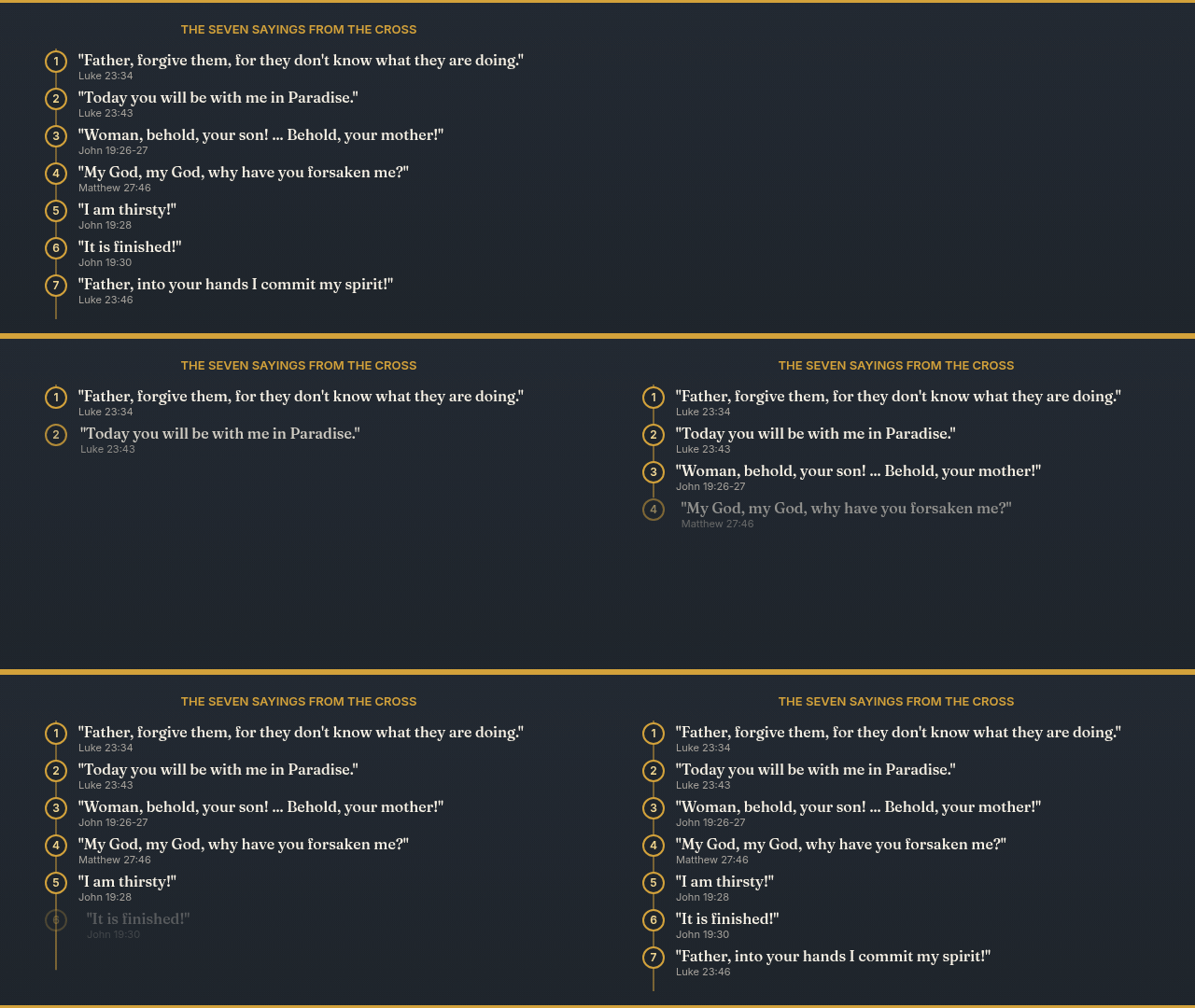
The Gospels record seven sayings from the cross:
- "Father, forgive them, for they don't know what they are doing" (Luke 23:34).
- To the criminal who asked to be remembered: "Assuredly I tell you, today you will be with me in Paradise" (Luke 23:43).
- To his mother and the beloved disciple: "Woman, behold your son!" and "Behold, your mother!" (John 19:26-27).
- "My God, my God, why have you forsaken me?" the opening words of Psalm 22 (Mark 15:34).
- "I am thirsty" (John 19:28).
- "It is finished" (John 19:30).
- "Father, into your hands I commit my spirit!" (Luke 23:46).
From noon until three in the afternoon, darkness covered the land. At about three, Jesus cried out and died. The curtain of the Temple was torn in two, from top to bottom, and a Roman centurion who watched said, "Truly this man was the Son of God!" (Mark 15:33-39). Among those who stayed to the end were the women from Galilee, including Mary Magdalene, Mary the mother of James and Joses, and Salome (Mark 15:40-41); John adds Jesus' mother and her sister (John 19:25).
Most historians date the crucifixion to Friday, April 7, AD 30, or Friday, April 3, AD 33, based on the years Pilate and Caiaphas held office, the date of Passover and the astronomy of the Jewish calendar.
Joseph of Arimathea, a respected council member who had secretly become a disciple, asked Pilate for the body. With Nicodemus he wrapped it in linen with spices and laid it in a new tomb cut in rock, and rolled a stone across the entrance. The women watched where he was laid (Mark 15:42-47; John 19:38-42).
Why the cross? The New Testament gives many pictures of what Jesus' death means, and they belong together. It is a ransom that sets captives free (Mark 10:45). It is the Passover lamb whose blood protects God's people (1 Corinthians 5:7). It is the suffering servant of Isaiah, "pierced for our transgressions" (Isaiah 53:5). It is a sacrifice that deals with sin once for all (Hebrews 9:26). It is God's victory over evil (Colossians 2:15). And above all it is love: "God commends his own love toward us, in that while we were yet sinners, Christ died for us" (Romans 5:8).
15. "He is not here": the resurrection
Early on Sunday morning, the women went to the tomb with spices to finish anointing the body. They found the stone rolled away and the tomb empty. A messenger told them, "Don't be amazed. You seek Jesus, the Nazarene, who has been crucified. He has risen! He is not here" (Mark 16:1-6).
The Gospels then describe a series of appearances. Jesus met Mary Magdalene in the garden, and she did not recognize him until he spoke her name (John 20:11-18). He walked unrecognized with two disciples on the road to Emmaus and was known to them "in the breaking of the bread" (Luke 24:13-35). He appeared to the disciples behind locked doors, showed them his hands and side, and ate with them (Luke 24:36-43; John 20:19-23). He invited Thomas, who had doubted, to touch his wounds, and Thomas answered, "My Lord and my God!" (John 20:24-29). By the Sea of Galilee he cooked breakfast for his disciples and three times asked Peter, who had denied him three times, "Do you love me?" (John 21:1-17). Paul adds that he appeared to more than five hundred at once, to his brother James, and last of all to Paul himself (1 Corinthians 15:5-8).
Finally, Luke says, after forty days Jesus led his disciples out near Bethany, blessed them and was taken up into heaven (Luke 24:50-51; Acts 1:3-11). His last commands sent them out: "Go and make disciples of all nations... Behold, I am with you always, even to the end of the age" (Matthew 28:19-20); "you will be witnesses to me in Jerusalem, in all Judea and Samaria, and to the uttermost parts of the earth" (Acts 1:8).
What historians say. The resurrection is a claim of faith, and history alone cannot prove or disprove it. But historians can examine what happened afterward, and several points are widely accepted, even by scholars who do not believe Jesus rose: his followers sincerely believed they had seen him alive; this belief arose very early, as the creed in 1 Corinthians 15 shows; it transformed frightened, scattered disciples into bold witnesses willing to suffer; it won over skeptics such as his brother James and the persecutor Paul; and it was proclaimed in Jerusalem, the very city where he had been publicly executed and buried. The Gospels' report that women were the first witnesses also stands out, since in that culture a woman's testimony carried little weight; it is not a detail people would have invented to persuade. Scholars offer different explanations of these facts. Christians have always given the one the first disciples gave: "The Lord is risen indeed!" (Luke 24:34).
His relationships
Jesus' life was full of people. Here are some who appear most often in the Gospels, with links to their pages.
- Mary, his mother. She said yes to God's call as a young woman (Luke 1:38), pondered the strange events of his birth "in her heart" (Luke 2:19), urged him to help at the wedding in Cana (John 2:5), stood at the foot of the cross (John 19:25) and prayed with the disciples after the resurrection (Acts 1:14).
- Joseph. A righteous man who protected Mary and the child, and taught Jesus his trade (Matthew 1:19-24).
- His brothers and sisters. James, Joses, Judas and Simon, and unnamed sisters (Mark 6:3). At first they did not believe in him (John 7:5). After the resurrection James became the leader of the Jerusalem church, and Jude (Judas) is traditionally linked with the Letter of Jude. Christians have understood "brothers" differently: Protestants usually read them as later children of Mary and Joseph; the Orthodox tradition, following early writers, as children of Joseph from an earlier marriage; Catholic tradition as cousins.
- John the Baptist. His relative (Luke 1:36), forerunner and baptizer, who said, "He must increase, but I must decrease" (John 3:30). Jesus called him the greatest "among those who are born of women" (Matthew 11:11).
- The Twelve. Simon Peter, Andrew, James and John the sons of Zebedee, Philip, Bartholomew (often identified with Nathanael), Matthew, Thomas, James son of Alphaeus, Thaddaeus (also called Judas son of James), Simon the Zealot and Judas Iscariot (Matthew 10:2-4; Luke 6:14-16). Peter, James and John formed an inner circle who were with him at the raising of Jairus' daughter, the transfiguration and Gethsemane.
- Mary Magdalene. A follower from Magdala on the Sea of Galilee, healed by Jesus, present at the cross and burial, and the first to see him risen (John 20:1-18). Early church writers called her "the apostle to the apostles." The later idea that she had been a prostitute does not come from the Gospels; it arose from a sermon of Pope Gregory the Great in 591 that merged several different women.
- Martha, Mary and Lazarus of Bethany. Close friends whose home was open to him (Luke 10:38-42; John 11:5).
- Nicodemus. A Pharisee and council member who came to Jesus by night (John 3:1-21), defended him before the council (John 7:50-51) and helped bury him.
- Opponents and judges. Caiaphas the high priest, Pontius Pilate the prefect, and Herod Antipas the tetrarch of Galilee.
- Paul. Never met Jesus during his earthly life, persecuted his followers, and then met the risen Lord on the road to Damascus (Acts 9:1-6). He became the great missionary to the non-Jewish world.
- The prophets who spoke of him. The Gospel writers saw Jesus foreshadowed in Moses, David, Isaiah, Micah, Daniel, Zechariah, Malachi and Jonah (Matthew 12:40). Jesus himself, on the Emmaus road, began "from Moses and from all the prophets" and explained "the things concerning himself" (Luke 24:27).
Read their stories
 Mary, mother of JesusMother of Jesus and followerJoseph of NazarethCarpenter and earthly father of Jesus
 John the BaptistProphet who prepared the way for JesusThe Twelve ApostlesThe original disciples Jesus chose and sent out
 PeterApostle, fisherman, and rock of the early church
 AndrewApostle, fisherman, and brother of Simon Peter
 James, son of ZebedeeApostle and brother of JohnJohnApostle, beloved disciple, and witness to the Word
 PhilipApostle from Bethsaida
 BartholomewApostle, often identified with Nathanael
 MatthewApostle, former tax collector, and Gospel writerThomasApostle and subject of a non-canonical sayings collection
 James, son of AlphaeusApostle, one of the twelve
 ThaddaeusApostle, also called Judas son of James
 Simon the ZealotApostle, one of the twelve
 Judas IscariotApostle who betrayed Jesus
 Mary MagdaleneFollower of Jesus and first witness of the resurrectionMartha and Mary of BethanySisters and friends of JesusLazarusFriend of Jesus raised from the deadNicodemusPharisee and member of the council who came to JesusCaiaphasHigh priest during the trial of JesusPontius PilateRoman governor of JudeaHerod AntipasRuler of Galilee and PereaJamesBrother of Jesus and leader of the Jerusalem churchJudeBrother of Jesus and writer of a short letter of warning
 PaulApostle to the nations and writer of the church's earliest lettersJohn MarkCompanion of Peter and Paul, and Gospel writerLukePhysician, companion of Paul, and historian of the early churchMosesLawgiver, prophet, and leader of Israel out of EgyptDavidKing of Israel, psalmist, and ancestor of the MessiahIsaiahProphet to Judah in the era of the Assyrian threatMicahProphet from Moresheth who spoke against corruptionDanielProphet and official in the courts of Babylon and PersiaZechariahProphet and priest who encouraged the Temple rebuildingMalachiThe last prophet of the Old TestamentJonahReluctant prophet sent to Nineveh
The ripple effect through history
The first church
Fifty days after the resurrection, at the feast of Pentecost, the disciples were filled with the Holy Spirit and Peter preached to the crowds in Jerusalem. About three thousand were baptized that day (Acts 2:1-41). The new community "continued steadfastly in the apostles' teaching and fellowship, in the breaking of bread, and prayer," and shared their goods with anyone in need (Acts 2:42-47). Persecution scattered them, and they carried the message with them: to Samaria, to an Ethiopian court official, to a Roman centurion named Cornelius, and to Antioch, where the disciples were first called "Christians" (Acts 11:26). Paul's journeys planted churches across Asia Minor and Greece, and by about AD 60 there were believers in Rome itself.
Persecution and growth
For nearly three centuries, Christianity had no legal standing. Nero blamed Christians for the fire of Rome in AD 64, and tradition holds that Peter and Paul were executed in Rome during that time. Persecution came and went, worst under Decius (250) and Diocletian (303-311). Yet the church kept growing. The sociologist Rodney Stark estimated that Christians were about 1.9% of the Roman population in 250 and around ten percent by 300.
Why did it grow? Part of the answer is how Christians lived. During plagues, they stayed to nurse the sick when others fled. They took in abandoned babies, cared for widows and buried the poor. In the 360s the emperor Julian, who tried to restore the old gods, complained in a letter to Arsacius, a pagan high priest, that "the impious Galilaeans support not only their own poor but ours as well" (Letter 22, translated by W. C. Wright).
Rome changes
In 312 the emperor Constantine fought under a Christian sign, and in 313 the Edict of Milan granted Christians freedom of worship. In 325 the Council of Nicaea gathered bishops from across the empire and produced the Nicene Creed, still confessed by most churches today: "We believe in one Lord, Jesus Christ, the only Son of God... true God from true God." In 380 the emperor Theodosius made Nicene Christianity the official faith of the empire. This brought freedom and influence, and it also brought new temptations of power that the church did not always resist.
Monasteries, hospitals and universities
Starting in the deserts of Egypt in the late 200s, men and women withdrew to pray and work in community. In about 529, Benedict of Nursia founded the monastery of Monte Cassino in Italy; his Rule, with its rhythm of "pray and work," shaped Western monasteries for the next fifteen centuries. Through the collapse of the Western Roman Empire, monks copied by hand the Scriptures, the church fathers and many classical Latin works, and kept learning alive.
Around 369, Basil, bishop of Caesarea in Cappadocia, built a large complex for the poor, the sick and travelers, with doctors and nurses, a place historians often call one of the first public hospitals. Church-run hospitals spread through the Byzantine and medieval world. Out of the cathedral and monastic schools came the first universities of Europe: Bologna (around 1088), Paris and Oxford (both in the 1100s). Their founders saw the study of creation as a way of honoring the Creator.
The first universities, grown from church and cathedral schools
Freedom for the enslaved
Christians share the shameful history of slavery; many enslavers called themselves Christians and twisted Scripture to defend it. But the movement to end slavery was also driven in large part by people who took Jesus' words seriously. Quakers in Britain and America organized petitions in the 1780s. William Wilberforce, an evangelical member of the British Parliament, fought for twenty years until the slave trade was abolished in 1807, and slavery in most of the British Empire was ended by the Slavery Abolition Act of 1833, passed days before his death. In America, Black churches, abolitionists such as Frederick Douglass and Harriet Tubman, and later the civil rights movement led by the Baptist pastor Martin Luther King Jr. appealed again and again to the teaching that every person bears God's image and that Christ came "to proclaim release to the captives" (Luke 4:18).
Art and music
No other life has inspired so much art. The earliest images of Jesus, as a shepherd carrying a sheep, are painted on the walls of the Roman catacombs. Then came Byzantine icons and mosaics, Gothic cathedrals with their stained-glass windows, Giotto's frescoes, Leonardo da Vinci's Last Supper, Michelangelo's Pietà and Sistine Chapel, and Rembrandt's Return of the Prodigal Son. In music, Gregorian chant gave way to the masses of Palestrina, the passions and cantatas of Johann Sebastian Bach, who signed his scores "to God alone the glory," and Handel's Messiah, first performed in Dublin in 1742 to raise money for prisoners and hospitals. African American spirituals, gospel music, and worship songs sung today in thousands of languages carry the same story.
A global faith today
The Pew Research Center's 2011 study found 2.18 billion Christians in 2010, nearly a third of the world's population, and the number had nearly quadrupled in a century, from about 600 million in 1910. The center of Christianity has moved. In 1910 most Christians lived in Europe and the Americas. By 2010, according to Pew, only about a quarter of all Christians lived in Europe (26%), 37% lived in the Americas, 24% in sub-Saharan Africa and 13% in Asia and the Pacific. The Christian share of sub-Saharan Africa's population rose from 9% in 1910 to 63% in 2010. Pew's 2025 report found that the number of Christians reached 2.3 billion in 2020, though the Christian share of the world fell to 28.8% as other groups grew faster. Christians remain the world's largest religious group, Pew reports: the followers of a Jewish craftsman from a village of a few hundred people.
Where the world's Christians live: Africa passes Europe
Christians as a share of the United States population
Languages still waiting for Bible translation to begin
Places in his life
- 1Bethlehem · Birthplace Luke 2:4-7
- 2Nazareth · Hometown Luke 4:16
- 3Sepphoris · Antipas' capital, 4 miles from Nazareth (not named in the Gospels)
- 4Jordan River (traditional baptism site, Qasr al-Yahud / Bethany beyond the Jordan) · Baptism by John Mark 1:9
- 5Cana (Kafr Kanna, traditional) · Water into wine John 2:1-11
- 6Capernaum · Ministry base Matthew 4:13
- 7Magdala · Home of Mary Magdalene Luke 8:2
- 8Bethsaida (et-Tell, probable) · Home of Peter, Andrew, Philip John 1:44
- 9Sea of Galilee · Calming the storm, walking on water Mark 4:35-41
- 10Nain · Widow's son raised Luke 7:11-17
- 11Mount Tabor (traditional) · Transfiguration by tradition Matthew 17:1-8
- 12Caesarea Philippi (Banias) · Peter's confession Matthew 16:13-16
- 13Sychar / Jacob's Well · Samaritan woman John 4:5-6
- 14Jericho · Bartimaeus and Zacchaeus Luke 19:1-10
- 15Bethany · Martha, Mary and Lazarus John 11:1
- 16Mount of Olives / Gethsemane · Prayer and arrest Mark 14:32-50
- 17Jerusalem, Temple Mount · Temple cleansing and teaching Mark 11:15-17
- 18Golgotha / tomb (Church of the Holy Sepulchre, traditional) · Crucifixion, burial, resurrection John 19:17-42
- 19Emmaus (location uncertain; Emmaus Nicopolis shown) · Road to Emmaus Luke 24:13-35
These are the main places named in the Gospels. Map coordinates for each are listed in this page's data file, and the map on the page is drawn from them.
- Bethlehem, his birthplace, six miles south of Jerusalem (Luke 2:4-7).
- Egypt, where the family took refuge (Matthew 2:13-15).
- Nazareth, his hometown in the hills of Galilee (Luke 4:16).
- The Jordan River, where John baptized him (Mark 1:9).
- Cana, where he turned water into wine (John 2:1-11).
- Capernaum, his base on the Sea of Galilee (Matthew 4:13).
- The Sea of Galilee, its towns of Magdala and Bethsaida, and the hills where he taught and fed the crowds.
- Nain, where he raised a widow's son (Luke 7:11).
- Sychar in Samaria, at Jacob's well (John 4:5-6).
- Caesarea Philippi, where Peter confessed him as the Christ (Matthew 16:13).
- Mount Tabor (by tradition), the mountain of the transfiguration.
- Jericho, where he healed blind Bartimaeus and met Zacchaeus (Luke 19:1).
- Bethany, the home of Martha, Mary and Lazarus (John 11:1).
- Jerusalem: the Temple, the upper room, Gethsemane on the Mount of Olives, the high priest's house, Pilate's headquarters, Golgotha and the garden tomb.
- Emmaus, where two disciples recognized him at supper (Luke 24:13).
Timeline
- c. 6-4 BCBirth in BethlehemLuke 2:1-7
- 4 BCDeath of Herod the Great; family settles in NazarethMatthew 2:19-23
- c. AD 8Age twelve, in the TempleLuke 2:41-52
- AD 14Tiberius becomes emperor
- AD 26Pontius Pilate becomes prefect of Judea
- c. AD 28-29John the Baptist preaches; Jesus baptizedLuke 3:1-22
- c. AD 28-30Galilean ministry; the Twelve chosenMark 3:13-19
- c. AD 29-30Peter's confession; transfigurationMatthew 16-17
- AD 30 or 33Last week, crucifixion and resurrectionMark 11-16
- +40 daysAscensionActs 1:3-11
- +50 daysPentecost, birth of the churchActs 2
- AD 313Edict of Milan
- AD 325Council of Nicaea
- c. 6-4 BC Birth in Bethlehem (Luke 2:1-7).
- 4 BC Death of Herod the Great; the family settles in Nazareth (Matthew 2:19-23).
- c. AD 8 At twelve, Jesus in the Temple (Luke 2:41-52).
- AD 14 Tiberius becomes emperor.
- AD 26 Pontius Pilate becomes prefect of Judea.
- c. AD 28-29 John the Baptist's ministry; Jesus is baptized (Luke 3:1-22).
- c. AD 28-30 Ministry in Galilee; the Twelve are chosen (Mark 3:13-19).
- c. AD 29-30 Peter's confession and the transfiguration (Matthew 16-17).
- AD 30 or 33 Last week in Jerusalem, crucifixion and resurrection (Mark 11-16).
- Forty days later Ascension (Acts 1:3-11).
- Fifty days later Pentecost and the birth of the church (Acts 2).
Go deeper
Read the Gospels. The best place to meet Jesus is in the four Gospels themselves: Matthew, Mark, Luke and John. Mark is the shortest and can be read in one evening.
Study tools. Blue Letter Bible and eBible.org let you look up the Greek words behind any verse. BibleProject has free study guides and videos on every Gospel.
Encyclopedias. Wikipedia: Jesus, Wikipedia: Historical Jesus and Encyclopaedia Britannica: Jesus.
Free public-domain books. - Flavius Josephus, Antiquities of the Jews (c. AD 94), translated by William Whiston. - Eusebius of Caesarea, Church History (early 300s), at the Christian Classics Ethereal Library. - Alfred Edersheim, The Life and Times of Jesus the Messiah (1883), rich on Jewish background. - Frederic W. Farrar, The Life of Christ (1874), at the Internet Archive. - John Foxe, Foxe's Book of Martyrs (1563), on those who died for their faith. - Lew Wallace, Ben-Hur: A Tale of the Christ (1880), the novel.
Sources for our numbers. Pew Research Center, Global Christianity (2011) and How the Global Religious Landscape Changed From 2010 to 2020 (2025). Rodney Stark's estimates as summarized in Wikipedia: Christianization of the Roman Empire. On the Roman and Jewish writers: Josephus on Jesus, Tacitus on Jesus, Pliny the Younger on Christians.
References and further reading
- Wikipedia: Jesus
- Wikipedia: Historical Jesus
- BibleProject: Book of Luke guide
- BibleProject: Luke-Acts video collection
- BibleProject: Sermon on the Mount videos
- Blue Letter Bible: Matthew 5 (KJV with Greek tools)
- eBible.org: Matthew 5
- CCEL: Eusebius, Church History (NPNF2 vol. 1)
- CCEL: Edersheim, The Life and Times of Jesus the Messiah
- Pew Research Center: Global Christianity (2011)
- Pew Research Center: How the Global Religious Landscape Changed From 2010 to 2020 (2025)
- Wikipedia: Josephus on Jesus
- Wikipedia: Tacitus on Jesus
- Wikipedia: Pliny the Younger on Christians
- Wikipedia: Christianization of the Roman Empire
- Wikipedia: Basil of Caesarea
- Wikipedia: Benedict of Nursia
- Wikipedia: Medieval university
- Wikipedia: William Wilberforce
Public-domain books, free to read
- Antiquities of the JewsFlavius Josephus (trans. William Whiston)
- Church History (Nicene and Post-Nicene Fathers, Series 2, Vol. 1)Eusebius of Caesarea
- The Life and Times of Jesus the MessiahAlfred Edersheim
- The Life of ChristFrederic W. Farrar
- Fox's Book of MartyrsJohn Foxe
- Ben-Hur: A Tale of the ChristLew Wallace
Watch
These videos load only when you click them.
- BibleProject, Gospel of Luke Summary: A Complete Animated Overview (Part 1).
- BibleProject, Gospel of John Summary: A Complete Animated Overview (Part 1).
- BibleProject, What Jesus Taught in the Sermon on the Mount (Visual Commentary).
- BibleProject, Why Jesus Called Himself the Son of Man.
- From the Manger to the Cross (1912), a silent film shot on location in Egypt and Palestine, now in the public domain, at the Internet Archive.
A closing word
Jesus asked his first followers, "But who do you say that I am?" Every reader of the Gospels still has to answer that question. Some see a wise teacher, some a prophet, some a puzzle. Christians, with Peter and Thomas, confess him as the Christ, the Son of the living God, our Lord and our God. Whatever you conclude, we invite you to read his words for yourself, slowly, in the Gospels. He promised, "Ask, and it will be given you. Seek, and you will find. Knock, and it will be opened for you" (Matthew 7:7).
Every saying of Jesus in our verse index
Sayings of Jesus in our daily verse index, by book

Our daily verse collection includes 140 passages where Jesus speaks, in the Gospels and in the few places where the risen Lord speaks in Acts, 2 Corinthians and Revelation. Each link opens that day's verse page, where you can read it in several translations and listen to it. Red-letter Bibles do not always agree on where Jesus' words begin and end; where that matters, we add a note.
Matthew
- Matthew 5:3: "Blessed are the poor in spirit, for theirs is..."
- Matthew 5:4: "Blessed are those who mourn, for they shall be..."
- Matthew 5:5: "Blessed are the gentle, for they shall inherit the..."
- Matthew 5:6: "Blessed are those who hunger and thirst for righteousness,..."
- Matthew 5:7: "Blessed are the merciful, for they shall obtain mercy."
- Matthew 5:8: "Blessed are the pure in heart, for they shall..."
- Matthew 5:9: "Blessed are the peacemakers, for they shall be called..."
- Matthew 5:14: "You are the light of the world. A city..."
- Matthew 5:44: "But I tell you, love your enemies, bless those..."
- Matthew 6:6: "But you, when you pray, enter into your inner..."
- Matthew 6:9-10: "'Our Father in heaven, may your name be kept..."
- Matthew 6:11: "Give us today our daily bread."
- Matthew 6:14: "For if you forgive men their trespasses, your heavenly..."
- Matthew 6:19-21: "Don't lay up treasures for yourselves on the earth,..."
- Matthew 6:24: "No one can serve two masters, for either he..."
- Matthew 6:26: "See the birds of the sky, that they don't..."
- Matthew 6:33: "But seek first God's Kingdom and his righteousness; and..."
- Matthew 6:34: "Therefore don't be anxious for tomorrow, for tomorrow will..."
- Matthew 7:7: "Ask, and it will be given you. Seek, and..."
- Matthew 7:12: "Therefore, whatever you desire for men to do to..."
- Matthew 7:24: "Everyone therefore who hears these words of mine and..."
- Matthew 9:12: "Those who are healthy have no need for a..."
- Matthew 10:29-31: "Aren't two sparrows sold for an assarion coin? Not..."
- Matthew 11:28: "Come to me, all you who labor and are..."
- Matthew 11:29: "Take my yoke upon you and learn from me,..."
- Matthew 11:30: "For my yoke is easy, and my burden is..."
- Matthew 12:35: "The good man out of his good treasure brings..."
- Matthew 14:27: "Cheer up! It is I! Don't be afraid."
- Matthew 15:18-19: "But the things which proceed out of the mouth..."
- Matthew 16:26: "For what will it profit a man if he..."
- Matthew 18:20: "For where two or three are gathered together in..."
- Matthew 18:21-22: "Lord, how often shall my brother sin against me,..." Peter asks; Jesus answers.
- Matthew 19:5-6: "and said, 'For this cause a man shall leave..." Jesus quotes Genesis 2:24.
- Matthew 19:14: "Allow the little children, and don't forbid them to..."
- Matthew 21:22: "All things, whatever you ask in prayer, believing, you..."
- Matthew 22:37-39: "'You shall love the Lord your God with all..."
- Matthew 24:35: "Heaven and earth will pass away, but my words..."
- Matthew 25:21: "His lord said to him, 'Well done, good and..." From the parable of the talents.
- Matthew 25:35-36: "for I was hungry and you gave me food..."
- Matthew 25:40: "The King will answer them, 'Most certainly I tell..."
- Matthew 26:41: "Watch and pray, that you don't enter into temptation...."
- Matthew 28:19: "Go and make disciples of all nations, baptizing them..."
- Matthew 28:20: "teaching them to observe all things that I commanded..."
Mark
- Mark 2:17: "Those who are healthy have no need for a..."
- Mark 4:39: "Peace! Be still! The wind ceased and there was..."
- Mark 5:34: "Daughter, your faith has made you well. Go in..."
- Mark 5:36: "But Jesus, when he heard the message spoken, immediately..."
- Mark 6:31: "Come away into a deserted place, and rest awhile...."
- Mark 7:21-23: "For from within, out of the hearts of men,..."
- Mark 8:36: "For what does it profit a man to gain..."
- Mark 9:23: "If you can believe, all things are possible to..."
- Mark 10:9: "What therefore God has joined together, let no man..."
- Mark 10:27: "With men it is impossible, but not with God,..."
- Mark 10:45: "For the Son of Man also came not to..."
- Mark 11:24: "Therefore I tell you, all things whatever you pray..."
- Mark 11:25: "Whenever you stand praying, forgive, if you have anything..."
- Mark 12:31: "The second is like this: 'You shall love your..."
- Mark 12:41-44: "Jesus sat down opposite the treasury and saw how..." Narrative; Jesus speaks in verses 43-44.
- Mark 13:31: "Heaven and earth will pass away, but my words..."
- Mark 14:38: "Watch and pray, that you may not enter into..."
- Mark 16:15: "Go into all the world and preach the Good..." From the longer ending of Mark (16:9-20), absent from the earliest manuscripts.
Luke
- Luke 6:31: "As you would like people to do to you,..."
- Luke 6:35: "But love your enemies, and do good, and lend,..."
- Luke 6:36: "Therefore be merciful, even as your Father is also..."
- Luke 6:37: "Don't judge, and you won't be judged. Don't condemn,..."
- Luke 6:38: "Give, and it will be given to you: good..."
- Luke 8:48: "Daughter, cheer up. Your faith has made you well...."
- Luke 9:23: "If anyone desires to come after me, let him..."
- Luke 9:62: "No one, having put his hand to the plow..."
- Luke 10:19: "Behold, I give you authority to tread on serpents..."
- Luke 10:27: "You shall love the Lord your God with all..."
- Luke 10:41-42: "Martha, Martha, you are anxious and troubled about many..."
- Luke 11:4: "Forgive us our sins, for we ourselves also forgive..."
- Luke 11:9: "I tell you, keep asking, and it will be..."
- Luke 11:13: "If you then, being evil, know how to give..."
- Luke 11:42: "But woe to you Pharisees! For you tithe mint..."
- Luke 12:7: "But the very hairs of your head are all..."
- Luke 12:15: "Beware! Keep yourselves from covetousness, for a man's life..."
- Luke 12:22: "Therefore I tell you, don't be anxious for your..."
- Luke 12:28: "But if this is how God clothes the grass..."
- Luke 12:32: "Don't be afraid, little flock, for it is your..."
- Luke 12:34: "For where your treasure is, there will your heart..."
- Luke 14:11: "For everyone who exalts himself will be humbled, and..."
- Luke 15:7: "I tell you that even so there will be..."
- Luke 15:20: "He arose and came to his father. But while..." From the parable of the lost son.
- Luke 16:10: "He who is faithful in a very little is..."
- Luke 16:13: "No servant can serve two masters, for either he..."
- Luke 17:17: "Weren't the ten cleansed? But where are the nine?"
- Luke 17:21: "neither will they say, 'Look, here!' or, 'Look, there!'..."
- Luke 18:16: "Allow the little children to come to me, and..."
- Luke 18:27: "The things which are impossible with men are possible..."
- Luke 19:10: "For the Son of Man came to seek and..."
- Luke 22:32: "but I prayed for you, that your faith wouldn't..."
- Luke 23:34: "Father, forgive them, for they don't know what they..."
- Luke 23:43: "Assuredly I tell you, today you will be with..."
John
- John 3:16: "For God so loved the world, that he gave..." Red-letter Bibles differ on whether Jesus' words to Nicodemus end at 3:15 or run through 3:21; many scholars read 3:16-21 as John's reflection.
- John 3:17: "For God didn't send his Son into the world..." See note on John 3:16.
- John 3:21: "But he who does the truth comes to the..." See note on John 3:16.
- John 4:14: "but whoever drinks of the water that I will..."
- John 4:24: "God is spirit, and those who worship him must..."
- John 4:35: "Don't you say, 'There are yet four months until..."
- John 5:24: "Most certainly I tell you, he who hears my..."
- John 5:39: "You search the Scriptures, because you think that in..."
- John 6:35: "I am the bread of life. Whoever comes to..."
- John 6:37: "All those whom the Father gives me will come..."
- John 7:38: "He who believes in me, as the Scripture has..."
- John 8:12: "I am the light of the world. He who..."
- John 8:31: "If you remain in my word, then you are..."
- John 8:32: "You will know the truth, and the truth will..."
- John 10:10: "The thief only comes to steal, kill, and destroy...."
- John 10:11: "I am the good shepherd. The good shepherd lays..."
- John 10:27: "My sheep hear my voice, and I know them,..."
- John 10:28: "I give eternal life to them. They will never..."
- John 11:25: "I am the resurrection and the life. He who..."
- John 12:24: "Most certainly I tell you, unless a grain of..."
- John 12:26: "If anyone serves me, let him follow me. Where..."
- John 13:34-35: "A new commandment I give to you, that you..."
- John 14:1: "Don't let your heart be troubled. Believe in God...."
- John 14:2: "In my Father's house are many homes. If it..."
- John 14:6: "I am the way, the truth, and the life...."
- John 14:15: "If you love me, keep my commandments."
- John 14:18: "I will not leave you orphans. I will come..."
- John 14:26: "But the Counselor, the Holy Spirit, whom the Father..."
- John 14:27: "Peace I leave with you. My peace I give..."
- John 15:5: "I am the vine. You are the branches. He..."
- John 15:7: "If you remain in me, and my words remain..."
- John 15:12: "This is my commandment, that you love one another,..."
- John 15:13: "Greater love has no one than this, that someone..."
- John 15:16: "You didn't choose me, but I chose you and..."
- John 16:22: "Therefore you now have sorrow, but I will see..."
- John 16:24: "Until now, you have asked nothing in my name...."
- John 16:33: "I have told you these things, that in me..."
- John 17:15: "I pray not that you would take them from..."
- John 17:17: "Sanctify them in your truth. Your word is truth."
- John 21:17: "Simon, son of Jonah, do you have affection for..." The risen Jesus to Peter by the lake.
Acts
- Acts 1:8: "But you will receive power when the Holy Spirit..." The risen Jesus before his ascension.
- Acts 20:35: "In all things I gave you an example, that..." Paul quotes a saying of Jesus not recorded in the Gospels: "It is more blessed to give than to receive."
2 Corinthians
- 2 Corinthians 12:9: "My grace is sufficient for you, for my power..." The risen Lord speaking to Paul.
Revelation
- Revelation 3:20: "Behold, I stand at the door and knock. If..." The risen Christ, in the letter to Laodicea.
- Revelation 22:20: "Yes, I am coming soon. Amen! Yes, come, Lord..." The risen Christ: "Yes, I am coming soon."
Sayings in our verse index
Blessed are the poor in spirit: for theirs is the kingdom of heaven.
Blessed are the poor in spirit, for theirs is the kingdom of heaven.
Blessed are they that mourn: for they shall be comforted.
Blessed are those who mourn, for they will be comforted. Grief gets company.
Blessed are the meek: for they shall inherit the earth.
Blessed are the meek, for they will inherit the earth. Gentleness wins in the end.
Blessed are they which do hunger and thirst after righteousness: for they shall be filled.
Blessed are those who hunger and thirst for what is right, for they will be filled.
Blessed are the merciful: for they shall obtain mercy.
Blessed are the merciful, for they will be shown mercy. It comes back around.
Blessed are the pure in heart: for they shall see God.
Blessed are the pure in heart, for they will see God.
Blessed are the peacemakers: for they shall be called the children of God.
Blessed are the peacemakers, for they will be called children of God.
Ye are the light of the world. A city that is set on an hill cannot be hid.
You are the light of the world. A city on a hill cannot be hidden.
But I say unto you, Love your enemies, bless them that curse you, do good to them that hate you, and pray for them which despitefully use you, and persecute you;
Love your enemies and pray for those who use you badly. That is a different kind of strength.
But thou, when thou prayest, enter into thy closet, and when thou hast shut thy door, pray to thy Father which is in secret; and thy Father which seeth in secret shall reward thee openly.
When you pray, go into your room and shut the door. Quiet is a place to meet.
After this manner therefore pray ye: Our Father which art in heaven, Hallowed be thy name. Thy kingdom come. Thy will be done in earth, as it is in heaven.
Our Father in heaven, may your name be honoured and your kingdom come.
Give us this day our daily bread.
Give us this day our daily bread. Ask for today's portion, not a decade of it.
For if ye forgive men their trespasses, your heavenly Father will also forgive you:
If you forgive others their wrongs, your Father will forgive yours.
Lay not up for yourselves treasures upon earth, where moth and rust doth corrupt, and where thieves break through and steal: But lay up for yourselves treasures in heaven, where neither moth nor rust doth corrupt, and where thieves do not break through nor steal: For where your treasure is, there will your heart be also.
Do not pile up treasure on earth. Put your treasure where it cannot rust.
No man can serve two masters: for either he will hate the one, and love the other; or else he will hold to the one, and despise the other. Ye cannot serve God and mammon.
You cannot serve God and money. One of them will take the lead.
Behold the fowls of the air: for they sow not, neither do they reap, nor gather into barns; yet your heavenly Father feedeth them. Are ye not much better than they?
Look at the birds. Your heavenly Father feeds them, and you matter more.
But seek ye first the kingdom of God, and his righteousness; and all these things shall be added unto you.
Seek first the kingdom of God, and the other things will be added.
Take therefore no thought for the morrow: for the morrow shall take thought for the things of itself. Sufficient unto the day is the evil thereof.
Do not worry about tomorrow. Today has enough of its own to carry.
Ask, and it shall be given you; seek, and ye shall find; knock, and it shall be opened unto you:
Ask and it will be given, seek and you will find, knock and it will open.
Therefore all things whatsoever ye would that men should do to you, do ye even so to them: for this is the law and the prophets.
Treat people the way you want to be treated. That sums up a lot of law.
Therefore whosoever heareth these sayings of mine, and doeth them, I will liken him unto a wise man, which built his house upon a rock:
The one who hears these words and does them is like a house built on rock.
But when Jesus heard that, he said unto them, They that be whole need not a physician, but they that are sick.
The healthy do not need a doctor, but the sick do. Asking for help is not weakness.
Are not two sparrows sold for a farthing? and one of them shall not fall on the ground without your Father. But the very hairs of your head are all numbered. Fear ye not therefore, ye are of more value than many sparrows.
Two sparrows sell for a penny, and not one falls without your Father. You are worth more.
Come unto me, all ye that labour and are heavy laden, and I will give you rest.
Come to me, all who are tired and carrying too much, and I will give you rest.
Take my yoke upon you, and learn of me; for I am meek and lowly in heart: and ye shall find rest unto your souls.
Take my yoke and learn from me, for I am gentle and humble in heart.
For my yoke is easy, and my burden is light.
My yoke is easy and my burden is light. Following should not break your back.
A good man out of the good treasure of the heart bringeth forth good things: and an evil man out of the evil treasure bringeth forth evil things.
A good person brings good things out of the good stored in their heart.
But straightway Jesus spake unto them, saying, Be of good cheer; it is I; be not afraid.
Be of good cheer. It is I. Do not be afraid.
But those things which proceed out of the mouth come forth from the heart; and they defile the man. For out of the heart proceed evil thoughts, murders, adulteries, fornications, thefts, false witness, blasphemies:
What comes out of the mouth starts in the heart. Change the heart, change the life.
For what is a man profited, if he shall gain the whole world, and lose his own soul? or what shall a man give in exchange for his soul?
What does it profit a person to gain the whole world and lose their own soul?
For where two or three are gathered together in my name, there am I in the midst of them.
Where two or three are gathered in my name, there I am among them.
Then came Peter to him, and said, Lord, how oft shall my brother sin against me, and I forgive him? till seven times? Jesus saith unto him, I say not unto thee, Until seven times: but, Until seventy times seven.
Not seven times, but seventy times seven. Forgiveness is not a tally.
And said, For this cause shall a man leave father and mother, and shall cleave to his wife: and they twain shall be one flesh? Wherefore they are no more twain, but one flesh. What therefore God hath joined together, let not man put asunder.
The two become one flesh. What God has joined together, let no one pull apart.
But Jesus said, Suffer little children, and forbid them not, to come unto me: for of such is the kingdom of heaven.
Let the children come to me. The kingdom belongs to people like them.
And all things, whatsoever ye shall ask in prayer, believing, ye shall receive.
Whatever you ask in prayer, believing, you will receive.
Jesus said unto him, Thou shalt love the Lord thy God with all thy heart, and with all thy soul, and with all thy mind. This is the first and great commandment. And the second is like unto it, Thou shalt love thy neighbour as thyself.
Love God with everything you are, and love your neighbor as yourself.
Heaven and earth shall pass away, but my words shall not pass away.
Heaven and earth will pass away, but my words will not pass away.
His lord said unto him, Well done, thou good and faithful servant: thou hast been faithful over a few things, I will make thee ruler over many things: enter thou into the joy of thy lord.
Well done, good and faithful servant. Faithfulness, not fame, gets the welcome.
For I was an hungred, and ye gave me meat: I was thirsty, and ye gave me drink: I was a stranger, and ye took me in: Naked, and ye clothed me: I was sick, and ye visited me: I was in prison, and ye came unto me.
I was hungry and you fed me, thirsty and you gave me a drink, sick and you visited.
And the King shall answer and say unto them, Verily I say unto you, Inasmuch as ye have done it unto one of the least of these my brethren, ye have done it unto me.
Whatever you did for the least of these, you did for me. Small kindness counts as worship.
Watch and pray, that ye enter not into temptation: the spirit indeed is willing, but the flesh is weak.
The spirit is willing but the flesh is weak. Watch and pray, and be gentle with yourself.
Go ye therefore, and teach all nations, baptizing them in the name of the Father, and of the Son, and of the Holy Ghost:
Go and make disciples of all nations, teaching them what I commanded.
Teaching them to observe all things whatsoever I have commanded you: and, lo, I am with you alway, even unto the end of the world. Amen.
And surely I am with you always, to the very end of the age.
When Jesus heard it, he saith unto them, They that are whole have no need of the physician, but they that are sick: I came not to call the righteous, but sinners to repentance.
I came to call not the healthy but the sick. Nobody has to pretend to be fine.
And he arose, and rebuked the wind, and said unto the sea, Peace, be still. And the wind ceased, and there was a great calm.
Peace, be still. The wind stopped and there was a great calm.
And he said unto her, Daughter, thy faith hath made thee whole; go in peace, and be whole of thy plague.
Your faith has made you whole. Go in peace and be healed.
As soon as Jesus heard the word that was spoken, he saith unto the ruler of the synagogue, Be not afraid, only believe.
Do not be afraid. Only believe.
And he said unto them, Come ye yourselves apart into a desert place, and rest a while: for there were many coming and going, and they had no leisure so much as to eat.
Come away by yourselves and rest a while. Rest was in the plan.
For from within, out of the heart of men, proceed evil thoughts, adulteries, fornications, murders, Thefts, covetousness, wickedness, deceit, lasciviousness, an evil eye, blasphemy, pride, foolishness: All these evil things come from within, and defile the man.
The catalog of what lives inside us, apart from God. He alone can clean the source.
For what shall it profit a man, if he shall gain the whole world, and lose his own soul?
What good is it to gain everything and lose your own soul?
Jesus said unto him, If thou canst believe, all things are possible to him that believeth.
All things are possible for the one who believes.
What therefore God hath joined together, let not man put asunder.
What God has joined together, let no one separate.
And Jesus looking upon them saith, With men it is impossible, but not with God: for with God all things are possible.
With people it is impossible, but not with God. All things are possible with God.
For even the Son of man came not to be ministered unto, but to minister, and to give his life a ransom for many.
The Son of Man came not to be served but to serve. Greatness looks like serving.
Therefore I say unto you, What things soever ye desire, when ye pray, believe that ye receive them, and ye shall have them.
Whatever you ask for in prayer, believe you have received it, and it will be yours.
And when ye stand praying, forgive, if ye have ought against any: that your Father also which is in heaven may forgive you your trespasses.
When you pray, forgive anyone you have something against.
And the second is like, namely this, Thou shalt love thy neighbour as thyself. There is none other commandment greater than these.
Love your neighbor as yourself. You are included in that command too.
And Jesus sat over against the treasury, and beheld how the people cast money into the treasury: and many that were rich cast in much. And there came a certain poor widow, and she threw in two mites, which make a farthing. And he called unto him his disciples, and saith unto them, Verily I say unto you, That this poor widow hath cast more in, than all they which have cast into the treasury: For all they did cast in of their abundance; but she of her want did cast in all that she had, even all her living.
She gave two small coins, and it was more than all the rest. Amounts are not the measure.
Heaven and earth shall pass away: but my words shall not pass away.
Heaven and earth will pass away, but my words will not.
Watch ye and pray, lest ye enter into temptation. The spirit truly is ready, but the flesh is weak.
Watch and pray so you do not fall into temptation. The spirit is willing.
And he said unto them, Go ye into all the world, and preach the gospel to every creature.
Go into all the world and tell the good news to every creature.
And as ye would that men should do to you, do ye also to them likewise.
Do to others as you would want them to do to you. Simple and hard.
But love ye your enemies, and do good, and lend, hoping for nothing again; and your reward shall be great, and ye shall be the children of the Highest: for he is kind unto the unthankful and to the evil.
Do good and lend without expecting a return. That is generosity that looks like God.
Be ye therefore merciful, as your Father also is merciful.
Be merciful, just as your Father is merciful.
Judge not, and ye shall not be judged: condemn not, and ye shall not be condemned: forgive, and ye shall be forgiven:
Forgive and you will be forgiven. Let go, and get let off.
Give, and it shall be given unto you; good measure, pressed down, and shaken together, and running over, shall men give into your bosom. For with the same measure that ye mete withal it shall be measured to you again.
Give, and it will be given to you, pressed down and running over.
And he said unto her, Daughter, be of good comfort: thy faith hath made thee whole; go in peace.
Daughter, your faith has made you well. Go in peace.
And he said to them all, If any man will come after me, let him deny himself, and take up his cross daily, and follow me.
Take up your cross daily and follow me. Following is a habit, not a moment.
And Jesus said unto him, No man, having put his hand to the plough, and looking back, is fit for the kingdom of God.
No one who puts a hand to the plough and keeps looking back is fit for the work.
Behold, I give unto you power to tread on serpents and scorpions, and over all the power of the enemy: and nothing shall by any means hurt you.
I give you power over the enemy, and nothing will hurt you.
And he answering said, Thou shalt love the Lord thy God with all thy heart, and with all thy soul, and with all thy strength, and with all thy mind; and thy neighbour as thyself.
Love the Lord your God with all your heart, soul, strength, and mind.
And Jesus answered and said unto her, Martha, Martha, thou art careful and troubled about many things: But one thing is needful: and Mary hath chosen that good part, which shall not be taken away from her.
Martha, Martha, you are worried about many things, but only one is needed.
And forgive us our sins; for we also forgive every one that is indebted to us. And lead us not into temptation; but deliver us from evil.
Forgive us our sins, for we also forgive everyone who owes us.
And I say unto you, Ask, and it shall be given you; seek, and ye shall find; knock, and it shall be opened unto you.
Ask and it will be given, seek and you will find, knock and the door will open.
If ye then, being evil, know how to give good gifts unto your children: how much more shall your heavenly Father give the Holy Spirit to them that ask him?
If you know how to give good gifts, how much more will your Father give the Holy Spirit.
But woe unto you, Pharisees! for ye tithe mint and rue and all manner of herbs, and pass over judgment and the love of God: these ought ye to have done, and not to leave the other undone.
Do not forget justice and the love of God. Small matters do not cancel big ones.
But even the very hairs of your head are all numbered. Fear not therefore: ye are of more value than many sparrows.
Even the hairs of your head are all numbered. Do not be afraid.
And he said unto them, Take heed, and beware of covetousness: for a man's life consisteth not in the abundance of the things which he possesseth.
Life is not measured by how much you own. That is a sentence worth memorising.
And he said unto his disciples, Therefore I say unto you, Take no thought for your life, what ye shall eat; neither for the body, what ye shall put on.
Do not worry about your life, what you will eat, or about your body.
If then God so clothe the grass, which is to day in the field, and to morrow is cast into the oven; how much more will he clothe you, O ye of little faith?
If he clothes the grass, how much more will he clothe you?
Fear not, little flock; for it is your Father's good pleasure to give you the kingdom.
Do not be afraid, little flock. Your Father is glad to give you the kingdom.
For where your treasure is, there will your heart be also.
Where your treasure is, your heart will be there too.
For whosoever exalteth himself shall be abased; and he that humbleth himself shall be exalted.
Whoever lifts themselves up will be humbled, and the humble will be lifted.
I say unto you, that likewise joy shall be in heaven over one sinner that repenteth, more than over ninety and nine just persons, which need no repentance.
There is joy in heaven over one person who turns around.
And he arose, and came to his father. But when he was yet a great way off, his father saw him, and had compassion, and ran, and fell on his neck, and kissed him.
While he was still far off, his father saw him and ran. Love runs.
He that is faithful in that which is least is faithful also in much: and he that is unjust in the least is unjust also in much.
Whoever is faithful in small things is faithful in big ones.
No servant can serve two masters: for either he will hate the one, and love the other; or else he will hold to the one, and despise the other. Ye cannot serve God and mammon.
No servant can serve two masters. You will end up loving one more.
And Jesus answering said, Were there not ten cleansed? but where are the nine?
Were not ten made clean? Where are the other nine? Thanks is rare and precious.
Neither shall they say, Lo here! or, lo there! for, behold, the kingdom of God is within you.
The kingdom of God is within you. Look inside before you look far away.
But Jesus called them unto him, and said, Suffer little children to come unto me, and forbid them not: for of such is the kingdom of God.
Let the little children come to me and do not stop them.
And he said, The things which are impossible with men are possible with God.
What is impossible with people is possible with God.
For the Son of man is come to seek and to save that which was lost.
The Son of Man came to seek and save what was lost. Being found is the point.
But I have prayed for thee, that thy faith fail not: and when thou art converted, strengthen thy brethren.
I have prayed for you that your faith would not fail. Someone prays for you.
Then said Jesus, Father, forgive them; for they know not what they do. And they parted his raiment, and cast lots.
Father, forgive them, for they do not know what they are doing.
And Jesus said unto him, Verily I say unto thee, To day shalt thou be with me in paradise.
Today you will be with me in paradise. Mercy at the last hour is still mercy.
For God so loved the world, that he gave his only begotten Son, that whosoever believeth in him should not perish, but have everlasting life.
God so loved the world that he gave his only Son. Love moved first.
For God sent not his Son into the world to condemn the world; but that the world through him might be saved.
God did not send his Son to condemn the world, but to save it.
But he that doeth truth cometh to the light, that his deeds may be made manifest, that they are wrought in God.
Whoever lives by the truth comes into the light. Honesty walks toward light.
But whosoever drinketh of the water that I shall give him shall never thirst; but the water that I shall give him shall be in him a well of water springing up into everlasting life.
The water I give will become a spring welling up to eternal life.
God is a Spirit: and they that worship him must worship him in spirit and in truth.
God is spirit, and those who worship him must worship in spirit and truth.
Say not ye, There are yet four months, and then cometh harvest? behold, I say unto you, Lift up your eyes, and look on the fields; for they are white already to harvest.
Lift up your eyes and look at the fields. They are already ripe for harvest.
Verily, verily, I say unto you, He that heareth my word, and believeth on him that sent me, hath everlasting life, and shall not come into condemnation; but is passed from death unto life.
Whoever hears my word and believes has crossed over from death to life.
Search the scriptures; for in them ye think ye have eternal life: and they are they which testify of me.
Search the Scriptures. They point to life, and they point to him.
And Jesus said unto them, I am the bread of life: he that cometh to me shall never hunger; and he that believeth on me shall never thirst.
I am the bread of life. Whoever comes to me will not be hungry.
All that the Father giveth me shall come to me; and him that cometh to me I will in no wise cast out.
Whoever comes to me I will never drive away. Never is a strong word.
He that believeth on me, as the scripture hath said, out of his belly shall flow rivers of living water.
Rivers of living water will flow from within whoever believes in me.
Then spake Jesus again unto them, saying, I am the light of the world: he that followeth me shall not walk in darkness, but shall have the light of life.
I am the light of the world. Whoever follows me will not walk in darkness.
Then said Jesus to those Jews which believed on him, If ye continue in my word, then are ye my disciples indeed;
If you hold to my teaching, you are really my disciples.
And ye shall know the truth, and the truth shall make you free.
You will know the truth, and the truth will set you free. Freedom begins with honesty.
The thief cometh not, but for to steal, and to kill, and to destroy: I am come that they might have life, and that they might have it more abundantly.
The thief comes to steal and kill. I came that they may have life, and have it fully.
I am the good shepherd: the good shepherd giveth his life for the sheep.
I am the good shepherd. The good shepherd lays down his life for the sheep.
My sheep hear my voice, and I know them, and they follow me:
My sheep hear my voice. I know them, and they follow me.
And I give unto them eternal life; and they shall never perish, neither shall any man pluck them out of my hand.
No one will snatch them out of my hand. You are held, not merely watched.
Jesus said unto her, I am the resurrection, and the life: he that believeth in me, though he were dead, yet shall he live:
I am the resurrection and the life. Death is not the end of the conversation.
Verily, verily, I say unto you, Except a corn of wheat fall into the ground and die, it abideth alone: but if it die, it bringeth forth much fruit.
Unless a seed falls into the ground and dies, it stays a single seed.
If any man serve me, let him follow me; and where I am, there shall also my servant be: if any man serve me, him will my Father honour.
Whoever serves me must follow me, and my Father will honour them.
A new commandment I give unto you, That ye love one another; as I have loved you, that ye also love one another. By this shall all men know that ye are my disciples, if ye have love one to another.
Love one another as I have loved you. That is how people will know you.
Let not your heart be troubled: ye believe in God, believe also in me.
Do not let your heart be troubled. Trust God, and trust me too.
In my Father's house are many mansions: if it were not so, I would have told you. I go to prepare a place for you.
In my Father's house are many rooms. There is space prepared with your name on it.
Jesus saith unto him, I am the way, the truth, and the life: no man cometh unto the Father, but by me.
I am the way, the truth, and the life. Road, honesty, and breath.
If ye love me, keep my commandments.
If you love me, you will keep my commands. Love shows up in what you do.
I will not leave you comfortless: I will come to you.
I will not leave you as orphans. I will come to you.
But the Comforter, which is the Holy Ghost, whom the Father will send in my name, he shall teach you all things, and bring all things to your remembrance, whatsoever I have said unto you.
The Comforter will teach you all things and remind you of what I said.
Peace I leave with you, my peace I give unto you: not as the world giveth, give I unto you. Let not your heart be troubled, neither let it be afraid.
My peace I give you, not the kind the world gives. Do not be afraid.
I am the vine, ye are the branches: He that abideth in me, and I in him, the same bringeth forth much fruit: for without me ye can do nothing.
I am the vine and you are the branches. Apart from me you cannot bear fruit.
If ye abide in me, and my words abide in you, ye shall ask what ye will, and it shall be done unto you.
If you remain in me and my words remain in you, ask whatever you wish.
This is my commandment, That ye love one another, as I have loved you.
This is my command: love each other the way I have loved you.
Greater love hath no man than this, that a man lay down his life for his friends.
Greater love has no one than this, to lay down their life for their friends.
Ye have not chosen me, but I have chosen you, and ordained you, that ye should go and bring forth fruit, and that your fruit should remain: that whatsoever ye shall ask of the Father in my name, he may give it you.
I chose you and appointed you to go and bear fruit that lasts.
And ye now therefore have sorrow: but I will see you again, and your heart shall rejoice, and your joy no man taketh from you.
Your grief will turn to joy, and no one will take that joy from you.
Hitherto have ye asked nothing in my name: ask, and ye shall receive, that your joy may be full.
Ask and you will receive, so that your joy may be complete.
These things I have spoken unto you, that in me ye might have peace. In the world ye shall have tribulation: but be of good cheer; I have overcome the world.
In this world you will have trouble. But take heart, I have overcome the world.
I pray not that thou shouldest take them out of the world, but that thou shouldest keep them from the evil.
I do not pray that you take them out of the world, but that you keep them from evil.
Sanctify them through thy truth: thy word is truth.
Set them apart by the truth. Your word is truth.
He saith unto him the third time, Simon, son of Jonas, lovest thou me? Peter was grieved because he said unto him the third time, Lovest thou me? And he said unto him, Lord, thou knowest all things; thou knowest that I love thee. Jesus saith unto him, Feed my sheep.
Lord, you know all things. You know that I love you. That is enough to be restored.
But ye shall receive power, after that the Holy Ghost is come upon you: and ye shall be witnesses unto me both in Jerusalem, and in all Judæa, and in Samaria, and unto the uttermost part of the earth.
You will receive power when the Spirit comes, and you will be my witnesses here and far off.
I have shewed you all things, how that so labouring ye ought to support the weak, and to remember the words of the Lord Jesus, how he said, It is more blessed to give than to receive.
It is more blessed to give than to receive. Jesus said it and it still holds.
And he said unto me, My grace is sufficient for thee: for my strength is made perfect in weakness. Most gladly therefore will I rather glory in my infirmities, that the power of Christ may rest upon me.
My grace is sufficient for you, for my strength is made perfect in weakness.
Behold, I stand at the door, and knock: if any man hear my voice, and open the door, I will come in to him, and will sup with him, and he with me.
I stand at the door and knock. If anyone opens, I will come in and eat with them.
He which testifieth these things saith, Surely I come quickly. Amen. Even so, come, Lord Jesus.
He who testifies to these things says, surely I am coming soon. Amen. Come, Lord Jesus.
Written by 508 Ministry. Scripture links open the public-domain World English Bible. Where Scripture, early church tradition and historians differ, this page says so.