
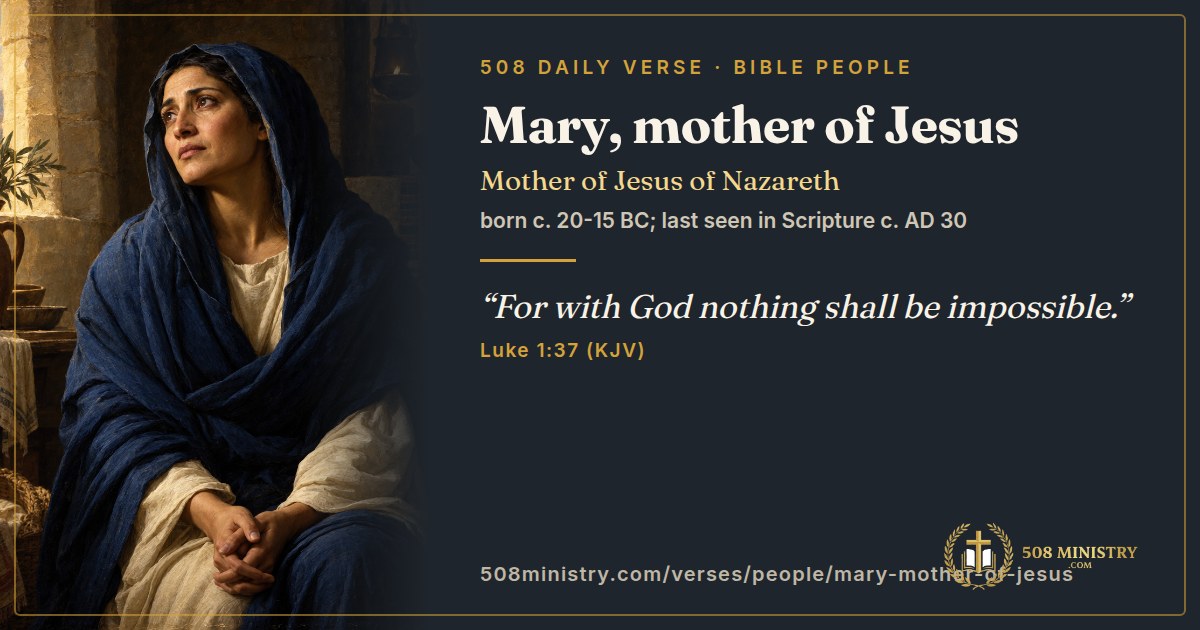

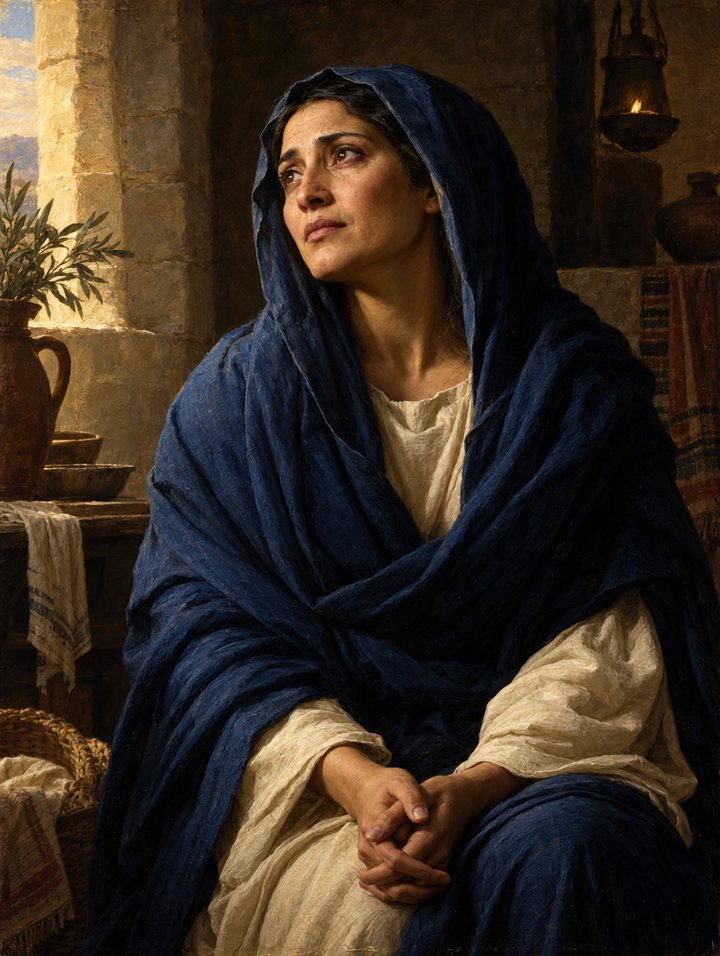
The world Mary was born into
To understand Mary, start with the ground under her feet. She lived in a country that was small, occupied and restless. Rome had taken control of Judea in 63 BC when the general Pompey marched into Jerusalem. A few decades later the Romans put Herod the Great on the throne as their client king. Herod was a skilled builder and a ruthless politician. He rebuilt the Temple in Jerusalem on a grand scale, and he also killed members of his own family when he suspected them of plotting. The Jewish historian Josephus, writing in the first century, records both sides of him in his Antiquities of the Jews.
Galilee, in the north, was farming country. People grew grain, olives and grapes, kept sheep and goats, and fished the lake. Nazareth was a very small place on a hillside. Archaeologists who have worked there describe a village of perhaps a few hundred people, with simple stone houses, cisterns cut into the rock, terraced fields and wine presses. Nearby, about an hour's walk away, the city of Sepphoris was being rebuilt as a regional capital during Mary's lifetime, so the area was not as isolated as it sounds. Work was available for a builder.
Religion shaped every day. Mary would have grown up with the Hebrew Scriptures read aloud, with Sabbath rest from Friday evening to Saturday evening, and with the yearly pilgrim feasts in Jerusalem: Passover, Pentecost and Tabernacles. Most women of her day did not learn to read, but they learned the Psalms and the stories by ear. As we will see, the song she sings in Luke 1 is stitched together from phrases that sound like Hannah's prayer in 1 Samuel 2 and from the Psalms. That tells us the Scriptures lived in her memory.
Marriage customs matter here too. A betrothal was a binding legal agreement, usually made when the girl was in her early teens, and it lasted about a year before the groom took her to his home. A betrothed woman was already called a wife in law. Sexual unfaithfulness during betrothal was treated as adultery. Keep that in mind when we reach the story of Joseph.
What Scripture says about her origins
The Bible does not tell us who Mary's parents were. Matthew gives us Joseph's family line, which runs back through David to Abraham (Matthew 1:1-17). Luke gives a second line (Luke 3:23-38) that many readers take to be Mary's own ancestry, though Luke does not say so. Luke also says that Mary was related to Elizabeth, the wife of the priest Zechariah (Luke 1:36). That would make Mary connected to the priestly tribe on one side of her family, although the word Luke uses can mean any kind of relative.
The names Joachim and Anne, given as Mary's parents, come from a second-century writing called the Protoevangelium of James. This is not part of the Bible, and historians generally date it long after Mary's death. It is the source for many later legends about her childhood, including a story that she was raised in the Temple. We can mention these traditions because they shaped Christian art and feast days, but we should not call them history. Scripture says only that she was a young woman, a virgin, engaged to a man named Joseph.
Chapter one: the announcement
Luke tells the story of the announcement with great care, and he says in his opening lines that he had investigated everything from the beginning (Luke 1:1-4). Some scholars suggest that Luke got these details from women close to Mary. Whatever the source, the scene is quiet. An angel named Gabriel comes to a young woman in Nazareth. He greets her as one who is highly favored. Luke records that she was greatly troubled by his words and wondered what kind of greeting this was (Luke 1:29).
The message is that she will conceive and bear a son, that she is to name him Jesus, and that he will be great and will be given the throne of his ancestor David. Mary's first response is a practical question: how can this be, since she has not been with a man? Notice that she does not simply say yes. She asks. Gabriel answers that the Holy Spirit will come on her and the power of the Most High will overshadow her, and he gives her a sign: her relative Elizabeth, who was thought unable to have children, is six months pregnant. Then comes the line our verse collection preserves: "For with God nothing shall be impossible" (Luke 1:37, KJV).
Mary's reply is the center of the scene: "Behold the handmaid of the Lord; be it unto me according to thy word" (Luke 1:38, KJV). Her word translated "handmaid" is the Greek doule, a female servant. She is not claiming importance. She is accepting a task she cannot fully understand, knowing that it may cost her reputation, her engagement and perhaps her safety. In a village where everyone knew everyone, an unexplained pregnancy would invite gossip at best.
Chapter two: Joseph and the hill country
Matthew tells the same events from Joseph's side. Joseph found out that Mary was pregnant and, being a righteous man who did not want to expose her to public disgrace, planned to end the engagement quietly. Then an angel spoke to him in a dream and told him not to be afraid to take Mary as his wife (Matthew 1:18-25). Joseph did so. You can read more about his part in the story on his own page, Joseph of Nazareth.
Luke says that Mary went "with haste" into the hill country of Judea to visit Elizabeth (Luke 1:39). The tradition places Elizabeth's home at Ein Karem, a village a few miles west of Jerusalem, though the Gospel only says "a city of Judah." The journey from Nazareth is roughly ninety miles, several days on foot. A young woman would not normally have made that trip alone, and Luke does not explain how she traveled.
When Mary greets Elizabeth, the baby in Elizabeth's womb, the future John the Baptist, leaps. Elizabeth, filled with the Holy Spirit, calls Mary "the mother of my Lord" and says, "Blessed is she that believed" (Luke 1:42-45). Mary then speaks the song known since the early centuries as the Magnificat, from its first word in the Latin Bible.
The Magnificat
Read Luke 1:46-55 and you will hear a poem that sounds more like a protest song than a lullaby. Mary says that God has "scattered the proud," "put down the mighty from their seats," "exalted them of low degree," and "filled the hungry with good things" while sending the rich away empty. She is not speaking in the abstract. She belongs to a people under occupation, and she sees the child she carries as the beginning of God's answer to generations of prayer.
The song is full of echoes. Hannah, the mother of the prophet Samuel, prayed in a similar way when she finally had a son (1 Samuel 2:1-10). The Psalms speak of God remembering mercy to Israel. Mary closes by pointing back to the promise made to Abraham and his descendants. In other words, she sees her own story as a small piece of a very old story.
Mary stays about three months with Elizabeth and then goes home (Luke 1:56). Luke does not say whether she stayed until John was born, though the order of his sentences suggests she left just before.
Chapter three: Bethlehem
Luke sets the birth of Jesus in the larger politics of the empire. A census decree went out from Caesar Augustus, and Joseph, because he was of David's house, traveled with Mary from Nazareth to Bethlehem, the town of David, about eighty miles to the south (Luke 2:1-7). Historians still debate the details of the census Luke mentions, including its date and whether people really had to travel to ancestral towns. Some propose that Luke is referring to an enrollment that took place under Quirinius, the Roman governor of Syria. Others suggest that Luke's wording means something slightly different. A careful reader can hold the question open and still take the story seriously.
Mary gave birth to her firstborn son, wrapped him in strips of cloth and laid him in a manger, a feeding trough, because there was no room for them in the guest quarters. Many scholars now think the word usually translated "inn" meant a guest room in a family home, and that the family space was crowded with relatives who had also returned for the census. If that is right, the picture of a hostile innkeeper turning them away is a later embellishment. The manger may have been in the lower part of a house where animals were kept at night.
Shepherds arrived that night, having been told by angels, and Luke notes quietly: "But Mary kept all these things, and pondered them in her heart" (Luke 2:19). That sentence is about as close as the Gospels come to a description of her inner life. She watches, she listens, she turns events over. Luke says it again at the end of the story of the boy Jesus in the Temple (Luke 2:51).
Matthew tells a different part of the story. Wise men from the east followed a star to Jerusalem and then to Bethlehem, where they found "the young child with Mary his mother" and gave him gifts (Matthew 2:11). Herod, hearing of a rival king, ordered the killing of the infants of Bethlehem, and Joseph, warned in a dream, took Mary and the child to Egypt until Herod died (Matthew 2:13-21). Josephus does not mention this event, which is not surprising since he covers many of Herod's crimes only in outline. Matthew also does not say how long the family stayed in Egypt. Afterward they returned and settled in Nazareth.
Chapter four: the Temple and the sword
Forty days after the birth, according to the law in Leviticus 12, Mary and Joseph brought Jesus to Jerusalem. Mary offered the sacrifice of two young pigeons or doves, which was the offering allowed for families who could not afford a lamb (Luke 2:22-24). That detail tells us about the family's finances. They were not destitute, but they were not wealthy.
In the Temple an old man named Simeon, who had been waiting for the consolation of Israel, took the child in his arms and praised God. Then he turned to Mary with words she could not have wanted to hear: "Yea, a sword shall pierce through thy own soul also" (Luke 2:35, KJV). An old widow, the prophet Anna, also came and spoke about the child to all who were looking for redemption.
The next time Mary appears, Jesus is twelve. The family had gone to Jerusalem for Passover, and on the way home Mary and Joseph realized their son was not with the group. After three days they found him in the Temple, sitting among the teachers, listening and asking questions. Mary said, with the exasperation of any parent, "Son, why hast thou thus dealt with us? behold, thy father and I have sought thee sorrowing" (Luke 2:48). His answer, "Wist ye not that I must be about my Father's business?", puzzled them. Luke adds that they did not understand it. Mary, the faithful mother, did not always understand her son. Then he went home to Nazareth and was obedient to them, and "Jesus increased in wisdom and stature, and in favour with God and man" (Luke 2:52). Our collection holds that line as Luke 2:52.
Chapter five: the wedding at Cana
For about eighteen years the Gospels say nothing. Joseph disappears from the record, which leads many to think he died before Jesus began his public work. Mary reappears in John's Gospel at a wedding in Cana, a village in Galilee. Jesus and his disciples were invited as well. The wine ran out, which in that culture would have been a deep embarrassment for the host family.
Mary notices the problem and tells her son, "They have no wine." His reply sounds abrupt to modern ears: "Woman, what have I to do with thee? mine hour is not yet come" (John 2:4). Readers have argued over the tone. "Woman" was a respectful form of address in that period, but the distance in the phrase is real. Jesus is signaling that from now on his calling comes first and that his mission will not be run by family expectations.
Mary does not argue. She turns to the servants and says the sentence that appears in our verse index: "Whatsoever he saith unto you, do it" (John 2:5, KJV). It is the last recorded speech of Mary in the Bible, and it is an instruction to trust her son. Jesus then has the servants fill six stone water jars, each holding twenty to thirty gallons, and what they draw out is wine of better quality than the first. John calls this the first of his signs.
Chapter six: family tension
The Gospels do not hide that Jesus' own family struggled with him. Mark says that when the crowds pressed in so thickly that Jesus and his disciples could not eat, his family "went out to lay hold on him: for they said, He is beside himself" (Mark 3:21). Later Mary and his brothers came to speak with him, and he said, "Who is my mother, or my brethren?" and pointed to the people around him: whoever does the will of God is his brother and sister and mother (Mark 3:31-35).
This passage is easy to misread. Jesus is not rejecting Mary. He is widening the meaning of family, and elsewhere Mary is shown as one of those who hear the word and obey. Luke records a woman in a crowd calling out, "Blessed is the womb that bare thee," and Jesus answering, "Yea rather, blessed are they that hear the word of God, and keep it" (Luke 11:27-28). The answer honors Mary by pointing at what made her great: she heard and kept.
Who were Jesus' "brothers"? Matthew and Mark name James, Joseph, Simon and Judas, and mention sisters (Matthew 13:55-56). Different Christian traditions read this differently. Many Protestants take them as Mary and Joseph's later children. The Orthodox tradition has long held that they were Joseph's children from an earlier marriage, an idea found in the Protoevangelium of James. The Catholic tradition has usually taught that they were cousins or close relatives, with Mary remaining a lifelong virgin. The Greek word adelphos normally means a full or half brother, but the Bible also uses it more broadly. We do not need to settle this to see what the New Testament emphasizes: James later became a leader of the church in Jerusalem, and "Jude" is traditionally the author of the short letter that bears his name. You can read about them on the pages for James and Jude.
Chapter seven: the cross
John, who was an eyewitness at the crucifixion, places Mary at the foot of the cross. "Now there stood by the cross of Jesus his mother, and his mother's sister, Mary the wife of Cleophas, and Mary Magdalene" (John 19:25). Simeon's prophecy of the sword is no longer a distant warning. A mother is watching her son die by Roman execution.
From the cross Jesus sees his mother and the disciple he loved standing nearby and says to her, "Woman, behold thy son!" and to the disciple, "Behold thy mother!" John writes, "And from that hour that disciple took her unto his own home" (John 19:26-27). This was an act of care. A widow, in that culture, depended on her sons. Jesus, even in agony, made sure his mother would be looked after. Most readers identify the disciple as John, the son of Zebedee, and many early Christians believed Mary lived with him afterward. Her other sons, as the Gospels suggest, were not yet believers (John 7:5).
Chapter eight: the upper room
After the resurrection, Acts 1:14 gives the last appearance of Mary in the New Testament. The eleven apostles were gathered in Jerusalem in an upper room, "with the women, and Mary the mother of Jesus, and with his brethren," and they were praying together. Notice who is there: Jesus' brothers, who once thought he was out of his mind, are now in the room. Something had changed them. Paul tells us that the risen Jesus appeared to James (1 Corinthians 15:7), and that may be part of the explanation.
Mary then disappears from the text. She is not mentioned in the letters of Paul or in the other writings of the New Testament, except for a brief and indirect reference in Galatians 4:4, where Paul says God sent his Son "made of a woman." The book of Revelation describes a woman clothed with the sun in chapter 12. Many Christians have read that vision as a symbol of Israel, or the church, or Mary herself. Scholars still discuss it, and readers should know that the text does not name her.
What happened to Mary afterward
We do not know how or where Mary died. The earliest Christian writers say nothing definite. By the fifth and sixth centuries, several traditions had developed. One says she died in Jerusalem, at a place now called the Church of the Dormition on Mount Zion. Another says she moved to Ephesus with the apostle John, and a house outside the city is venerated today. The belief in her Assumption into heaven is held by the Catholic and Orthodox churches and was defined as a dogma in the Catholic Church in 1950. Protestants do not hold this belief, because it has no basis in the New Testament.
The church historian Eusebius, in the fourth century, wrote the first great history of the church and drew heavily on earlier sources. You can read his Church History online. He mentions the family of Jesus and their descendants, but he gives no account of Mary's death. This silence is a reminder to be honest about what sources tell us. Anything about her later life beyond Acts 1 rests on tradition, and different churches weigh that tradition differently.
How Christians have understood Mary
By the year 431, at the Council of Ephesus, the church formally gave Mary the title Theotokos, a Greek word meaning "God-bearer." The title was less about Mary than about Jesus: the council wanted to say that the child she carried was truly God and truly human from the beginning. In the Orthodox and Catholic churches, Mary has been honored since early centuries with prayers, feast days and icons. Catholic and Orthodox Christians ask for her prayers, and they distinguish this from the worship that belongs to God alone. Protestant churches have generally honored her as a model of faith but do not pray to her, and they stress that the Bible presents her as a recipient of grace and not a source of it.
Islam also holds Mary in high regard. She is the only woman named in the Quran, and an entire chapter (Surah 19) is named after her. Many Muslims and Christians in the Middle East have long shared respect for her, a connection that has sometimes opened doors for friendship.
Whatever your tradition, her story contains a quiet challenge. She was a young woman with no power, no money and no platform, living in a village that no one outside Galilee would have noticed. She received a call that could have ruined her life, asked an honest question, then said yes. She followed her son from the stable to the cross, and she was in the room when the church was born.
The ripple effect
Mary's influence on art and culture is almost impossible to measure. The earliest known picture of Mary with the child is in the Roman catacomb of Priscilla, painted in the second or third century. By the Middle Ages, cathedrals across Europe were dedicated to her: Notre-Dame in Paris, Chartres, and hundreds more. Composers from Josquin to Bach to Schubert set the Magnificat and the Ave Maria. Painters from Giotto to Raphael to Rembrandt returned to her again and again. Hospitals and orphanages in many nations carry her name.
In the modern era, her pattern of humble obedience has shaped churches in every continent. Communities of women religious have served the sick and poor in her name for centuries. And ordinary mothers, whatever their beliefs, have recognized something familiar in a woman who "kept all these things, and pondered them in her heart."
Mary's words in our verse collection
The Bible records only a handful of Mary's spoken words. Two are in our daily verse collection:
- Luke 1:37, spoken by the angel to her: "For with God nothing shall be impossible."
- John 2:5, spoken by Mary: "Whatsoever he saith unto you, do it."
You can also read her full song in Luke 1:46-55 and her words to Jesus in Luke 2:48.
Sayings in our verse index
Places
- 1Nazareth · Her home village; the announcement
- 2Ein Karem (traditional) · Elizabeth's home in the hill country of Judea
- 3Bethlehem · Birth of Jesus
- 4Jerusalem · Temple, cross, upper room
- 5Cana · Wedding where Jesus performed his first sign
- 6Ephesus · Eastern tradition of her later life with John
- Nazareth: Mary's home village in Galilee, where the announcement took place.
- Ein Karem / hill country of Judea: where Elizabeth lived and where Mary visited her.
- Bethlehem: the birthplace of Jesus.
- Jerusalem: the Temple, where Jesus was presented and later found as a boy; also the site of the cross and the upper room.
- Cana: the village where Jesus performed his first sign.
- Ephesus: where one tradition says Mary lived with John.
Timeline
- -6The announcement in Nazareth and visit to ElizabethLuke 1:26-56
- -5Birth of Jesus in BethlehemLuke 2:1-20
- -4Presentation in the Temple; flight to EgyptLuke 2:22-38; Matthew 2:13-15
- 8Jesus at twelve in the TempleLuke 2:41-52
- 27Wedding at CanaJohn 2:1-11
- 30At the cross and in the upper roomJohn 19:25-27; Acts 1:14
- 431Council of Ephesus names her TheotokosCouncil of Ephesus
- About 20 to 15 BC: Mary born, probably in Galilee.
- About 6 to 5 BC: the announcement in Nazareth; the visit to Elizabeth; the birth in Bethlehem.
- About 5 to 4 BC: the presentation in the Temple; the flight to Egypt; the return to Nazareth.
- About AD 8: Jesus at twelve in the Temple.
- About AD 27: the wedding at Cana.
- About AD 30: the cross and the upper room.
- 431: the Council of Ephesus names her Theotokos.
People in this story
 Jesus of NazarethTeacher, healer, and the Christ
 John the BaptistProphet who prepared the way for JesusJohnApostle, beloved disciple, and witness to the Word
 Mary MagdaleneFollower of Jesus and first witness of the resurrectionJamesBrother of Jesus and leader of the Jerusalem churchJudeBrother of Jesus and writer of a short letter of warning
Watch
Go deeper
Start with the primary sources: read Luke 1 and 2 in one sitting, then Matthew 1 and 2, then John 2 and John 19. After that, read the Catholic Encyclopedia's article on the Blessed Virgin Mary for the Catholic perspective, and compare it with the Protestant and Orthodox sections of the references below. Alfred Edersheim's Life and Times of Jesus the Messiah describes the setting in detail. Philip Schaff's History of the Christian Church tells how devotion to Mary grew. The BibleProject video on Luke 1 and 2 is also helpful. Check each source, compare them, and think about what each one is claiming and why.
References and further reading
- Wikipedia: Mary, mother of Jesus
- Catholic Encyclopedia: The Blessed Virgin Mary
- eBible.org: Luke 1
- eBible.org: Luke 1
- Blue Letter Bible: Luke 1:26
- Eusebius, Church History (New Advent)
- Edersheim, The Life and Times of Jesus the Messiah (CCEL)
- Schaff, History of the Christian Church, vol. 2 (CCEL)
Public-domain books, free to read
- Antiquities of the JewsFlavius Josephus
- The Life and Times of Jesus the MessiahAlfred Edersheim
- Church HistoryEusebius of Caesarea
- Ante-Nicene Fathers, vol. 8Various, ed. Roberts and Donaldson
Written by 508 Ministry. Scripture links open the public-domain World English Bible. Where Scripture, early church tradition and historians differ, this page says so.