

What we know, and what we do not
Joseph is mentioned by name in only a handful of chapters. Matthew gives him four scenes. Luke gives him a few lines at the birth and at the Temple. John records that others called Jesus "the son of Joseph" (John 1:45, 6:42). Mark, the earliest Gospel, does not name him at all, and calls Jesus "the carpenter, the son of Mary" (Mark 6:3). That unusual phrase has led some scholars to think Joseph was already dead by the time Jesus began to teach, since a man was usually identified by his father.
Everything beyond this comes from later writings. The most influential is the Protoevangelium of James from the second century, which describes Joseph as an older widower with sons from an earlier marriage. Another is the History of Joseph the Carpenter, a work probably written several centuries later that describes his death at age 111. These are interesting for the history of Christian devotion, but they are not eyewitness accounts, and they should not be mixed up with what Scripture says. When this page speaks of tradition, it will say so.
The world Joseph lived in
Joseph was born into a country where almost everyone worked with their hands and almost no one had spare money. Rome ruled Judea through client kings and governors. Herod the Great, the king who ruled when Jesus was born, taxed heavily and spent a fortune on building projects, including the rebuilding of the Temple in Jerusalem. After Herod died in 4 BC, his kingdom was divided among his sons. Archelaus took Judea and Samaria and was so brutal that Rome removed him around AD 6. Herod Antipas ruled Galilee, and it was under Antipas that Jesus would grow up and later teach.
Josephus, the first-century Jewish historian, describes this period in Antiquities of the Jews. He writes about riots in Jerusalem after Herod's death, about a Galilean uprising led by a man named Judas around the time of the Roman census, and about the rebuilding of Sepphoris. Sepphoris sat only about four miles from Nazareth. It had been burned during the unrest after Herod's death, and Antipas rebuilt it as his capital. A skilled builder living nearby would have found work there. This is a reasonable inference, not a stated fact, since the Gospels never say where Joseph worked.
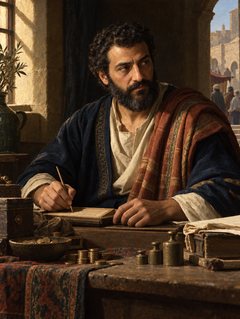
The word translated "carpenter" is tekton. In ordinary Greek it means a craftsman who works with hard materials. In a village like Nazareth, where wood was scarce, such a man probably worked with both timber and stone: roofing beams, doors, plows, yokes, tools, and the walls of houses. It was honest, skilled work, and it did not make anyone rich. When his neighbors in Nazareth later called Jesus "the carpenter's son," they were placing him as someone ordinary.
Joseph's family and ancestry
Matthew opens his Gospel with a genealogy that runs from Abraham through David to "Jacob begat Joseph the husband of Mary, of whom was born Jesus, who is called Christ" (Matthew 1:16). Luke gives a different list, going backward from Jesus to Adam, and calls Jesus "the son (as was supposed) of Joseph, which was the son of Heli" (Luke 3:23). The two lists disagree about Joseph's father: Matthew says Jacob, Luke says Heli. Christian writers have offered several explanations. One is that Matthew traces the legal line and Luke the biological one. Another is that Luke traces Mary's family, with Joseph counted as Heli's son-in-law. A third is that the lists reflect a levirate marriage, in which a man marries his brother's widow to continue the family line. The African writer Julius Africanus, around AD 220, proposed this third view, and Eusebius preserves his discussion in his Church History.
Whatever the explanation, both Gospels say the same thing about the point that mattered: Joseph came from David's line. That meant Jesus, as Joseph's legal son, inherited the royal claim. Many Jews at the time hoped for a descendant of David who would restore the kingdom, and Matthew is writing to show that the man they were waiting for had arrived.
Chapter one: the dilemma
Matthew introduces Joseph at the worst moment of his life. He and Mary were engaged, which in that culture was a legal bond that required a formal divorce to dissolve. Before they lived together, Mary was found to be pregnant. Joseph knew the child was not his.
Matthew describes his reaction in a single sentence: "Then Joseph her husband, being a just man, and not willing to make her a publick example, was minded to put her away privily" (Matthew 1:19, KJV). The word "just" tells us he was devoted to the Law of Moses. That Law allowed him to have Mary publicly shamed, and in a severe reading it could have meant stoning. Joseph chose the gentler path. He planned to issue the divorce papers quietly, in front of two witnesses, and spare her humiliation.
Pause on that decision. Joseph had every right to be angry. He chose mercy before he knew the whole story. That is the first thing the Bible tells us about his character.
Then, while he was thinking about this, "behold, the angel of the Lord appeared unto him in a dream, saying, Joseph, thou son of David, fear not to take unto thee Mary thy wife: for that which is conceived in her is of the Holy Ghost" (Matthew 1:20). The angel told him to name the child Jesus, a Greek form of Joshua, meaning "the Lord saves." Naming the child was an act of legal fatherhood. By giving him the name, Joseph accepted him as his own. Matthew adds, "Then Joseph being raised from sleep did as the angel of the Lord had bidden him, and took unto him his wife" (Matthew 1:24). Obedience came right away, with no recorded argument.
Joseph did not live with Mary as a husband until after Jesus was born (Matthew 1:25). That detail matters to the early Christian claim that Jesus' conception was not through Joseph.
Chapter two: Bethlehem
Luke does not mention Joseph's dream, but he tells us what happened next. When the emperor Augustus ordered a census, Joseph took Mary from Nazareth to Bethlehem "because he was of the house and lineage of David" (Luke 2:4). The journey was about eighty miles. Mary was close to giving birth. Joseph would have been responsible for finding food, shelter and safety on the road.
In Bethlehem, there was no room for them in the guest area, and Jesus was born and laid in a manger (Luke 2:7). Joseph was there. Luke's account is mostly about Mary and the shepherds, but Joseph is part of the scene: the shepherds "found Mary, and Joseph, and the babe lying in a manger" (Luke 2:16). On the eighth day the child was circumcised and named Jesus, as the angel had said (Luke 2:21). Joseph, as the legal father, gave the name.
When Jesus was about six weeks old, Joseph and Mary took him to the Temple in Jerusalem to offer the sacrifice required of new mothers. Their offering, "a pair of turtledoves, or two young pigeons" (Luke 2:24), was the one permitted to people too poor to afford a lamb. Luke says that Joseph and Mary "marvelled at those things which were spoken of him" by Simeon and Anna (Luke 2:33). Joseph, like Mary, was still learning who this child was.
Chapter three: the flight to Egypt
Matthew then describes a very different scene. Wise men from the east came to Jerusalem looking for the child born king of the Jews. Herod, who had been king for over thirty years and who feared rivals, asked them to report back when they found him. After they found Jesus in Bethlehem and worshiped him, they were warned in a dream not to return to Herod.
The angel appeared to Joseph in a second dream: "Arise, and take the young child and his mother, and flee into Egypt, and be thou there until I bring thee word: for Herod will seek the young child to destroy him" (Matthew 2:13). Joseph got up in the night and left. There was no debate and no waiting for morning. A carpenter with a wife and a toddler became a refugee.
Egypt was the logical place. It was outside Herod's reach, and a large Jewish community lived there, especially in Alexandria. The Gospel does not say where the family settled or how Joseph supported them, but a skilled craftsman could likely find work. Herod then ordered the killing of the boys in Bethlehem aged two and under (Matthew 2:16). Josephus does not record this event, though he describes Herod's other murders in some detail, including the killing of his own sons. Historians differ about how to read this silence. Bethlehem was a small village, and the number killed may have been small.
Herod died in 4 BC. Matthew says that the angel appeared in a third dream, telling Joseph to return to the land of Israel (Matthew 2:19-20). Joseph set out, but when he heard that Archelaus ruled Judea in his father's place, he was afraid to go there. A fourth dream directed him to Galilee, and the family settled in Nazareth (Matthew 2:22-23). This time Joseph chose a quiet village in a district ruled by a different son, Herod Antipas.
Look at the pattern. Four dreams, four obedient actions: take Mary as wife, flee to Egypt, return, settle in Galilee. Each time Joseph acted at once. Each time his action was a risk that might have looked foolish to his neighbors. Joseph's whole story is a lesson in listening and then doing.
Chapter four: Passover when Jesus was twelve
Luke gives one more scene with Joseph, and it is the last in the Bible. Every year Joseph and Mary went to Jerusalem for Passover, a journey of several days each way. When Jesus was twelve, the family traveled in a large caravan of relatives and neighbors. On the way home, Joseph and Mary assumed Jesus was with the group, and a full day passed before they realized he was missing. They went back to Jerusalem and searched for three days.
When they finally found him in the Temple, talking with the teachers, Mary spoke for both of them: "Son, why hast thou thus dealt with us? behold, thy father and I have sought thee sorrowing" (Luke 2:48). Notice that she calls Joseph "thy father." Jesus replied, "How is it that ye sought me? wist ye not that I must be about my Father's business?" (Luke 2:49). This is the first recorded saying of Jesus, and it quietly corrects the word: he has a Father above Joseph. Luke notes that his parents "understood not the saying which he spake unto them" (Luke 2:50).
Then comes the line that tells us how Joseph did his job: Jesus "went down with them, and came to Nazareth, and was subject unto them" (Luke 2:51). The son of God accepted Joseph's authority in his home.
The silent years
After this scene Joseph vanishes from the text. Jesus begins his public work around age thirty, and Luke says he was "as was supposed the son of Joseph" (Luke 3:23). At the wedding in Cana (John 2), Mary is present but Joseph is not mentioned. At the cross, Jesus entrusts Mary to the apostle John (John 19:26-27), which makes the most sense if Joseph was no longer alive. Early Christian tradition agrees, saying that Joseph died before Jesus began his ministry. The evidence is circumstantial, and we cannot be certain.
What did Joseph teach his son? The Gospels never say. But they do show Jesus using images that came from a working family: yokes that are easy, houses built on rock or sand, a plank in the eye, wineskins, mustard seeds. Jesus was known in Nazareth as "the carpenter" (Mark 6:3), and when he returned there to teach, people were scandalized: "Is not this the carpenter's son?" (Matthew 13:55). They knew his family. That fact is a quiet witness to Joseph's life: for thirty years, Jesus was an ordinary man in an ordinary village, and no one noticed anything unusual.
Relationships
Joseph's family connects him to many people on this site. His wife Mary is the best known. Mary's relative Elizabeth was the mother of John the Baptist. The "brothers" of Jesus named in Matthew 13:55, James, Joseph, Simon and Judas, are discussed on Mary's page, and James and Jude became leaders in the early church. Matthew and Luke are the two writers who tell us the most about Joseph. David, his famous ancestor, appears on his own page.
Read their stories
 Mary, mother of JesusMother of Jesus and follower
 Jesus of NazarethTeacher, healer, and the Christ
 John the BaptistProphet who prepared the way for JesusDavidKing of Israel, psalmist, and ancestor of the Messiah
 MatthewApostle, former tax collector, and Gospel writerLukePhysician, companion of Paul, and historian of the early churchJamesBrother of Jesus and leader of the Jerusalem churchJudeBrother of Jesus and writer of a short letter of warning
How Christians have remembered Joseph
For the first few centuries, Joseph received little attention. Devotion to him grew slowly. By the Middle Ages, writers such as Bernard of Clairvaux and later Jean Gerson praised him, and in the 1400s his feast on March 19 spread across Western Europe. The Catholic Church declared him patron of the universal church in 1870, and Pope Pius XII added a second feast, St. Joseph the Worker, on May 1, in 1955. You can read a detailed Catholic summary of the tradition in the Catholic Encyclopedia. In the Orthodox churches, Joseph is commemorated on the Sunday after Christmas. Protestant churches do not have a feast for him, but many preach about him at Christmas.
In art, Joseph is usually shown as a quiet figure beside Mary and the child: Giotto, Rembrandt and Georges de La Tour all painted him. De La Tour's candlelit pictures of Joseph the carpenter with the boy Jesus holding a light are among the most beloved in the genre.
Many people find in Joseph a model of the kind of faith that does not draw attention. He is a man who did the right thing when it was costly, who kept his word, and who raised a child that was not biologically his. For adoptive fathers, stepfathers and anyone who has stepped into a family and taken responsibility, Joseph is a patron in a very real sense.
The ripple effect
The practical effect of Joseph's choices is hard to overstate. If he had divorced Mary quietly and walked away, her child would have grown up in disgrace. If he had stayed in Bethlehem after the visit of the wise men, Herod's soldiers would have found them. If he had returned to Judea under Archelaus, he would have walked into danger. Each decision protected the life of Jesus. Without Joseph's choices, there would be no Sermon on the Mount, no cross, no resurrection and no church. That does not make Joseph the hero of the story, since Matthew and Luke are clear that God is the one acting. But Joseph's ordinary obedience was one of the means God used.
His trade has also left a mark. Christian communities of craftsmen, such as guilds of carpenters in medieval Europe, took Joseph as their patron. Today he is invoked by fathers, workers, immigrants and those who seek a home. Schools, hospitals, orphanages and religious orders have carried his name for centuries.
Joseph's words
The Gospels do not record a single sentence spoken by Joseph. This silence has itself become part of his portrait. Our verse collection contains no sayings by him. The nearest we can come is to read the words spoken to him, such as the angel's greeting, "Joseph, thou son of David, fear not" (Matthew 1:20), and the words said about him: "a just man" (Matthew 1:19). You can read the whole account in Matthew 1 and Matthew 2.
Places
- 1Bethlehem · Family town; birth of Jesus
- 2Jerusalem · Temple presentation; Passover visit
- 3Egypt (region, Nile delta) · Refuge from Herod; exact place not recorded
- 4Nazareth · Home and workshop
- 5Sepphoris · City rebuilt by Herod Antipas near Nazareth
- Bethlehem: the town of David, where Joseph's family was registered and Jesus was born.
- Jerusalem: the Temple, where Jesus was presented and where he was found at age twelve.
- Egypt: where the family fled from Herod.
- Nazareth: the village in Galilee where Joseph worked and raised Jesus.
- Sepphoris: the nearby city rebuilt by Herod Antipas, where a builder might have found work.
Timeline
- -6Dream; marriage to MaryMatthew 1:18-25
- -5Journey to Bethlehem; birth of JesusLuke 2:1-7
- -4Flight to EgyptMatthew 2:13-15
- -4Return and settlement in NazarethMatthew 2:19-23
- 8Passover visit when Jesus was twelveLuke 2:41-52
- About 25 to 20 BC: Joseph probably born (not recorded).
- About 6 to 5 BC: the dream, the marriage, the journey to Bethlehem, the birth.
- About 5 to 4 BC: the presentation in the Temple; the visit of the wise men; the flight to Egypt.
- 4 BC: Herod dies; the family returns and settles in Nazareth.
- About AD 8: the Passover visit when Jesus was twelve.
- Before AD 27: Joseph's death, according to the evidence of the Gospels and tradition.
Watch
Go deeper
Read the Gospels first. Then see how scholars and early Christians have worked with the gaps. Alfred Edersheim's Life and Times of Jesus the Messiah describes the family and village life in detail. The Ante-Nicene Fathers, volume 8 includes early apocryphal writings. They show how quickly people began to fill in the gaps. Compare them with the sober account in Matthew and Luke, and ask what each adds and what it leaves out. The BibleProject video on Matthew is a good place to see how Matthew shapes his story around Joseph's dreams.
References and further reading
- Wikipedia: Joseph (father of Jesus)
- Catholic Encyclopedia: St. Joseph
- eBible.org: Matthew 1-2
- eBible.org: Matthew 1
- Josephus, Antiquities of the Jews (Project Gutenberg)
- Eusebius, Church History (New Advent)
- Edersheim, The Life and Times of Jesus the Messiah (CCEL)
- Ante-Nicene Fathers, vol. 8 (CCEL)
Public-domain books, free to read
- Antiquities of the JewsFlavius Josephus
- The Life and Times of Jesus the MessiahAlfred Edersheim
- Church HistoryEusebius of Caesarea
- Ante-Nicene Fathers, vol. 8Various, ed. Roberts and Donaldson
Written by 508 Ministry. Scripture links open the public-domain World English Bible. Where Scripture, early church tradition and historians differ, this page says so.