

The world John was born into
John was born to a priestly family in a country that felt abandoned by God. The prophets had gone quiet. Many Jews believed that no prophet had spoken since Malachi, some four centuries earlier, and they were waiting. Rome ruled the land through the cruel Herod the Great and then, after his death in 4 BC, through his sons and Roman governors. Taxes were heavy. Political and religious groups disagreed about what faithfulness required. The Sadducees controlled the Temple, the Pharisees emphasized the law and its interpretation, the Essenes withdrew to the desert, and the Zealots wanted to fight Rome.
Josephus describes this world in Antiquities of the Jews. He lists the movements of the day and mentions a number of popular leaders who gathered followers in the wilderness. In that setting a prophet who lived on the edge of the desert and demanded repentance would draw attention. And the idea of the wilderness meant something. Israel had become a nation in the desert under Moses. Many hoped that God would meet them there again. The prophet Isaiah had spoken of "the voice of him that crieth in the wilderness, Prepare ye the way of the LORD" (Isaiah 40:3), a verse all four Gospels apply to John.
The birth of John
Luke begins his Gospel with John. He tells us that in the days of Herod, king of Judea, there was a priest named Zechariah of the division of Abijah. His wife Elizabeth was also from a priestly family. They were both "righteous before God, walking in all the commandments and ordinances of the Lord blameless," but "they had no child, because that Elizabeth was barren, and they both were now well stricken in years" (Luke 1:5-7).
There were thousands of priests in Judea, and they served in the Temple in rotating shifts of a week or so, twice a year. Zechariah was chosen by lot to burn incense in the sanctuary, an honor that might come only once in a priest's life. While he was alone inside, with the crowd praying outside, the angel Gabriel appeared and said, "Fear not, Zacharias: for thy prayer is heard; and thy wife Elisabeth shall bear thee a son, and thou shalt call his name John" (Luke 1:13).
The angel's description of the boy sounds like an old prophet. He would be great in the sight of the Lord. He would drink no wine or strong drink, which marks a special consecration, and he would be filled with the Holy Spirit from birth. He would turn many in Israel back to God, and he would go before the Lord "in the spirit and power of Elias" (Luke 1:17), the Greek form of Elijah. That echoes the last verses of the Old Testament: "Behold, I will send you Elijah the prophet before the coming of the great and dreadful day of the LORD" (Malachi 4:5). See the page for Malachi for more on that promise.
Zechariah doubted. He asked how he could know, since he and his wife were old. Gabriel replied that because Zechariah had not believed, he would be unable to speak until the child was born. When he came out to the waiting people, he could not give the priestly blessing. They realized that he had seen a vision.
Elizabeth became pregnant and hid herself for five months. In the sixth month, Gabriel was sent to Nazareth to speak to Mary, who was related to Elizabeth. Mary went to visit, and when she greeted Elizabeth, "the babe leaped in her womb; and Elisabeth was filled with the Holy Ghost" (Luke 1:41). Luke is already telling us how John's life will go: even before birth he pointed to Jesus.
On the eighth day, the neighbors gathered for the circumcision and expected the baby to be named after his father. Elizabeth said, "Not so; but he shall be called John." They objected, since no relative had that name. They turned to Zechariah, who wrote on a tablet, "His name is John." At once his mouth was opened, and he spoke. His song, the Benedictus (Luke 1:68-79), praises God for visiting his people and ends with a promise about his son: "And thou, child, shalt be called the prophet of the Highest: for thou shalt go before the face of the Lord to prepare his ways."
Luke sums up the next thirty years in a single sentence: "And the child grew, and waxed strong in spirit, and was in the deserts till the day of his shewing unto Israel" (Luke 1:80).
The wilderness years
Where was John during those years? The Gospel does not say beyond "the deserts." Some scholars wonder whether he lived for a time near the Essene community at Qumran, on the northwest shore of the Dead Sea. The Essenes taught about the end of the age, practiced ritual washing, and used Isaiah 40:3 to describe their own mission. There are real similarities. But John is not mentioned in the Dead Sea Scrolls, and his message differs from theirs in important ways: John went public, invited ordinary people, and did not require withdrawal or membership. If he had contact with them, it did not define him. We should say that this is a reasonable theory and not a known fact.
Chapter one: the voice at the Jordan
In the fifteenth year of Emperor Tiberius, which most scholars date to about AD 28 or 29, Luke says "the word of God came unto John the son of Zacharias in the wilderness" (Luke 3:1-2). Luke names the rulers of the day, Pontius Pilate, Herod Antipas, Philip, Annas and Caiaphas. He is anchoring this story in real history.
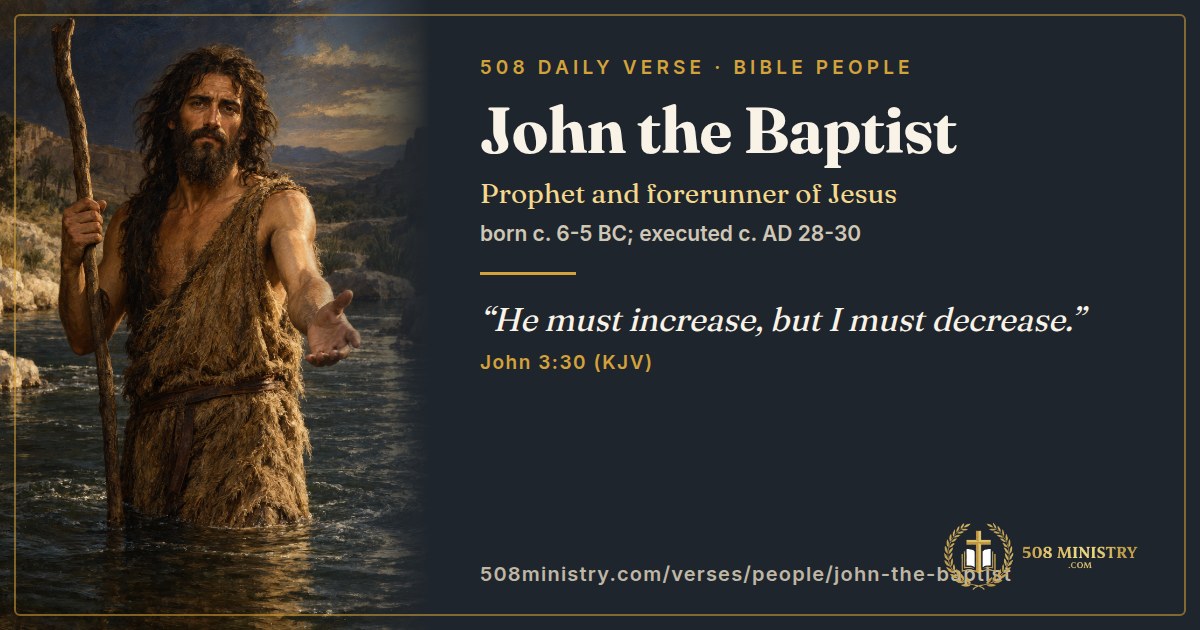
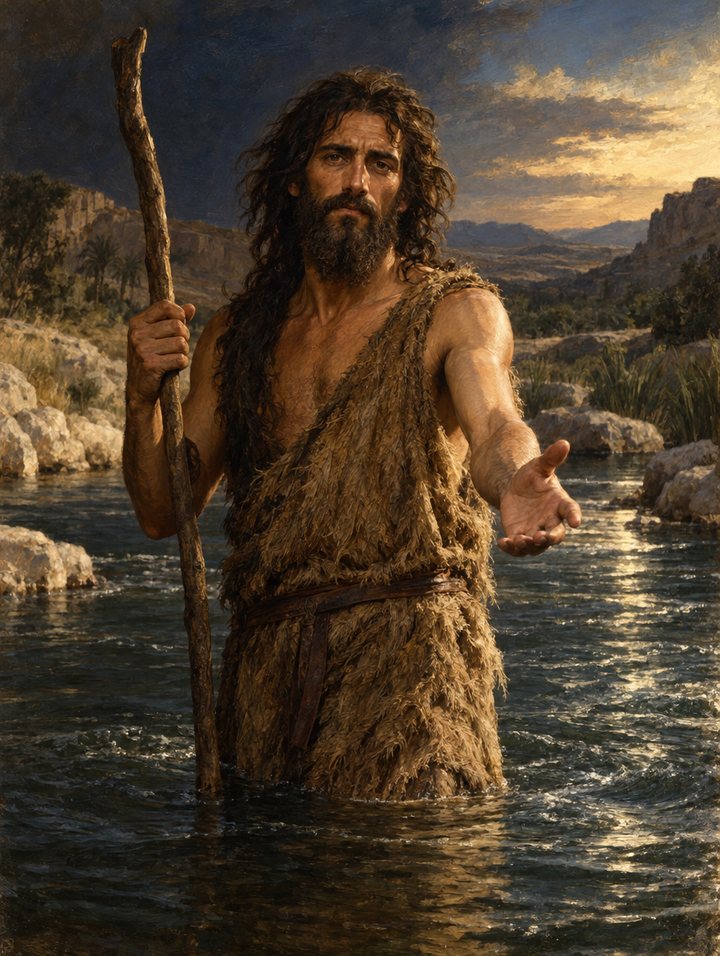
John appeared in the region of the Jordan River, preaching "the baptism of repentance for the remission of sins" (Luke 3:3). Matthew and Mark describe his clothing: "a garment of camel's hair, and a leathern girdle about his loins; and his meat was locusts and wild honey" (Matthew 3:4). His appearance recalled the prophet Elijah, who wore a hairy garment and a leather belt (2 Kings 1:8). Locusts were a permitted food under the law in Leviticus 11, and wild honey was gathered from rock crevices. This was simple food for a man who owned nothing.
Crowds came: "Then went out to him Jerusalem, and all Judaea, and all the region round about Jordan, and were baptized of him in Jordan, confessing their sins" (Matthew 3:5-6). Baptism itself was not new. Jewish people washed ritually for purity, and converts from other nations immersed as part of joining Israel. What was new was John's use of it: he told people who were already Jews that they needed to be washed and to start again. Nobody was exempt just because Abraham was their ancestor. He told the religious leaders who came, "O generation of vipers, who hath warned you to flee from the wrath to come?... think not to say within yourselves, We have Abraham to our father: for I say unto you, that God is able of these stones to raise up children unto Abraham" (Matthew 3:7-9).
What John told the crowds
Luke records the practical teaching that Matthew leaves out. When the crowds asked, "What shall we do then?" John answered, "He that hath two coats, let him impart to him that hath none; and he that hath meat, let him do likewise" (Luke 3:10-11). To tax collectors he said, "Exact no more than that which is appointed you." To soldiers he said, "Do violence to no man, neither accuse any falsely; and be content with your wages" (Luke 3:12-14).
Notice that he did not tell tax collectors to quit their jobs or soldiers to desert. He asked them to do their work honestly. John's repentance was practical. It showed up in how people shared food, handled money and used power.
Then he spoke about someone coming after him: "I indeed baptize you with water unto repentance: but he that cometh after me is mightier than I, whose shoes I am not worthy to bear: he shall baptize you with the Holy Ghost, and with fire" (Matthew 3:11). The language of the sandal is striking. Removing a master's sandals was a task so humble that Jewish teachers said a student should not be forced to do it. John says he is not worthy even of that.
Chapter two: the baptism of Jesus
One day Jesus came from Galilee to the Jordan to be baptized by John. Matthew records that John tried to stop him: "I have need to be baptized of thee, and comest thou to me?" Jesus answered, "Suffer it to be so now: for thus it becometh us to fulfil all righteousness" (Matthew 3:14-15). John agreed. As Jesus came up from the water, the heavens opened, the Spirit of God descended like a dove, and a voice said, "This is my beloved Son, in whom I am well pleased" (Matthew 3:16-17).
Why was Jesus baptized? Christians give different answers. Many say he was identifying himself with the people he came to save, taking his place beside sinners. Others say it was the moment of his public anointing. The Gospels agree on the main point: this scene starts his public ministry. Read it in Matthew 3.
The Gospel of John adds John the Baptist's own testimony. The next day, seeing Jesus coming toward him, John said, "Behold the Lamb of God, which taketh away the sin of the world!" (John 1:29). He said he had not known who Jesus was, but that the one who sent him to baptize told him: "Upon whom thou shalt see the Spirit descending, and remaining on him, the same is he which baptizeth with the Holy Ghost" (John 1:33). John then sent two of his own disciples to follow Jesus, and one of them was Andrew, who brought his brother Simon Peter. That is how the first followers of Jesus came to him: through John. See the detail in John 1:19-42.
"He must increase, but I must decrease"
For a while both men baptized at the same time, John at Aenon near Salim and Jesus in Judea. Some of John's disciples became anxious. They came to him and said, "Rabbi, he that was with thee beyond Jordan, to whom thou barest witness, behold, the same baptizeth, and all men come to him" (John 3:26). It was a very human reaction. Their teacher's crowds were shrinking.
John's answer is one of the most admired speeches in the Bible. He compares himself to the friend of the bridegroom, who stands and listens and rejoices at the bridegroom's voice. "This my joy therefore is fulfilled. He must increase, but I must decrease" (John 3:29-30). That last line is in our daily verse collection as John 3:30.
It is hard to find a more graceful way to give up the spotlight. John had a movement. He gave it away. Many Christians have used his sentence as a prayer for their own work, especially people in ministry who struggle with pride.
Chapter three: prison
John did not hold back from confronting the powerful. Herod Antipas, the ruler of Galilee and Perea, had married Herodias, who was the wife of his half-brother Philip. The marriage broke Jewish law, and John said so publicly. Luke records that he rebuked Herod "for all the evils which Herod had done" (Luke 3:19-20). Herod arrested John and put him in prison.
Josephus confirms this account of John's imprisonment and gives the location: the fortress of Machaerus, east of the Dead Sea. In Antiquities of the Jews, Josephus writes that Herod feared John's influence over the people, thinking that his eloquence might lead to an uprising, and had him killed. Josephus calls John "a good man" who urged the Jews to practice virtue, justice and piety and to come together in baptism. His explanation of the motive differs from the Gospel account, which stresses John's rebuke of Herod's marriage, but the two can be read together: political fear and personal anger both worked against John.
Mark adds a telling detail: Herod "feared John, knowing that he was a just man and an holy, and observed him; and when he heard him, he did many things, and heard him gladly" (Mark 6:20). The tyrant kept the prophet alive partly because he was fascinated by him.
The question from prison
In prison, John had doubts. Matthew records that John sent his disciples to ask Jesus, "Art thou he that should come, or do we look for another?" (Matthew 11:3). It is a startling question from a man who had pointed to Jesus as the Lamb of God. Some readers think John was asking for the sake of his disciples. Others think that he was honestly struggling. Jesus was not the kind of Messiah John had expected. John had preached about an axe at the root of the trees and a fire that would burn the chaff. Jesus was healing the sick and eating with sinners. And meanwhile John sat in a cell.
Jesus did not scold him. He told the messengers, "Go and shew John again those things which ye do hear and see: The blind receive their sight, and the lame walk, the lepers are cleansed, and the deaf hear, the dead are raised up, and the poor have the gospel preached to them. And blessed is he, whosoever shall not be offended in me" (Matthew 11:4-6). He was quoting phrases from the book of Isaiah. Then, after John's disciples left, Jesus turned to the crowd and said of John, "Among them that are born of women there hath not risen a greater than John the Baptist" (Matthew 11:11). That is the highest compliment Jesus ever paid a person. Notice the order: he praised John after the moment of doubt, not before.
Chapter four: the death of John
Mark tells the story of John's death in detail (Mark 6:17-29). On Herod's birthday, he held a banquet for his officials and leading men of Galilee. Herodias's daughter danced, and Herod, pleased, promised with an oath to give her whatever she asked, up to half his kingdom. The girl consulted her mother, who said, "The head of John the Baptist." She returned at once to the king and asked for the head on a platter. Mark says the king was "exceeding sorry," but because of his oath and his guests, he refused to go back on his word. He sent an executioner, who beheaded John in the prison and brought the head on a platter. John's disciples came and took his body and laid it in a tomb.
Josephus names Herodias's daughter as Salome, though the Gospels do not give her name. He also reports that some Jews believed the defeat of Herod's army by the Nabatean king Aretas, whose daughter Herod had divorced to marry Herodias, was divine punishment for killing John. That happened around AD 36.
When Jesus heard the news, "he departed thence by ship into a desert place apart" (Matthew 14:13). Even Jesus needed time to grieve.
John's disciples and his later legacy
John's death did not end his movement. Acts 19:1-7 describes a group of about twelve disciples at Ephesus who had received "John's baptism" and had not heard of the Holy Spirit. Paul explained that John had told people to believe in the one coming after him, namely Jesus, and baptized them in Jesus' name. This suggests that John's followers spread beyond Judea and persisted for decades.
A small religious group in Iraq and Iran called the Mandaeans venerate John the Baptist and practice frequent baptism, though their beliefs differ greatly from Christianity and scholars debate their origins. In Islam, John is honored as the prophet Yahya, mentioned in the Quran in Surah 19 and elsewhere.
In Christian tradition, John's feast on June 24 was among the earliest saints' days, placed six months before Christmas, in line with Luke's note that Elizabeth was six months pregnant when Mary conceived. In the East he is called "the Forerunner." The Orthodox churches show him with wings in icons, as a messenger. Western art depicts him with a camel-hair coat, a staff and a lamb. One of Leonardo da Vinci's last paintings is a John the Baptist pointing upward. Caravaggio, Titian and many others painted his story.
The ripple effect
Baptism became the central rite of entry into the Christian community, and the practice of immersion or pouring in water spread through the Roman world within a century. The word "baptize" is now used in many languages. The church of St. John Lateran in Rome, named for John the Baptist and John the Evangelist, is the cathedral of the bishop of Rome. Cities and universities carry his name, and the Knights of St. John, who founded hospitals in Jerusalem and later Rhodes and Malta, took him as patron.
Equally important is his example: a man who said, in public, that he was not the main character, and meant it. In a culture of self-promotion, his words are still countercultural.
John's words in our verse collection
Our collection holds one saying of John the Baptist: John 3:30, "He must increase, but I must decrease." Other well-known sayings are not currently in the collection. Read them for yourself in John 1:23 ("I am the voice of one crying in the wilderness") and John 1:29 ("Behold the Lamb of God").
Sayings in our verse index
He must increase, but I must decrease.
He must become greater, and I must become less. That frees you from the spotlight.
Places
- 1Ein Karem (traditional) · Traditional birthplace
- 2Judean wilderness · Where he lived before his ministry
- 3Jordan River, Bethany beyond the Jordan · Baptism site near Qasr al-Yahud
- 4Machaerus · Herod's fortress where he was imprisoned and killed
- 5Jerusalem · Crowds came from the city
- Ein Karem / hill country of Judea: the traditional birthplace of John.
- Judean wilderness: where John lived before his public ministry.
- Jordan River, Bethany beyond the Jordan: the main baptism site, associated today with the area near Qasr al-Yahud.
- Aenon near Salim: where John baptized later, according to John 3:23; the exact site is unknown.
- Machaerus: Herod's fortress east of the Dead Sea, where Josephus says John was imprisoned and killed.
Timeline
- -6Birth of JohnLuke 1:57-80
- 28Begins preaching and baptizingLuke 3:1-3
- 29Baptizes JesusMatthew 3:13-17
- 29Imprisoned by Herod AntipasLuke 3:19-20
- 30Executed at MachaerusMark 6:17-29
- 36Antipas loses war to Aretas, seen by some as judgmentJosephus, Antiquities 18.5.2
- About 6 to 5 BC: John born to Zechariah and Elizabeth.
- About AD 28 to 29: John begins preaching and baptizing at the Jordan.
- About AD 29: John baptizes Jesus.
- About AD 29 to 30: John imprisoned by Herod Antipas.
- About AD 29 to 30: John executed at Machaerus.
- About AD 36: Herod Antipas loses a war to Aretas, which some Jews linked to John's death.
People in this story
 Jesus of NazarethTeacher, healer, and the Christ
 Mary, mother of JesusMother of Jesus and follower
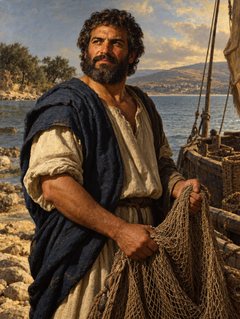 PeterApostle, fisherman, and rock of the early churchIsaiahProphet to Judah in the era of the Assyrian threatMalachiThe last prophet of the Old TestamentJohnApostle, beloved disciple, and witness to the Word
Watch
Go deeper
Read Luke 1, Matthew 3 and 11, Mark 6 and John 1 and 3 in order. Then compare the Gospel account with Josephus's Antiquities of the Jews, Book 18. Notice where they agree, where they differ, and why. Alfred Edersheim's Life and Times of Jesus the Messiah discusses John at length. The BibleProject overview of the Gospel of John shows how John's Gospel presents the Baptist's testimony.
References and further reading
- Wikipedia: John the Baptist
- eBible.org: Matthew 3
- eBible.org: John 3
- eBible.org: Matthew 3
- Josephus, Antiquities of the Jews (Project Gutenberg)
- Edersheim, The Life and Times of Jesus the Messiah (CCEL)
- Schaff, History of the Christian Church, vol. 2 (CCEL)
- BibleProject
Public-domain books, free to read
- Antiquities of the JewsFlavius Josephus
- The Life and Times of Jesus the MessiahAlfred Edersheim
- History of the Christian Church, vol. 2Philip Schaff
- Church HistoryEusebius of Caesarea
Written by 508 Ministry. Scripture links open the public-domain World English Bible. Where Scripture, early church tradition and historians differ, this page says so.