
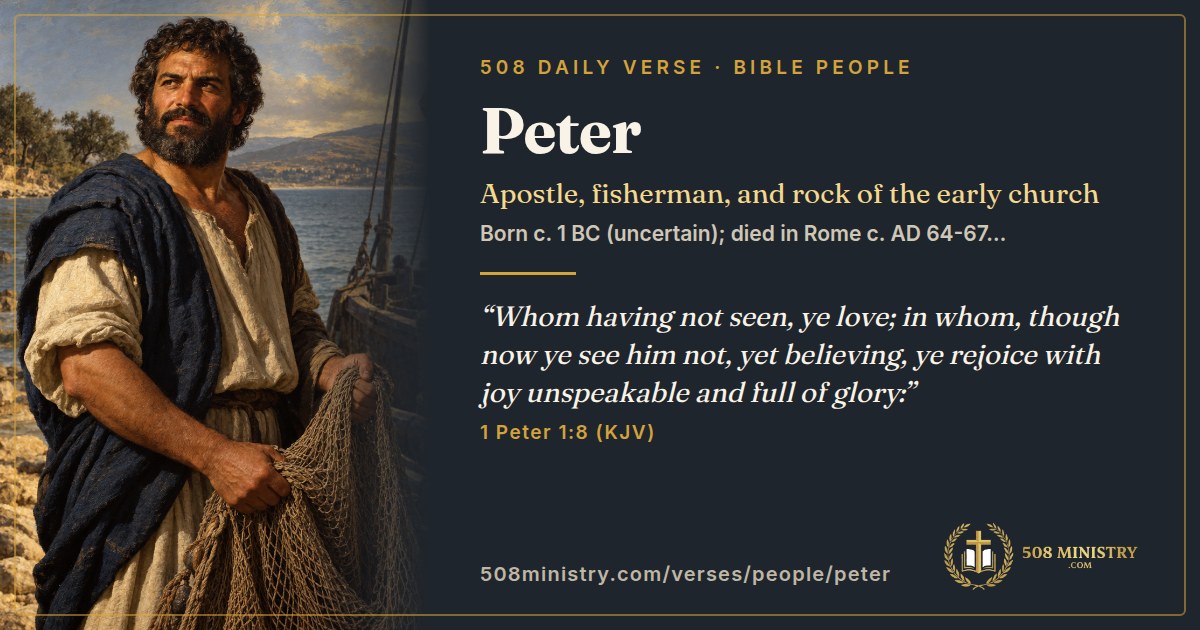

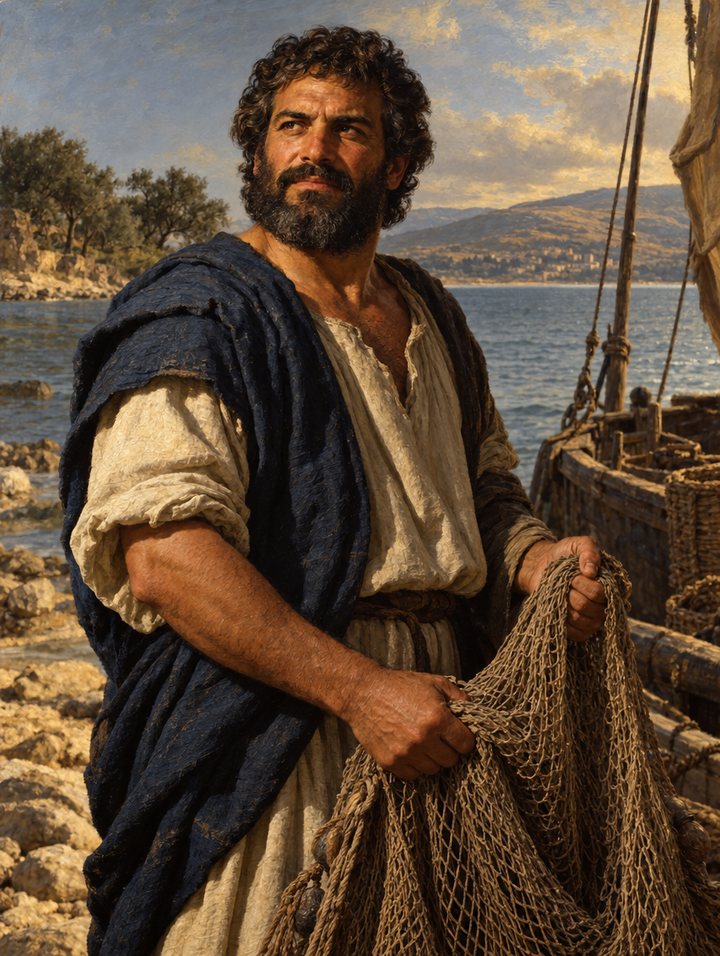
The world Peter was born into
Peter was born around the turn of the era, probably a few years before or after 1 BC. He grew up in a Jewish Galilee that sat inside the Roman world but did not feel Roman. Rome had taken Judea in 63 BC, when Pompey marched into Jerusalem. The Romans then ruled through client kings. Herod the Great governed until 4 BC, and after his death his sons divided the territory. Herod Antipas took Galilee and ruled it through all of Peter's adult life with Jesus. Philip, another son, ruled the region east of the Jordan that included Bethsaida. Judea itself came under direct Roman governors, and Pontius Pilate held that office from about AD 26 to 36.
Galilee was a farming and fishing country, crowded and busy. Josephus, the Jewish general turned historian, wrote that the region was densely populated, with many towns and villages. He claimed that even the smallest villages held over fifteen thousand people. Modern historians think that number is far too high, but the picture of a lively, productive land is right. The lake, which the Gospels call the Sea of Galilee and Luke calls the Lake of Gennesaret, was ringed with towns. Fishing was a real industry. Salted and dried fish went to markets across the region. Archaeologists found a first-century fishing boat preserved in the mud near Magdala in 1986, about twenty-seven feet long, built of several kinds of wood, repaired many times. It gives a hands-on sense of the boat Peter worked from.
Fishing was not a poor man's last resort, as sermons sometimes suggest. Fishermen like Peter's family held licenses or leases from the tax system of Antipas, and they paid for the right to fish. Luke tells us Peter and his partners were able to hire workers (Luke 5:10 says James and John were partners with Simon, and Mark 1:20 says Zebedee had hired men). That points to a working small business, not to a day laborer. Peter also owned a house in Capernaum, which Mark 1:29-31 mentions, and where his mother-in-law lived. Excavations at Capernaum uncovered an octagonal church of the fifth century built over an earlier house church, which in turn sat over a first-century house. Many Christians believe it is the house of Peter. That identification rests on tradition and on graffiti and layers of reverent use. It is plausible, and it cannot be proven.
The religious world was just as full. The Jews of the first century waited for God to act. They lived under foreign rule, and the Scriptures promised a Messiah of David's line who would set things right. Different groups gave different answers about how. The Pharisees stressed careful obedience to the law and its traditions. The Sadducees ran the temple. The Essenes withdrew to the desert. Zealots would eventually choose arms. Ordinary people like Peter went to synagogue on the Sabbath, kept the feasts, paid the temple tax, and hoped. When Jesus came preaching that the kingdom of God was near, he found a crowd that was already listening.
Peter's language matters, too. He spoke Aramaic at home and probably some Greek for business, as a lake trader dealing with Gentiles in the Decapolis would need. His Galilean accent gave him away in Jerusalem on the night of the arrest (Matthew 26:73). By tradition, he never lost the rough edges of a working man. Acts 4:13 says the leaders in Jerusalem saw that Peter and John were "unlearned and ignorant men," using words that mean untrained in formal rabbinic schooling, and "they took knowledge of them, that they had been with Jesus."
Chapter one: The call by the lake
John's Gospel gives the first meeting. Andrew, who had been a follower of John the Baptist, heard the Baptist point to Jesus and say "Behold the Lamb of God." Andrew went with Jesus for the day, and then went to find his brother. John 1:41-42 records what happened: "He first findeth his own brother Simon, and saith unto him, We have found the Messias... And he brought him to Jesus. And when Jesus beheld him, he said, Thou art Simon the son of Jona: thou shalt be called Cephas." So the nickname came on day one, before Peter had done anything to deserve it. In John's account, the name is a promise about what Jesus would make of him.
Matthew, Mark and Luke tell a second, later scene that sits comfortably beside John's. Jesus is walking beside the lake in Galilee. Peter and Andrew are casting a net. Jesus says, "Follow me, and I will make you fishers of men" (Matthew 4:19). Matthew and Mark say they left their nets at once. Luke tells the story more fully, and Luke 5:1-11 is the richest of the three. Jesus borrows Peter's boat as a pulpit so the crowd on the shore can hear him. Then he tells Peter to push out into deep water and let down the nets. Peter, who had fished all night and caught nothing, answers with a tired, honest line: "Master, we have toiled all the night, and have taken nothing: nevertheless at thy word I will let down the net."
The nets nearly broke. Two boats began to sink under the load. Peter's reaction is the key to his whole character. He did not celebrate. He fell at Jesus' knees and said, "Depart from me; for I am a sinful man, O Lord" (Luke 5:8). Here is a man who recognizes holiness and flinches. Jesus did not argue about the sin. He said, "Fear not; from henceforth thou shalt catch men." They brought the boats to land, and "forsook all, and followed him."
Many scholars read John 1 and Luke 5 as two stages of one relationship. Peter first met Jesus through Andrew and spent time with him, then later made the decision to leave the business full time. That reading is not required by the text, but it fits a pattern in how people really change careers.
Chapter two: In the inner circle
Peter appears in every list of the Twelve, and always first (Matthew 10:2-4, Mark 3:16-19, Luke 6:14-16, Acts 1:13). Matthew even writes "the first, Simon, who is called Peter." Within the Twelve there was a smaller group of three, Peter, James and John, who saw things the others did not. Jesus took only those three into the room when he raised the daughter of Jairus (Mark 5:37). Only those three went up the mountain at the Transfiguration (Mark 9:2). Only those three, with Andrew in Mark's account, heard the private teaching about the end of the age on the Mount of Olives (Mark 13:3). And those three were taken deeper into the garden at Gethsemane (Mark 14:33).
Peter was the one who spoke. Again and again the Gospels record the disciples' questions and Peter is the one who asks them. He is impulsive and sometimes wrong. When Jesus walked toward the boat on the water in a storm, Peter called out, "Lord, if it be thou, bid me come unto thee on the water." Jesus said, "Come." Peter climbed over the side and walked, until he saw the wind and began to sink (Matthew 14:28-31). Notice the shape of the story. The faith was real, and so was the failure, and Jesus' hand was there at the exact moment of the fall: "O thou of little faith, wherefore didst thou doubt?" Our verse index carries the words Jesus spoke over that lake, "Be of good cheer; it is I; be not afraid" (Matthew 14:27).
On another day, many disciples left after a hard teaching about bread and flesh in John 6. Jesus turned to the Twelve and asked if they would go as well. Peter's answer is among the most quoted lines in the Gospel: "Lord, to whom shall we go? thou hast the words of eternal life. And we believe and are sure that thou art that Christ, the Son of the living God" (John 6:68-69). He did not claim to understand everything. He claimed there was nowhere else to go.
Chapter three: Caesarea Philippi
The turning point of the Gospels, according to Matthew 16, Mark 8 and Luke 9, happens in the far north, near the headwaters of the Jordan at Caesarea Philippi. The place itself was a statement. A spring poured out of a cliff face where a sanctuary to the god Pan had been built, and Herod's son Philip had made the town a showpiece city in honor of Caesar. Standing among the shrines of other powers, Jesus asked his disciples, "Whom do men say that I the Son of man am?" They gave the common answers: John the Baptist, Elijah, Jeremiah, one of the prophets. Then he asked the question that matters for every reader: "But whom say ye that I am?"
Peter answered: "Thou art the Christ, the Son of the living God" (Matthew 16:16). Mark's version is shorter, "Thou art the Christ," and Luke's is "The Christ of God." The three fit together. Matthew alone includes Jesus' reply, which has been argued over for two thousand years. "Blessed art thou, Simon Barjona: for flesh and blood hath not revealed it unto thee, but my Father which is in heaven. And I say also unto thee, That thou art Peter, and upon this rock I will build my church; and the gates of hell shall not prevail against it. And I will give unto thee the keys of the kingdom of heaven" (Matthew 16:17-19).
Here Christians disagree, and we should say it fairly. The Roman Catholic Church reads the "rock" as Peter himself and understands the keys as an office passed on to his successors, the bishops of Rome. Most Protestant churches read the rock as Peter's confession, that Jesus is the Christ, or as Christ himself, and read the keys as the authority to announce the gospel, which Peter exercised in Acts, and which Matthew 18:18 extends to the whole community of disciples. The Eastern Orthodox churches honor Peter highly but do not see a primacy of jurisdiction in Rome. The wordplay in Greek (Petros and petra) and in the original Aramaic (Kepha, which would be the same word twice) is part of the argument. Whatever one concludes, nobody can read the passage and deny that Jesus gave Peter a leading place in the first generation of the church. Acts shows that place in action.
Then comes the shock. Right after the confession, Jesus began to tell them that he must go to Jerusalem, suffer, be killed, and rise again. Peter took him aside and began to rebuke him: "Be it far from thee, Lord: this shall not be unto thee." Jesus turned and said, "Get thee behind me, Satan: thou art an offence unto me: for thou savourest not the things that be of God, but those that be of men" (Matthew 16:22-23). The man called a rock in one paragraph is called a stumbling stone in the next. The Gospels do not hide this, and neither should we. Peter is a person, not a statue. Our index has a verse from that same chapter, "For what is a man profited, if he shall gain the whole world, and lose his own soul?" (Matthew 16:26), spoken to Peter and the rest in that exact moment.
Chapter four: The mountain, the sword and the basin
Six days later Peter, James and John went up the mountain with Jesus, and he was transfigured before them. His face shone like the sun and his clothes became white as light. Moses and Elijah appeared and spoke with him. Peter, afraid and wanting to do something, suggested building three shelters (Mark 9:5-6; Mark adds "for he wist not what to say"). A cloud came over them, and a voice said, "This is my beloved Son: hear him." Decades later, Peter himself looked back on that morning in his second letter: "We have not followed cunningly devised fables... but were eyewitnesses of his majesty... we were with him in the holy mount" (2 Peter 1:16-18).
The questions kept coming. Peter asked how often he must forgive a brother who sinned against him, and offered what must have seemed generous: seven times? Jesus said, "I say not unto thee, Until seven times: but, Until seventy times seven" (Matthew 18:21-22). Peter asked, "Behold, we have forsaken all, and followed thee; what shall we have therefore?" (Matthew 19:27), a question that makes every reader a little more comfortable with their own mixed motives.
The last night is where Peter's best and worst appear together. At the Passover meal, Jesus began to wash his disciples' feet. When he came to Peter, the fisherman objected: "Thou shalt never wash my feet." Jesus said, "If I wash thee not, thou hast no part with me." Peter swung to the other extreme: "Lord, not my feet only, but also my hands and my head" (John 13:6-9). There was no halfway with him.
Jesus warned him that Satan would sift the disciples like wheat, "but I have prayed for thee, that thy faith fail not: and when thou art converted, strengthen thy brethren" (Luke 22:32). Notice the when, not if. Peter swore he would die with Jesus. Jesus told him that before the rooster crowed he would deny him three times. In the garden Peter fell asleep while Jesus prayed, and Jesus said to him, "Watch and pray, that ye enter not into temptation: the spirit indeed is willing, but the flesh is weak" (Matthew 26:41). When the soldiers came, Peter drew a sword and cut off the ear of the high priest's servant (John 18:10 names both men, Peter and Malchus). Jesus told him to put it away, and healed the ear (Luke 22:51).
Chapter five: The courtyard and the fire
After the arrest, Peter followed at a distance. John 18 says he and "another disciple" got into the high priest's courtyard. Around a charcoal fire a servant girl said, "Thou also wast with Jesus of Galilee." He denied it. A second person said the same, and he denied it with an oath. A bit later bystanders said, "Surely thou also art one of them; for thy speech bewrayeth thee," and he began to curse and to swear, "I know not the man." Luke adds a detail that has been painted countless times: "And the Lord turned, and looked upon Peter... And Peter went out, and wept bitterly" (Luke 22:61-62).
The Gospels were written by people who knew Peter and his story, and they kept this scene. If the church had been building a legend of a flawless leader, this is the one scene it would have cut. Instead all four Gospels tell it. Many historians treat that as evidence that the story is true, since nobody would have invented such an embarrassing fact about the church's most prominent figure. It is also a deep comfort. The one who denied Christ is the one Christ restored.
Chapter six: Restoration by the lake
After the resurrection, the angel at the empty tomb sent a message with careful words: "Go your way, tell his disciples and Peter that he goeth before you into Galilee" (Mark 16:7). The words "and Peter" are easy to skip. They are an invitation addressed by name to the man who thought he had lost everything. Paul adds in 1 Corinthians 15:5 that the risen Jesus "was seen of Cephas, then of the twelve," and Luke 24:34 says the disciples told each other, "The Lord is risen indeed, and hath appeared to Simon." The details of that private meeting are not recorded. They did not need to be.
John 21 closes the circle. Peter and a few others had gone back to fishing. They worked all night and caught nothing, the same failure as in Luke 5. A figure on the shore called out to cast the net on the right side, and the net filled so much they could not haul it. John said, "It is the Lord." Peter jumped into the water. On the beach was a charcoal fire, the same kind of fire as in the courtyard, with fish cooking on it and bread. After breakfast, Jesus asked Peter three times, "Simon, son of Jonas, lovest thou me?" Three questions for three denials. Peter, hurt by the third asking, answered, "Lord, thou knowest all things; thou knowest that I love thee." Each time Jesus gave him work: "Feed my lambs... Feed my sheep" (John 21:15-17; our verse index holds verse 17). Then Jesus told him how his life would end and said, "Follow me" (John 21:18-19), the same words he had spoken at the lake years before.
Chapter seven: Pentecost and the early church
Acts takes up the story. In Acts 1, Peter is the one who stands up among the hundred and twenty believers and proposes replacing Judas, and Matthias is chosen. On the day of Pentecost, fifty days after Passover, with Jerusalem packed with pilgrims from across the Mediterranean, the Holy Spirit came on the disciples and they began to speak in other languages. Peter stood with the eleven and preached. This is the same man who cowered in a courtyard seven weeks earlier. He quoted the prophet Joel and Psalm 16, and he told the crowd plainly that the Jesus they had crucified God had raised up. They were "pricked in their heart" and asked what to do. Peter said, "Repent, and be baptized every one of you in the name of Jesus Christ for the remission of sins, and ye shall receive the gift of the Holy Ghost" (Acts 2:38). About three thousand people were baptized that day. Luke then describes a community that "continued stedfastly in the apostles' doctrine and fellowship, and in breaking of bread, and in prayers" (Acts 2:42).
Peter's next recorded act is a healing. At the temple gate called Beautiful, a man lame from birth asked Peter and John for money. Peter said, "Silver and gold have I none; but such as I have give I thee: In the name of Jesus Christ of Nazareth rise up and walk" (Acts 3:6). The healed man went into the temple leaping and praising God. Peter preached again, calling the people to repent "that your sins may be blotted out" (Acts 3:19).
The authorities arrested Peter and John and put them before the Sanhedrin, the same court that had condemned Jesus. Peter, "filled with the Holy Ghost," said, "Neither is there salvation in any other: for there is none other name under heaven given among men, whereby we must be saved" (Acts 4:12). The rulers "saw the boldness of Peter and John, and perceived that they were unlearned and ignorant men" (Acts 4:13). Ordered to stop preaching, Peter said they could not, and later told the council plainly, "We ought to obey God rather than men" (Acts 5:29). After one arrest the apostles were beaten and left "rejoicing that they were counted worthy to suffer shame for his name."
The early chapters of Acts also contain hard stories. Ananias and Sapphira lied about the proceeds of a sale and died on the spot (Acts 5:1-11). Peter's authority in that scene is frightening, and Luke says "great fear came upon all the church." In Samaria, Peter and John confronted Simon the sorcerer, who wanted to buy the power of the Spirit (Acts 8:14-24). In Joppa, Peter prayed for a disciple named Tabitha (Dorcas) and she was raised from death (Acts 9:36-42).
Chapter eight: The door opens to the nations
The most important turning point in Peter's life after Pentecost is in Acts 10. In Joppa, staying with a tanner named Simon, Peter went up on the roof to pray at midday and fell into a trance. He saw a sheet lowered from heaven full of animals that the law of Moses called unclean. A voice said, "Rise, Peter; kill, and eat." Peter answered, "Not so, Lord; for I have never eaten any thing that is common or unclean." The voice said, "What God hath cleansed, that call not thou common." It happened three times. While he was still puzzling over it, messengers arrived from a Roman centurion in Caesarea named Cornelius, a God-fearing man who had been told in a vision to send for Peter.
Peter understood. He went, and entered a Gentile house, which a strict Jew of that time would not do. He told Cornelius, "Of a truth I perceive that God is no respecter of persons: But in every nation he that feareth him, and worketh righteousness, is accepted with him" (Acts 10:34-35). As he preached about "Jesus of Nazareth... who went about doing good, and healing all that were oppressed of the devil; for God was with him" (Acts 10:38), the Holy Spirit fell on all who heard. Peter ordered them baptized. When he returned to Jerusalem, some believers criticized him for eating with uncircumcised men, and he told the whole story step by step. At the Jerusalem Council in about AD 49 (Acts 15), Peter stood up and reminded the leaders that God "put no difference between us and them, purifying their hearts by faith" (Acts 15:8-9). That speech helped decide that Gentile believers did not have to become Jews to follow Jesus. Without that decision, Christianity could easily have remained a movement inside Judaism. The church was never the same.
Chapter nine: Prison, Paul and Antioch
In about AD 41 to 44, Herod Agrippa I ruled Judea as king. To please the Jewish leaders, he killed James the brother of John with the sword, and, seeing that it pleased them, arrested Peter during the days of Unleavened Bread (Acts 12:1-3). Four squads of soldiers guarded him, he was chained between two soldiers, and the plan was to bring him out for trial after Passover. "Peter therefore was kept in prison: but prayer was made without ceasing of the church unto God for him" (Acts 12:5). That night an angel struck his side, the chains fell off, and the gates opened by themselves. Peter walked to the house of Mary, the mother of John Mark, where people were praying. The servant girl Rhoda recognized his voice and was so excited that she forgot to open the door, and the praying believers told her she was out of her mind. Luke's detail here has the ring of a story told by people who were in the room. After that Acts says Peter "departed, and went into another place" (Acts 12:17). From this point, James the brother of the Lord (James) emerges as the leader in Jerusalem, and Peter becomes a traveling apostle.
Paul gives us several glimpses of Peter in his own letters. In Galatians 1:18 he says that three years after his conversion he went up to Jerusalem "to see Peter," and stayed with him fifteen days. In Galatians 2, Paul describes a later and sharper moment at Antioch, where Peter had been eating freely with Gentile believers but pulled back when some men came from James. Paul writes, "I withstood him to the face, because he was to be blamed." Peter had slipped, again, into fear. The letters do not report the aftermath, but Peter's second letter speaks of "our beloved brother Paul" and his wisdom (2 Peter 3:15). The two men disagreed in public and still honored each other.
Paul also says in 1 Corinthians 9:5 that Peter traveled with his wife, which tells us Peter was married and that his wife went with him in ministry, and in 1 Corinthians 1:12 that some Corinthians said, "I am of Cephas." Peter's reach, in other words, went well beyond Palestine.
Chapter ten: Peter's letters
The New Testament contains two letters in Peter's name. First Peter is addressed "to the strangers scattered throughout Pontus, Galatia, Cappadocia, Asia, and Bithynia," which is the northern half of what is now Turkey. It encourages believers who are suffering unfair treatment for their faith. It says, "Be sober, be vigilant; because your adversary the devil, as a roaring lion, walketh about, seeking whom he may devour" (1 Peter 5:8). It also offers some of the kindest lines in Scripture. "Casting all your care upon him; for he careth for you" (1 Peter 5:7). "Humble yourselves therefore under the mighty hand of God, that he may exalt you in due time" (1 Peter 5:6). "And above all things have fervent charity among yourselves: for charity shall cover the multitude of sins" (1 Peter 4:8). There are many other lines worth reading in our index, collected below. The letter ends with a greeting from "she that is at Babylon, elected together with you," and "Marcus my son" (1 Peter 5:13). Early readers understood "Babylon" as a coded name for Rome, the great empire that persecuted the church, which is one reason many take the letter as evidence that Peter was in Rome. A few scholars read Babylon literally. The majority of ancient testimony points to Rome.
Scholars debate who actually wrote the letters. First Peter says it was written "by Silvanus, a faithful brother" (1 Peter 5:12), and many think Silvanus, also called Silas, may have helped with its polished Greek. Some modern critics doubt that a Galilean fisherman could have produced such Greek, and others point out that Peter lived and preached for decades in a Greek-speaking world and had help from secretaries. The early church accepted First Peter widely and with little doubt. Second Peter is harder. It was disputed longer in the early church, and many modern scholars question whether Peter wrote it. Others defend it as genuine. We cannot settle that debate here. The letter itself offers something beautiful whoever wrote it: "According as his divine power hath given unto us all things that pertain unto life and godliness... whereby are given unto us exceeding great and precious promises: that by these ye might be partakers of the divine nature" (2 Peter 1:3-4). It also reminds us of God's patience: "The Lord is not slack concerning his promise, as some men count slackness; but is longsuffering to us-ward, not willing that any should perish, but that all should come to repentance" (2 Peter 3:9). It closes with a line that could stand as Peter's life prayer: "But grow in grace, and in the knowledge of our Lord and Saviour Jesus Christ" (2 Peter 3:18).
Chapter eleven: Mark, Rome and the memory of a preacher
One of the earliest traditions about the Gospels concerns Peter. Eusebius, quoting a bishop named Papias who wrote around AD 110 to 130, reports that Mark, who had been Peter's interpreter, "wrote down accurately, though not in order, all that he remembered of the things said and done by the Lord." Eusebius also cites Clement of Alexandria saying that when Peter preached in Rome, many who heard him urged Mark to write down what had been said. Modern scholars take this tradition seriously while debating its details. It would explain why Mark's Gospel is so vivid, why Peter appears in it so often, and why Mark includes Peter's failures without softening them. Some have pointed out that the Gospel's outline of Jesus' ministry matches the outline of Peter's sermon to Cornelius in Acts 10:36-41. That is a scholarly argument, not proof, but it is a thoughtful one.
Death and legacy
Scripture does not narrate Peter's death. John 21:18-19 gives a hint, with Jesus saying that when Peter was old, "another shall gird thee, and carry thee whither thou wouldest not," and John adds, "This spake he, signifying by what death he should glorify God." Second Peter 1:14 has Peter saying that "shortly I must put off this my tabernacle, even as our Lord Jesus Christ hath shewed me."
The earliest testimony outside Scripture comes from Clement, a leader of the church in Rome, who wrote to the Corinthians around AD 95 to 96. He speaks of "the greatest and most righteous pillars of the Church" who were persecuted and put to death, and he names Peter, who "after enduring not one or two but many labours... went to the place of glory that was his due." Ignatius, writing around AD 110, says that he does not command the Romans as Peter and Paul did. Dionysius of Corinth, around AD 170, says that Peter and Paul taught together in Italy and were martyred at the same time. Eusebius, writing in the early fourth century, reports from earlier writers that Peter was crucified in Rome under Nero, and that he asked to be crucified upside down because he considered himself unworthy to die as his Lord had. The upside-down detail first appears in the third-century Acts of Peter, a work that mixes legend with history. The famous "Quo vadis" story, in which Peter flees Rome, meets Jesus on the road, hears him say he is going to Rome to be crucified again, and turns back, comes from the same work. It is a moving tale and not good history.
Nero blamed the Christians for the great fire of Rome in AD 64. The Roman historian Tacitus, writing about fifty years later and no friend of the church, describes how Christians were arrested in large numbers, dressed in animal skins and torn by dogs, or set on fire to serve as lamps at night. Peter's death most likely falls in that persecution, around AD 64, though some place it a few years later. The place is traditionally the Vatican Hill, near Nero's circus. Constantine built a great basilica over the traditional burial site in the fourth century, and the present St. Peter's Basilica stands there still. In the 1940s, Vatican excavators found a first and second century cemetery under the church and a monument that Gaius, a Roman churchman, mentioned around AD 200 as "the trophy of Peter." Whether the bones found nearby are Peter's is argued. Pope Paul VI announced in 1968 that bones had been identified as probably his. Historians generally accept that Peter was martyred in Rome and that early Christians venerated a grave on the Vatican hill. They are more cautious about the details.
The ripple effect
It is hard to overstate how far this one fisherman's story has traveled. His confession at Caesarea Philippi became the church's core creed. His sermon at Pentecost set the pattern for preaching that calls for repentance. His reluctant step into Cornelius' house opened the church to every people on earth. The Pew Research Center's projections estimated about 2.2 billion Christians worldwide in 2010, roughly 31 percent of the world's population, and projected 2.9 billion by 2050. Those numbers follow in a straight line from a conversation by a lake.
His name is carried by one of the most visited buildings in the world, by countless churches, and by some of the most common given names in many languages: Peter, Pierre, Pedro, Pietro, Piotr. The saying "the keys of the kingdom" entered ordinary speech, and so did "the rock" as an image of steadiness. Artists from Caravaggio to Rembrandt painted his tears, and composers wrote about the rooster.
What Peter teaches us
First, that failure is not the end. The disciple who sank, who rebuked Jesus, who slept in the garden and denied him by the fire, is the one Jesus picked to strengthen the others. The pattern does not excuse sin. It describes grace, and it explains why a man who had failed so publicly could write, "The God of all grace, who hath called us unto his eternal glory by Christ Jesus, after that ye have suffered a while, make you perfect, stablish, strengthen, settle you" (1 Peter 5:10).
Second, that faith often looks like a half step. Peter walked on water for a few steps, and then sank, and then was caught. He did not wait for certainty. When Jesus said "Come," he went. Mark 9:24 captures the same honesty from another man: "Lord, I believe; help thou mine unbelief." Many people of faith live there.
Third, that love is the center. The risen Jesus did not ask Peter for apologies, theology or promises. He asked, "Lovest thou me?" Everything else in Peter's life came from the answer.
Fourth, that leadership means service. The man who objected to having his feet washed spent the rest of his life washing the feet of the church. His own advice to other leaders in 1 Peter 5:2-3 is to "feed the flock of God... not for filthy lucre, but of a ready mind; neither as being lords over God's heritage, but being ensamples to the flock."
Relationships
- Andrew, his brother, who brought him to Jesus: Andrew
- James and John, his fishing partners and fellow members of the inner three: James and John
- Jesus, who named him, taught him, and restored him: Jesus
- Mark, his interpreter and companion, and the traditional source of the second Gospel: Mark
- Paul, with whom he agreed, disagreed and was martyred in the same city: Paul
- Judas Iscariot and Matthias, the traitor and his replacement: Judas Iscariot, Matthias
- Cornelius, the centurion whose household received the Spirit through Peter's preaching (Acts 10)
- Herod Antipas and Pontius Pilate, the rulers of Peter's world: Herod Antipas, Pontius Pilate
- John the Baptist, whose preaching sent Andrew to Jesus: John the Baptist
- The rest of the Twelve: The Twelve
Read their stories
 AndrewApostle, fisherman, and brother of Simon Peter
 James, son of ZebedeeApostle and brother of John
 John the ApostleApostle and beloved disciple
 Jesus of NazarethTeacher, healer, and the ChristJohn MarkCompanion of Peter and Paul, and Gospel writer
 PaulApostle to the nations and writer of the church's earliest lettersMatthiasApostle chosen to replace Judas
 Judas IscariotApostle who betrayed Jesus
 John the BaptistProphet who prepared the way for JesusHerod AntipasRuler of Galilee and PereaPontius PilateRoman governor of JudeaThe Twelve ApostlesThe original disciples Jesus chose and sent out
A note on sources and honesty
This profile follows the New Testament first. It draws on the early church historian Eusebius (writing about AD 325) for what the second and third generations remembered, and it marks his reports as tradition. For background on first-century Galilee and Judea we rely on Josephus, whose Jewish Antiquities and Jewish War are in the public domain. We link a few helpful books at the end of this page. Scholars still argue about the exact dates of Peter's life, the authorship of 2 Peter, and the details of his death. Where evidence is thin, we say so.
Timeline
- -1Born in Bethsaida (approximate)John 1:44
- 27Brought to Jesus by Andrew; named CephasJohn 1:40-42
- 28Called to leave his netsLuke 5:1-11
- 29Confession at Caesarea PhilippiMatthew 16:13-19
- 30Denies Jesus, then is restoredLuke 22:54-62; John 21
- 30Preaches at PentecostActs 2:14-41
- 37Meets Cornelius in Caesarea (date approximate)Acts 10
- 44Imprisoned by Herod Agrippa I, freedActs 12:1-19
- 49Speaks at the Jerusalem CouncilActs 15:7-11
- 64Martyred in Rome under Nero (tradition; some date later)Eusebius, Church History 2.25
Places
- 1Bethsaida · home town; site et-Tell is the leading identification
- 2Capernaum · base of Jesus' Galilee ministry; family home
- 3Sea of Galilee · fishing lake
- 4Caesarea Philippi (Banias) · Peter's confession, Matthew 16
- 5Jerusalem · Pentecost, early church
- 6Joppa · Acts 9-10
- 7Caesarea Maritima · Cornelius, Acts 10
- 8Antioch · Galatians 2
- 9Rome · traditional place of Peter's martyrdom
Watch
Go deeper
Read Luke 5, Matthew 16, John 21 and Acts 10, then 1 Peter at one sitting. The links on this page lead to the public-domain texts and reference articles we used.
References and further reading
- Wikipedia
- Wikipedia article
- Blue Letter Bible lexicon entry for the name
- Eusebius, Church History (CCEL)
- Schaff, History of the Christian Church vol. 1 (CCEL)
- Josephus, Antiquities of the Jews (Project Gutenberg)
- Edersheim, Life and Times of Jesus the Messiah (Internet Archive)
- Foxe, Book of Martyrs (Project Gutenberg)
- BibleProject
- Pew Research Center, Religious Projections 2010-2050
- Wikipedia: Saint Peter's Basilica
- Wikipedia: Papias of Hierapolis
- Wikipedia: Herod Agrippa I
Public-domain books, free to read
- Church History (Eusebius), NPNF series 2 vol. 1Eusebius of Caesarea
- Antiquities of the JewsFlavius Josephus
- The Wars of the JewsFlavius Josephus
- The Life and Times of Jesus the MessiahAlfred Edersheim
- Fox's Book of MartyrsJohn Foxe
- History of the Christian Church, vol. 1: Apostolic ChristianityPhilip Schaff
- The Apostolic Fathers with Justin Martyr and Irenaeus (ANF vol. 1)Ante-Nicene Fathers
Every verse in our index linked to this life
Written in letters traditionally attributed to Peter. 1 Peter 1:7; 2 Peter 1:4; 1 Peter 1:8; 2 Peter 1:5-7; 1 Peter 2:2; 2 Peter 1:19; 1 Peter 2:24; 2 Peter 3:9; 1 Peter 3:7; 2 Peter 3:13; 1 Peter 3:8; 2 Peter 3:18; 1 Peter 3:15; 1 Peter 4:8; 1 Peter 4:10; 1 Peter 5:6; 1 Peter 5:7; 1 Peter 5:10; 1 Peter 1:3; 2 Peter 1:3.
Preached or spoken by Peter in Acts. Acts 2:38; Acts 3:6; Acts 3:19; Acts 4:12; Acts 4:13; Acts 5:29; Acts 10:34; Acts 10:38; Acts 15:8.
Spoken to or beside Peter. Matthew 14:27; Matthew 16:26; Matthew 18:21-22; Matthew 26:41; Mark 14:38; Luke 22:32; John 21:17; Acts 12:5; Mark 16:6.
Verses from our index
Written in letters traditionally attributed to Peter
That the trial of your faith, being much more precious than of gold that perisheth, though it be tried with fire, might be found unto praise and honour and glory at the appearing of Jesus Christ:
The testing of your faith is worth more than gold, and it will result in praise.
Whereby are given unto us exceeding great and precious promises: that by these ye might be partakers of the divine nature, having escaped the corruption that is in the world through lust.
He has given us great and precious promises, so we can share in his nature.
Whom having not seen, ye love; in whom, though now ye see him not, yet believing, ye rejoice with joy unspeakable and full of glory:
Though you have not seen him, you love him, and you are filled with inexpressible joy.
And beside this, giving all diligence, add to your faith virtue; and to virtue knowledge; And to knowledge temperance; and to temperance patience; and to patience godliness; And to godliness brotherly kindness; and to brotherly kindness charity.
Add to your faith goodness, knowledge, self control, perseverance, godliness, and love.
As newborn babes, desire the sincere milk of the word, that ye may grow thereby:
Like newborn babies, crave pure spiritual milk, so that you may grow up in your salvation.
We have also a more sure word of prophecy; whereunto ye do well that ye take heed, as unto a light that shineth in a dark place, until the day dawn, and the day star arise in your hearts:
We have a sure word, like a lamp shining in a dark place, until the day dawns.
Who his own self bare our sins in his own body on the tree, that we, being dead to sins, should live unto righteousness: by whose stripes ye were healed.
He carried our sins in his body, and by his wounds you have been healed.
The Lord is not slack concerning his promise, as some men count slackness; but is longsuffering to us-ward, not willing that any should perish, but that all should come to repentance.
The Lord is patient with you, not wanting anyone to perish but everyone to come back.
Likewise, ye husbands, dwell with them according to knowledge, giving honour unto the wife, as unto the weaker vessel, and as being heirs together of the grace of life; that your prayers be not hindered.
Husbands, live with your wives with understanding and give them honour as joint heirs.
Nevertheless we, according to his promise, look for new heavens and a new earth, wherein dwelleth righteousness.
We are looking forward to new heavens and a new earth, where righteousness lives.
Finally, be ye all of one mind, having compassion one of another, love as brethren, be pitiful, be courteous:
Be like minded, sympathetic, loving one another, compassionate and humble.
But grow in grace, and in the knowledge of our Lord and Saviour Jesus Christ. To him be glory both now and for ever. Amen.
Grow in the grace and knowledge of our Lord and Saviour. Growth is the assignment.
But sanctify the Lord God in your hearts: and be ready always to give an answer to every man that asketh you a reason of the hope that is in you with meekness and fear:
Always be ready to give an answer for the hope you have, but do it with gentleness and respect.
And above all things have fervent charity among yourselves: for charity shall cover the multitude of sins.
Above all, love each other deeply, because love covers a multitude of sins.
As every man hath received the gift, even so minister the same one to another, as good stewards of the manifold grace of God.
Each of you should use whatever gift you have received to serve others.
Humble yourselves therefore under the mighty hand of God, that he may exalt you in due time:
Humble yourselves under God's hand, and he will lift you up in due time.
Casting all your care upon him; for he careth for you.
Cast all your anxiety on him, because he cares for you. Care is the reason.
But the God of all grace, who hath called us unto his eternal glory by Christ Jesus, after that ye have suffered a while, make you perfect, stablish, strengthen, settle you.
The God of all grace, after you have suffered a little while, will restore and strengthen you.
Blessed be the God and Father of our Lord Jesus Christ, which according to his abundant mercy hath begotten us again unto a lively hope by the resurrection of Jesus Christ from the dead,
He has given us new birth into a living hope through the resurrection of Jesus Christ.
According as his divine power hath given unto us all things that pertain unto life and godliness, through the knowledge of him that hath called us to glory and virtue:
His divine power has given us everything we need for a godly life.
Verses from our index
Preached or spoken by Peter in Acts
Then Peter said unto them, Repent, and be baptized every one of you in the name of Jesus Christ for the remission of sins, and ye shall receive the gift of the Holy Ghost.
Turn around and be baptised, and you will receive the gift of the Holy Spirit.
Then Peter said, Silver and gold have I none; but such as I have give I thee: In the name of Jesus Christ of Nazareth rise up and walk.
Silver and gold I do not have, but what I have I give you. In the name of Jesus, walk.
Repent ye therefore, and be converted, that your sins may be blotted out, when the times of refreshing shall come from the presence of the Lord;
Turn to God, so that times of refreshing may come from the Lord.
Neither is there salvation in any other: for there is none other name under heaven given among men, whereby we must be saved.
Salvation is found in no one else. There is no other name given among people.
Now when they saw the boldness of Peter and John, and perceived that they were unlearned and ignorant men, they marvelled; and they took knowledge of them, that they had been with Jesus.
They noticed that these men had been with Jesus. Time with him shows.
Then Peter and the other apostles answered and said, We ought to obey God rather than men.
We ought to obey God rather than people. Conscience outranks applause.
Then Peter opened his mouth, and said, Of a truth I perceive that God is no respecter of persons:
God does not play favourites. Nobody is outside the invitation.
How God anointed Jesus of Nazareth with the Holy Ghost and with power: who went about doing good, and healing all that were oppressed of the devil; for God was with him.
He went around doing good and healing everyone under the power of the enemy.
And God, which knoweth the hearts, bare them witness, giving them the Holy Ghost, even as he did unto us;
God, who knows the heart, accepted them. He sees past what people read.
Verses from our index
Spoken to or beside Peter
But straightway Jesus spake unto them, saying, Be of good cheer; it is I; be not afraid.
Be of good cheer. It is I. Do not be afraid.
For what is a man profited, if he shall gain the whole world, and lose his own soul? or what shall a man give in exchange for his soul?
What does it profit a person to gain the whole world and lose their own soul?
Then came Peter to him, and said, Lord, how oft shall my brother sin against me, and I forgive him? till seven times? Jesus saith unto him, I say not unto thee, Until seven times: but, Until seventy times seven.
Not seven times, but seventy times seven. Forgiveness is not a tally.
Watch and pray, that ye enter not into temptation: the spirit indeed is willing, but the flesh is weak.
The spirit is willing but the flesh is weak. Watch and pray, and be gentle with yourself.
Watch ye and pray, lest ye enter into temptation. The spirit truly is ready, but the flesh is weak.
Watch and pray so you do not fall into temptation. The spirit is willing.
But I have prayed for thee, that thy faith fail not: and when thou art converted, strengthen thy brethren.
I have prayed for you that your faith would not fail. Someone prays for you.
He saith unto him the third time, Simon, son of Jonas, lovest thou me? Peter was grieved because he said unto him the third time, Lovest thou me? And he said unto him, Lord, thou knowest all things; thou knowest that I love thee. Jesus saith unto him, Feed my sheep.
Lord, you know all things. You know that I love you. That is enough to be restored.
Peter therefore was kept in prison: but prayer was made without ceasing of the church unto God for him.
The church prayed constantly for him. Praying for someone is real work.
And he saith unto them, Be not affrighted: Ye seek Jesus of Nazareth, which was crucified: he is risen; he is not here: behold the place where they laid him.
He is risen. He is not here. The story did not end where they thought.
Written by 508 Ministry. Scripture links open the public-domain World English Bible. Where Scripture, early church tradition and historians differ, this page says so.