
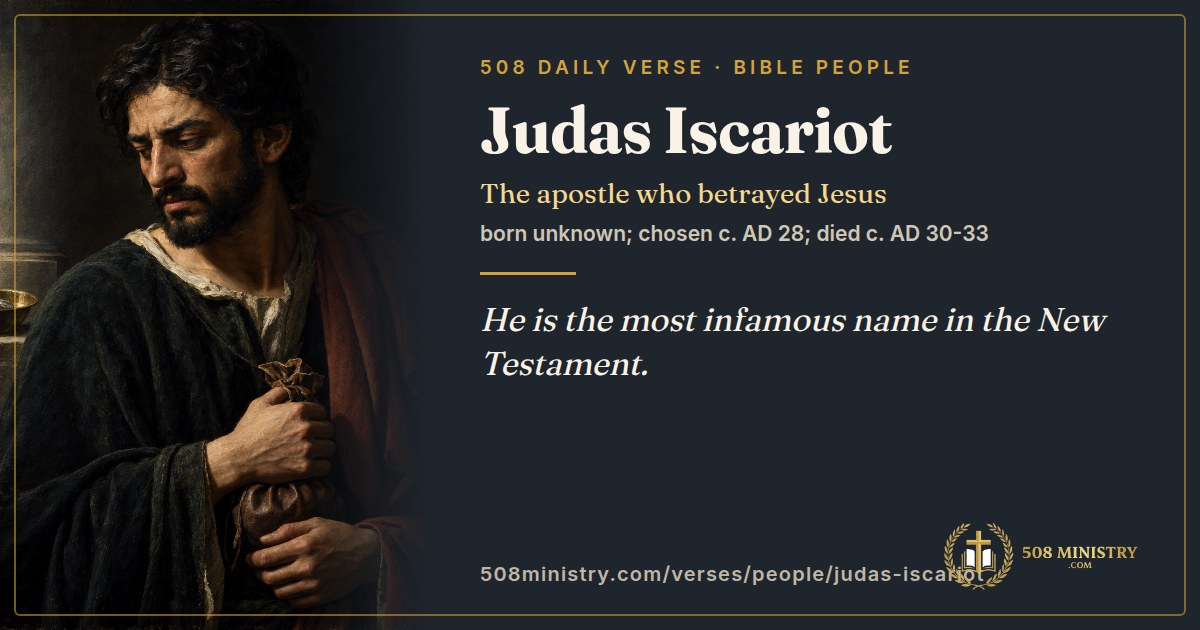

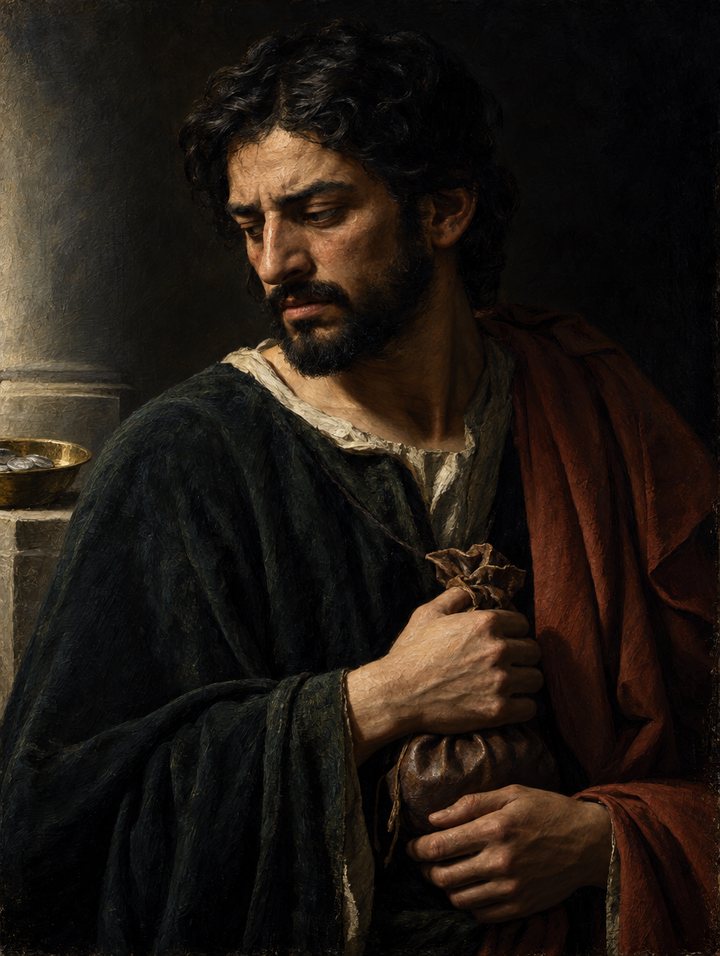
The world he was born into
Judas lived in the first-century Jewish homeland under Roman rule. Pontius Pilate governed Judea from AD 26 to 36, Herod Antipas ruled Galilee, and the high priest Caiaphas, with the council of the chief priests, ran the Temple and held considerable power under Roman permission. You can read about the rulers in Pontius Pilate, Herod Antipas and Caiaphas.
The age was tense. Many people longed for God to act, and for a deliverer. Teachers drew crowds, and movements rose and were crushed. The authorities in Jerusalem knew that a charismatic teacher followed by a large crowd, especially at Passover when the city swelled with pilgrims, could set off trouble that Rome would punish. That fear is why they wanted to deal with Jesus quietly (Mark 14:1-2; John 11:47-53).
Names tell part of this story. "Judas" is the Greek form of the Hebrew name Judah, one of the most common names of the period, borne with pride because of the heroic Judas Maccabeus two centuries before. It was the name of a patriarch and a tribe. Nobody in the first century would have heard a villain's name in it. That changed only after this man bore it.
The second part of his name, "Iscariot," is less clear. The most widely accepted explanation is that it means "man of Kerioth" (Hebrew ish Keriyyot), a town in southern Judea (compare Joshua 15:25). If so, Judas was almost certainly the only one of the Twelve from Judea. The rest came from Galilee, the north, with its own accent and its own habits, and a man from the south could have felt like an outsider among them. Other proposals include a link to the Latin word sicarius, "dagger man," a term later used for violent rebels, or to an Aramaic word for "false one." None can be proved, and the Gospels do not explain it. John tells us his father's name: Judas was "the son of Simon Iscariot" (John 6:71; 13:2, 26).
What the Gospels tell us
Chosen with the others
Judas is named in all four lists of the Twelve, and he is always last, with a note about what he did: "Judas Iscariot, who also betrayed him" (Mark 3:19; compare Matthew 10:4; Luke 6:16). The Gospel writers wrote after the betrayal, so the tag was added in hindsight. Luke tells us that Jesus spent a night in prayer before choosing the Twelve (Luke 6:12-16). Judas was among those chosen. Whatever else was true, he was not an intruder.
Matthew 10 records that Jesus sent the Twelve out two by two, giving them "authority over unclean spirits, to cast them out, and to heal every disease and every sickness" (Matthew 10:1). Judas was one of the twelve who went. Nothing in the Gospels suggests that his preaching or healing was any different from the others'. Like the others, he would have heard Jesus' teaching and seen the signs that the Gospels describe. Whatever he later did, he was exposed to everything the others were.
The money box
John's Gospel tells us that Judas carried the group's common purse. The Twelve apparently held a shared fund, from which they gave to the poor and bought what they needed. At the last supper, when Jesus told Judas to do what he was going to do quickly, the others assumed that "Judas had the money box, that Jesus said to him, 'Buy the things that we need for the feast,' or that he should give something to the poor" (John 13:29). Nobody suspected anything. That shows that they trusted him with their funds.
John also reports a darker detail. Six days before Passover, in Bethany, Mary, the sister of Lazarus, poured a pound of costly perfume on Jesus' feet and wiped them with her hair. Judas objected: "Why wasn't this ointment sold for three hundred denarii, and given to the poor?" John adds his own comment: "Now he said this, not that he cared for the poor, but because he was a thief, and having the money box, used to steal what was put into it" (John 12:4-6).
Treat that note with care. It is John's judgment, written decades after the events and after the betrayal had been judged by the church. It does not appear in Matthew, Mark or Luke. Matthew says the disciples as a group were indignant at the waste, and Mark says "some" were (Matthew 26:8; Mark 14:4). John singles out Judas. Whether John knew something the other writers did not, or whether he read the betrayal back into the earlier scene, we cannot tell. The note may well be accurate, but it is a single source.
The bargain
Matthew, Mark and Luke all place the agreement with the chief priests soon after the anointing at Bethany. Matthew gives the clearest account: "Then one of the twelve, who was called Judas Iscariot, went to the chief priests, and said, 'What are you willing to give me, that I should deliver him to you?' They weighed out for him thirty pieces of silver. From that time he sought opportunity to betray him" (Matthew 26:14-16).
Thirty pieces of silver was a specific amount. Exodus 21:32 sets thirty shekels as the compensation owed for a slave gored by an ox. In Zechariah 11:12-13, the prophet, playing the part of a shepherd, is paid thirty pieces of silver as his wages and throws them "to the potter in the house of Yahweh." Matthew will pick up that image later. The sum was real money, and it was also not a fortune. It was the price of a slave.
Luke adds that "Satan entered into Judas who was surnamed Iscariot, who was numbered with the twelve" (Luke 22:3). The chief priests wanted to arrest Jesus "in the absence of the multitude" (Luke 22:6). Their problem was to find him away from the crowds, and Judas could tell them where he would be at night.
The table
The last supper is the heart of the story, and each Gospel tells it with different details.
All four Gospels have Jesus announce that one of the Twelve would betray him. In Matthew, each of the disciples asks, "Surely not I, Lord?" (Matthew 26:22). Jesus says that the one who dipped his hand in the dish with him will betray him, and then adds a sentence that has troubled readers ever since: "The Son of Man goes, even as it is written of him, but woe to that man through whom the Son of Man is betrayed! It would be better for that man if he had not been born" (Matthew 26:24). Then Matthew records a short exchange: "Judas, who betrayed him, answered, 'It isn't me, is it, Rabbi?' He said to him, 'You said it'" (Matthew 26:25).
John's version is quieter and more personal. Before the meal, John says, "the devil had already put into the heart of Judas Iscariot, the son of Simon, to betray him" (John 13:2). Then Jesus gets up, takes off his outer clothes, and begins to wash the disciples' feet (John 13:4-5). The text does not skip anyone. The feet of Judas were among them. Peter protests; Jesus answers; and in the middle of the scene Jesus says, "You are clean, but not all of you" (John 13:10-11).
Later, John records that Jesus was "troubled in spirit" and said, "One of you will betray me" (John 13:21). The disciples looked at one another, unsure. Peter signaled to the disciple lying next to Jesus to ask who it was. Jesus said, "It is he to whom I will give this piece of bread when I have dipped it." He dipped the bread and gave it to Judas, the son of Simon Iscariot. "After the piece of bread, Satan entered into him. Then Jesus said to him, 'What you do, do quickly'" (John 13:26-27). Judas took the bread, went out at once, and John adds four words: "It was night" (John 13:30).
Offering the dipped bread was a gesture of honor to a guest, not a condemnation. The Gospels do not say whether Judas could have turned back at that moment. They show Jesus giving him one more sign of friendship before he left the room.
What happened right after he left is worth noticing. John 13:31 says, "When he had gone out, Jesus said, 'Now the Son of Man is glorified.'" Then comes the new commandment: "A new commandment I give to you, that you love one another. Just as I have loved you, you also love one another. By this everyone will know that you are my disciples, if you have love for one another" (John 13:34-35, in our verse index). Those words were said to the eleven who remained. Judas was already out in the dark. The sentence "just as I have loved you" included a love that had washed Judas' feet.
The garden and the kiss
After the supper, Jesus led the eleven across the Kidron valley to a garden at the foot of the Mount of Olives. John says, "Judas also, who betrayed him, knew the place, for Jesus often met there with his disciples" (John 18:2). Judas came with a detachment of soldiers and officers from the chief priests and Pharisees, carrying lanterns, torches and weapons.
The three earlier Gospels tell us the sign he arranged. "Now he who betrayed him gave them a sign, saying, 'Whoever I kiss, he is the one. Seize him'" (Matthew 26:48). Then: "Immediately he came to Jesus, and said, 'Hail, Rabbi!' and kissed him" (Matthew 26:49). A kiss was the normal greeting between a student and a teacher. In the dark, with no flashlights, it marked out which man in a group was the one they wanted.
Jesus answered him in words that Matthew and Luke record differently. In Matthew he says, "Friend, why are you here?" (Matthew 26:50). In Luke, "Judas, do you betray the Son of Man with a kiss?" (Luke 22:48). The word translated "friend" in Matthew is a less intimate one than the usual word for a friend, but it is not hostile. It was the word used by a master to address someone in a particular role, and it carries a note of sad irony. Jesus did not call him an enemy even then. He called him by name.
The end
Here the sources split, and the split is real.
Matthew's account (27:3-10). When Judas saw that Jesus had been condemned, "he changed his mind" (the Greek word is metamelētheis, "regretted" or "felt remorse") and brought the thirty pieces of silver back to the chief priests and elders. He said, "I have sinned in that I betrayed innocent blood." They replied, "What is that to us? You see to it." Judas threw the silver into the sanctuary, left, and "went away and hanged himself." The priests picked up the coins and said they could not put them in the treasury, "since it is the price of blood," so they bought the potter's field as a burial place for foreigners. It has been called "the field of blood" ever since. Matthew then says this fulfilled a prophecy, which he attributes to "Jeremiah," though the wording is closest to Zechariah 11:12-13, with echoes of Jeremiah 18 and 32.
The account in Acts (1:15-20). Peter, speaking to the believers a few weeks later, says Judas "obtained the portion of this ministry" and "this man obtained a field with the reward for his wickedness, and falling headlong, his body burst open, and all his intestines gushed out." The field, Peter says, became known in the Jerusalem dialect as Akeldama, "field of blood." Peter then quotes Psalms 69:25 and 109:8 and calls for a replacement.
Notice what differs. In Matthew, the priests buy the field with the returned silver, and Judas hangs himself. In Acts, Judas buys the field and falls. The details do not match, though they share the thirty pieces, the field, the name "Field of Blood" and the sense of a violent end. Christians have long offered ways to fit them together: that Judas hanged himself and the body later fell and burst; that the priests bought the field in Judas' name, so that in a legal sense he "purchased" it. These are possible, and they remain guesses. A fair reader should say that the Gospels agree on the main facts and differ on the details, and that the church has never required one particular reconciliation.
The most important thing about Matthew's version is the repentance. Judas did feel remorse. He confessed, "I have sinned," and he tried to give the money back. But Matthew describes the end of that road as despair. Peter, who also failed that night, wept bitterly and later was restored on the shore of the Sea of Galilee (John 21:15-19). The two men's stories begin the same way, with a failure of loyalty. They end in different places, and the church has often reflected on the difference. The difference was not that Peter's sin was smaller. It was that Peter had someone to go back to.
For anyone reading this who knows what despair feels like: the story of Judas does not say that no road was open. It says he did not find it. Please do not walk it alone.
Why did he do it?
The Gospels never say with a single voice. They offer several explanations, and they do not rank them.
Money. Matthew's Judas asks, "What are you willing to give me?" (Matthew 26:15). John calls him a thief (John 12:6). Greed is the explanation most often given, and some part of it may be true. But thirty pieces of silver was not a fortune. It was the price of a slave.
Satan. Luke and John say that Satan entered Judas (Luke 22:3; John 13:27), and John says the devil had put the betrayal in his heart (John 13:2). John also reports Jesus saying earlier, "Didn't I choose you, the twelve, and one of you is a devil?" (John 6:70). This tells us that the Gospel writers saw the betrayal as part of a larger conflict. It does not tell us that Judas was a puppet. Elsewhere the same Gospels hold him responsible. Jesus says, "woe to that man" (Matthew 26:24).
Scripture and God's plan. Jesus says repeatedly that these events had to happen in order to fulfill the Scriptures (John 13:18, quoting Psalm 41:9, "He who eats my bread has lifted up his heel against me"; John 17:12; Acts 1:16). Christians have long held two things together here: that God knew and used the betrayal, and that Judas chose it. Foreknowledge is not the same as compulsion. If a friend knows you will fail, his knowing does not make you fail.
Disappointment or political hope. This explanation does not appear in the Gospels at all. Some modern readers have suggested that Judas, the lone Judean among Galileans, expected a political messiah and turned on Jesus when Jesus refused to lead a revolt, or that he meant to force Jesus' hand by handing him over. The theory is possible, since many Jews of the time expected a king who would break Roman power. It is a modern guess. We have no evidence for it, and the Gospels never mention it.
Fear. Mark and Luke show Jesus warning the Twelve repeatedly that he would be handed over and killed. A frightened man in Judas' position might have decided to protect himself. This, too, is guesswork.
The plain fact is that the Gospel writers, who knew Judas' story well, did not tell us what was in his heart. They said what he did. We should be cautious about claiming to know more than they did.
Judas in the early church and after
The Gospel of Judas
In 2006, the National Geographic Society published a text called the Gospel of Judas, a Coptic manuscript from a papyrus codex found in Egypt in the 1970s and dated by radiocarbon to roughly the third or fourth century. The church father Irenaeus had mentioned a work of this name around AD 180, and said it was used by a Gnostic group (Against Heresies 1.31.1). The newly found text may be a copy of that work or something related to it. Gnostics taught that the material world was flawed and that salvation came through secret knowledge.
In the text, Jesus tells Judas, and only Judas, secrets that he does not tell the others. The first translators read the document as presenting Judas as the hero, the one disciple who understood Jesus and who helped him escape the prison of the body. Other scholars have challenged that reading, arguing that the text can also be translated so that Judas is the "thirteenth demon," a figure the author means to mock. The debate continues.
What nearly all scholars agree on is this. The Gospel of Judas is a second-century Gnostic composition. It was written well after the death of the apostle, it was not written by Judas, and it tells us about the beliefs of a particular Gnostic group and not about what happened in Jerusalem. The four canonical Gospels, written much closer to the events, remain the historical record. You can read the scholarly overview at Wikipedia.
Dante, art and the word itself
Dante, in his Inferno (about 1320), places Judas in the lowest circle of hell, held in the mouth of Satan himself. It is a poet's judgment, not church teaching. The Catholic Church has never declared that any particular person is in hell, including Judas. The church's official position is that his act was a grave sin and that the final state of his soul belongs to God.
Artists have returned to the story again and again. Giotto's Kiss of Judas in the Scrovegni Chapel in Padua (about 1305) shows Judas wrapping Jesus in his cloak, face to face, eye to eye. Leonardo's Last Supper shows Judas clutching a small bag, with his face in shadow. Caravaggio's The Taking of Christ (about 1602) catches the moment just after the kiss. Rembrandt's Judas Returning the Thirty Pieces of Silver (1629) is a painting of Judas, crumpled and desperate, kneeling before priests who turn away.
The name itself has lived a hard life. "Judas" is a word for a traitor in many languages. It has also been used, tragically, to slander the Jewish people as a whole, since "Judas" is the same name as "Judah" and "Jew" in many languages. That is a historical wrong. Judas, like Jesus and every other apostle, was a Jew, and his act was an individual's. It cannot be pinned on a people. The church has repeatedly condemned the use of the betrayal story as an excuse for hatred, and every reader of these pages should do the same.
The sayings in our verse index
Judas has no recorded sayings in the index, and the words attributed to him in the Gospels (Matthew 26:15, 25, 49; Mark 14:45; John 12:5) are not among the daily verses. The index does hold passages from the same night and from Jesus' teaching on how to treat even an enemy, which Judas heard:
- John 13:1, "Having loved his own who were in the world, he loved them to the uttermost," said just before the foot washing, in the same room as Judas.
- John 13:34-35, the new commandment, given after Judas had left.
- Matthew 9:12, "Those who are healthy have no need for a physician, but those who are sick do."
- Matthew 5:44, "Love your enemies, bless those who curse you."
- Matthew 26:41, "Watch and pray, that you don't enter into temptation. The spirit indeed is willing, but the flesh is weak."
- Luke 22:32, "I prayed for you, that your faith wouldn't fail," said to Simon Peter at the supper.
Read in that setting, the verses are a quiet commentary. They are the words of a teacher who knew exactly what was coming and kept on giving love in the room.
Same night or related
No indexed words of Judas; these were spoken at or around the supper he attended
Now before the feast of the passover, when Jesus knew that his hour was come that he should depart out of this world unto the Father, having loved his own which were in the world, he loved them unto the end.
Having loved his own, he loved them to the very end. Love finishes what it starts.
A new commandment I give unto you, That ye love one another; as I have loved you, that ye also love one another. By this shall all men know that ye are my disciples, if ye have love one to another.
Love one another as I have loved you. That is how people will know you.
But when Jesus heard that, he said unto them, They that be whole need not a physician, but they that are sick.
The healthy do not need a doctor, but the sick do. Asking for help is not weakness.
But I say unto you, Love your enemies, bless them that curse you, do good to them that hate you, and pray for them which despitefully use you, and persecute you;
Love your enemies and pray for those who use you badly. That is a different kind of strength.
Watch and pray, that ye enter not into temptation: the spirit indeed is willing, but the flesh is weak.
The spirit is willing but the flesh is weak. Watch and pray, and be gentle with yourself.
But I have prayed for thee, that thy faith fail not: and when thou art converted, strengthen thy brethren.
I have prayed for you that your faith would not fail. Someone prays for you.
Relationships
- Jesus chose him, trusted him with the money, washed his feet, fed him at the table, and called him "friend" in the garden.
- Peter also failed that night, by denying Jesus three times, and was restored.
- Matthias was chosen by lot to take his place among the Twelve (Acts 1:23-26).
- Caiaphas and the chief priests made the bargain with him.
- Pontius Pilate presided over the trial that followed.
- James the son of Alphaeus, Thaddaeus and Simon the Zealot sat with him in the third group of four in every list.
- Matthew records the fullest account of his remorse and death (Matthew 27:3-10).
- John the apostle gives the most personal account of the table and the night.
- The Twelve is the group page.
Read their stories
 Jesus of NazarethTeacher, healer, and the Christ
 PeterApostle, fisherman, and rock of the early churchMatthiasApostle chosen to replace JudasCaiaphasHigh priest during the trial of JesusPontius PilateRoman governor of JudeaHerod AntipasRuler of Galilee and Perea
 James, son of AlphaeusApostle, one of the twelve
 ThaddaeusApostle, also called Judas son of James
 Simon the ZealotApostle, one of the twelve
 MatthewApostle, former tax collector, and Gospel writerJohnApostle, beloved disciple, and witness to the WordThe Twelve ApostlesThe original disciples Jesus chose and sent out
Places
- 1Kerioth (approximate, site disputed) · probable home town
- 2Capernaum · Galilee base
- 3Bethany · John 12:1-8
- 4Jerusalem (upper room) · John 13
- 5Gethsemane · Matthew 26:47-50
- 6Akeldama (Hinnom Valley) · traditional site of the Field of Blood
- Kerioth, in southern Judea, his probable home.
- Capernaum and Galilee, where the Twelve were chosen and trained.
- Bethany, where Mary anointed Jesus and Judas objected (John 12).
- The upper room, Jerusalem, the last supper and the foot washing.
- Gethsemane, the garden on the Mount of Olives, where the kiss took place.
- The Temple, where the silver was thrown down.
- Akeldama, the Field of Blood, traditionally placed on the south side of the Hinnom Valley, in Jerusalem. A Greek Orthodox monastery stands near the traditional site.
A timeline
- c. AD 28Chosen among the TwelveLuke 6:12-16
- c. AD 29Sent out with the TwelveMatthew 10
- c. AD 30-33Objects at the anointing in BethanyJohn 12:1-8
- c. AD 30-33Bargain for thirty pieces of silverMatthew 26:14-16
- c. AD 30-33Last supper, foot washing, Judas leavesJohn 13
- c. AD 30-33The kiss in GethsemaneMatthew 26:47-50
- c. AD 30-33Remorse and deathMatthew 27:3-10; Acts 1:18
- c. AD 30-33Matthias chosen to replace himActs 1:15-26
- c. AD 180Irenaeus mentions a Gnostic 'Gospel of Judas'Against Heresies 1.31.1
- c. 1305Giotto, Kiss of Judas, PaduaScrovegni Chapel
- 2006Coptic Gospel of Judas publishedNational Geographic
| Year | Event |
|---|---|
| c. AD 28 | Chosen among the Twelve (Luke 6:12-16) |
| c. AD 29 | Sent out with the Twelve (Matthew 10) |
| c. AD 30-33 | Mary anoints Jesus at Bethany; Judas objects (John 12:1-8) |
| c. AD 30-33 | Agrees with the chief priests for thirty pieces of silver (Matthew 26:14-16) |
| c. AD 30-33 | The last supper; the foot washing; Judas leaves (John 13) |
| c. AD 30-33 | The kiss in Gethsemane (Matthew 26:47-50) |
| c. AD 30-33 | Remorse, the silver thrown down, his death (Matthew 27:3-10; Acts 1:18) |
| c. AD 30-33 | Matthias chosen to replace him (Acts 1:15-26) |
| c. AD 180 | Irenaeus mentions a Gnostic "Gospel of Judas" |
| c. AD 220-340 | Radiocarbon range for the surviving Coptic copy of the Gospel of Judas |
| c. 1305 | Giotto paints the Kiss of Judas in Padua |
| 2006 | The Coptic Gospel of Judas is published |
Why he matters
Judas matters because he reminds us that being close to Jesus is not the same as following him. He was chosen, trained and trusted. He was given a place at the table and a share of the work. And he walked away from all of it for the price of a slave.
His story is a warning, and the warning is not about some other, worse kind of person. The Gospels list the Twelve in a way that makes this plain. After the supper, when Jesus said one of them would betray him, they did not ask, "Is it Judas?" Each one asked, "Surely not I?" Nobody could point at him in advance. The warning is for any believer who is tempted to treat the faith as a means to something else.
The story also shows something about Jesus. He did not expose Judas to the others before the end. He gave him the bread. He washed his feet. He named the betrayal without cruelty and called him "friend" when he arrived with the soldiers. Every account of the arrest depicts a teacher in control of himself and unwilling to meet betrayal with hatred. Christians have found in that picture a model for dealing with betrayal in their own lives.
Finally, the story of Judas is a reminder of what happens to anyone who sins and cannot believe in mercy. The Gospels say Judas felt remorse, and they do not say he trusted that he could be forgiven. The difference between him and Peter is not a measure of how much each had done wrong. It is the question of whom each of them ran toward. Anyone who has failed badly can read the story and take it as a warning and also as an invitation, as an arrow pointing toward the one person Judas did not go to.
By the numbers
| Gospel support | |
|---|---|
| Money | Matthew 26:15; John 12:6 |
| Satan entered him | Luke 22:3; John 13:2, 27 |
| Fulfilment of Scripture | John 13:18; 17:12; Acts 1:16 |
| Political hope (modern theory) | none in the text |
| Fear (modern theory) | none in the text |
Watch
Go deeper
Start with the accounts of his death: Matthew 27:3-10 and Acts 1:12-26. Read the supper in John 13:21-30. For background, see the Wikipedia article on Judas Iscariot and the Wikipedia article on Judas Iscariot. For the Gnostic text, see the Wikipedia article on the Gospel of Judas. For the early church, read Eusebius in the Christian Classics Ethereal Library. For a visual walk through the last week, watch the BibleProject's animated overview of the Gospel of John, part 2.
Every link on this page was checked when we built it, and the full list is in our file of verified sources.
References and further reading
- Wikipedia: Judas Iscariot
- Wikipedia: Gospel of Judas
- Wikipedia: Akeldama
- Wikipedia: Kerioth
- Wikipedia article on : Judas Iscariot (topical)
- Blue Letter Bible: Matthew 27:3-10 (KJV)
- Blue Letter Bible: Acts 1:12-26 (KJV)
- Blue Letter Bible: John 13:21-30 (KJV)
- Blue Letter Bible: Matthew 26:47-56 (KJV)
- Bible Project
Public-domain books, free to read
- The Ecclesiastical History (Church History)Eusebius of Caesarea
- The Life and Times of Jesus the MessiahAlfred Edersheim
- The Life of ChristFrederic W. Farrar
- Antiquities of the JewsFlavius Josephus
- Fox's Book of MartyrsJohn Foxe
Written by 508 Ministry. Scripture links open the public-domain World English Bible. Where Scripture, early church tradition and historians differ, this page says so.