

The world he was born into
James lived in Galilee, the northern district of the Jewish homeland. When Jesus began teaching, around AD 27 to 29, the region was ruled by Herod Antipas, a client of Rome, and Judea to the south was governed by a Roman prefect, Pontius Pilate. You can read about the rulers in Herod Antipas and Pontius Pilate.
Galilee was green, crowded and busy. It had fertile hills, fishing villages on the lake, and a road network that tied the region into the larger Roman trade system. Villages were small, and most people knew each other from birth. Family names mattered, because a man was usually introduced by his father: "James, son of Alphaeus." The name Alphaeus, in Greek Alphaios, probably reflects an Aramaic name such as Halfai or Chalfai. A few scholars think it could be a variant of Clopas, a name that appears in John 19:25. That identification is possible, and it is also unproven.
Most Galileans were Jews who spoke Aramaic, knew some Greek, kept the Sabbath, attended the synagogue and traveled to Jerusalem for the major feasts. The Scriptures were read aloud, not owned privately, and a family's religious education came through listening. Many people in these villages held a quiet hope that God would soon visit his people. When a teacher from Nazareth began to say that the kingdom of God had come near, those who were already waiting listened hard.
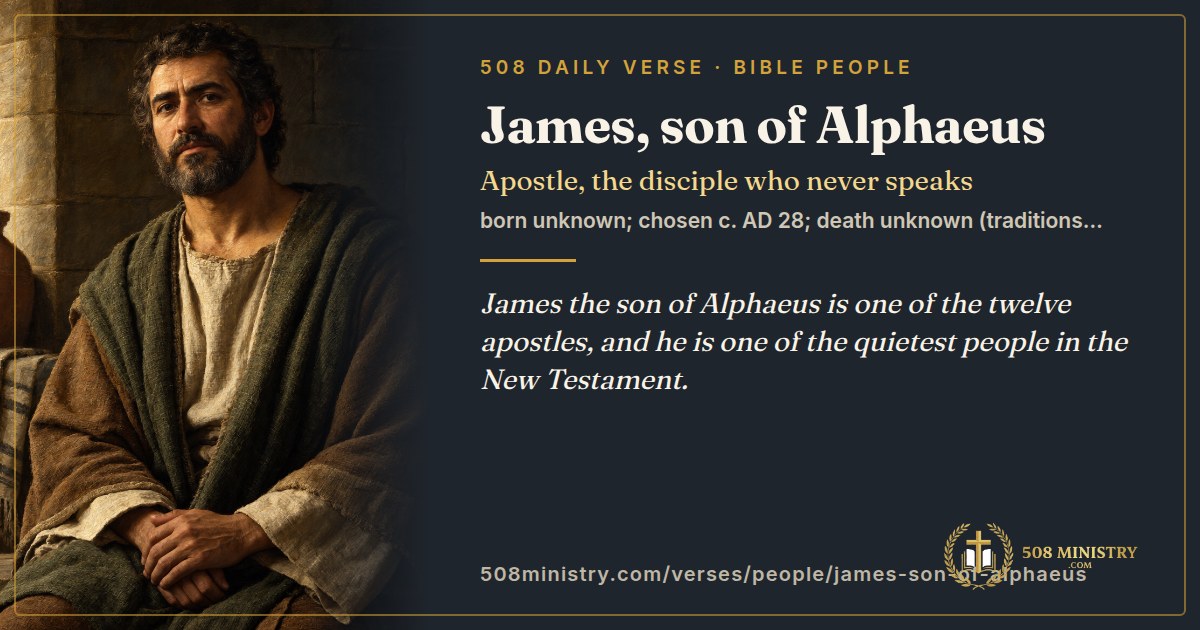
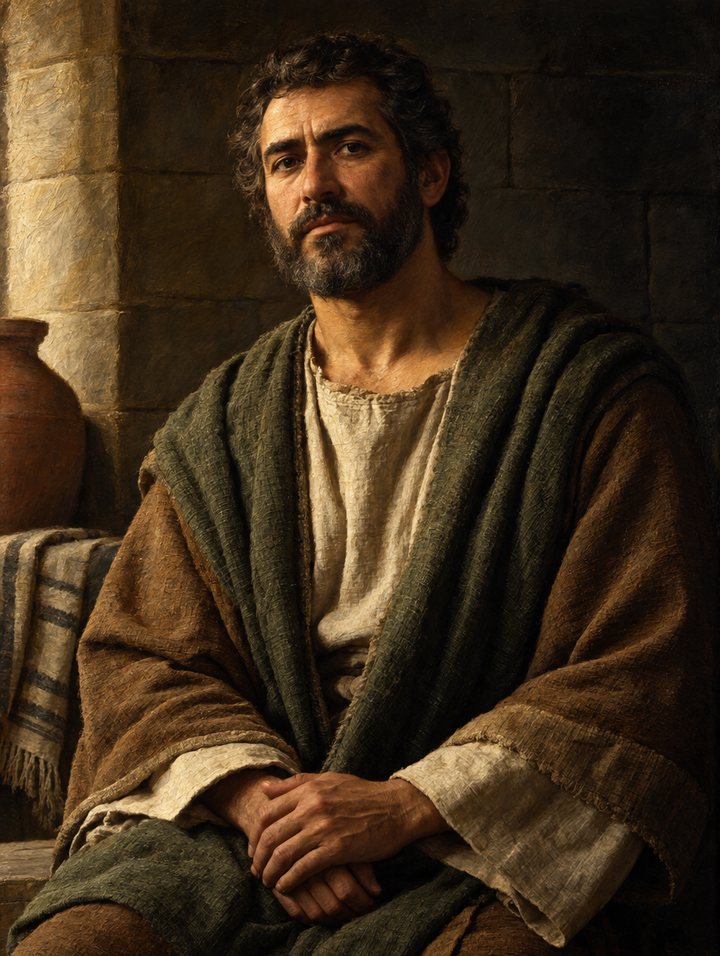
James was one of the people who listened and followed. Beyond that we know nothing of his work, his family, his age or his village. The New Testament does not tell us whether he was a fisherman, a farmer, a craftsman or something else. We should resist the temptation to fill in the gaps, as later legends have done.
What the New Testament says
Four lists
The four lists of the apostles are the only places the name appears:
- Matthew 10:3: "Philip and Bartholomew; Thomas and Matthew the tax collector; James the son of Alphaeus, and Thaddaeus."
- Mark 3:18: "Andrew, Philip, Bartholomew, Matthew, Thomas, James the son of Alphaeus, Thaddaeus, Simon the Zealot."
- Luke 6:15: "Matthew and Thomas, James the son of Alphaeus, and Simon who was called the Zealot."
- Acts 1:13: "Peter, John, James and Andrew, Philip and Thomas, Bartholomew and Matthew, James the son of Alphaeus, Simon the Zealot, and Judas the son of James."
Three things stand out. First, in all four lists James heads the same group, the third group of four, along with Thaddaeus, Simon the Zealot and, in the earlier lists, Judas Iscariot. In Luke 6:16 and Acts 1:13 Thaddaeus is replaced by "Judas the son of James," and many readers think those are two names for the same man. Second, the first group in every list is always Peter, Andrew, James and John, and the second is Philip, Bartholomew, Matthew and Thomas. Scholars have noticed that this grouping stays steady even when the order inside it moves, and some suggest Jesus sent the Twelve out in these three squads of four. The text does not say so, but the pattern is there. Third, James is always first in his group, which means he was either the best known or the oldest, or simply the one the lists happened to put there.
Luke is clear about how the Twelve came to be. "He went out to the mountain to pray, and he continued all night in prayer to God. When it was day, he called his disciples, and from them he chose twelve, whom he also named apostles" (Luke 6:12-13). James was prayed over before he was chosen. Whatever his later obscurity, the choosing was not careless.
What the Twelve did together
Because James is never singled out, the way to learn anything about his experience is to read what the Twelve did as a group. A short list follows. In each of these scenes James was present, but the text does not name him.
The sending (Matthew 10:1-42). Jesus gave the Twelve authority over unclean spirits and over every kind of sickness, and sent them out in pairs to the towns of Israel. Matthew 10 is the longest set of instructions to them. They were to travel light, take no money, rely on hospitality, and expect hostility. Jesus told them, "Behold, I send you out as sheep among wolves" (Matthew 10:16). In the same chapter he said that God knows each sparrow, and "you are of more value than many sparrows" (Matthew 10:29-31, which is in our verse index). James heard that sentence with the others. A man the lists never describe was told, by name as one of twelve, that the Father counts the hairs of his head.
The feeding of the crowd (Mark 6:30-44). The Twelve distributed the loaves and fish. They gathered the leftovers afterward, twelve baskets of them (Mark 6:43).
The last supper (Matthew 26:20-30; Mark 14:17-26; Luke 22:14-23). At the Passover table, Jesus took bread and a cup and told the Twelve what they meant. All of them ate. All of them were told one among them would betray him.
Gethsemane (Matthew 26:36-46). The three closest friends went deeper into the garden. The rest were left near the gate with the instruction, "Sit here, while I go over there and pray." James was likely among those left behind.
The flight (Matthew 26:56). "Then all the disciples left him and fled." The Gospels do not exempt anyone. The flight includes James.
The upper room and the commission. After the resurrection, the eleven met Jesus in Galilee on a mountain. "Go and make disciples of all nations... Behold, I am with you always, even to the end of the age" (Matthew 28:19-20, both in our verse index). James was one of the eleven to whom those words were spoken.
The ascension and the promise. On the Mount of Olives, before the ascension, Jesus said, "You will receive power when the Holy Spirit has come upon you. You will be witnesses to me in Jerusalem, in all Judea and Samaria, and to the uttermost parts of the earth" (Acts 1:8, in our verse index). Luke then names the eleven who returned to the upper room, and James the son of Alphaeus is there in verse 13. In verse 14 Luke adds that they "all continued with one accord in prayer and supplication, with the women and Mary the mother of Jesus, and with his brothers."
Pentecost (Acts 2). The Spirit fell on those gathered in Jerusalem, and the apostles began to preach in languages they had not studied. James, one of the eleven, was in the room. The tongues of fire rested on "each one of them" (Acts 2:3).
Those scenes are the whole of the written record. We have James as part of a group, never as a figure. That is a fact about the sources, and it is also a mark of how much the early church valued the Twelve as a group. The number mattered. Twelve tribes, twelve thrones (Matthew 19:28), twelve foundation stones (Revelation 21:14). The Twelve were meant to be a sign that God was gathering Israel again. For that sign, each of the twelve names counted, including this one.
The choice of Matthias
When the eleven chose a replacement for Judas Iscariot, Peter laid out the criteria: a man who had been with them "all the time that the Lord Jesus went in and out among us, beginning from the baptism of John, to the day that he was received up from us" (Acts 1:21-22). The man chosen was Matthias. James the son of Alphaeus prayed over that decision, and then he prayed over it again when the lot fell. In the New Testament, he is last seen as one of the people doing exactly that.
Three men called James
The most useful thing a reader can do with this page is learn to tell the Jameses apart. It is easy to mix them up, and many people have.
-
James the son of Zebedee. Brother of John, a fisherman, one of the inner three with Peter and John. He was the first apostle to die for the faith, executed by sword on the order of Herod Agrippa I around AD 44 (Acts 12:1-2). His father's name is Zebedee, not Alphaeus. See James son of Zebedee.
-
James the son of Alphaeus. The subject of this page, one of the Twelve, otherwise unknown.
-
James the brother of the Lord. A brother of Jesus, who did not believe during Jesus' ministry (John 7:5), saw the risen Lord (1 Corinthians 15:7), became the leader of the church in Jerusalem (Acts 15:13; Galatians 1:19; 2:9), and is the traditional author of the letter of James. He is not listed among the Twelve. Both the Jewish historian Josephus (Antiquities 20.9.1) and the church writer Hegesippus, as quoted by Eusebius (Church History 2.23), report that he was killed in Jerusalem around AD 62. See James.
Some Christian traditions, particularly in the West from the time of Jerome in the fourth century, have tried to identify James son of Alphaeus with James the brother of the Lord. Jerome's argument was that "brother" meant "cousin," and that Alphaeus was the same man as Clopas, whose wife Mary stood at the cross (John 19:25). Eastern churches never accepted the merger, and most modern Bible scholars do not either. The evidence is thin, and the New Testament has Paul speaking about "James the Lord's brother" separately from "the Twelve" in the same chapter (1 Corinthians 15:5-7). The honest position is that the identification is possible but unproven, and that the plain reading of the lists keeps them apart.
"James the Less"
Mark 15:40 mentions a woman among those watching the crucifixion from a distance: "Mary the mother of James the less and of Joses, and Salome." The Greek word translated "less" is mikros, which means "small" or "little." It could refer to his height, or his age, or simply to distinguish him from the better-known James. Matthew 27:56 says "Mary the mother of James and Joses" and Luke 24:10 says "Mary the mother of James."
Tradition has long identified this "James the Less" with James the son of Alphaeus, and the title "the Less" has become a nickname for him in English. The identification is reasonable, because "the less" suggests someone distinguished from the "greater" James among the Twelve, but the Gospels do not make the link. There were many Marys and many Jameses. We can say that a woman named Mary, the mother of a James and a Joses, was there at the cross, and that the church has often linked her son with our James. Beyond that, we are working from inference.
Alphaeus, Levi and Clopas
Mark calls the tax collector Levi "the son of Alphaeus" (Mark 2:14). Because the Twelve list includes both "Matthew the tax collector" and "James the son of Alphaeus," some readers have wondered whether Matthew and James were brothers. If Levi is Matthew, and both were sons of an Alphaeus, the idea has a natural appeal. The Gospels never say it, though, and the lists of the Twelve do not treat the two as a pair. The apostles named as brothers elsewhere are always marked as such: Peter and Andrew, James and John. If Matthew and James were brothers, the lists would probably have said so. It is better to say that we do not know. For the story of Matthew's call, see Matthew.
What early church tradition remembered
Traditions about James the son of Alphaeus are late and uneven. We offer them as stories the church told, not as established history.
Where he preached. Various later lists assign the apostles to regions. For James the son of Alphaeus, the traditions include Judea, Syria and Egypt. The assignments differ from one source to the next, and none of them comes from the first or second century. The early church historian Eusebius, writing around AD 325, preserves a tradition that the apostles scattered across the world after Pentecost (Church History 3.1), but he does not give a destination for James.
How he died. A number of accounts say James the son of Alphaeus was martyred, with details that vary: stoned, clubbed, or crucified. Some later accounts place his death in Egypt. Others combine his story with that of James the Lord's brother, whose death in Jerusalem is much better attested. This is exactly what one would expect when a lesser-known name gets absorbed into a better-known one. A careful reader will notice that the best-attested martyrdom of a James belongs to the brother of the Lord, and the martyrdom of James the son of Zebedee is the only one the New Testament records.
His relics and his feast. The Basilica of the Twelve Holy Apostles in Rome holds, by long tradition, relics of Philip and of a James the apostle, identified as James the son of Alphaeus. The Roman church keeps May 3 as the feast of Saints Philip and James. The Eastern Orthodox churches commemorate the Apostle James the son of Alphaeus on October 9. Those dates and those relics show how the church has honored him, and they do not prove anything about his life.
Foxe's Book of Martyrs, a popular sixteenth-century collection, retells the traditions about the apostles' deaths in English. Readers should treat it as a Protestant retelling of medieval tradition. It is useful for seeing how the stories were passed on, and it is not a primary source. You can read it free on Project Gutenberg.
The sayings in our verse index
James has no recorded sayings, so there is nothing in the index that he said. The index does hold passages addressed to him, as one of the Twelve:
- Matthew 10:29-31, the sparrows, spoken in the mission discourse to the Twelve.
- Matthew 28:19-20, the Great Commission, spoken to the eleven.
- Acts 1:8, the promise of the Spirit and the call to witness, spoken to the apostles before the ascension.
Reading them with his name in mind is a good exercise. They were said to a man who is nearly invisible in the text, and they are as much his as anyone's.
Addressed to the twelve
No recorded words of James; these passages were spoken to the Twelve
Are not two sparrows sold for a farthing? and one of them shall not fall on the ground without your Father. But the very hairs of your head are all numbered. Fear ye not therefore, ye are of more value than many sparrows.
Two sparrows sell for a penny, and not one falls without your Father. You are worth more.
Go ye therefore, and teach all nations, baptizing them in the name of the Father, and of the Son, and of the Holy Ghost:
Go and make disciples of all nations, teaching them what I commanded.
Teaching them to observe all things whatsoever I have commanded you: and, lo, I am with you alway, even unto the end of the world. Amen.
And surely I am with you always, to the very end of the age.
But ye shall receive power, after that the Holy Ghost is come upon you: and ye shall be witnesses unto me both in Jerusalem, and in all Judæa, and in Samaria, and unto the uttermost part of the earth.
You will receive power when the Spirit comes, and you will be my witnesses here and far off.
Relationships
- Jesus called him, taught him, and sent him.
- Matthew may have been his brother. Mark 2:14 gives Levi's father the same name as James's father, but the New Testament does not say they were brothers.
- Thaddaeus, Simon the Zealot and Judas Iscariot stand with him in the lists, in the third group of four.
- Peter and James the son of Zebedee head the first group, and James son of Alphaeus is the ninth name in Acts 1:13, heading the last group of the eleven.
- James, the brother of Jesus, who led the church in Jerusalem, is a different man.
- Matthias replaced Judas Iscariot, with James present at the choosing.
- The Twelve is the group page.
Read their stories
 Jesus of NazarethTeacher, healer, and the Christ
 MatthewApostle, former tax collector, and Gospel writer
 ThaddaeusApostle, also called Judas son of James
 Simon the ZealotApostle, one of the twelve
 Judas IscariotApostle who betrayed Jesus
 PeterApostle, fisherman, and rock of the early church
 James, son of ZebedeeApostle and brother of JohnJamesBrother of Jesus and leader of the Jerusalem churchMatthiasApostle chosen to replace JudasThe Twelve ApostlesThe original disciples Jesus chose and sent outHerod AntipasRuler of Galilee and PereaPontius PilateRoman governor of Judea
Places
- 1Galilee · where the Twelve were chosen
- 2Jerusalem (upper room) · Acts 1:13; Pentecost
- 3Rome, Basilica of the Twelve Holy Apostles · relics by tradition
- Galilee, where the Twelve were chosen and trained.
- Jerusalem, the upper room, Pentecost and the early church.
- Judea, Syria and Egypt, where later traditions send him, with little certainty.
- Rome, where relics said to be his rest in the Basilica of the Twelve Holy Apostles.
A timeline
- c. AD 28Chosen after a night of prayerLuke 6:12-16
- c. AD 29Sent out with the TwelveMatthew 10
- c. AD 30-33Last supper and GethsemaneMatthew 26
- c. AD 30-33The Great CommissionMatthew 28:16-20
- c. AD 30-33In the upper room; Matthias chosenActs 1:13-26
- c. AD 30-33PentecostActs 2
- c. AD 44James son of Zebedee executed (a different James)Acts 12:2
- c. AD 62James the Lord's brother killed in Jerusalem (a different James)Josephus, Antiquities 20.9.1
- 4th centuryJerome argues for merging the lesser-known JamesesJerome
- 6th centuryRelics of Philip and James placed in Rome (tradition)Basilica of the Twelve Holy Apostles
| Year | Event |
|---|---|
| c. AD 28 | Chosen among the Twelve after a night of prayer (Luke 6:12-16) |
| c. AD 29 | Sent out with the Twelve (Matthew 10) |
| c. AD 30-33 | Last supper, Gethsemane, the flight (Matthew 26) |
| c. AD 30-33 | The Great Commission (Matthew 28:16-20) |
| c. AD 30-33 | In the upper room; the choice of Matthias (Acts 1:13-26) |
| c. AD 30-33 | Pentecost (Acts 2) |
| c. AD 44 | James son of Zebedee executed by Herod Agrippa I (Acts 12:2) |
| c. AD 62 | James the Lord's brother killed in Jerusalem (Josephus; Hegesippus) |
| 4th century | Jerome argues for identifying the two lesser-known Jameses |
| 6th century | Relics of Philip and James, according to tradition, placed in Rome |
Why he matters
Peter preached at Pentecost and John wrote a Gospel. Paul crossed the Roman Empire. Behind them stood several of the Twelve about whom the New Testament says almost nothing, and James the son of Alphaeus is one of them.
Yet each of those men left a trade, a household and a normal life to follow a teacher from Nazareth. Each walked miles of Galilean road. Each heard the sparrows sermon and the Beatitudes and the Great Commission. Each ran at Gethsemane, and each came back. Whatever James did after Pentecost, the church that grew from the work of those men eventually reached the whole world. A tradition of quiet work went on in the places no historian wrote about.
If you serve in a place where no one is going to write down your name, this is your apostle. The fact that Scripture lists him four times without a single word tells us the Lord counted him, and the lists are the proof. The church has always said that the names of the Twelve are written on the foundations of the city (Revelation 21:14). His is among them.
By the numbers
Watch
Go deeper
Start with the four lists: Matthew 10:1-4, Luke 6:12-16, and Acts 1:12-26. For background, see the Wikipedia article on James the Less and the Wikipedia article on James, son of Alphaeus. For the other Jameses, see Josephus' Antiquities (book 20, chapter 9) and Eusebius' Church History (book 2, chapter 23). For the early church that grew around the Twelve, watch the BibleProject's animated overview of the book of Acts, part 1.
Every link on this page was checked when we built it, and the full list is in our file of verified sources.
References and further reading
- Wikipedia: James, son of Alphaeus
- Wikipedia article on : James the Less (topical)
- Blue Letter Bible: Matthew 10:1-4 (KJV)
- Blue Letter Bible: Luke 6:12-16 (KJV)
- Blue Letter Bible: Acts 1:12-26 (KJV)
- Bible Project
- Eusebius, Church History (CCEL), book 2 chapter 23 on James the Just
- Josephus, Antiquities of the Jews (Project Gutenberg), book 20
Public-domain books, free to read
- The Ecclesiastical History (Church History)Eusebius of Caesarea
- The Life and Times of Jesus the MessiahAlfred Edersheim
- The Life of ChristFrederic W. Farrar
- Antiquities of the JewsFlavius Josephus
- Fox's Book of MartyrsJohn Foxe
Written by 508 Ministry. Scripture links open the public-domain World English Bible. Where Scripture, early church tradition and historians differ, this page says so.