
The world he was born into
Thaddaeus lived in the first-century Jewish homeland under Roman rule. Rome had governed Judea since 63 BC. Galilee, where Jesus spent most of his public work, was ruled by Herod Antipas, and Judea by Roman prefects, of whom Pontius Pilate (AD 26-36) is the best known. See Herod Antipas and Pontius Pilate for the men who held power.
The ordinary people lived on farms and in small towns, and many of them were in debt. Taxes went to Rome, to the Herods and to the Temple, and a bad harvest could cost a family its land. Revolts had flared before and would flare again, and the memory of crushed uprisings was fresh. The emotions of the age were a mixture of hope, resentment and caution. People talked about when God would act, and they argued over how.
Names in that world were fluid. Jewish men commonly carried a Hebrew name and a second name used in Greek or Aramaic. The name Judas, in Hebrew Yehudah, was one of the most common of all, thanks to the heroic Judas Maccabeus two centuries earlier. Since it was common, it caused confusion even then, and one reason the Gospel writers distinguish one Judas from another is that so many of them lived in the same communities. This is why John took care to write "Judas (not Iscariot)" (John 14:22). The man who betrayed Jesus had made the name painful, and the writers knew it.
Thaddaeus is a different kind of name. It is probably an Aramaic nickname or short form, and its exact meaning is uncertain. Some ancient writers connected it to a word for "heart" or "breast," and one old tradition suggests "courageous" or "beloved." Jerome, in the fourth century, noticed that some manuscripts of Matthew call him "Lebbaeus" and linked that to the Hebrew word for "heart." Scholars today say the etymology cannot be settled. What is certain is that the apostle seems to have been known by a nickname distinct from the common Judas, which made it easier to tell him from the other Judas in the group.
What the New Testament says
One man, several names
Compare the four lists of the apostles.
- Matthew 10:3: "Thomas and Matthew the tax collector; James the son of Alphaeus, and Thaddaeus." Some manuscripts, including the one behind the King James Version, read "Lebbaeus, whose surname was Thaddaeus."
- Mark 3:18: "...James the son of Alphaeus, Thaddaeus, Simon the Zealot."
- Luke 6:15-16: "...James the son of Alphaeus, and Simon who was called the Zealot, and Judas the son of James, and Judas Iscariot."
- Acts 1:13: "...James the son of Alphaeus, Simon the Zealot, and Judas the son of James."
The pattern is plain. The apostle who sits in the third group of four, with James the son of Alphaeus, Simon the Zealot and Judas Iscariot, appears as "Thaddaeus" in Matthew and Mark and as "Judas the son of James" in Luke and Acts. There are twelve apostles in each list. The easiest way to reconcile the lists is to take Thaddaeus and Judas the son of James as one man with two names. Most readers in both the East and the West have done so since early times. It is a reasonable inference, not a statement in the text, and we should hold it with that label.
One more phrase deserves attention. Luke's Greek says Ioudas Iakobou, "Judas of James," which leaves out the word "son." Most translations supply "son," and the King James Version supplies "brother." The Greek does not decide it. The usual reading, "son," is the more common construction, but some readers have argued that Luke meant "brother." That second reading leads to a connection with Jude, the author of the New Testament letter, who calls himself "a brother of James" (Jude 1:1). We will return to that.
The question in the upper room (John 14:22)
Thaddaeus gets one scene in the New Testament, and John tells it without using the name Thaddaeus. On the night before his arrest, Jesus is giving the Twelve his last long teaching. He washes their feet (John 13), tells them to love one another as he has loved them (John 13:34-35, in our verse index), and tells them he is going away. He says they will not be left alone. "I will not leave you orphans. I will come to you" (John 14:18, in our verse index). The Holy Spirit will come, he says, to teach and remind them of everything he has said (John 14:26, in our verse index). And then comes the great line about peace: "Peace I leave with you. My peace I give to you; not as the world gives, I give to you. Don't let your heart be troubled, neither let it be fearful" (John 14:27, in our verse index).
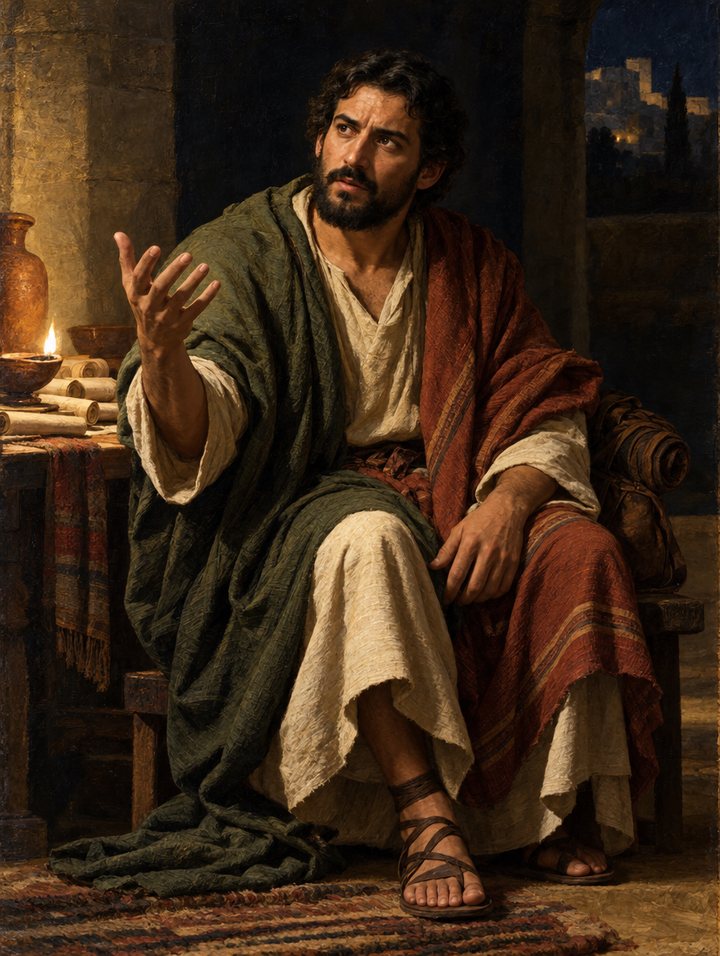
In the middle of that long conversation, one of the Twelve interrupts. "Judas (not Iscariot) said to him, 'Lord, what has happened that you are about to reveal yourself to us, and not to the world?'" (John 14:22).
Read the question slowly. It shows a man trying to understand the plan. Jesus has just said that the world will not see him anymore, but the disciples will (John 14:19). Judas wants to know why. If the Messiah is real, why not show himself to everyone? Why only to this small group of ordinary men? It is the question every reader eventually asks, and a Galilean villager asks it at the table with the greatest teacher in history just before the arrest.
Jesus does not scold the question. He answers it with a promise: "If a man loves me, he will keep my word. My Father will love him, and we will come to him, and make our home with him" (John 14:23).
That sentence is one of the most tender in the Gospel. The answer to "why only us?" is that the revelation is not a spectacle. It is a relationship. Jesus tells him that the Father and the Son will come and make a home with anyone who loves him and keeps his word. The Greek word for "home" there is the same one used for the "rooms" in the Father's house in John 14:2. Early in the chapter, Jesus promises to prepare a place for his followers. Here he reverses it: the Father and the Son will make their dwelling in the follower. John 14:2 and 14:23 belong together, and both answer a Galilean's worry that he has been left outside. Thaddaeus's question is the hinge between them.
Then Jesus continues, and the chapter ends with the lines about peace and the world's approach. Whoever the apostle was, his single question moved the conversation forward.
Not Iscariot
The way John introduces him is a small piece of history. He writes "Judas (not Iscariot)" because the other Judas had already come up in the same Gospel several times (6:71; 12:4; 13:2, 26-30). By the time the Gospel was written, the name had become tainted. Readers who knew the church knew both men, and John wanted no confusion on the page. The fact that the disciple is identified only by what he was not, in a passage this tender, says something about what it cost the faithful Judas to share a name with the traitor.
Not the author of the letter of Jude
The New Testament contains a short letter attributed to "Jude, a servant of Jesus Christ, and brother of James" (Jude 1:1). Many Christians have assumed that this Jude is the apostle. He is probably not. The letter's author calls himself a brother of James, and Mark 6:3 names the brothers of Jesus as James, Joses, Judas and Simon. So the letter's Jude is most naturally the brother of Jesus, a man who did not believe during Jesus' ministry (John 7:5) and later became a leader in the church. The letter itself, in verse 17, refers to "the apostles of our Lord Jesus Christ" as people he looks back on, which would be an odd way for an apostle to speak of himself. See Jude for the letter and its author.
The reason for the confusion is easy to see. "Judas the son of James" could be read as "Judas the brother of James," and the letter's author is "Jude, brother of James." The names line up. But the Greek of Luke more naturally says "son," and the letter's author never calls himself an apostle. Most modern scholars separate the two. Some early Christians did not.
What early church tradition remembered
Here we move from Scripture to later memory. The reports are old, but they are not first-century eyewitness reports, and they do not all agree.
Edessa and the letter of King Abgar
The earliest substantial tradition about a "Thaddaeus" comes from Eusebius of Caesarea, who wrote his Church History around AD 325. In book 1, chapter 13, he says he found in the archives of the city of Edessa (now Şanlıurfa in southeastern Turkey) the record of an exchange of letters between King Abgar V and Jesus himself. In the story, Abgar, who was ill, wrote to Jesus asking him to come and heal him. Jesus replied that he could not come, but that after his ascension one of his disciples would be sent. After the ascension, Eusebius says, "Judas, who was also called Thomas," sent Thaddaeus, "one of the seventy," to Edessa, where he healed the king and preached. You can read Eusebius's account at the Christian Classics Ethereal Library.
Careful readers should note two things. First, Eusebius's Thaddaeus is described as "one of the seventy" disciples mentioned in Luke 10, not as one of the Twelve. In Syriac tradition he is called Addai. Later writers merged the two figures, and the Eastern churches often speak of the apostle and the disciple in one breath. Second, most modern historians treat the letters between Abgar and Jesus as a legend that grew up in the third century, not as a letter from Jesus. The story shows that Christianity in Edessa had an early and respected origin. It does not prove that the apostle Thaddaeus was there.
Armenia
The Armenian Apostolic Church traces its beginnings to two apostles, Thaddaeus and Bartholomew. According to Armenian tradition, Thaddaeus preached in the region, won converts, was martyred, and was buried in what is now northwestern Iran. Armenia became the first state in the world to adopt Christianity as its official religion, in the early fourth century, under King Tiridates III and Gregory the Illuminator. The Armenian church has always held that its faith was already planted by the apostles in the first century, and it calls itself the "Armenian Apostolic" church for that reason.
A monastery known as the Monastery of Saint Thaddeus (also called Qara Kelisa, "Black Church") stands in the mountains of northwestern Iran. It was founded, by tradition, on the site of Thaddaeus's burial and was part of the Armenian Monastic Ensembles of Iran named a UNESCO World Heritage Site in 2008. The earliest surviving buildings are much later than the first century, but pilgrims have visited the place for centuries.
Persia, and Simon
In the Western tradition, Thaddaeus and Simon the Zealot are paired. The pairing appears in a collection of stories about the apostles called the Passion of Simon and Jude, which was composed centuries after their lifetimes and was attributed to a certain Abdias. In that account, the two men preach in Persia, confront magicians, convert many, and are killed together by a mob. Modern scholars treat the text as legendary. The Roman church keeps their feast together on October 28, and a tradition holds that relics of the two are kept in St Peter's Basilica in Rome. Neither the shared journey nor the shared death can be traced to any early source.
Emblems
In church art, Thaddaeus is often shown with a club or an axe, or with a small image of Jesus on a medallion. The medallion recalls the Abgar story, in which, according to later versions, Jesus pressed his face on a cloth and sent the image to the king. The club and axe come from the later legends of his death. None of these has historical standing, but they are part of how Christians have remembered him.
The patron of desperate cases
The most surprising chapter in the life of Thaddaeus comes in modern times.
For many centuries, he had a modest place in the calendar. Then, in the eighteenth and nineteenth centuries, Catholic devotion in Europe, and later in the United States, began to treat "St. Jude" as the patron of hopeless cases. The usual explanation is a simple one. Because his name was so close to the name of Judas Iscariot, people hesitated to ask for his help, and so, the saying went, he was a saint nobody prayed to and who therefore had more time for the desperate. Other explanations point to the sharp urgency of the New Testament letter of Jude, which belongs to a different man, and to a line in the letter that speaks of contending for the faith in difficult times. The history of the devotion is real, but its reasoning has always been popular piety more than doctrine.
In the early twentieth century, Catholic devotion to St. Jude grew quickly in the United States, especially in the hard years of the Great Depression. In 1962, the entertainer Danny Thomas, who said he had once prayed to St. Jude when he was desperate for work, founded St. Jude Children's Research Hospital in Memphis, Tennessee. It has since become one of the best-known pediatric cancer centers in the world, and it says it treats children without charging their families for treatment, travel or housing. A man the New Testament remembers for one question has become, in a sense, the namesake of one of the most generous medical missions in the world.
We should be plain about what this means. The Bible does not teach praying to saints, and Protestant readers will take a different view of the practice than Catholic and Orthodox ones. But the history of the devotion shows how a man with almost no recorded words can come to stand for something that millions of people find meaningful.
The sayings in our verse index
Thaddaeus has no recorded words in the New Testament except his one question, which is not in our index as a separate item. Our index does hold passages from the conversation that question belongs to, all spoken by Jesus on the night of the last supper while Thaddaeus sat at the table:
- John 13:34-35, the new commandment to love one another.
- John 14:1, 14:2, "Don't let your heart be troubled," and the rooms in the Father's house.
- John 14:6, "I am the way, the truth, and the life."
- John 14:15, "If you love me, keep my commandments."
- John 14:18, "I will not leave you orphans."
- John 14:26, the Spirit who will teach and remind them.
- John 14:27, "Peace I leave with you."
- John 15:5, 15:7, 15:12, 15:13, 15:16, the vine, abiding, and the greatest love.
- John 16:22, 16:24, 16:33, sorrow turned to joy, and "I have overcome the world."
His own question, "Lord, what has happened that you are about to reveal yourself to us, and not to the world?" (John 14:22), sits exactly between 14:18 and 14:26, and Jesus' answer in 14:23 is the line that connects them.
From same conversation
His only recorded line, John 14:22, is not indexed; these passages come from the same conversation
A new commandment I give unto you, That ye love one another; as I have loved you, that ye also love one another. By this shall all men know that ye are my disciples, if ye have love one to another.
Love one another as I have loved you. That is how people will know you.
Let not your heart be troubled: ye believe in God, believe also in me.
Do not let your heart be troubled. Trust God, and trust me too.
In my Father's house are many mansions: if it were not so, I would have told you. I go to prepare a place for you.
In my Father's house are many rooms. There is space prepared with your name on it.
Jesus saith unto him, I am the way, the truth, and the life: no man cometh unto the Father, but by me.
I am the way, the truth, and the life. Road, honesty, and breath.
If ye love me, keep my commandments.
If you love me, you will keep my commands. Love shows up in what you do.
I will not leave you comfortless: I will come to you.
I will not leave you as orphans. I will come to you.
But the Comforter, which is the Holy Ghost, whom the Father will send in my name, he shall teach you all things, and bring all things to your remembrance, whatsoever I have said unto you.
The Comforter will teach you all things and remind you of what I said.
Peace I leave with you, my peace I give unto you: not as the world giveth, give I unto you. Let not your heart be troubled, neither let it be afraid.
My peace I give you, not the kind the world gives. Do not be afraid.
I am the vine, ye are the branches: He that abideth in me, and I in him, the same bringeth forth much fruit: for without me ye can do nothing.
I am the vine and you are the branches. Apart from me you cannot bear fruit.
If ye abide in me, and my words abide in you, ye shall ask what ye will, and it shall be done unto you.
If you remain in me and my words remain in you, ask whatever you wish.
This is my commandment, That ye love one another, as I have loved you.
This is my command: love each other the way I have loved you.
Greater love hath no man than this, that a man lay down his life for his friends.
Greater love has no one than this, to lay down their life for their friends.
Ye have not chosen me, but I have chosen you, and ordained you, that ye should go and bring forth fruit, and that your fruit should remain: that whatsoever ye shall ask of the Father in my name, he may give it you.
I chose you and appointed you to go and bear fruit that lasts.
And ye now therefore have sorrow: but I will see you again, and your heart shall rejoice, and your joy no man taketh from you.
Your grief will turn to joy, and no one will take that joy from you.
Hitherto have ye asked nothing in my name: ask, and ye shall receive, that your joy may be full.
Ask and you will receive, so that your joy may be complete.
These things I have spoken unto you, that in me ye might have peace. In the world ye shall have tribulation: but be of good cheer; I have overcome the world.
In this world you will have trouble. But take heart, I have overcome the world.
Relationships
- Jesus chose him, and answered his question in John 14:23.
- James the son of Alphaeus, Simon the Zealot and Judas Iscariot are the other three in his group of four.
- Thomas speaks just before him in John 14:5, and Eusebius says it was Thomas who sent Thaddaeus to Edessa.
- Philip speaks between them in John 14:8, so the questions run Thomas, Philip, Judas.
- Bartholomew is linked with him in Armenian tradition as co-founder of the Armenian church.
- Jude, the brother of Jesus and author of the letter, is a different man, though the two are often confused.
- James, brother of Jesus and leader of the Jerusalem church, is the "James" in the letter's opening line.
- Matthias replaced Judas Iscariot, and Thaddaeus was one of the eleven who prayed over the choice (Acts 1:13-26).
- The Twelve is the group page.
Read their stories
 Jesus of NazarethTeacher, healer, and the Christ
 James, son of AlphaeusApostle, one of the twelve
 Simon the ZealotApostle, one of the twelve
 Judas IscariotApostle who betrayed JesusThomasApostle and subject of a non-canonical sayings collection
 PhilipApostle from Bethsaida
 BartholomewApostle, often identified with NathanaelJudeBrother of Jesus and writer of a short letter of warningJamesBrother of Jesus and leader of the Jerusalem churchMatthiasApostle chosen to replace JudasThe Twelve ApostlesThe original disciples Jesus chose and sent outHerod AntipasRuler of Galilee and PereaPontius PilateRoman governor of Judea
Death and legacy
The New Testament does not describe how Thaddaeus died. The Armenian tradition says he was martyred in the territory of modern northwestern Iran. The Western tradition says he and Simon were killed in Persia. Both are late. If he did go east, he joined the many early Christians who carried the message beyond the Roman frontier, to places where the story of Jesus would be told in Syriac, Armenian and Persian.
His legacy is easier to describe in pieces:
- A question. John 14:22 is the model of an honest question asked at the right moment. It shows that Jesus did not mind being asked why.
- A promise. The reply, "we will come to him, and make our home with him" (John 14:23), is one of the clearest statements in the New Testament that the Christian life is a shared life with God.
- A church. Armenian Christians have for seventeen centuries claimed Thaddaeus and Bartholomew as their founders, and the Armenian Apostolic Church is among the oldest national churches in the world.
- A mission. Whatever the details of his journeys, the legends about him align with a real historical fact. Early Christians did carry the message eastward, and the churches of Syria, Mesopotamia, Armenia and later India are part of the result.
- A hospital. The modern devotion that grew around his name led to St. Jude Children's Research Hospital, which has treated children from across the United States and around the world.
Places
- 1Galilee · the Twelve chosen
- 2Jerusalem (upper room) · John 14; Acts 1:13
- 3Edessa (Sanliurfa) · Eusebius, Church History 1.13
- 4Monastery of Saint Thaddeus (Chaldoran, Iran) · Armenian tradition of burial; UNESCO 2008
- 5Rome, St Peter's Basilica · relics of Simon and Jude by tradition
Beyond this map: Memphis, Tennessee (Wikipedia: St. Jude Children's Research Hospital).
Map drawn by 508 Ministry from Natural Earth public-domain data. Locations of ancient sites are approximate; some identifications are traditional.- Galilee, where the Twelve were chosen.
- The upper room in Jerusalem, where he asked his question (John 14).
- Edessa (Şanlıurfa), where Eusebius places the mission of Thaddaeus, one of the seventy.
- Armenia, claimed by tradition as his mission field.
- Chaldoran, in northwestern Iran, site of the Monastery of Saint Thaddeus.
- Rome, where relics of Simon and Jude are said to rest in St Peter's Basilica.
- Memphis, Tennessee, home of St. Jude Children's Research Hospital.
A timeline
- c. AD 28Chosen among the TwelveLuke 6:12-16
- c. AD 29Sent out with the TwelveMatthew 10
- c. AD 30-33Asks his question at the last supperJohn 14:22
- c. AD 30-33In the upper room; Matthias chosenActs 1:13-26
- after the ascensionThaddaeus of the seventy sent to Edessa (Eusebius)Church History 1.13
- c. AD 301 (traditional)Armenia adopts ChristianityArmenian tradition
- c. AD 325Eusebius records the Edessa traditionChurch History 1.13
- 6th centuryPassion of Simon and Jude composedpseudo-Abdias
- 1962St. Jude Children's Research Hospital founded by Danny ThomasMemphis
- 2008Armenian Monastic Ensembles of Iran named a UNESCO siteUNESCO
| Year | Event |
|---|---|
| c. AD 28 | Chosen among the Twelve (Luke 6:12-16) |
| c. AD 29 | Sent out with the Twelve (Matthew 10) |
| c. AD 30-33 | Asks his question in the upper room (John 14:22) |
| c. AD 30-33 | In the upper room after the ascension; Matthias chosen (Acts 1:13-26) |
| after the ascension | Edessa mission, according to Eusebius (a "Thaddaeus" of the seventy) |
| 4th century | Armenia adopts Christianity; the church claims apostolic roots |
| c. AD 325 | Eusebius records the Edessa tradition (Church History 1.13) |
| 6th century and later | The Passion of Simon and Jude tells of their shared mission and death |
| 1962 | Danny Thomas founds St. Jude Children's Research Hospital |
| 2008 | Armenian monastic ensembles of Iran, including St. Thaddeus, become a UNESCO site |
Why he matters
Most people who follow Jesus are not leaders or writers. They are people who sit at the table and listen and sometimes say, "I don't understand." Thaddaeus is the patron of that experience. His question is not a brilliant one, but it is honest, and the answer it received is for everyone: God does not stage a display for the crowd. He comes to the ones who love him, and he makes a home there.
For the ministry reader, the confusion around his names is a gentle reminder that a name that sounds like a bad one is not the same as a bad name. The man who had to be introduced as "not Iscariot" got a promise that includes everyone who comes after him.
By the numbers
| name used | |
|---|---|
| Matthew | Thaddaeus (some manuscripts: Lebbaeus) |
| Mark | Thaddaeus |
| Luke | Judas the son of James |
| John | Judas (not Iscariot) |
| Acts | Judas the son of James |
Watch
Go deeper
Start with John 14 in full: Blue Letter Bible, John 14:1-14, then read on to the end of the chapter. The lists of the Twelve are at Matthew 10:1-4 and Luke 6:12-16. For background, see the Wikipedia article on Thaddaeus and the Wikipedia article on Jude the Apostle. For the Edessa story, read Eusebius' Church History, book 1 chapter 13, at the Christian Classics Ethereal Library. For a visual walk through John's Gospel, watch the BibleProject's animated overview, part 2, which covers the upper room.
Every link on this page was checked when we built it, and the full list is in our file of verified sources.
References and further reading
- Wikipedia: Jude the Apostle (Thaddaeus)
- Wikipedia: Monastery of Saint Thaddeus
- Wikipedia: Armenian Apostolic Church
- Wikipedia: Epistle of Jude (a different Jude)
- Wikipedia: Abgar V of Edessa
- Wikipedia article on : Thaddaeus (topical)
- Blue Letter Bible: John 14:1-14 (KJV)
- Blue Letter Bible: John 14:15-31 (KJV)
- Blue Letter Bible: Matthew 10:1-4 (KJV)
- Bible Project
- Wikipedia: Saint Thaddeus Monastery (Armenian Monastic Ensembles of Iran)
- Wikipedia: St. Jude Children's Research Hospital
Public-domain books, free to read
- The Ecclesiastical History (Church History)Eusebius of Caesarea
- The Life and Times of Jesus the MessiahAlfred Edersheim
- The Life of ChristFrederic W. Farrar
- Antiquities of the JewsFlavius Josephus
- Fox's Book of MartyrsJohn Foxe
Written by 508 Ministry. Scripture links open the public-domain World English Bible. Where Scripture, early church tradition and historians differ, this page says so.