

The world Philip was born into
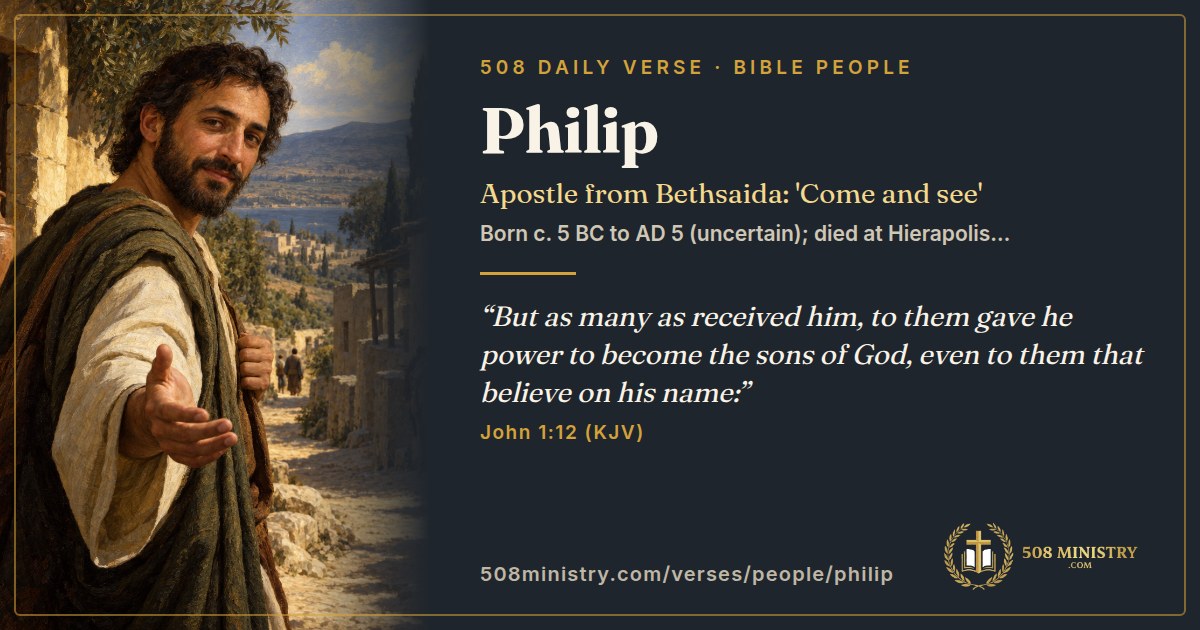
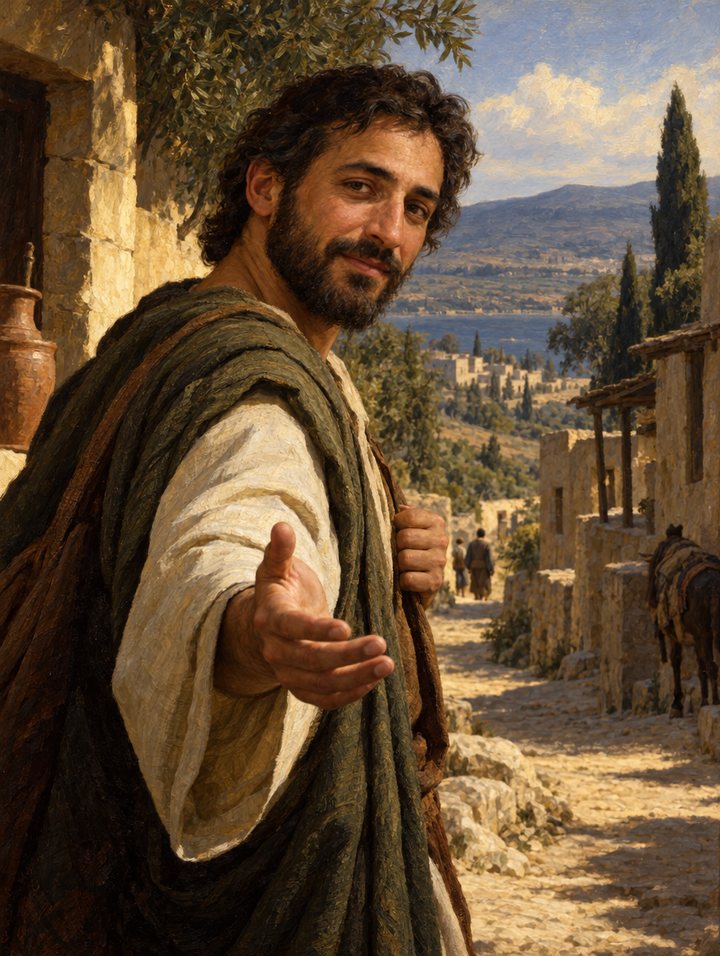
Philip was born in the first decades of the first century in Bethsaida, which means "house of fishing" in Aramaic. The town stood on the northeast shore of the Sea of Galilee near the mouth of the Jordan River, in the territory of Philip the tetrarch, a son of Herod the Great, who governed the lands east of the Jordan from 4 BC to AD 34. The tetrarch had rebuilt Bethsaida as a city and renamed it Julias in honor of Julia, the daughter of the emperor Augustus. It was a lakeside place of fishermen, traders and boat builders. Most archaeologists identify it with a mound called et-Tell, where excavations since 1987 under Rami Arav of the University of Nebraska at Omaha have uncovered city walls, houses, fishing weights and hooks, and a large gate complex, with evidence of both Jewish and Gentile life. That fits the Gospels, which put the village on the border of Galilee and the Greek-speaking cities of the Decapolis.
Many people in the district were bilingual. They spoke Aramaic at home and Greek in the market, and they gave their children Hebrew or Greek names. Among the Twelve, two have Greek names, Andrew and Philip. Peter's nickname is Greek as well. A Greek name did not mean a person was less Jewish. It meant he came from a place where two worlds touched.
Politics hung over everything. The Romans had ruled Judea directly since AD 6, when Archelaus was removed, and Pontius Pilate was governor from about AD 26 to 36. In Galilee, Herod Antipas governed under Roman authority. Taxes were heavy and the religious hopes of the people were high. Philip would have known the message of John the Baptist, since the Baptist drew crowds from all over, and Andrew, his neighbor, was among the Baptist's disciples.
Chapter one: "Follow me"
John 1:43-45 gives the call. The scene follows the day on which Andrew and another disciple spent the afternoon with Jesus and Andrew brought Peter. "The day following Jesus would go forth into Galilee, and findeth Philip, and saith unto him, Follow me. Now Philip was of Bethsaida, the city of Andrew and Peter." The words are few. Jesus found Philip. In the other calls it is the disciples who go and find someone or bring someone along. Here Jesus does the finding. In John's Gospel, Philip is the only disciple to whom Jesus says "Follow me" at the outset.
The note that Philip was from Bethsaida, "the city of Andrew and Peter," is a small reminder that faith in this story moved along the ties of a village. Andrew told Peter. Jesus found Philip, who was a neighbor of both. Philip then went to find Nathanael.
Verse 45 reads: "Philip findeth Nathanael, and saith unto him, We have found him, of whom Moses in the law, and the prophets, did write, Jesus of Nazareth, the son of Joseph." Notice the phrase "We have found him." It echoes Andrew's words to Peter, "We have found the Messias" (John 1:41), and the repetition is a sign of how the news was spreading from person to person. Philip's summary is clear and shows he knew his Bible: the one Moses and the prophets wrote about. At the same time, he describes Jesus in a way he later learns to correct: "the son of Joseph." Philip did not yet understand who Jesus was. He understood enough to say come.
Nathanael's reaction is famous. "Can there any good thing come out of Nazareth?" Nazareth was a tiny village of a few hundred people in the hills, unmentioned in the Old Testament, and Nathanael, who came from Cana, a few miles away, may have known it well enough to be skeptical. Many readers have felt the weight of his question. Philip's reply is among the best-known lines in all the Gospels, and in the end the wisest. He did not argue. He did not defend Nazareth or produce a proof from the prophets. He said, "Come and see" (John 1:46). It was the same invitation Jesus had given Andrew that first afternoon, "Come and see" (John 1:39). Philip passed it on word for word.
That is Philip's gift. He is not an orator or a theologian. He is the man who knows that some questions are best answered by inviting the questioner to meet the person. Nathanael came, and Jesus said of him, "Behold an Israelite indeed, in whom is no guile!" (John 1:47). This Nathanael is the same man the other Gospels call Bartholomew, as we explain in his own profile. The fact that Philip paired with Bartholomew in all three lists in Matthew, Mark and Luke supports the identification. They were evidently friends from the start. Our verse index has a line from the same chapter that describes how people respond to Jesus: "But as many as received him, to them gave he power to become the sons of God" (John 1:12).
Chapter two: Among the Twelve
When Jesus chose the Twelve, Philip stood among them. Matthew 10:3, Mark 3:18, Luke 6:14 and Acts 1:13 all name him fifth. In each of the lists, the Twelve fall into three groups of four, and each group is led by the same man in the same order. The first four are led by Peter, the second by Philip, and the third by James the son of Alphaeus. Philip, then, led the middle group. Some readers think this means he was a kind of organizer, someone the middle four looked to. It is only an inference from the pattern, but the pattern is real, and it gives Philip a quiet prominence.
Philip is paired with Bartholomew in all three Synoptic Gospels, and Matthew is paired with Thomas. In Acts, the pairs are different. The pairing suggests the friendship we have already seen, and perhaps that they were sent out two by two as Jesus did with the Twelve (Mark 6:7).
Chapter three: The test of the loaves
In John 6, a huge crowd followed Jesus across the Sea of Galilee. He went up on a mountain and sat with his disciples. "When Jesus then lifted up his eyes, and saw a great company come unto him, he saith unto Philip, Whence shall we buy bread, that these may eat? And this he said to prove him: for he himself knew what he would do" (John 6:5-6).
Why Philip? It may be because the place was near Bethsaida, Philip's hometown. John 6:1 and Luke 9:10 place the miracle near that village. Philip would know the area, the markets and the prices. Jesus asked the local man where the bread could be bought.
Philip answered like a person who checked the numbers: "Two hundred pennyworth of bread is not sufficient for them, that every one of them may take a little" (John 6:7). The coin was the denarius, a day's wage for a laborer, so two hundred denarii was roughly eight months' pay. Philip was honest and practical. He did the math, and the math said it was impossible. But it was a test, and he failed it the way most of us would. He saw the problem exactly and still left Jesus out of the calculation.
Notice, though, that Jesus did not rebuke him. The Gospel says only that the question was a test, and that Jesus himself knew what he would do. Then Andrew produced the boy with five barley loaves and two small fish (John 6:8-9), and Jesus fed the crowd with them. Philip, standing beside Andrew, saw it happen. He would have carried one of the twelve baskets of leftovers, a basket for each disciple. Many readers have taken from this scene a gentle lesson for anyone who is good at estimating. Realistic assessment is not a sin. It just is not the last word. The next day, in the synagogue at Capernaum, Jesus taught, "I am the bread of life: he that cometh to me shall never hunger; and he that believeth on me shall never thirst" (John 6:35). Philip had seen the sign, and now he heard what it meant. Our index also holds the line "All that the Father giveth me shall come to me; and him that cometh to me I will in no wise cast out" (John 6:37).
Chapter four: The Greeks who wanted to see Jesus
In the last week of Jesus' life, John 12:20-22 tells of another small scene that says a lot about Philip. "And there were certain Greeks among them that came up to worship at the feast: The same came therefore to Philip, which was of Bethsaida of Galilee, and desired him, saying, Sir, we would see Jesus. Philip cometh and telleth Andrew: and again Andrew and Philip tell Jesus."
Why did the Greeks come to Philip? There are several possible reasons. His name was Greek, so they may have thought he would be sympathetic. He came from a border town, so he might be at home with Gentiles. He may have spoken Greek better than his Aramaic-speaking friends. The text gives no reason, and we should not pretend to know. But we can see that Philip's background made him someone Gentiles could approach.
Notice Philip's caution. He did not simply lead the Greeks to Jesus. Jesus had earlier told his disciples to go "not into the way of the Gentiles" on their first mission (Matthew 10:5), and Philip may have wondered whether it was right to bring Gentiles to him at this stage. So he did what a careful person does, and asked a friend. He went to Andrew, and together they went to Jesus. It is a picture of teamwork. Philip had the connection, Andrew had the boldness for introductions, and together they got the job done.
We do not know whether the Greeks ever met Jesus. John does not say. What he records is Jesus' response, which signals that the hour had come: "The hour is come, that the Son of man should be glorified. Verily, verily, I say unto you, Except a corn of wheat fall into the ground and die, it abideth alone: but if it die, it bringeth forth much fruit" (John 12:23-24). It is as if the arrival of the first Gentile seekers told Jesus that his death was now what would bring in the nations. Our verse index has that saying, and the line after it: "If any man serve me, let him follow me; and where I am, there shall also my servant be: if any man serve me, him will my Father honour" (John 12:26).
Chapter five: "Shew us the Father"
The last Philip scene is in the upper room. Jesus has been telling the disciples that he is going away, and that they know the way. Thomas says he does not. Jesus answers with one of the most famous sayings in the Gospels: "I am the way, the truth, and the life: no man cometh unto the Father, but by me. If ye had known me, ye should have known my Father also: and from henceforth ye know him, and have seen him" (John 14:6-7). Our verse index holds verse 6, with the verses on either side: "Let not your heart be troubled" (John 14:1) and "In my Father's house are many mansions" (John 14:2).
Then Philip spoke. "Philip saith unto him, Lord, shew us the Father, and it sufficeth us" (John 14:8). It is a heartfelt request, almost a prayer. Philip had walked with Jesus for about three years and he still wanted more. He wanted to see God. Anyone who has felt that way, who loves Jesus and still longs for a clearer, closer view of God, can understand Philip.
Jesus answered with tenderness and a touch of sadness. "Have I been so long time with you, and yet hast thou not known me, Philip? he that hath seen me hath seen the Father; and how sayest thou then, Shew us the Father?" (John 14:9). Then he explained: "Believest thou not that I am in the Father, and the Father in me? the words that I speak unto you I speak not of myself: but the Father that dwelleth in me, he doeth the works. Believe me that I am in the Father, and the Father in me: or else believe me for the very works' sake" (John 14:10-11).
Here is the great claim of the Christian faith, put simply: that to look at Jesus is to see what God is like. And it came in answer to the question of a fisherman from Bethsaida who wanted to see God. No other disciple's question draws such a statement. A great many Christians believe that Philip asked, in this moment, the question every person asks. Jesus did not scold him for it. He said, in effect, "You have already seen."
Philip's name is also, unexpectedly, tied to a theological tradition. The doctrine that Christ reveals the Father is a keystone of the church's teaching on the Trinity, and the answer to Philip is cited in the early church's debates, as in Athanasius' defense of Christ's full deity in the fourth century. A question from a quiet, practical man in an upper room fed centuries of reflection.
Chapter six: After the ascension
Acts 1:13 lists Philip among the eleven in the upper room in Jerusalem after the ascension, "continuing with one accord in prayer and supplication." After that, the New Testament does not mention him again as an apostle. Almost everything we say about his later life comes from tradition, and it is bound up with the other Philip.
Let us separate them. The Philip of Acts 6 to 8 and 21 was one of the Seven chosen to oversee the daily distribution of food among the Greek-speaking widows (Acts 6:1-6). After Stephen's death, Philip went to Samaria and preached, and many believed (Acts 8:5-13). An angel then directed him to the road from Jerusalem to Gaza, where he met an Ethiopian official reading Isaiah 53 in his chariot. Philip explained the passage, "and preached unto him Jesus," and baptized him (Acts 8:26-39). Then the Spirit carried him away, and he turned up in Azotus and preached in all the towns until he reached Caesarea. Twenty years later, Paul stayed in his house there, and Luke notes that Philip had four unmarried daughters who prophesied (Acts 21:8-9). This Philip is called "the evangelist," and he was not one of the Twelve. Acts 8:1 says that when persecution scattered the church, "they were all scattered abroad throughout the regions of Judaea and Samaria, except the apostles." Since the apostles remained in Jerusalem, the Philip preaching in Samaria cannot have been an apostle. For that reason, most scholars and many church fathers distinguish the two.
But early Christian writers were not always so careful. Polycrates, bishop of Ephesus, writing about AD 190, said that "Philip, one of the twelve apostles," lay buried at Hierapolis together with two of his daughters who had grown old as virgins, and another daughter who had died in the Holy Spirit and was buried at Ephesus. That is quoted by Eusebius in his Church History (3.31 and 5.24). Eusebius himself also quotes Papias, who lived at Hierapolis, as saying that he had heard Philip's daughters tell remarkable stories (3.39). Two different men may have been mixed in memory. Either Polycrates was thinking of the evangelist, whose daughters are known from Acts, and called him an apostle by mistake. Or there was a tradition about Philip the apostle and daughters that we cannot now sort out. Eusebius himself seems uncertain, and some modern scholars favor the first explanation. It is a case where the evidence is genuinely mixed.
What tradition says about his death
The most detailed account of Philip's later life comes from the Acts of Philip, an apocryphal work probably written in the fourth or fifth century, long after the events. It tells how Philip, with his sister Mariamne and Bartholomew, preached in Greece, Phrygia and elsewhere, performed miracles and confronted pagan priests. At Hierapolis, it says, he cast out a serpent or dragon worshiped there, and the angered city authorities had him crucified upside down. Some versions say he was stoned, or that he was hanged by the ankles, and that Bartholomew was also arrested. An earthquake struck, the crowd was frightened, and Philip told them to release Bartholomew and leave him on the cross. The text shows a rough, imaginative style quite unlike the book of Acts, and historians do not treat it as reliable. It does show how Hierapolis kept Philip's memory alive, and the dates in it (the death falling around AD 80, under Domitian) are as uncertain as the rest. The upside-down crucifixion is also told of Peter, and it may be a borrowed motif.
Hierapolis, now Pamukkale in Turkey, was a thriving Greek-Roman spa city built on a hill of white calcium terraces from hot springs. Christianity arrived early. Paul's letter to the Colossians mentions it (Colossians 4:13), and Papias was bishop there in the early second century. A large octagonal building on a hill outside the city, the Martyrium of St. Philip, was built in the fifth century, probably over what was believed to be his tomb. In 2011, an Italian archaeological team led by Francesco D'Andria announced that it had found a tomb they believed to be Philip's, near the church. The announcement drew wide interest, but other scholars have been cautious. The tomb's date and identification rest on circumstantial reasoning, and no inscription names Philip. We note the find, and we treat the identification as possible and unproven.
Philip is remembered in the Western church on 3 May, together with James the son of Alphaeus. In the Eastern churches, his day is 14 November, and the forty days of Advent fasting in the Orthodox tradition begin the day after, which is why the season is sometimes called the Philip fast.
The gospel that carries his name
A last confusion should be mentioned. There is a book called the Gospel of Philip. It is not in the New Testament, and Philip did not write it. It is a Gnostic text from around the third century, found among the Nag Hammadi writings in Egypt in 1945. It teaches ideas about secret knowledge and the spiritual world that the early church rejected as contrary to the apostles' teaching. Philip's name was attached to it to give it prestige, a common practice at the time. Anyone who comes across a claim based on the "Gospel of Philip" should know that historians date it long after the apostle's lifetime and that it tells us nothing reliable about him.
Legacy and the ripple effect
What did the quiet apostle leave behind? Mostly two sentences. "Come and see" and "Lord, shew us the Father." The first is the best method of introducing people to Jesus ever devised. It does not require a perfect argument. It asks only that people look for themselves. The second is the question that reaches below every other question and that Jesus answered in terms every reader can grasp. The man whom the Gospels remember as practical and cautious asked the deepest question and received the clearest answer.
Philip's invitation has traveled. A faith that began with a handful of villagers from Bethsaida now counts about 2.2 billion adherents, according to the Pew Research Center's 2010 estimate, with a projection of around 2.9 billion in 2050. Surveys of how people come to faith show again and again the role of personal invitation: a friend, a relative, a neighbor who says, in effect, "Come and see." Philip's method remains the most effective. The villages of the lake sent that invitation across the Mediterranean world and past it.
In the Christian East, Philip is honored among the great apostles, and his name is borne by countless people: Philip, Philippe, Felipe, Filippo, Fülöp. The name was already common in Greek, and after the apostle it became more so. Cities and churches carry it, and a European king, a prince consort and a number of saints have been named for him.
What Philip teaches us
First, that an invitation can do what an argument cannot. Nathanael's doubt was real and reasonable, and Philip did not try to talk him out of it. He said, "Come and see." Many people today are carrying honest doubts about faith, and they are rarely moved by pressure. They are moved by an invitation to look, to listen and to meet.
Second, that being practical and being faithful are not opposites. Philip did the math at the feeding of the five thousand, and the math said no. Jesus did not rebuke him. He used the occasion to show what he could do. If you are the kind of person who counts the cost, you are not disqualified. Bring your honest numbers, and watch what happens when they meet the one who made the numbers.
Third, that it is good to ask for more. "Shew us the Father, and it sufficeth us" is not a lack of faith. It is a hunger for God. Jesus answered it with patience. If you long to see God more clearly, bring that longing to Christ. He said, "He that hath seen me hath seen the Father."
Fourth, that a connector is a servant. Philip's role in the Greeks' story was small, but without him they might never have reached Jesus. Not everyone has a big platform. Some people open the door.
Relationships
- Andrew, his neighbor from Bethsaida and his partner in bringing the Greeks to Jesus: Andrew
- Peter, also of Bethsaida: Peter
- Bartholomew (Nathanael), the friend he brought to Jesus and his usual partner in the lists of the Twelve: Bartholomew
- Jesus, who found him and answered his question: Jesus
- Thomas, who spoke in the same upper room scene just before him: Thomas
- John, whose Gospel is the only one to tell Philip's story: John
- Stephen and the Seven of Acts 6, among whom the other Philip, the evangelist, served: Stephen
- The rest of the Twelve: The Twelve
Read their stories
 AndrewApostle, fisherman, and brother of Simon Peter
 PeterApostle, fisherman, and rock of the early church
 BartholomewApostle, often identified with Nathanael
 Jesus of NazarethTeacher, healer, and the ChristThomasApostle and subject of a non-canonical sayings collection
 John the ApostleApostle and beloved discipleStephenDeacon and first Christian martyrHerod AntipasRuler of Galilee and PereaPontius PilateRoman governor of JudeaThe Twelve ApostlesThe original disciples Jesus chose and sent out
A note on sources and honesty
Philip's reliable record is in John 1:43-51, John 6:5-7, John 12:20-22, John 14:8-11, and the apostle lists in Matthew 10, Mark 3, Luke 6 and Acts 1. Everything about his preaching and death comes from tradition. Polycrates, Papias and Eusebius give the earliest hints, while the Acts of Philip is a late and legendary text. The identity of the Philip buried at Hierapolis is uncertain because of the confusion with Philip the evangelist. The 2011 tomb find is reported but disputed. We have tried to say where each claim comes from, and we have avoided inventing details.
Because Philip does not speak in the verse index, we have no direct sayings of his to quote beyond his own words in John. The verses that our index holds from the scenes he stood in, such as John 1:12, 6:35, 12:24, 12:26, 14:1, 14:2 and 14:6, are listed in the section below because they were spoken near him, not by him.
Timeline
- 27Found by Jesus: 'Follow me'John 1:43
- 27Brings Nathanael: 'Come and see'John 1:45-46
- 29Calculates the cost of feeding the crowdJohn 6:5-7
- 30Brings the Greeks to Jesus with AndrewJohn 12:20-22
- 30Asks 'Lord, shew us the Father'John 14:8-9
- 30In the upper room after the ascensionActs 1:13
- 80Dies at Hierapolis (tradition, date uncertain)Polycrates in Eusebius, Church History 3.31
- 2011Italian team announces a tomb at Hierapolis it believes may be Philip'sArchaeological announcement, disputed
Places
- 1Bethsaida · home town; site et-Tell is the leading identification
- 2Capernaum · base of Jesus' Galilee ministry; family home
- 3Sea of Galilee · fishing lake
- 4Jerusalem · Pentecost, early church
- 5Cana of Galilee (Khirbet Qana) · Nathanael's home
- 6Hierapolis · traditional death place of Philip
Watch
Go deeper
Read John 1:35-51 slowly, then John 6:1-14 and John 12:20-33, then John 14:1-14. Watch for the places where Philip stands, and notice that in three of the four he is with Andrew. Then read Eusebius, Church History, book 3, chapters 31 and 39, to see how the early church remembered the family of Philip. The links below lead to public-domain texts and reference articles.
References and further reading
- Wikipedia
- Wikipedia article
- Blue Letter Bible lexicon entry for the name
- Eusebius, Church History (CCEL)
- Schaff, History of the Christian Church vol. 1 (CCEL)
- Josephus, Antiquities of the Jews (Project Gutenberg)
- Edersheim, Life and Times of Jesus the Messiah (Internet Archive)
- Foxe, Book of Martyrs (Project Gutenberg)
- BibleProject
- Pew Research Center, Religious Projections 2010-2050
- Wikipedia: Hierapolis
- Wikipedia: Bethsaida
Public-domain books, free to read
- Church History (Eusebius), NPNF series 2 vol. 1Eusebius of Caesarea
- Antiquities of the JewsFlavius Josephus
- The Wars of the JewsFlavius Josephus
- The Life and Times of Jesus the MessiahAlfred Edersheim
- Fox's Book of MartyrsJohn Foxe
- History of the Christian Church, vol. 1: Apostolic ChristianityPhilip Schaff
- The Apostolic Fathers with Justin Martyr and Irenaeus (ANF vol. 1)Ante-Nicene Fathers
Every verse in our index linked to this life
None of our indexed verses were spoken by Philip the Apostle. These indexed verses come from scenes where he was present. John 1:12; John 1:16; John 6:35; John 6:37; John 12:24; John 12:26; John 14:1; John 14:2; John 14:6.
Verses from our index
None of our indexed verses were spoken by Philip the Apostle. These indexed verses come from scenes where he was present
But as many as received him, to them gave he power to become the sons of God, even to them that believe on his name:
To all who received him he gave the right to become children of God.
And of his fulness have all we received, and grace for grace.
Out of his fullness we have all received grace upon grace. Grace stacking on grace.
And Jesus said unto them, I am the bread of life: he that cometh to me shall never hunger; and he that believeth on me shall never thirst.
I am the bread of life. Whoever comes to me will not be hungry.
All that the Father giveth me shall come to me; and him that cometh to me I will in no wise cast out.
Whoever comes to me I will never drive away. Never is a strong word.
Verily, verily, I say unto you, Except a corn of wheat fall into the ground and die, it abideth alone: but if it die, it bringeth forth much fruit.
Unless a seed falls into the ground and dies, it stays a single seed.
If any man serve me, let him follow me; and where I am, there shall also my servant be: if any man serve me, him will my Father honour.
Whoever serves me must follow me, and my Father will honour them.
Let not your heart be troubled: ye believe in God, believe also in me.
Do not let your heart be troubled. Trust God, and trust me too.
In my Father's house are many mansions: if it were not so, I would have told you. I go to prepare a place for you.
In my Father's house are many rooms. There is space prepared with your name on it.
Jesus saith unto him, I am the way, the truth, and the life: no man cometh unto the Father, but by me.
I am the way, the truth, and the life. Road, honesty, and breath.
Written by 508 Ministry. Scripture links open the public-domain World English Bible. Where Scripture, early church tradition and historians differ, this page says so.