

The world Andrew was born into
Andrew grew up in the same Galilee as his brother, under the same Roman rule, in a Jewish society that had learned to live under foreign power while waiting for God to act. Herod the Great had died in 4 BC and his sons divided the kingdom. Herod Antipas governed Galilee and Perea. His brother Philip governed the territory east of the Jordan, including Bethsaida, which Philip rebuilt and renamed Julias in honor of Caesar Augustus' daughter. Judea, with Jerusalem, passed to direct Roman governors, and Pontius Pilate served from about AD 26 to 36.
Bethsaida deserves attention, because it explains something about Andrew. The name means "house of fishing" in Aramaic, and it was a lakeside village with an inlet from the Jordan River. The site is now identified by most archaeologists with et-Tell, a mound a short way inland from the present shoreline, though the lake level and the coast have shifted over the centuries and some prefer a nearby site. John 1:44 says that Philip, Andrew and Peter all came from Bethsaida, and that is a small piece of evidence for how a group of friends came to follow Jesus together. They were neighbors. Later John 12:21 says Philip was "of Bethsaida of Galilee." Bethsaida sat on the border between Jewish Galilee and the Greek-speaking cities of the Decapolis, and it was also a mixed place. Andrew and Philip both carry Greek names, while Peter, whose name Simon is Hebrew, also carries a Greek nickname, Petros. A family that gave a son the name Andrew was a family with feet in two cultures.
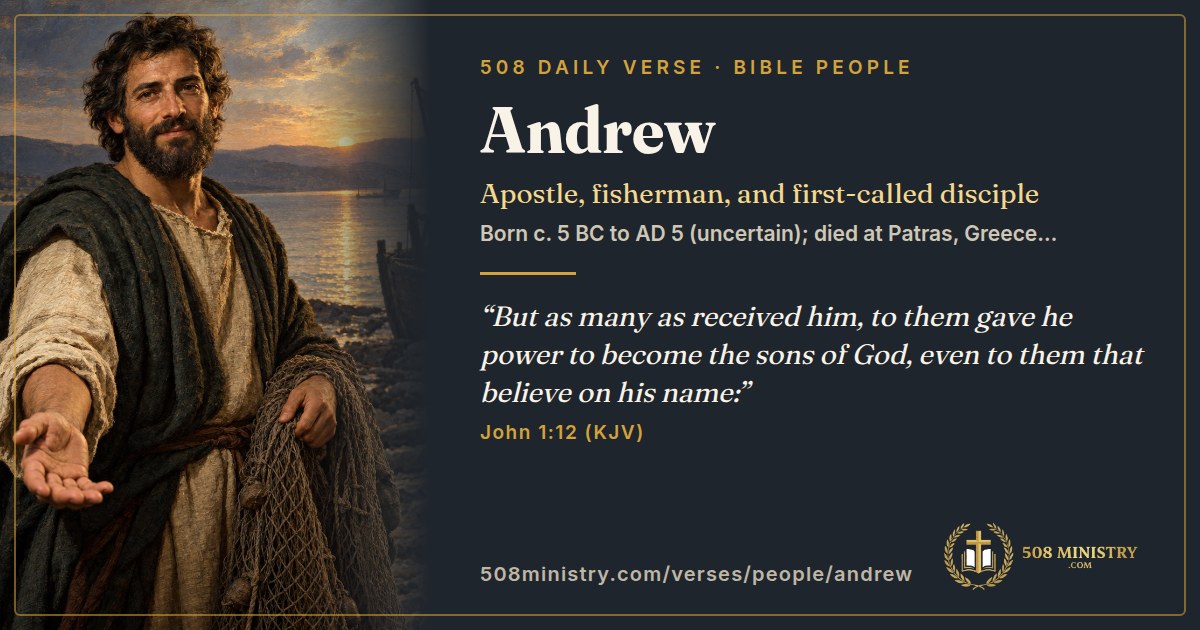
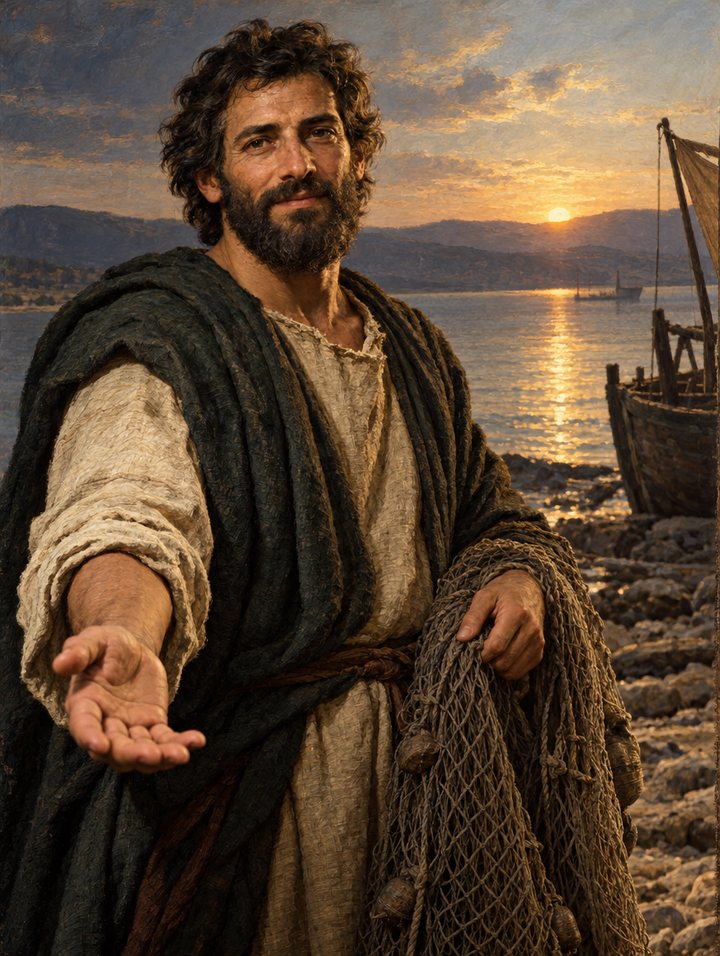
The family business was fishing. Mark 1:16 says Simon and Andrew were "casting a net into the sea: for they were fishers." The Greek word used for their net is a casting net, a circular net thrown by hand from the shore or a boat in shallow water. That is different from the large dragnets the partners James and John used. Andrew and Peter worked in two modes. Luke 5 shows them in a boat with a bigger net as well. The family later lived in Capernaum, where Mark 1:29 says Jesus entered "the house of Simon and Andrew." So the house was jointly known as theirs. A fishing family in the first century usually held a lease from the tax system under Antipas, and the lake produced dried and salted fish that went to markets across the region. Andrew was not a poor man on the margins, but a small tradesman working with his brother, and his story begins with the moment he decided that something mattered more than the work.
The religious setting had a special tension. Many Jews were looking for the Messiah. Some looked for a king who would drive out Rome, others for a priest or a prophet. The wilderness preacher John, son of Zechariah, was baptizing at the Jordan and calling the people to repent because "the kingdom of heaven is at hand." Large crowds went out to him. Andrew was one of them.
Chapter one: The disciple of John
The fourth Gospel supplies the first scene, and it is the most important one for understanding Andrew. John 1:35-42 describes it. On a day when John the Baptist stood with two of his disciples, he saw Jesus walking by and said, "Behold the Lamb of God!" The two disciples heard him and followed Jesus. Jesus turned and asked them, "What seek ye?" They said, "Rabbi, where dwellest thou?" He said, "Come and see." They went and saw where he stayed and "abode with him that day: for it was about the tenth hour," which is about four in the afternoon by Jewish reckoning.
John names one of the two as Andrew. The other is not named, and many readers over the centuries have thought the unnamed disciple was the author of the Gospel himself, John the apostle, who has a habit of leaving himself nameless. That is an inference and not a statement of Scripture, but it fits.
Then comes the line that defines Andrew: "He first findeth his own brother Simon, and saith unto him, We have found the Messias, which is, being interpreted, the Christ. And he brought him to Jesus" (John 1:41-42). The word "first" suggests that the unnamed companion also went to find a brother, perhaps James. Andrew, in any event, did something that has proved to be the most effective way of spreading faith in all of history. He did not argue. He did not give a lecture. He said, in effect, "I have found him," and he took his brother along. Our verse index carries a line from the same chapter, "But as many as received him, to them gave he power to become the sons of God, even to them that believe on his name" (John 1:12), and one that could be written over Andrew's whole life: "And of his fulness have all we received, and grace for grace" (John 1:16).
Notice what this scene says about Andrew's character. He was a seeker who had already given himself to a prophet's preaching, and when that prophet pointed to someone greater, Andrew followed without jealousy. That is not a small thing. John the Baptist's disciples were loyal to him, and the Gospels record that some of them felt competitive when Jesus began to draw bigger crowds (John 3:26). Andrew did not. He changed teachers on the Baptist's own word. The Baptist had said, "He must increase, but I must decrease" (John 3:30), and Andrew took him at his word.
Chapter two: The call at the lake
Matthew 4:18-20 and Mark 1:16-18 record the second meeting, which most readers think happened some time after the first. Jesus was walking by the Sea of Galilee. He saw two brothers, Simon called Peter and Andrew, casting a net. "Follow me, and I will make you fishers of men." They left their nets and followed him. Matthew and Mark name Peter first, then Andrew, and describe the call to both together.
There is no real contradiction between John 1 and the later call. John describes a first encounter at the Jordan in Judea. The other Gospels describe a later invitation to leave the work and travel as his constant companions. Between the two, Andrew and Peter went back to the family trade. Many ordinary people today make a decision in two stages too: first they meet something that interests them, then later they commit. It is easy to read the calling stories as dramatic, one-off events, and it is a relief to see that they were more like real life.
What "fishers of men" meant to a fisherman is simple. A net does not make a fish come; the fisherman goes where the fish are, prepares the net, and then brings them in. The work was patient and sometimes unrewarding. For Andrew it became his whole life's pattern. He was a catcher of people, one at a time.
Chapter three: In the circle of the Twelve
When Jesus chose the Twelve, Andrew was among them (Matthew 10:2; Mark 3:18; Luke 6:14; Acts 1:13). The lists vary in order but follow a pattern. In Matthew 10:2 and Luke 6:14, Andrew is named second, right after Peter, as a brother. In Mark 3:18 and Acts 1:13, he is moved down and Peter, James and John come first. That small difference tells us that Andrew stood close to the core group without being one of the three who went everywhere with Jesus. Mark does have him in a special scene, though. In Mark 13:3, as Jesus sat on the Mount of Olives opposite the temple, "Peter and James and John and Andrew asked him privately" about the end of the age. So the group of four fishermen heard the private teaching that Jesus gave on the future. Andrew was in the inner conversation, even if he is not in every list of the inner three.
Andrew's role in the Twelve, as the Gospels show it, was connector. Whatever the occasion, he is found bringing someone or something to Jesus. John is the Gospel that shows this best, and it shows it three times.
Chapter four: The boy with the loaves
The first of these is the feeding of the five thousand. All four Gospels tell the story, and only John names Andrew and Philip as the speakers (John 6:5-9). A huge crowd had followed Jesus up a hillside on the far side of the lake. Jesus turned to Philip, a man from Andrew's own hometown, and asked, "Whence shall we buy bread, that these may eat?" John adds that Jesus said this to test him, "for he himself knew what he would do." Philip, a practical man, calculated: "Two hundred pennyworth of bread is not sufficient for them." That was about eight months of a day laborer's wages.
Then Andrew spoke up. "There is a lad here, which hath five barley loaves, and two small fishes: but what are they among so many?" (John 6:8-9). Look at what Andrew did. He had walked through the crowd and found a boy with a small lunch. He did not think it was enough, and he said so. But he brought it anyway. And Jesus took the five loaves and the two fish, gave thanks, and distributed them, and everyone ate as much as they wanted. Twelve baskets of scraps were gathered afterward.
Andrew's contribution was tiny. It was also essential. He did not produce the miracle, and he doubted the arithmetic out loud, but he put the little he found into Jesus' hands. Many readers have taken this scene as a picture of his whole role. Others have noted something sweet in it: Andrew noticed a boy. In a crowd of thousands, in a setting where adults were worrying about money, Andrew saw a child. Barley loaves were the cheapest bread, the food of the poor, so this was likely the lunch of a family with very little. The boy, whose name we never learn, gave all he had. Our verse index includes a word from the same chapter of John, "I am the bread of life: he that cometh to me shall never hunger" (John 6:35), spoken the next day in the synagogue at Capernaum, and another, "All that the Father giveth me shall come to me; and him that cometh to me I will in no wise cast out" (John 6:37).
Chapter five: The Greeks at the feast
The third scene is the most telling. John 12:20-22 happens in the final week, after the entry into Jerusalem. Among those who came up to worship at the Passover feast were "certain Greeks." These were Gentiles who feared the God of Israel and came to Jerusalem to worship. They came to Philip and said, "Sir, we would see Jesus." Philip did not know what to do. He did not simply take them. Instead, "Philip cometh and telleth Andrew: and again Andrew and Philip tell Jesus."
It is easy to miss the care in this sentence. Philip went to Andrew, and Andrew went with him to Jesus. Evidently Andrew was the person you went to when you wanted to bring someone to Jesus. These were the first Gentile seekers in John's Gospel, and the one who brings them is Andrew. Jesus answers with one of his most important teachings: "The hour is come, that the Son of man should be glorified. Verily, verily, I say unto you, Except a corn of wheat fall into the ground and die, it abideth alone: but if it die, it bringeth forth much fruit" (John 12:23-24). That saying is in our index, with the next verse, "If any man serve me, let him follow me; and where I am, there shall also my servant be: if any man serve me, him will my Father honour" (John 12:26). The arrival of the Greeks signals to Jesus that the time of his death is near, and that through his death the world will be drawn to him.
Taken together, these three scenes make a pattern that no other disciple shares so clearly. Andrew brings Peter. Andrew brings the boy's lunch. Andrew brings the Greeks. He never preaches a famous sermon in the Gospels, never asks the great questions, never draws a sword or walks on water. He introduces. If evangelism is, as many have said, one beggar telling another beggar where to find bread, then Andrew is its patron.
Chapter six: The question on the hillside
Andrew's presence at the Mount of Olives in Mark 13 deserves another look. In the days before Jesus' arrest, with the temple's great stones glittering in the sun, a disciple had remarked on the buildings, and Jesus told them that not one stone would be left upon another. The four fishermen came to him privately and asked, "Tell us, when shall these things be? and what shall be the sign when all these things shall be fulfilled?" Jesus gave a long answer, full of warnings and encouragement. It includes the line "Heaven and earth shall pass away: but my words shall not pass away" (Mark 13:31), which is in our index. Andrew sat there as one of the four who asked the question. It is a reminder that even the quiet one in the group wanted to understand.
The last night and the empty tomb
The Gospels do not mention Andrew by name in the story of the arrest. Like the others, he fled (Mark 14:50). After the crucifixion, the disciples hid together. Acts 1:13 lists Andrew among the eleven who met in the upper room in Jerusalem, "continuing with one accord in prayer and supplication." After the resurrection he joined the others in waiting for the Spirit. Beyond this, Scripture is silent.
There is one more note from tradition that touches Scripture. The Muratorian fragment, a list of New Testament books from Rome in the late second century, says that the Gospel of John came about when Andrew was told in a revelation that John should write it all down, with the other disciples reviewing it. This is a late tradition, not evidence, but it shows that the early church saw Andrew as a respected figure among the first generation.
What tradition says about his later life
Here we leave the New Testament and enter tradition, and we should be careful. The earliest outside reference to Andrew's mission field comes from Origen, as quoted by Eusebius in his Church History (3.1). Eusebius, writing about AD 325, says that the apostles divided the world among themselves by lot. Thomas received Parthia, Andrew received Scythia, and John received Asia. Scythia then meant the lands north of the Black Sea, reaching as far as what is now Ukraine and southern Russia. This is a tradition recorded two or three centuries after the events. We do not know how Origen or Eusebius came by it.
A much later tradition, which first appears in medieval sources, says that Andrew preached in Byzantium, the later Constantinople, and ordained its first bishop, Stachys, who is named in Romans 16:9. This tradition helped the church of Constantinople claim an apostolic origin, rivaling Rome's claim to Peter. That fact is worth noticing: Andrew's story was partly shaped by the church politics of later centuries. The Ecumenical Patriarch of Constantinople to this day is called the successor of the "First-Called," a title taken from John 1:35-42, where Andrew is the first disciple to follow.
The Acts of Andrew is an apocryphal work from the second or third century that tells how Andrew preached in Greece, performed miracles, and was crucified at Patras. The text survives only in pieces, and the church never accepted it as Scripture. Its details include a long speech Andrew makes to the cross in which he welcomes it. Historians treat the work as pious fiction, though it may preserve an old memory that Andrew died at Patras in Achaia. Eusebius does not give the place of Andrew's death. The idea that he was crucified on an X-shaped cross, now called the saltire or St. Andrew's cross, does not appear in the early sources at all. It shows up in the tenth century and becomes common in medieval art. Many scholars think it is a late development. An earlier tradition has him tied to an ordinary cross, and the pious detail that he lingered for two days, preaching to the crowd, is part of the legendary material.
His relics have an interesting history. According to a tradition recorded by Jerome and others, the emperor Constantius II transferred relics said to be Andrew's from Patras to Constantinople in AD 357, to the church of the Holy Apostles. After the Fourth Crusade sacked Constantinople in 1204, Cardinal Peter of Capua took relics from the city to Amalfi in Italy in the early thirteenth century, where they are still kept in the cathedral. In 1964 Pope Paul VI returned the head of Andrew to Patras as a gesture of friendship toward the Greek Orthodox Church. A cathedral in Patras today holds it. The mix of history and legend here is thick, and we cannot say for certain whose bones these are.
Andrew in Scotland, Russia and beyond
Why is the Scottish flag a white diagonal cross on blue? The story, in its medieval form, says that relics of Andrew were brought to a place on the east coast of Scotland by a monk named Regulus, or Saint Rule, who was shipwrecked there in the fourth century, in a version of the legend. Another version has a bishop named Acca of Hexham bringing relics in the eighth century. The town that grew up there took the name St Andrews, and its cathedral and later its university, founded in 1413, became one of the great centers of Scottish learning. Medieval Scots made Andrew their patron. A Scottish declaration of independence, the Declaration of Arbroath of 1320, even names him, calling Andrew "the first of His Apostles." The saltire appears on Scottish flags and seals from the Middle Ages, and the modern flag of Scotland is the saltire. The Union flag of the United Kingdom combines it with the crosses of England and Ireland.
In the East, a medieval Russian tradition, found in the Primary Chronicle of the twelfth century, says that Andrew traveled up the Dnieper River from the Black Sea and stood on the hills where Kyiv later rose. He set up a cross and prophesied that God's grace would shine on that place and a great city would be built. Historians regard the story as a later effort to link the Russian church with an apostle. Even so, Russia's highest naval flag, the Saint Andrew's flag, still bears a blue saltire on white, and the Order of Saint Andrew was Russia's highest honor under the tsars. Romania also honors Andrew as the one who first preached in its territory, and the Romanian Orthodox Church holds his feast on 30 November as a national day. Greece, Ukraine and Georgia share in the veneration, and several cities and universities carry his name.
The date is easy to remember. The Western and Eastern churches both keep his feast on 30 November. In the Western church calendar, it fell at the end of the church year and later marked the beginning of Advent, so the first week of the season of waiting begins with the first disciple.
Death and legacy
If we put the strands together, the picture is this. The New Testament says almost nothing about how Andrew's life ended. The best-supported early tradition is that he went to the lands around the Black Sea and later to Greece, and that he was martyred, probably by crucifixion, at Patras. He may have been in his sixties or seventies. Many church historians see no reason to doubt the main outline that Andrew was martyred, since the early church recorded that nearly all the apostles were, though they also point out how thin the evidence is. Even a critical historian can accept that Andrew was a real person who followed Jesus and stood among the earliest leaders of the church.
His legacy is stronger than the details. What the church remembers about Andrew is a disposition, not a doctrine or a miracle. He was not jealous of the Baptist, and he was not jealous of his own brother. History remembers Peter, who preached to thousands, yet Peter might never have met Jesus without Andrew. That is a lesson about how faith moves among people. Most of the people who changed the course of history had someone like Andrew behind them, a person whose name is rarely spoken.
There is also a quieter kind of ripple. A large share of Christians in the world today came to faith because a friend, a relative or a neighbor invited them. Researchers who study conversion have found this again and again: personal invitation beats mass media. Andrew's pattern, the personal introduction, is the chief way the faith has spread. The Pew Research Center estimated about 2.2 billion Christians worldwide in 2010 and projected about 2.9 billion by 2050. Behind each of those numbers lies a line of people who said to someone, "Come and see."
What Andrew teaches us
First, that small offerings matter. The boy's lunch fed thousands. Andrew did not know it would, and he doubted it would, and he brought it anyway. We do not need to know how our small contribution will be used. We need only to bring it.
Second, that being second is no failure. Andrew is almost always named in relation to someone else: "Simon Peter's brother." He seems to have accepted this without complaint. In a culture that prizes the spotlight, he stands for an honest kind of service that does not need to be seen. Jesus said that "whosoever will be great among you, shall be your minister" and that "even the Son of man came not to be ministered unto, but to minister, and to give his life a ransom for many" (Mark 10:43-45; our index holds verse 45). Andrew lived that out.
Third, that the best invitation is simple. "Come and see" was Jesus' own phrase, and "We have found him" was Andrew's. Neither needs an argument. Both need a willingness to say something personal to another person.
Fourth, that the gospel is for outsiders. When the Greeks asked to see Jesus, they reached him through Andrew. The man who brought his brother, and a boy, also brought strangers. Nobody seems to have been outside the reach of his welcome.
Relationships
- Peter, his brother, whom he brought to Jesus: Peter
- Philip, his fellow townsman from Bethsaida and his partner in bringing the Greeks: Philip
- James and John, the sons of Zebedee, partners in the fishing business and members of the group who heard the Olivet teaching: James, John
- John the Baptist, his first teacher, who pointed him to Jesus: John the Baptist
- Jesus, who called him and fed thousands with a boy's lunch: Jesus
- The rest of the Twelve: The Twelve
Read their stories
 PeterApostle, fisherman, and rock of the early church
 PhilipApostle from Bethsaida
 James, son of ZebedeeApostle and brother of John
 John the ApostleApostle and beloved disciple
 John the BaptistProphet who prepared the way for Jesus
 Jesus of NazarethTeacher, healer, and the ChristHerod AntipasRuler of Galilee and PereaPontius PilateRoman governor of JudeaThe Twelve ApostlesThe original disciples Jesus chose and sent out
A note on sources and honesty
For Andrew, the New Testament gives the reliable core: John 1:35-42, Matthew 4:18-20, Mark 1:16-18 and 1:29, Mark 13:3, John 6:8-9, John 12:20-22 and Acts 1:13. Everything else is tradition of varying age and reliability. The mission to Scythia comes from Eusebius, quoting Origen. The martyrdom at Patras comes from the Acts of Andrew and later writers. The saltire cross, the Scottish and Russian legends and the details of the relics are medieval. We have tried to name each layer. If you read other accounts that tell the legends as plain fact, you now know where to check.
By the numbers
Timeline
- 27Follows Jesus after John the Baptist points him outJohn 1:35-40
- 27Brings his brother PeterJohn 1:41-42
- 28Called to leave his netsMark 1:16-18
- 29Finds the boy with the loavesJohn 6:8-9
- 30Brings the Greeks with PhilipJohn 12:20-22
- 30Waits with the eleven in the upper roomActs 1:13
- 357Relics said to move from Patras to ConstantinopleJerome, Against Vigilantius
- 1964Head returned to Patras by Pope Paul VIVatican announcement 1964
Places
- 1Bethsaida · home town; site et-Tell is the leading identification
- 2Capernaum · base of Jesus' Galilee ministry; family home
- 3Sea of Galilee · fishing lake
- 4Jerusalem · Pentecost, early church
- 5Constantinople (Byzantium) · later tradition, relics
- 6Patras · traditional place of martyrdom
- 7Amalfi · relics in the cathedral
Beyond this map: St Andrews, Scotland (medieval cult site).
Map drawn by 508 Ministry from Natural Earth public-domain data. Locations of ancient sites are approximate; some identifications are traditional.Watch
Go deeper
Read John 1, John 6 and John 12 in one sitting, and watch for Andrew's three appearances. Then read Eusebius, Church History, book 3, chapter 1, for the early tradition of the apostles' mission fields. The public-domain books and reference links at the bottom of this page will take you further.
References and further reading
- Wikipedia
- Wikipedia article
- Blue Letter Bible lexicon entry for the name
- Eusebius, Church History (CCEL)
- Schaff, History of the Christian Church vol. 1 (CCEL)
- Josephus, Antiquities of the Jews (Project Gutenberg)
- Edersheim, Life and Times of Jesus the Messiah (Internet Archive)
- Foxe, Book of Martyrs (Project Gutenberg)
- BibleProject
- Pew Research Center, Religious Projections 2010-2050
- Wikipedia: Bethsaida
- Wikipedia: Capernaum
Public-domain books, free to read
- Church History (Eusebius), NPNF series 2 vol. 1Eusebius of Caesarea
- Antiquities of the JewsFlavius Josephus
- The Wars of the JewsFlavius Josephus
- The Life and Times of Jesus the MessiahAlfred Edersheim
- Fox's Book of MartyrsJohn Foxe
- History of the Christian Church, vol. 1: Apostolic ChristianityPhilip Schaff
- The Apostolic Fathers with Justin Martyr and Irenaeus (ANF vol. 1)Ante-Nicene Fathers
Every verse in our index linked to this life
None of our indexed verses were spoken by Andrew. These indexed verses come from scenes where he was present. John 1:12; John 1:16; John 6:35; John 6:37; John 12:24; John 12:26; Mark 10:45; Mark 13:31.
Verses from our index
None of our indexed verses were spoken by Andrew. These indexed verses come from scenes where he was present
But as many as received him, to them gave he power to become the sons of God, even to them that believe on his name:
To all who received him he gave the right to become children of God.
And of his fulness have all we received, and grace for grace.
Out of his fullness we have all received grace upon grace. Grace stacking on grace.
And Jesus said unto them, I am the bread of life: he that cometh to me shall never hunger; and he that believeth on me shall never thirst.
I am the bread of life. Whoever comes to me will not be hungry.
All that the Father giveth me shall come to me; and him that cometh to me I will in no wise cast out.
Whoever comes to me I will never drive away. Never is a strong word.
Verily, verily, I say unto you, Except a corn of wheat fall into the ground and die, it abideth alone: but if it die, it bringeth forth much fruit.
Unless a seed falls into the ground and dies, it stays a single seed.
If any man serve me, let him follow me; and where I am, there shall also my servant be: if any man serve me, him will my Father honour.
Whoever serves me must follow me, and my Father will honour them.
For even the Son of man came not to be ministered unto, but to minister, and to give his life a ransom for many.
The Son of Man came not to be served but to serve. Greatness looks like serving.
Heaven and earth shall pass away: but my words shall not pass away.
Heaven and earth will pass away, but my words will not.
Written by 508 Ministry. Scripture links open the public-domain World English Bible. Where Scripture, early church tradition and historians differ, this page says so.