

The world John was born into
John was born, like his brother, in the early years of the first century in the fishing country around Bethsaida and Capernaum. Galilee was under Herod Antipas, and Judea under Roman governors, among them Pontius Pilate from about AD 26 to 36. The family business was fishing. Mark 1:20 says Zebedee had hired servants, which suggests a boat owner with some means. Zebedee and his sons were partners with Simon and Andrew (Luke 5:10). The Gospel of John itself shows inside knowledge of Jerusalem. It knows the names of the high priest's household, mentions that "another disciple" was known to the high priest and got Peter into the courtyard (John 18:15-16), and gives details about the temple and the festivals that suggest the author spent time in Judea and Jerusalem. Some scholars take this as a sign that John's family had connections there. Others think it reflects the author's later residence or his sources.
The religious climate of the Judea that formed him mixed hope and tension. The temple stood in its splendor, rebuilt by Herod the Great, and thousands came up for the feasts. The Baptist preached near the Jordan, drawing crowds from the countryside, and John was among those who went. The fourth Gospel, which is the only Gospel to show the Baptist's disciples becoming Jesus' disciples, is evidently told by someone who had been there.
Chapter one: Two disciples at the Jordan
John 1:35-40 describes the day. John the Baptist was standing with two of his disciples. When he saw Jesus walking, he said, "Behold the Lamb of God!" The two followed Jesus, and Jesus asked, "What seek ye?" They said, "Rabbi, where dwellest thou?" He said, "Come and see." One of them is named as Andrew. The other is not named, and the fourth Gospel never names its main source. The most natural reading, which has been held since the early church, is that the unnamed disciple was John himself, who then and there became a follower of Jesus. The Gospel adds a small detail that reads like a memory: "it was about the tenth hour" (verse 39), around four in the afternoon. The detail has no purpose in the story except that someone remembered it.
The pattern repeats later. Throughout the fourth Gospel, one figure is never named: the disciple whom Jesus loved. He is at the Last Supper, at the trial, at the cross, at the tomb, and in the boat at the end. A natural reading is that this was the author's way of writing himself into the book without drawing attention to himself. The Gospel says so in its last chapter: "This is the disciple which testifieth of these things, and wrote these things: and we know that his testimony is true" (John 21:24). The "we" suggests that others, perhaps his own community, stood behind the book and vouched for it.
Chapter two: The sons of thunder
The call by the lake, as told in Mark 1:19-20 and Luke 5:1-11, put John in a boat mending nets with his father and his older brother. Jesus called, and they followed. The Synoptic Gospels (Matthew, Mark and Luke) give us the other side of John, which the fourth Gospel never mentions. Mark 3:17 tells us that Jesus nicknamed James and John "Boanerges, which is, The sons of thunder." The name suggests passion and fire. The stories in which it comes to life show two young men with sharp tempers and sharper ambitions.
In Mark 9:38, John said, "Master, we saw one casting out devils in thy name, and he followed not us: and we forbad him, because he followed not us." Jesus' answer was, "Forbid him not: for there is no man which shall do a miracle in my name, that can lightly speak evil of me. For he that is not against us is on our part." On the road to Jerusalem, as told in Luke 9:51-56, a Samaritan village refused to welcome Jesus. James and John asked whether they should call down fire from heaven to consume the village. Jesus turned and rebuked them. And in Mark 10:35-45, the two brothers, or their mother on their behalf, asked for the seats on either side of Jesus in his glory. Jesus asked whether they could drink his cup. They said they could. He told them they would, and that places of honor were not his to give. These scenes are told in full in the profile of James, son of Zebedee.
If these were the only things we knew about John, we would take him for an intolerant, ambitious young man. And yet, the same John, according to tradition, became the apostle of love. How the thunder became tenderness is the story of his life, and it is a story that begins with how he looked at Jesus.
Chapter three: The inner circle and the mountain
John was one of the three whom Jesus took with him to moments others did not see. He was present at the raising of Jairus' daughter (Mark 5:37), at the Transfiguration (Mark 9:2-8), and in Gethsemane (Mark 14:33). When Jesus sent two disciples to prepare the Passover meal, Luke 22:8 says the two were Peter and John. At the Last Supper, John 13:23 says that "there was leaning on Jesus' bosom one of his disciples, whom Jesus loved." In the seating customs of the time, a person reclining at a table lay on his left side, with the head near the chest of the person next to him. So the beloved disciple was in the place of honor next to Jesus. When Peter wanted to find out who would betray Jesus, he signaled to this disciple, who asked.
The Transfiguration left its mark on John's writing. In John 1:14 he writes, "And the Word was made flesh, and dwelt among us, (and we beheld his glory, the glory as of the only begotten of the Father,) full of grace and truth." "We beheld his glory" is the language of someone who had stood on a mountain and seen it. In his first letter he begins in the same way: "That which was from the beginning, which we have heard, which we have seen with our eyes, which we have looked upon, and our hands have handled, of the Word of life" (1 John 1:1). He insists that this was not an idea but a fact he had seen and touched.
Chapter four: The Last Supper and the new commandment
The upper room occupies a huge part of John's Gospel. Five chapters, John 13 through 17, take place on that night. They contain the foot washing, the farewell talks and the prayer for unity. Many of the best-loved verses in the Bible come from this stretch, and our index holds a long list of them.
At the start of the evening, John says with tenderness: "Having loved his own which were in the world, he loved them unto the end" (John 13:1). Then Jesus washed the disciples' feet. John, who had once wanted fire from heaven, watched his Master kneel with a towel. Jesus gave a new commandment: "A new commandment I give unto you, That ye love one another; as I have loved you, that ye also love one another. By this shall all men know that ye are my disciples, if ye have love one to another" (John 13:34-35). He comforted them: "Let not your heart be troubled: ye believe in God, believe also in me. In my Father's house are many mansions... I go to prepare a place for you" (John 14:1-2). He said, "I am the way, the truth, and the life: no man cometh unto the Father, but by me" (John 14:6). He promised the Holy Spirit, "the Comforter" (John 14:26), and said, "Peace I leave with you, my peace I give unto you: not as the world giveth, give I unto you" (John 14:27). He taught, "I am the vine, ye are the branches: He that abideth in me, and I in him, the same bringeth forth much fruit: for without me ye can do nothing" (John 15:5). And he said, "Greater love hath no man than this, that a man lay down his life for his friends" (John 15:13). All of these lines are in our verse index. One of the clearest sayings in the whole Gospel comes in John 16:33: "In the world ye shall have tribulation: but be of good cheer; I have overcome the world."
Whatever one makes of the question of how John's Gospel was composed, whether it preserves Jesus' words closely or reflects decades of meditation on them, the conversations in John's upper room were treasured by the beloved disciple. He remembered them with a clarity that decades did not take away.
Chapter five: The cross
The beloved disciple was at the cross. The Synoptic Gospels say that Jesus' followers fled, and Mark 14:50 says "they all forsook him, and fled." John 19:25-27 alone tells us who stood near. "Now there stood by the cross of Jesus his mother, and his mother's sister, Mary the wife of Cleophas, and Mary Magdalene. When Jesus therefore saw his mother, and the disciple standing by, whom he loved, he saith unto his mother, Woman, behold thy son! Then saith he to the disciple, Behold thy mother! And from that hour that disciple took her unto his own home."
Think about what that scene means. Jesus, dying, with all the cosmic weight of what was happening, paused to arrange care for his mother. He gave her to the disciple he trusted most. The man who had once asked for a throne beside Christ's was given something quieter: a mother to look after. John accepted it, and from that hour, the text says, she lived in his home. A tradition that is common in the East says that she stayed with John in Ephesus until her death, though other traditions place her last years in Jerusalem. Some historians point out that if John was Jesus' cousin through Salome, as some think, then the arrangement kept the family within the family, though that is an inference. Jesus' own brothers did not yet believe in him (John 7:5), which may also explain why he did not hand his mother to them.
John also reports a detail that no one else does. After Jesus died, a soldier pierced his side with a spear, and "forthwith came there out blood and water." John adds, "And he that saw it bare record, and his record is true: and he knoweth that he saith true, that ye might believe" (John 19:35). The author is saying that he was there.
Chapter six: The race to the tomb
On the morning of the resurrection, Mary Magdalene ran to tell Peter and "the other disciple, whom Jesus loved," that the stone had been moved. The two ran to the tomb together. "So they ran both together: and the other disciple did outrun Peter, and came first to the sepulchre. And he stooping down, and looking in, saw the linen clothes lying; yet went he not in." Peter, arriving, went straight in. Then the other disciple went in, "and he saw, and believed" (John 20:3-8). The story has the flavor of an old man's honest memory of a footrace. He was faster. He hesitated at the door. Peter was bolder. He believed first. All three details are in character.
Later in John 21, the two disciples appear together again in the story of the great catch of fish. After the night of nothing, a figure on the shore called to them. It was John who said to Peter, "It is the Lord" (John 21:7). Peter jumped into the water. The one who loved recognized him first, and the one who was bold swam to him first. After breakfast, Jesus restored Peter and gave him his task. Peter, turning, saw the beloved disciple following and asked, "Lord, and what shall this man do?" Jesus said, "If I will that he tarry till I come, what is that to thee? follow thou me" (John 21:21-22). The saying spread among the believers that this disciple would not die, and the Gospel corrects the rumor: Jesus did not say that, but only, "If I will that he tarry till I come, what is that to thee?" (John 21:23). That correction suggests the Gospel was finished or edited after John's death, or at least when he was very old.
Chapter seven: Pentecost and Jerusalem
Acts shows John working beside Peter. He is named among the eleven in Acts 1:13. He walked with Peter to the temple at the hour of prayer, and when Peter healed the lame man, John was beside him (Acts 3:1-10). Both were arrested and brought before the Sanhedrin. Acts 4:13 says, "Now when they saw the boldness of Peter and John, and perceived that they were unlearned and ignorant men, they marvelled; and they took knowledge of them, that they had been with Jesus." The word the council used for "unlearned" meant without formal training in the schools. John, who would one day write the most philosophically rich of the Gospels, was seen as a layman. Acts 4:20 has the line that best sums up both men: "For we cannot but speak the things which we have seen and heard."
When Philip the evangelist had preached in Samaria and many believed, the church sent Peter and John from Jerusalem to pray for the new believers (Acts 8:14-17). The man who once wanted to burn a Samaritan village now walked into Samaria to lay hands on Samaritan believers and pray that they receive the Holy Spirit. The connection is hard to miss. Luke seems to want us to see how far John has come.
Paul, writing to the Galatians about a visit to Jerusalem around AD 49, says that "James, Cephas, and John, who seemed to be pillars, perceived the grace that was given unto me, they gave to me and Barnabas the right hands of fellowship" (Galatians 2:9). So John was still in Jerusalem around that time, and recognized as one of the leaders.
Chapter eight: Ephesus and the later years
Here Scripture goes quiet and early tradition takes over. The principal witness is Irenaeus, bishop of Lyon, who wrote around AD 180. As a young man, Irenaeus had listened to Polycarp, bishop of Smyrna, and Polycarp, he says, had known John. In a letter to a man named Florinus, preserved by Eusebius, Irenaeus recalled how Polycarp used to speak "of his intercourse with John and with the rest of those who had seen the Lord." That is a three-link chain: John, Polycarp, Irenaeus. Irenaeus says in Against Heresies (3.1.1) that John, "the disciple of the Lord, who also had leaned upon His breast, did himself publish a Gospel during his residence at Ephesus in Asia." He also says that John lived at Ephesus until the time of the emperor Trajan, who reigned from AD 98 to 117. Polycrates, bishop of Ephesus around AD 190, also says John is buried there, calling him the one who "leaned on the Lord's breast."
Ephesus, then, was a huge port city in what is now Turkey. It held the temple of Artemis, one of the seven wonders of the ancient world, a theater that seated about twenty-five thousand people, and a large Jewish community. Paul had founded a church there in the 50s (Acts 19), and Timothy had led it. The tradition says that after the destruction of Jerusalem in AD 70, and as the center of Christian life moved north and west, John settled there and became the leading elder of the churches in the province of Asia.
Eusebius preserves some charming stories from this period, from Clement of Alexandria. One is about a young man whom John had entrusted to a bishop's care, and who fell in with robbers and became their captain. When John returned and learned what had happened, he rode out into the hills, was captured by the robber band and found the young man at its head. The young man tried to run away in shame, but the old apostle chased him, crying, "Why do you flee from me, your own father, unarmed and old? Pity me, my son; do not fear. You still have hope of life. I will give account to Christ for you. If need be, I will willingly endure your death, as the Lord endured death for us. For you I will give up my own life. Stop! Believe! Christ has sent me." The young man stopped, threw down his weapons and wept, and was restored to the church. Whether or not the details are exact, the picture of the old man who runs after a lost son is the same man who later wrote, "Behold, what manner of love the Father hath bestowed upon us, that we should be called the sons of God" (1 John 3:1).
Another story comes from Jerome in the fourth century. In his old age, when John was too weak to walk to church, his disciples would carry him in and he would say only: "Little children, love one another." When asked why he repeated the same words, he answered: "It is the Lord's commandment, and if this only be done, it is enough." This story is late and cannot be verified, but it fits the message of his first letter, in which love is the test of everything.
A third story, from Irenaeus, says that John once went to bathe at Ephesus and, seeing the heretic Cerinthus inside, left at once, saying, "Let us flee, lest even the bath-house fall down, because Cerinthus, the enemy of the truth, is within." Irenaeus heard it from people who had heard Polycarp tell it. It shows that John was remembered as defending the church's faith against false teaching about Christ's humanity.
Chapter nine: Patmos
Revelation 1:9 says: "I John, who also am your brother, and companion in tribulation, and in the kingdom and patience of Jesus Christ, was in the isle that is called Patmos, for the word of God, and for the testimony of Jesus Christ." Patmos is a small, rocky island in the Aegean Sea, about forty miles off the Turkish coast. The Romans used islands like it as places of banishment. Early tradition, in Irenaeus, Clement of Alexandria and Eusebius, says that the exile took place under the emperor Domitian, who ruled from AD 81 to 96, and that John was released when Nerva came to the throne after Domitian's death. Some scholars suggest an earlier date under Nero. The majority view favors Domitian's reign, partly because of the evidence of emperor worship in Asia Minor at that time.
On Patmos, John says, "I was in the Spirit on the Lord's day," and heard a loud voice. He saw the risen Christ in glory, and wrote the visions that make up the Book of Revelation, beginning with letters to seven churches in Asia, including Ephesus. It is an extraordinary book, full of symbols, and Christians interpret it in many ways. Its central message is simple and was written for people under pressure: Christ is alive, he rules, and he will make all things new. Our index holds several verses from it. "Behold, I stand at the door, and knock: if any man hear my voice, and open the door, I will come in to him, and will sup with him, and he with me" (Revelation 3:20). "Thou art worthy, O Lord, to receive glory and honour and power: for thou hast created all things" (Revelation 4:11). "And God shall wipe away all tears from their eyes; and there shall be no more death, neither sorrow, nor crying, neither shall there be any more pain: for the former things are passed away" (Revelation 21:4). "Behold, I make all things new" (Revelation 21:5). And the book ends with "Even so, come, Lord Jesus" (Revelation 22:20).
A story attached to this exile is told by Tertullian around AD 200: that John, before his banishment, was taken to Rome, plunged into boiling oil, and came out unharmed. Jerome later placed the event at the Latin Gate, and a church in Rome, San Giovanni a Porta Latina, commemorates it. Historians view the account with caution. It appears in no earlier source and no one else reports it.
The question of authorship
Did John the apostle write the Gospel, the three letters and Revelation? It is fair to say that scholars disagree, and to lay out why.
The Gospel of John: Irenaeus, Polycrates and others in the second century assign it to John the apostle at Ephesus. The Gospel itself says its source is the beloved disciple (John 21:24). Many conservative and some critical scholars accept apostolic authorship or at least that the apostle stood behind the testimony. Others believe the Gospel was shaped over time by a community of John's followers, or written by a different John, an elder in Ephesus. They point to the very different style and teaching from the Synoptics and to the Gospel's late date, usually put between AD 85 and 100. A scrap of papyrus known as P52, a fragment of John 18 held in the John Rylands Library in Manchester, is usually dated to the first half of the second century, around AD 125 to 150. That means the Gospel was already circulating, possibly in Egypt, not long after the traditional date, which makes late-second-century invention of the text unlikely.
The three letters: First John is tied closely to the Gospel in style, vocabulary and theme. Second and Third John, the shortest books in the New Testament, are written by "the elder." Papias, a bishop of Hierapolis around AD 110 to 130, mentions an "elder John" distinct from John the apostle, and this has fueled the theory that "John the Elder" wrote some or all of the Johannine writings. Eusebius himself believed that the elder John, not the apostle, wrote Revelation, partly because he disliked the book's teaching about a thousand-year reign. The question remains open.
Revelation: the author calls himself John four times and says he was on Patmos. He never says he was an apostle. Justin Martyr, around AD 155, names "John, one of the apostles of Christ" as its author. Later, a church leader in Alexandria named Dionysius, around AD 250, noted that the Greek of Revelation differs from the Gospel's, being rougher, and argued for a different John. Modern scholars are split.
We think a reasonable position is this. The core tradition that John the son of Zebedee was a leading figure in the Ephesian church and stands behind the Johannine tradition is early and strong. How much he personally wrote and how much was shaped by his circle is debated by serious, faithful scholars. We treat the books as Scripture either way, and for a profile of the apostle we draw on them with the clear note that attribution is tradition.
Death and legacy
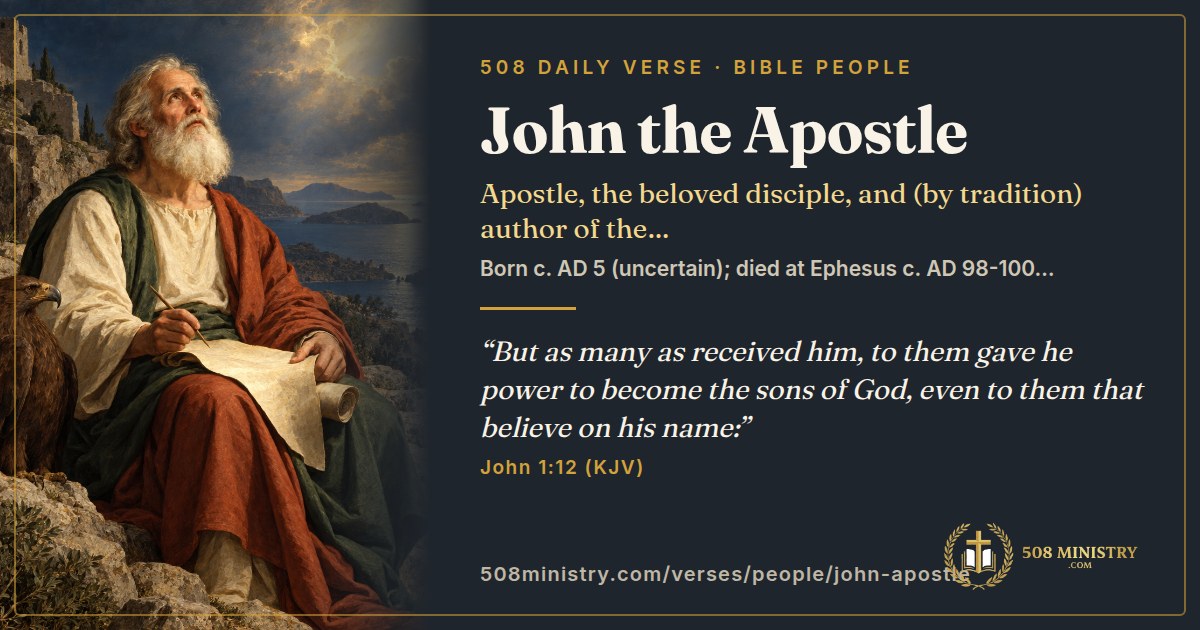
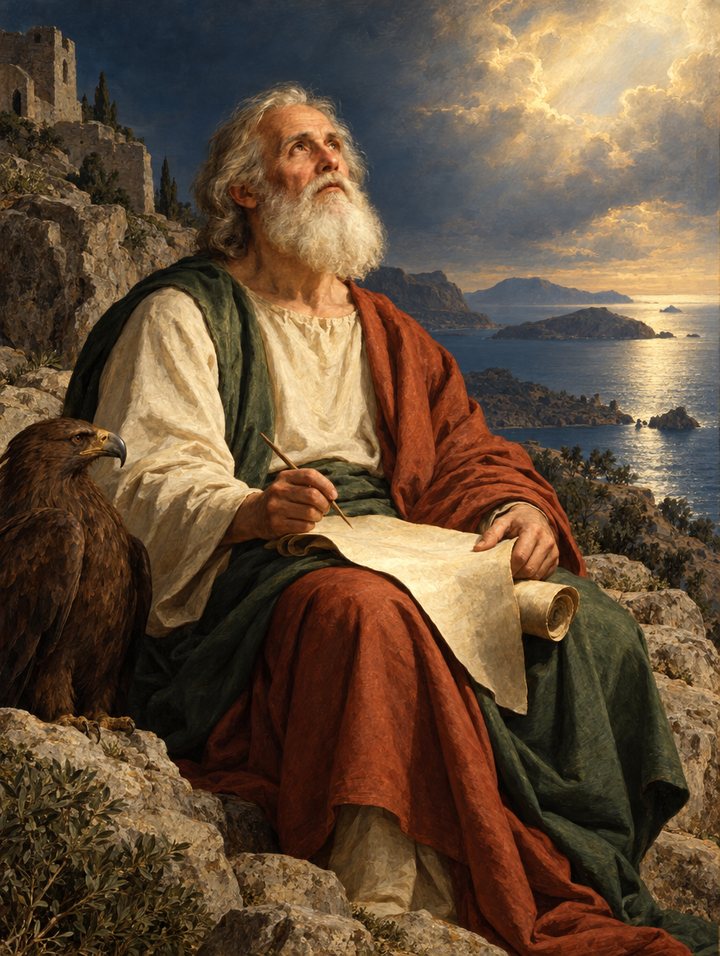
According to the dominant tradition, John died of old age in Ephesus, around AD 98 to 100, at the end of the first century. He would have been in his nineties if he was born near AD 5 or so. He is the one apostle whom tradition says did not die a martyr's death, though he suffered exile and, in the legend, the cauldron of oil. For this reason later writers speak of him as a martyr in will but not in deed. In the church's artistic tradition, he is often shown young and beardless, beside a cup with a serpent rising from it (from a legend that he drank poison unharmed) or with an eagle, the symbol assigned to the fourth Gospel by Irenaeus and Jerome, whose soaring vision looks directly at the sun.
A church was built over the traditional tomb on the hill of Ayasuluk, near Ephesus, by the fourth century. In the sixth century, the emperor Justinian built a large basilica of St. John there, whose ruins can still be visited at Selçuk in Turkey. The sixth-century basilica was a significant pilgrimage center. Archaeologists have found the remains of an earlier structure beneath it. As with every apostle's grave, identification rests on a continuous tradition and not on proof.
John's legacy is enormous and often missed. Verses like "God so loved the world" (John 3:16) and "God is love" (1 John 4:8) are probably the most quoted lines in the Bible. The Prologue of his Gospel shaped the church's teaching on who Christ is, and it was the key text for the councils of the fourth and fifth centuries that defined the doctrine of the Trinity and the incarnation. Augustine's sermons on the Gospel of John fill a long book. Bach set the Passion according to St. John. Revelation inspired a huge range of art, music and poetry, from medieval cathedral windows to Handel's Messiah, which draws on its imagery in the "Hallelujah" chorus. A great number of the church's hymns come from John's visions.
The ripple effect
If Peter's life opened the church to the nations, John's writing gave the church its voice for love. Every time a believer says "God is love," they are quoting him. His first letter, which says "We love him, because he first loved us" (1 John 4:19) and "if we love one another, God dwelleth in us" (1 John 4:12), became the basis for Christian charity, hospitals, hospices and care for strangers. The command to love one another, which he heard on the last night, became in the early church the identifying mark that pagans noticed. The Roman writer Lucian, in the second century, mocked Christians for their willingness to care for their own, and the emperor Julian, in the fourth century, complained that the Galileans fed the poor of other faiths as well as their own.
The numbers also tell part of the story. The Pew Research Center estimated about 2.2 billion Christians worldwide in 2010 and projected around 2.9 billion in 2050. The Gospel of John is among the most widely translated pieces of writing in history. It is often the first book translated into a new language by Bible translators and the book that missionaries and new readers are encouraged to start with.
What John teaches us
First, that people change. The man who wanted to burn a village became the man who wrote "He that loveth not knoweth not God; for God is love" (1 John 4:8). That change did not come from becoming softer by nature. It came from being close to Jesus for years and from watching him love people.
Second, that proximity matters. John was called the disciple whom Jesus loved, and he saw himself that way with gratitude, not with pride. He did not write "the disciple who loved Jesus best," but "the one Jesus loved." Whoever grasps that has the foundation for loving others. As he writes, "We love him, because he first loved us" (1 John 4:19).
Third, that staying counts. John stayed at the cross. He did not say much and could do nothing, but he was there. Sometimes the most important thing a person can do is be present.
Fourth, that love and truth belong together. The same man who said "Little children, love one another" also said that anyone who denies the Father and the Son is deceiving others (1 John 2:22), and he walked out of the bathhouse when a false teacher walked in. In John, love is never vague or soft. It is rooted in the truth that the Word became flesh. "My little children, let us not love in word, neither in tongue; but in deed and in truth" (1 John 3:18).
Fifth, that the story ends well. Revelation is a book of comfort. The same man who was exiled on a rock sees a new heaven, and writes to people being squeezed by an empire that the throne is not Caesar's. In the end there is a river and a tree and a city with no temple because God is there. "And the Spirit and the bride say, Come. And let him that heareth say, Come. And let him that is athirst come. And whosoever will, let him take the water of life freely" (Revelation 22:17).
Relationships
- James, his older brother, the first of the Twelve to die: James
- Peter, his closest companion in the early church: Peter
- Andrew, who may have been with him when they first followed Jesus: Andrew
- Jesus, who loved him, named him and entrusted his mother to him: Jesus
- Mary the mother of Jesus, who lived in his care after the crucifixion: Mary, mother of Jesus
- John the Baptist, his first teacher: John the Baptist
- Mary Magdalene, who brought the news of the empty tomb: Mary Magdalene
- Nicodemus and Lazarus, whose stories only John tells: Nicodemus, Lazarus
- Paul, who met him in Jerusalem and called him a pillar: Paul
- Polycarp and Irenaeus, the next two links in the chain of memory
- The rest of the Twelve: The Twelve
Read their stories
 James, son of ZebedeeApostle and brother of John
 PeterApostle, fisherman, and rock of the early church
 AndrewApostle, fisherman, and brother of Simon Peter
 Jesus of NazarethTeacher, healer, and the Christ
 Mary, mother of JesusMother of Jesus and follower
 John the BaptistProphet who prepared the way for Jesus
 Mary MagdaleneFollower of Jesus and first witness of the resurrectionNicodemusPharisee and member of the council who came to JesusLazarusFriend of Jesus raised from the dead
 PaulApostle to the nations and writer of the church's earliest lettersJohnApostle, beloved disciple, and witness to the WordThe Twelve ApostlesThe original disciples Jesus chose and sent out
A note on sources and honesty
The Gospels, Acts, Galatians and the letters and Revelation attributed to John are our primary sources. For the later years we depend on Irenaeus, Clement of Alexandria, Polycrates, Tertullian, Eusebius and Jerome, who recorded what earlier generations remembered. We have marked each tradition and noted where historians doubt it. The authorship debate is real, and we have tried to state both sides fairly without declaring the question settled.
Timeline
- 27Follows Jesus after the Baptist points him outJohn 1:35-40
- 28Called from the boatMark 1:19-20
- 30Last Supper; stands at the cross; receives Mary into his homeJohn 13-19
- 30Runs to the empty tombJohn 20:3-8
- 30Heals with Peter at the Beautiful GateActs 3:1-10
- 49Recognized as a pillar in JerusalemGalatians 2:9
- 95Exiled to Patmos under Domitian (tradition)Revelation 1:9; Irenaeus
- 98Dies at Ephesus under Trajan (tradition)Irenaeus, Against Heresies 3.3.4
Places
- 1Bethsaida · home town; site et-Tell is the leading identification
- 2Capernaum · base of Jesus' Galilee ministry; family home
- 3Sea of Galilee · fishing lake
- 4Jerusalem · Pentecost, early church
- 5Samaria · Acts 8:14-17, approximate
- 6Ephesus · John's later home by tradition
- 7Patmos · Revelation 1:9
Watch
Go deeper
Read the Gospel of John at one sitting, which takes about two hours. Then read 1 John, which takes fifteen minutes. Then read Revelation 1, 21 and 22. Read Eusebius, Church History, book 3, for the tradition of John's later life. The links at the bottom of the page lead to public-domain texts and reference articles.
References and further reading
- Wikipedia
- Wikipedia article
- Blue Letter Bible lexicon entry for the name
- Eusebius, Church History (CCEL)
- Schaff, History of the Christian Church vol. 1 (CCEL)
- Josephus, Antiquities of the Jews (Project Gutenberg)
- Edersheim, Life and Times of Jesus the Messiah (Internet Archive)
- Foxe, Book of Martyrs (Project Gutenberg)
- BibleProject
- Pew Research Center, Religious Projections 2010-2050
- Wikipedia: Gospel of John
- Wikipedia: Book of Revelation
- Wikipedia: Ephesus
- Wikipedia: Patmos
- Wikipedia: Polycarp
Public-domain books, free to read
- Church History (Eusebius), NPNF series 2 vol. 1Eusebius of Caesarea
- Antiquities of the JewsFlavius Josephus
- The Wars of the JewsFlavius Josephus
- The Life and Times of Jesus the MessiahAlfred Edersheim
- Fox's Book of MartyrsJohn Foxe
- History of the Christian Church, vol. 1: Apostolic ChristianityPhilip Schaff
- The Apostolic Fathers with Justin Martyr and Irenaeus (ANF vol. 1)Ante-Nicene Fathers
Every verse in our index linked to this life
In the Gospel attributed to John (mostly words of Jesus recorded by him). John 1:12; John 1:16; John 2:5; John 3:16; John 3:17; John 3:21; John 3:30; John 4:14; John 4:24; John 4:35; John 5:24; John 5:39; John 6:35; John 6:37; John 7:38; John 8:12; John 8:31; John 8:32; John 10:10; John 10:11; John 10:27; John 10:28; John 11:25; John 11:35; John 12:24; John 12:26; John 13:1; John 13:34-35; John 14:1; John 14:2; John 14:6; John 14:15; John 14:18; John 14:26; John 14:27; John 15:5; John 15:7; John 15:12; John 15:13; John 15:16; John 16:22; John 16:24; John 16:33; John 17:15; John 17:17; John 20:31; John 21:17; John 1:5.
In the letters of John (tradition). 1 John 2:15; 2 John 1:8; 3 John 1:4; 1 John 3:1; 1 John 3:18; 1 John 4:4; 1 John 4:7; 1 John 4:8; 1 John 4:12; 1 John 4:18; 1 John 4:19; 1 John 4:21; 1 John 5:4; 1 John 5:14; 1 John 1:9; 2 John 1:6; 3 John 1:2.
In Revelation (tradition). Revelation 4:11; Revelation 5:12; Revelation 7:17; Revelation 19:7; Revelation 21:4; Revelation 21:5; Revelation 21:6; Revelation 21:7; Revelation 21:23; Revelation 22:17; Revelation 22:20; Revelation 3:20.
Verses from our index
In the Gospel attributed to John (mostly words of Jesus recorded by him)
But as many as received him, to them gave he power to become the sons of God, even to them that believe on his name:
To all who received him he gave the right to become children of God.
And of his fulness have all we received, and grace for grace.
Out of his fullness we have all received grace upon grace. Grace stacking on grace.
His mother saith unto the servants, Whatsoever he saith unto you, do it.
Whatever he says to you, do it. Good advice from his mother, and for us.
For God so loved the world, that he gave his only begotten Son, that whosoever believeth in him should not perish, but have everlasting life.
God so loved the world that he gave his only Son. Love moved first.
For God sent not his Son into the world to condemn the world; but that the world through him might be saved.
God did not send his Son to condemn the world, but to save it.
But he that doeth truth cometh to the light, that his deeds may be made manifest, that they are wrought in God.
Whoever lives by the truth comes into the light. Honesty walks toward light.
He must increase, but I must decrease.
He must become greater, and I must become less. That frees you from the spotlight.
But whosoever drinketh of the water that I shall give him shall never thirst; but the water that I shall give him shall be in him a well of water springing up into everlasting life.
The water I give will become a spring welling up to eternal life.
God is a Spirit: and they that worship him must worship him in spirit and in truth.
God is spirit, and those who worship him must worship in spirit and truth.
Say not ye, There are yet four months, and then cometh harvest? behold, I say unto you, Lift up your eyes, and look on the fields; for they are white already to harvest.
Lift up your eyes and look at the fields. They are already ripe for harvest.
Verily, verily, I say unto you, He that heareth my word, and believeth on him that sent me, hath everlasting life, and shall not come into condemnation; but is passed from death unto life.
Whoever hears my word and believes has crossed over from death to life.
Search the scriptures; for in them ye think ye have eternal life: and they are they which testify of me.
Search the Scriptures. They point to life, and they point to him.
And Jesus said unto them, I am the bread of life: he that cometh to me shall never hunger; and he that believeth on me shall never thirst.
I am the bread of life. Whoever comes to me will not be hungry.
All that the Father giveth me shall come to me; and him that cometh to me I will in no wise cast out.
Whoever comes to me I will never drive away. Never is a strong word.
He that believeth on me, as the scripture hath said, out of his belly shall flow rivers of living water.
Rivers of living water will flow from within whoever believes in me.
Then spake Jesus again unto them, saying, I am the light of the world: he that followeth me shall not walk in darkness, but shall have the light of life.
I am the light of the world. Whoever follows me will not walk in darkness.
Then said Jesus to those Jews which believed on him, If ye continue in my word, then are ye my disciples indeed;
If you hold to my teaching, you are really my disciples.
And ye shall know the truth, and the truth shall make you free.
You will know the truth, and the truth will set you free. Freedom begins with honesty.
The thief cometh not, but for to steal, and to kill, and to destroy: I am come that they might have life, and that they might have it more abundantly.
The thief comes to steal and kill. I came that they may have life, and have it fully.
I am the good shepherd: the good shepherd giveth his life for the sheep.
I am the good shepherd. The good shepherd lays down his life for the sheep.
My sheep hear my voice, and I know them, and they follow me:
My sheep hear my voice. I know them, and they follow me.
And I give unto them eternal life; and they shall never perish, neither shall any man pluck them out of my hand.
No one will snatch them out of my hand. You are held, not merely watched.
Jesus said unto her, I am the resurrection, and the life: he that believeth in me, though he were dead, yet shall he live:
I am the resurrection and the life. Death is not the end of the conversation.
Jesus wept.
Jesus wept. God cries with you before he fixes anything.
Verily, verily, I say unto you, Except a corn of wheat fall into the ground and die, it abideth alone: but if it die, it bringeth forth much fruit.
Unless a seed falls into the ground and dies, it stays a single seed.
If any man serve me, let him follow me; and where I am, there shall also my servant be: if any man serve me, him will my Father honour.
Whoever serves me must follow me, and my Father will honour them.
Now before the feast of the passover, when Jesus knew that his hour was come that he should depart out of this world unto the Father, having loved his own which were in the world, he loved them unto the end.
Having loved his own, he loved them to the very end. Love finishes what it starts.
A new commandment I give unto you, That ye love one another; as I have loved you, that ye also love one another. By this shall all men know that ye are my disciples, if ye have love one to another.
Love one another as I have loved you. That is how people will know you.
Let not your heart be troubled: ye believe in God, believe also in me.
Do not let your heart be troubled. Trust God, and trust me too.
In my Father's house are many mansions: if it were not so, I would have told you. I go to prepare a place for you.
In my Father's house are many rooms. There is space prepared with your name on it.
Jesus saith unto him, I am the way, the truth, and the life: no man cometh unto the Father, but by me.
I am the way, the truth, and the life. Road, honesty, and breath.
If ye love me, keep my commandments.
If you love me, you will keep my commands. Love shows up in what you do.
I will not leave you comfortless: I will come to you.
I will not leave you as orphans. I will come to you.
But the Comforter, which is the Holy Ghost, whom the Father will send in my name, he shall teach you all things, and bring all things to your remembrance, whatsoever I have said unto you.
The Comforter will teach you all things and remind you of what I said.
Peace I leave with you, my peace I give unto you: not as the world giveth, give I unto you. Let not your heart be troubled, neither let it be afraid.
My peace I give you, not the kind the world gives. Do not be afraid.
I am the vine, ye are the branches: He that abideth in me, and I in him, the same bringeth forth much fruit: for without me ye can do nothing.
I am the vine and you are the branches. Apart from me you cannot bear fruit.
If ye abide in me, and my words abide in you, ye shall ask what ye will, and it shall be done unto you.
If you remain in me and my words remain in you, ask whatever you wish.
This is my commandment, That ye love one another, as I have loved you.
This is my command: love each other the way I have loved you.
Greater love hath no man than this, that a man lay down his life for his friends.
Greater love has no one than this, to lay down their life for their friends.
Ye have not chosen me, but I have chosen you, and ordained you, that ye should go and bring forth fruit, and that your fruit should remain: that whatsoever ye shall ask of the Father in my name, he may give it you.
I chose you and appointed you to go and bear fruit that lasts.
And ye now therefore have sorrow: but I will see you again, and your heart shall rejoice, and your joy no man taketh from you.
Your grief will turn to joy, and no one will take that joy from you.
Hitherto have ye asked nothing in my name: ask, and ye shall receive, that your joy may be full.
Ask and you will receive, so that your joy may be complete.
These things I have spoken unto you, that in me ye might have peace. In the world ye shall have tribulation: but be of good cheer; I have overcome the world.
In this world you will have trouble. But take heart, I have overcome the world.
I pray not that thou shouldest take them out of the world, but that thou shouldest keep them from the evil.
I do not pray that you take them out of the world, but that you keep them from evil.
Sanctify them through thy truth: thy word is truth.
Set them apart by the truth. Your word is truth.
But these are written, that ye might believe that Jesus is the Christ, the Son of God; and that believing ye might have life through his name.
These things are written so that you may believe, and believing, have life.
He saith unto him the third time, Simon, son of Jonas, lovest thou me? Peter was grieved because he said unto him the third time, Lovest thou me? And he said unto him, Lord, thou knowest all things; thou knowest that I love thee. Jesus saith unto him, Feed my sheep.
Lord, you know all things. You know that I love you. That is enough to be restored.
And the light shineth in darkness; and the darkness comprehended it not.
The light shines in the darkness, and the darkness has not overcome it.
Verses from our index
In the letters of John (tradition)
Love not the world, neither the things that are in the world. If any man love the world, the love of the Father is not in him.
Do not love the world or the things in it. Affection has to be aimed.
Look to yourselves, that we lose not those things which we have wrought, but that we receive a full reward.
Watch yourselves, so you do not lose what we have worked for, but receive a full reward.
I have no greater joy than to hear that my children walk in truth.
I have no greater joy than to hear that my children are walking in the truth.
Behold, what manner of love the Father hath bestowed upon us, that we should be called the sons of God: therefore the world knoweth us not, because it knew him not.
See what great love the Father has given us, that we should be called his children.
My little children, let us not love in word, neither in tongue; but in deed and in truth.
Let us not love with words only, but with actions and in truth.
Ye are of God, little children, and have overcome them: because greater is he that is in you, than he that is in the world.
The one who is in you is greater than the one who is in the world.
Beloved, let us love one another: for love is of God; and every one that loveth is born of God, and knoweth God.
Let us love one another, because love comes from God.
He that loveth not knoweth not God; for God is love.
Whoever does not love does not know God, because God is love.
No man hath seen God at any time. If we love one another, God dwelleth in us, and his love is perfected in us.
If we love one another, God lives in us, and his love is made complete in us.
There is no fear in love; but perfect love casteth out fear: because fear hath torment. He that feareth is not made perfect in love.
Perfect love drives out fear. Fear has to do with punishment, and love is bigger.
We love him, because he first loved us.
We love because he first loved us. He started it.
And this commandment have we from him, That he who loveth God love his brother also.
Whoever loves God must also love their brother and sister. The two come as a pair.
For whatsoever is born of God overcometh the world: and this is the victory that overcometh the world, even our faith.
This is the victory that overcomes the world: our faith.
And this is the confidence that we have in him, that, if we ask any thing according to his will, he heareth us:
If we ask anything according to his will, he hears us.
If we confess our sins, he is faithful and just to forgive us our sins, and to cleanse us from all unrighteousness.
If we confess our sins, he is faithful and just and will forgive us and cleanse us.
And this is love, that we walk after his commandments. This is the commandment, That, as ye have heard from the beginning, ye should walk in it.
This is love, that we walk according to his commands. Love has a direction.
Beloved, I wish above all things that thou mayest prosper and be in health, even as thy soul prospereth.
I pray that you may enjoy good health and that all may go well with you.
Verses from our index
In Revelation (tradition)
Thou art worthy, O Lord, to receive glory and honour and power: for thou hast created all things, and for thy pleasure they are and were created.
You are worthy, our Lord and God, to receive glory and honour and power.
Saying with a loud voice, Worthy is the Lamb that was slain to receive power, and riches, and wisdom, and strength, and honour, and glory, and blessing.
Worthy is the Lamb who was slain, to receive power and wealth and wisdom and honour.
For the Lamb which is in the midst of the throne shall feed them, and shall lead them unto living fountains of waters: and God shall wipe away all tears from their eyes.
He will lead them to springs of living water, and God will wipe away every tear.
Let us be glad and rejoice, and give honour to him: for the marriage of the Lamb is come, and his wife hath made herself ready.
Let us rejoice and be glad, for the wedding of the Lamb has come.
And God shall wipe away all tears from their eyes; and there shall be no more death, neither sorrow, nor crying, neither shall there be any more pain: for the former things are passed away.
He will wipe every tear from their eyes. No more death or mourning or crying or pain.
And he that sat upon the throne said, Behold, I make all things new. And he said unto me, Write: for these words are true and faithful.
Behold, I am making all things new. Not patched, made new.
And he said unto me, It is done. I am Alpha and Omega, the beginning and the end. I will give unto him that is athirst of the fountain of the water of life freely.
I am the Alpha and the Omega. To the thirsty I will give water without cost.
He that overcometh shall inherit all things; and I will be his God, and he shall be my son.
Whoever overcomes will inherit all this. The fight has an inheritance attached.
And the city had no need of the sun, neither of the moon, to shine in it: for the glory of God did lighten it, and the Lamb is the light thereof.
The city does not need the sun or moon, for the glory of God gives it light.
And the Spirit and the bride say, Come. And let him that heareth say, Come. And let him that is athirst come. And whosoever will, let him take the water of life freely.
Let anyone who is thirsty come. Whoever wishes, let them take the free gift of water.
He which testifieth these things saith, Surely I come quickly. Amen. Even so, come, Lord Jesus.
He who testifies to these things says, surely I am coming soon. Amen. Come, Lord Jesus.
Behold, I stand at the door, and knock: if any man hear my voice, and open the door, I will come in to him, and will sup with him, and he with me.
I stand at the door and knock. If anyone opens, I will come in and eat with them.
Written by 508 Ministry. Scripture links open the public-domain World English Bible. Where Scripture, early church tradition and historians differ, this page says so.