
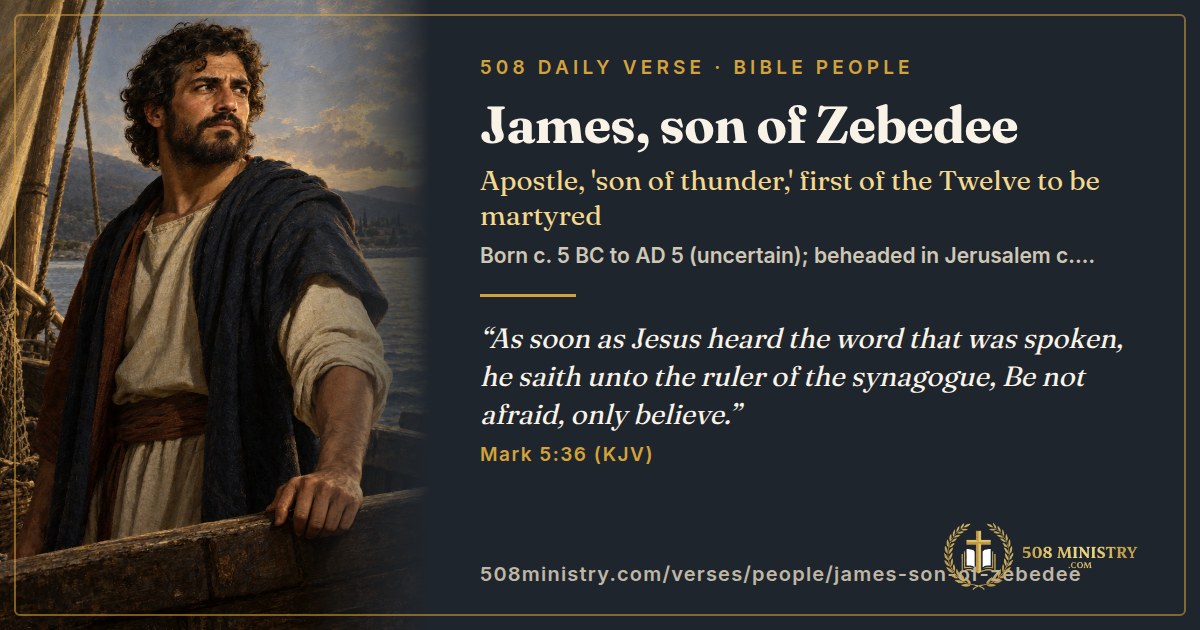

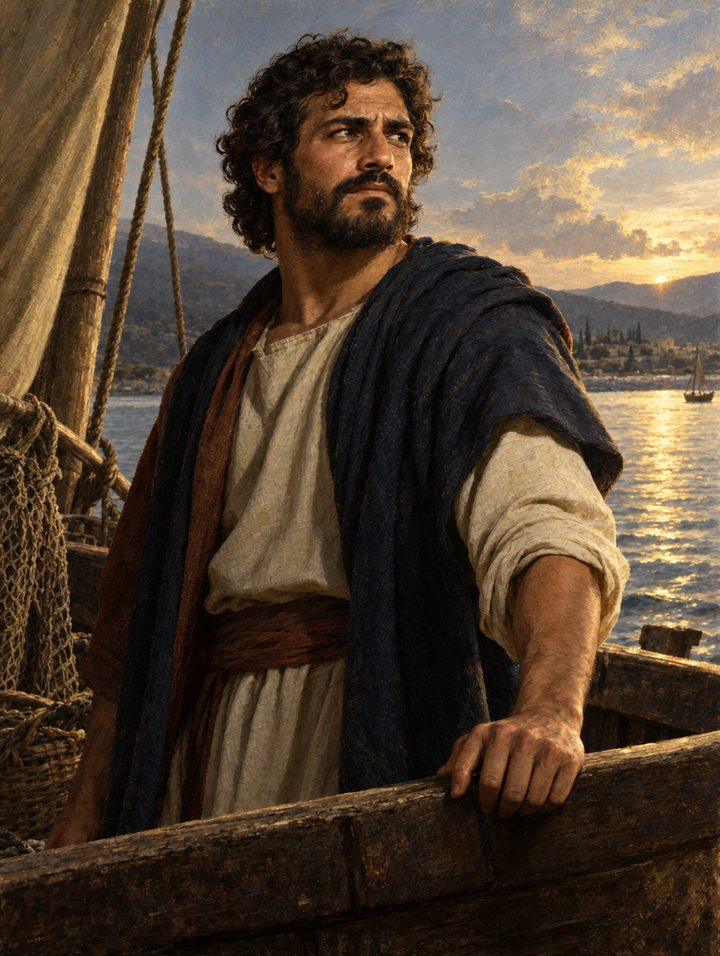
The world James was born into
James was born in the first years of the first century, in a Galilee governed by Herod Antipas and surrounded by Roman power. The family lived and worked around the northern shore of the lake, in the Capernaum and Bethsaida region. Zebedee had a fishing business. Mark 1:20 says that when Jesus called James and John, they "left their father Zebedee in the ship with the hired servants, and went after him." That detail is useful. Zebedee had hired men, so his business was big enough to employ others. James and John were not poor boys from a hut but sons of a boat owner with some standing. The family seems to have worked in partnership with the family of Simon and Andrew, since Luke 5:10 calls James and John "partners with Simon."
His mother Salome is not named in Matthew's account of the request for thrones but appears in other places. Matthew 27:56 lists, among the women at the cross, "the mother of Zebedee's children," and Mark 15:40 names the same group as including "Salome." That makes it very likely that Salome was the mother of James and John. John 19:25 lists the women at the cross as Jesus' mother, "his mother's sister," Mary the wife of Cleophas, and Mary Magdalene. If "his mother's sister" is a separate person from Mary the wife of Cleophas, many readers take her to be Salome. If so, James and John were first cousins of Jesus. That is an inference from a comparison of lists, not a statement of Scripture, and scholars are divided on it. It would explain a few things, including why their mother felt free to approach Jesus on their behalf and why Jesus, at the cross, entrusted his own mother to John.
The religious world of Galilee was lively and anxious. People talked about the Messiah, and about when God would break the power of Rome. The family of Zebedee could well have been among those who talked, and the name "sons of thunder" suggests some fire in the household.
The land itself matters to the story. Bethsaida and Capernaum are only a few miles apart, and the lake provided a closed world where everyone knew everyone. The same families fished the same waters, sold to the same markets and worshiped in the same synagogue, and Mark 1:21 says Jesus taught in the synagogue of Capernaum. The word on the lake traveled fast.
Chapter one: The call
Mark 1:19-20 tells the story in a few lines. Jesus, walking along the shore, had just called Simon and Andrew. "And when he had gone a little further thence, he saw James the son of Zebedee, and John his brother, who also were in the ship mending their nets. And straightway he called them: and they left their father Zebedee in the ship with the hired servants, and went after him." Matthew 4:21-22 tells it almost identically. Notice that James is named first. Whenever the two brothers appear together, James comes first, which is a sign that he was the older. John is often called "the brother of James," not the other way around.
Luke 5:1-11 gives a fuller picture of the same time. After the great catch of fish, the boats were so full that Simon beckoned to "their partners, which were in the other ship, that they should come and help them." James and John came, and Luke says they were "amazed" along with Peter. Jesus told Peter, "Fear not; from henceforth thou shalt catch men." The brothers, together with Peter, "forsook all, and followed him." It cost James something. A son who leaves his father in the boat is not making a small decision. Among the things the Gospel does not tell us is how Zebedee felt. A later saying of Jesus gives a hint that families were divided and also blessed: "There is no man that hath left house, or brethren, or sisters, or father, or mother, or wife, or children, or lands, for my sake, and the gospel's, but he shall receive an hundredfold now in this time" (Mark 10:29-30).
Chapter two: The inner three
When Jesus appointed the Twelve, James and John were among them. Mark 3:17 adds a detail that no other list gives: "And James the son of Zebedee, and John the brother of James; and he surnamed them Boanerges, which is, The sons of thunder." Scholars have wondered about the Aramaic behind the name. Bene regesh would mean "sons of tumult" or "sons of commotion," and the Greek Boanerges is a rough rendering. The nickname was probably affectionate, a family joke about two men who were loud, fierce and quick to speak. It fits the stories that follow.
Within the Twelve there was a smaller circle that Jesus took with him to the most important moments of his ministry: Peter, James and John. The Gospels name them again and again. When Jesus went to the home of Jairus, the synagogue leader whose twelve-year-old daughter had died, he let no one follow him "save Peter, and James, and John the brother of James" (Mark 5:37). He took the three up a high mountain, where he was transfigured before them, his clothes becoming "exceeding white as snow," and Moses and Elijah appeared and talked with him (Mark 9:2-8). He told them not to speak of it until after the resurrection. On the Mount of Olives, these three with Andrew asked him about the end of the age (Mark 13:3). And in Gethsemane, "he taketh with him Peter and James and John, and began to be sore amazed, and to be very heavy" (Mark 14:33). James saw Jesus' power over death, his glory, and his anguish. Why those three? The Gospels do not say. Many readers think it was a matter of readiness or friendship, not rank.
Of the three, James is the only one we never hear speak alone. Peter speaks constantly, and John has the Gospel and letters that bear his name. James speaks only in company with his brother. We have two recorded words from him, and both of them show an intense young man who needed to grow.
Chapter three: The village that would not receive them
In Luke 9, Jesus "stedfastly set his face to go to Jerusalem," and sent messengers ahead of him into a Samaritan village to arrange lodging. "And they did not receive him, because his face was as though he would go to Jerusalem." Jews and Samaritans had been enemies for centuries over where God should be worshiped. The villagers wanted nothing to do with a pilgrim headed for the Jerusalem temple.
James and John answered in a way that nobody could mistake. "Lord, wilt thou that we command fire to come down from heaven, and consume them, even as Elias did?" (Luke 9:54). They had a scriptural precedent in mind: Elijah had called down fire on soldiers in 2 Kings 1. And what did Jesus do? "But he turned, and rebuked them, and said, Ye know not what manner of spirit ye are of. For the Son of man is not come to destroy men's lives, but to save them" (Luke 9:55-56, as found in many manuscripts; some of the oldest manuscripts do not include the sentence in verse 55, but the rebuke is in verse 55 either way). They went to another village. That is the origin of the name sons of thunder, at least as we see it in action. It is a moment that deserves to be read slowly, because the church has needed it again and again.
Mark 9:38 gives a related scene. John says, "Master, we saw one casting out devils in thy name, and he followed not us: and we forbad him, because he followed not us." Jesus said, "Forbid him not." John speaks for the group here, but James was surely part of the "we." Both brothers were protective of their place near Jesus, and the Gospels are honest about it.
Chapter four: The request for the throne
The most famous scene about James takes place on the road to Jerusalem, in the last weeks of Jesus' life. Jesus had just told the Twelve, for the third time, that he would be handed over, mocked, flogged and killed, and that he would rise again. Mark 10:35 then says, "And James and John, the sons of Zebedee, come unto him, saying, Master, we would that thou shouldest do for us whatsoever we shall desire." Jesus asked what they wanted. They said, "Grant unto us that we may sit, one on thy right hand, and the other on thy left hand, in thy glory."
Matthew 20:20-21 tells the story with a difference. There it is "the mother of Zebedee's children" who comes with her sons and asks for the places of honor, and the sons kneel with her. The two accounts are not in conflict. Most readers take them to mean that the mother raised the request and the brothers stood behind it, and Jesus answered the sons: "Ye know not what ye ask." Matthew says, "He said unto them." Either way, James is part of the request, and it comes at a painful time. Jesus has just described his own death, and the two disciples are asking about seats.
Jesus does not scold them for wanting to be close to him. He asks, "Can ye drink of the cup that I drink of? and be baptized with the baptism that I am baptized with?" These were images for suffering. The cup in the Old Testament was often a cup of God's judgment or of sorrow, and baptism here means being overwhelmed or plunged into trouble. They answered, "We can." They had no idea what they were saying. Jesus replied, "Ye shall indeed drink of the cup that I drink of; and with the baptism that I am baptized withal shall ye be baptized: but to sit on my right hand and on my left hand is not mine to give; but it shall be given to them for whom it is prepared" (Mark 10:39-40).
Those words proved to be an exact prophecy of James' end. He would be the first of the Twelve to drink the cup. John, according to tradition, would outlive them all in a long exile, and his suffering would be of another kind. The ten other disciples, Mark says, "began to be much displeased with James and John." Their anger shows that the ambition was shared. The group was fighting over rank right up to the Last Supper (Luke 22:24).
Then Jesus called them together and gave one of the central teachings of the Gospels: "Ye know that they which are accounted to rule over the Gentiles exercise lordship over them; and their great ones exercise authority upon them. But so shall it not be among you: but whosoever will be great among you, shall be your minister: And whosoever of you will be chief, shall be servant of all. For even the Son of man came not to be ministered unto, but to minister, and to give his life a ransom for many" (Mark 10:42-45). Verse 45 is in our verse index. Everything James later did must be read in the light of that answer.
Chapter five: Sleeping in the garden
In Gethsemane, the three closest disciples failed. Jesus took them deeper into the garden and said, "My soul is exceeding sorrowful unto death: tarry ye here, and watch." Then he went forward and prayed. Three times he came back and found them asleep. He said to Peter, "Simon, sleepest thou? couldest not thou watch one hour? Watch ye and pray, lest ye enter into temptation. The spirit truly is ready, but the flesh is weak" (Mark 14:37-38). The index holds verse 38. This is the same James who had said "We can." He could not stay awake for an hour. The lesson is plain: courage, promised in a moment of confidence, has to be earned through weakness acknowledged.
When the soldiers came, "they all forsook him, and fled" (Mark 14:50). James ran with the rest.
Chapter six: After the resurrection
James is silent for the stretch of the Gospels after the crucifixion, but he appears in the list of the eleven in Acts 1:13, where "Peter, and James, and John, and Andrew" are first named as those who went up to the upper room in Jerusalem. John 21:2 tells us that "the sons of Zebedee" were among the seven who were fishing with Peter when the risen Jesus appeared on the shore. The brothers were back in the boat, fishing at night, as when they had first been called. And again the net filled. The loss of the three years was undone in a morning.
James received the Holy Spirit with the others at Pentecost and began to preach in Jerusalem. Acts does not give any of his sermons. The book instead follows Peter, and later Paul. The silence is not a sign of unimportance. James was one of the pillars of the first church, and the Jerusalem community looked to him. Paul, writing to the Galatians, mentions "James, Cephas, and John, who seemed to be pillars" (Galatians 2:9), although there the James is most likely the brother of the Lord.
Chapter seven: The first martyr among the Twelve
Acts 12:1-2 contains one of the most compressed sentences in the New Testament. "Now about that time Herod the king stretched forth his hands to vex certain of the church. And he killed James the brother of John with the sword." That is all. There is no speech, no trial recorded, no last words. James drank the cup.
The Herod here is Herod Agrippa I, grandson of Herod the Great. He was a friend of the emperor Caligula and later Claudius, who gave him the whole kingdom of his grandfather, covering Judea, Galilee and the territories to the north and east. He ruled from AD 41 until his sudden death in AD 44, and he courted the Jewish leaders by showing zeal for the law. Josephus portrays him as pious and popular with the Jerusalem establishment. Acts 12:3 says "because he saw it pleased the Jews, he proceeded further to take Peter also." So James' death was probably a political calculation. The king wanted to be seen to defend the people from a growing movement. The sword was the Roman method of execution for citizens, a quick beheading, and it suggests that James was condemned as a leader of a dangerous sect.
The date is probably AD 44, or possibly 41 to 43, in the days around Passover. He had followed Jesus for about three years and worked in the early church for about a dozen more. He would have been in his forties, give or take.
Tradition adds a moving detail. Eusebius, in his Church History (2.9), quotes Clement of Alexandria, who lived about AD 150 to 215, as saying that the man who led James to the judgment seat, seeing his testimony, was moved and confessed himself a Christian too. "So they were both led away together," Clement says, and on the way the man asked James' forgiveness. James looked at him for a moment, and said, "Peace be with thee," and kissed him, and both were beheaded together. This account is not in Acts. It comes from a writer a century and a half later who may have drawn on an older oral report. Historians treat it as an early tradition of uncertain value, and it is a lovely echo of the sons-of-thunder who once wanted to call down fire. The man who had wanted to burn a village now kissed his accuser.
Death and legacy: the apostle in Spain
Most of what people say about James after Acts 12 is a later story. Beginning in the seventh century, a tradition appears in Spain that James had preached there before returning to Jerusalem. The earliest written support for this comes from an eighth-century hymn and from a text called the Breviarium Apostolorum. Critical historians doubt that James could have traveled to Spain, preached and returned in the short time available, and they point out that no writer before the seventh century mentions any Spanish mission. A better-known part of the legend says that after his death, his disciples carried his body in a stone boat to Galicia in northwest Spain, where it was buried.
The tradition took on a life of its own in the early ninth century, when a hermit named Pelayo is said to have seen strange lights over a field. The local bishop, Theodemir of Iria Flavia, examined the site and announced that he had found the tomb of the apostle. King Alfonso II of Asturias built a church there. The name of the city that grew up around it, Santiago de Compostela, is thought to come from Sant Iago, "Saint James," and Compostela, which may come from the Latin for "field of the star" or from a word for a burial ground. Scholars still dispute the origin of the second word. Throughout the Middle Ages, pilgrims streamed to the site. The Camino de Santiago, the Way of Saint James, is a network of routes that cross France and Spain to reach Santiago. Pilgrims wear or carry the scallop shell, which became the sign of the pilgrimage. The Pilgrim's Office in Santiago reported more than 400,000 pilgrims arriving on foot, by bicycle or on horseback in 2023, a record that has been rising. Many walk for religious reasons, others for adventure or reflection, and plenty for both.
The story also fed Spanish history in another way. In the Reconquista, the long campaign of the Christian kingdoms to retake the Iberian Peninsula from Muslim rule, James became Santiago Matamoros, "Saint James the Moor-slayer," a warrior on a white horse who was said to appear in battle. That image comes from the late Middle Ages and is far from the Gospel's portrait of a man who was rebuked for wanting to call down fire on a village. The church, and the history of the church, has had to work out what to do with that gap. We think it is better to hold the two side by side honestly. The soldier-saint is a legend, and the sons-of-thunder story is Scripture.
Is James really buried at Santiago? The cathedral says so, and in 1884 Pope Leo XIII issued a bull affirming the relics as authentic. Many historians are skeptical. They note the absence of early evidence and the strong possibility that the cult grew from political and religious needs in ninth-century Spain. A few scholars take the tradition more seriously. We cannot settle it here. What cannot be disputed is the effect: for more than a thousand years the memory of James has moved ordinary people to walk hundreds of miles, and that is a sort of legacy few apostles have.
The Church of England and other churches keep his feast on 25 July. Churches, hospitals and towns named San Diego, San Jaime, Saint-Jacques, Santiago and Saint James carry his name across the world. The name James, Jacob, Jacques, Diego and Jaime, all come from the same Hebrew name Jacob, and "Santiago" itself is a contraction of "Sant Iago," meaning Saint James.
The ripple effect
James' story has traveled through history in odd ways. The famous Camino is now counted among the great pilgrimage routes of the world and was designated the first European Cultural Route by the Council of Europe in 1987. Medieval hospitals and hostels along it laid some of the foundations of care for travelers. Cathedrals, bridges and monasteries were built to serve the road, and ideas moved along it. Walkers write that the daily rhythm of walking, sharing food and resting in strangers' company changes them.
More basic still is the pattern James set. The first of the Twelve to die was neither the best known nor the oldest in faith. He was the hot-tempered one, the ambitious one, the one who said "We can" without knowing what it meant. In him the church saw that the road to becoming like Christ is the road of service and suffering, as Jesus told him on the road to Jerusalem. By the end of the first century, the church had begun to treat martyrdom as the highest form of witness. The word "martyr" means witness, and James was the first of the apostles to be one.
By Pew Research Center's projection, about 2.9 billion people could identify as Christian by 2050, up from about 2.2 billion in 2010. Those numbers include Spain and Latin America, where devotion to Santiago has been a powerful cultural force for centuries.
What James teaches us
First, that ambition can be redeemed. James wanted the best seat, and Jesus did not tell him to stop wanting greatness. He told him what greatness costs and where it is found. A person who wants to matter can learn to matter by serving.
Second, that temper is not the end of the story. The man who wanted to burn a village is remembered, in Clement's account, as the man who said "Peace be with thee" to his executioner. Whether the details are exact or not, the arc is the one the Gospels trace. People change when they spend time with Jesus.
Third, that "We can" must give way to "Help us." James and John answered Jesus' question about the cup with quick confidence and then fell asleep in the garden. The prayer that follows self-confidence is not despair but dependence. That is the only kind of strength that lasts.
Fourth, that a short life can finish well. We know almost nothing about James' last decade. We know how it ended. The cup that he accepted without understanding, he drank with open eyes.
Relationships
- John, his younger brother, with whom he shared the nickname and the request: John
- Peter and Andrew, his partners and fellow fishermen: Peter, Andrew
- Zebedee and Salome, his parents; Salome was among the women at the cross and the empty tomb
- Jesus, who called him, named him, taught him and prophesied his death: Jesus
- Herod Agrippa I, the king who had him killed (Acts 12)
- James the brother of the Lord, the Jerusalem church leader who is often confused with him: James
- James the son of Alphaeus, the other apostle with his name: James the son of Alphaeus
- The rest of the Twelve: The Twelve
Read their stories
 John the ApostleApostle and beloved disciple
 PeterApostle, fisherman, and rock of the early church
 AndrewApostle, fisherman, and brother of Simon Peter
 Jesus of NazarethTeacher, healer, and the ChristJamesBrother of Jesus and leader of the Jerusalem church
 James, son of AlphaeusApostle, one of the twelveHerod AntipasRuler of Galilee and PereaPontius PilateRoman governor of JudeaThe Twelve ApostlesThe original disciples Jesus chose and sent out
A note on sources and honesty
The Gospels of Mark, Matthew and Luke give the reliable core of the story, and Acts 12:2 gives his death. Clement of Alexandria, as quoted by Eusebius, supplies an early tradition about the executioner. Everything about Spain, Santiago de Compostela and the warrior saint is medieval tradition, and its historical basis is disputed. We have flagged it as such. We also noted the guesswork involved in the idea that James and John were cousins of Jesus. We prefer to say plainly where the evidence stops.
Timeline
- 28Called with John from his father's boatMark 1:19-20
- 29Raised Jairus' daughter scene; TransfigurationMark 5:37; 9:2
- 30Asks for seats beside Jesus; Jesus answers about the cupMark 10:35-45
- 30Sleeps in GethsemaneMark 14:33-37
- 44Beheaded under Herod Agrippa IActs 12:1-2
- 814Tomb said to be found in Galicia (medieval tradition)Medieval Spanish sources
Places
- 1Sea of Galilee · fishing lake
- 2Capernaum · base of Jesus' Galilee ministry; family home
- 3Bethsaida · home town; site et-Tell is the leading identification
- 4Jerusalem · Pentecost, early church
- 5Samaria (village on the road to Jerusalem) · Luke 9:51-56, location approximate
Beyond this map: Santiago de Compostela (medieval tradition of his tomb).
Map drawn by 508 Ministry from Natural Earth public-domain data. Locations of ancient sites are approximate; some identifications are traditional.Watch
Go deeper
Read Mark 10:35-45 slowly, then Acts 12:1-5. Read Luke 9:51-56 alongside them, and notice how far one man travels in a short book. Then read Eusebius, Church History 2.9, for the oldest tradition about his death. The links below lead to public-domain texts and reference articles.
References and further reading
- Wikipedia
- Wikipedia article
- Blue Letter Bible lexicon entry for the name
- Eusebius, Church History (CCEL)
- Schaff, History of the Christian Church vol. 1 (CCEL)
- Josephus, Antiquities of the Jews (Project Gutenberg)
- Edersheim, Life and Times of Jesus the Messiah (Internet Archive)
- Foxe, Book of Martyrs (Project Gutenberg)
- BibleProject
- Pew Research Center, Religious Projections 2010-2050
- Wikipedia: Camino de Santiago
- Wikipedia: Herod Agrippa I
Public-domain books, free to read
- Church History (Eusebius), NPNF series 2 vol. 1Eusebius of Caesarea
- Antiquities of the JewsFlavius Josephus
- The Wars of the JewsFlavius Josephus
- The Life and Times of Jesus the MessiahAlfred Edersheim
- Fox's Book of MartyrsJohn Foxe
- History of the Christian Church, vol. 1: Apostolic ChristianityPhilip Schaff
- The Apostolic Fathers with Justin Martyr and Irenaeus (ANF vol. 1)Ante-Nicene Fathers
Every verse in our index linked to this life
None of our indexed verses were spoken by James, son of Zebedee. These indexed verses come from scenes where he was present. Mark 5:36; Mark 10:45; Mark 14:38; Luke 9:23.
Verses from our index
None of our indexed verses were spoken by James, son of Zebedee. These indexed verses come from scenes where he was present
As soon as Jesus heard the word that was spoken, he saith unto the ruler of the synagogue, Be not afraid, only believe.
Do not be afraid. Only believe.
For even the Son of man came not to be ministered unto, but to minister, and to give his life a ransom for many.
The Son of Man came not to be served but to serve. Greatness looks like serving.
Watch ye and pray, lest ye enter into temptation. The spirit truly is ready, but the flesh is weak.
Watch and pray so you do not fall into temptation. The spirit is willing.
And he said to them all, If any man will come after me, let him deny himself, and take up his cross daily, and follow me.
Take up your cross daily and follow me. Following is a habit, not a moment.
Written by 508 Ministry. Scripture links open the public-domain World English Bible. Where Scripture, early church tradition and historians differ, this page says so.