


Two men named Lazarus
Start with a clarification, because it matters. The New Testament has two figures named Lazarus. One is a character in a parable Jesus told: a poor man covered with sores who lay at the gate of a rich man and who, after death, was carried by angels to Abraham's side (Luke 16:19-31). That Lazarus is part of a story Jesus told. The other is a real man of Bethany in John 11, the friend of Jesus. Some readers have noticed that, at the end of the parable, Abraham says the rich man's brothers would not be persuaded "though one rose from the dead" (Luke 16:31), and that the real Lazarus was in fact raised. John does not say this is a connection. It may just be a striking echo. Lazarus was a common name, a short form of Eleazar.
This page is about the Lazarus of John 11.
The world he lived in
Bethany lay on the eastern slope of the Mount of Olives, on the road between Jericho and Jerusalem. The name probably comes from the Hebrew beth ananiah or beth ani, "house of Ananiah" or "house of the poor," and scholars are not certain which. The village was close enough to Jerusalem that it could be reached on foot in under an hour, and far enough to be quiet. During the pilgrim festivals, when thousands of people filled the capital, villages like Bethany offered rooms and meals.
The family of Lazarus seems to have been comfortable. They owned a house with room to host Jesus and his disciples. They had a family tomb cut into rock. His sister Mary owned perfume worth a year's wages, and "many of the Jews" from Jerusalem came to console the family after his death (John 11:19), which suggests a family with connections. The Gospels do not say what Lazarus did for a living. Because he is the only brother, he would have been head of the household and the one responsible for his sisters.
What the Gospels tell us about him
Almost everything the Bible says about Lazarus is in two chapters. Luke mentions Martha and Mary but never names their brother. Matthew and Mark mention Bethany but not him. Only John introduces him, and he introduces him by his sickness: "Now a certain man was sick, named Lazarus, of Bethany, the town of Mary and her sister Martha" (John 11:1).
John says something about the relationship before anything else: the sisters' message to Jesus reads, "Lord, behold, he whom thou lovest is sick" (John 11:3). Here Lazarus is described by the love of Jesus. Later John states it outright: "Now Jesus loved Martha, and her sister, and Lazarus" (John 11:5). Some scholars have suggested that Lazarus was the "disciple whom Jesus loved," the unnamed witness whom the Gospel of John mentions several times. Most scholars, however, hold that the beloved disciple was one of the Twelve, and the strongest tradition names the apostle John. The idea of Lazarus is an interesting minority view. The text does not settle it.
Chapter one: illness and delay
The sisters sent word to Jesus, who was beyond the Jordan at the time, probably in the area where John the Baptist had baptized. Jesus said, "This sickness is not unto death, but for the glory of God, that the Son of God might be glorified thereby" (John 11:4). Then he waited two more days. He told his disciples what had happened in a puzzling way: "Our friend Lazarus sleepeth; but I go, that I may awake him out of sleep." The disciples thought he meant natural sleep, which would be a good sign. So Jesus told them plainly, "Lazarus is dead. And I am glad for your sakes that I was not there, to the intent ye may believe" (John 11:11-15).
The delay is the knot in the story. Lazarus was ill, his friends cared, and Jesus could have reached him in time. He chose not to. John does not try to soften it. Only later in the story does the reason come out: Jesus wanted people to see something greater than a healing. A sick man who gets well is a miracle. A man dead four days who comes out of a tomb is something else.
Chapter two: four days
When Jesus arrived, Lazarus had been in the tomb four days. This number is deliberate. Jewish teachers in later centuries wrote that the spirit hovers near the body for three days hoping to return, and on the fourth day, when decay has begun, it leaves for good. We do not know if that belief was current in the first century, but John's detail seems intended to leave no doubt that Lazarus was truly dead. Martha says as much when Jesus asks them to open the tomb: "by this time he stinketh" (John 11:39).
The conversations that follow are with Lazarus' sisters, and they are covered on the page for Martha and Mary of Bethany. Here is the central moment: Jesus said to Martha, "I am the resurrection, and the life: he that believeth in me, though he were dead, yet shall he live" (John 11:25). That sentence sits in our verse collection as John 11:25. And at the tomb, "Jesus wept" (John 11:35), preserved in our collection as John 11:35.
Chapter three: "Lazarus, come forth"
The tomb was a cave with a stone across the entrance. Jesus told the bystanders to take the stone away. They did. He prayed aloud, thanking the Father for hearing him, and said he had spoken so the crowd would believe that the Father had sent him.
"And when he thus had spoken, he cried with a loud voice, Lazarus, come forth. And he that was dead came forth, bound hand and foot with graveclothes: and his face was bound about with a napkin. Jesus saith unto them, Loose him, and let him go" (John 11:43-44).
Several things in that passage are worth noticing. First, Jesus called Lazarus by name. Writers since early centuries have observed that if he had said only "come forth," all the dead would have risen. Second, Lazarus came out bound, which means he had to shuffle out of the tomb wrapped in strips of linen. Third, the last instruction was not for Lazarus but for the bystanders: "Loose him." The community had a part to play in unbinding the man who had come back. Preachers have often drawn an application: those who have been given new life are often still wrapped in old habits and need help in freeing themselves.
John does not report any words from Lazarus. We do not know what he said, where he thought he had been, or how he felt. The silence is part of the account. The story is not about his experience of death. It is about the one who called him out.
The reaction
"Then many of the Jews which came to Mary, and had seen the things which Jesus did, believed on him. But some of them went their ways to the Pharisees, and told them what things Jesus had done" (John 11:45-46). The chief priests and Pharisees called a meeting of the council and said, "What do we? for this man doeth many miracles. If we let him thus alone, all men will believe on him: and the Romans shall come and take away both our place and nation" (John 11:47-48).
This is important. They did not deny that the miracle had happened. The leaders did not argue that Lazarus was not dead. They were afraid of the consequences, since a popular movement around a miracle worker might draw Roman attention, and Rome had put down messianic movements before. The high priest Caiaphas said, "It is expedient for us, that one man should die for the people, and that the whole nation perish not" (John 11:50). John adds that Caiaphas, as high priest that year, spoke more truly than he knew. "Then from that day forth they took counsel together for to put him to death" (John 11:53).
The story of Lazarus therefore ends in a plot to kill Jesus. The man who gives life to one friend gives his own life for others.
Chapter four: the supper and the plot against Lazarus
John 12 picks up six days before Passover. Jesus came to Bethany, "where Lazarus was which had been dead, whom he raised from the dead. There they made him a supper; and Martha served: but Lazarus was one of them that sat at the table with him" (John 12:1-2). Lazarus sits at a table, eating with Jesus. This picture makes the point that he is physically alive, in a way that no one could argue with. A ghost does not eat dinner.
Word spread. "Much people of the Jews therefore knew that he was there: and they came not for Jesus' sake only, but that they might see Lazarus also, whom he had raised from the dead" (John 12:9). The chief priests then "consulted that they might put Lazarus also to death; Because that by reason of him many of the Jews went away, and believed on Jesus" (John 12:10-11). It is a chilling detail. A man who had just returned from the grave was now a target. Living proof of the miracle was inconvenient for those who wanted it to go away.
Later that week, as Jesus entered Jerusalem on a donkey to the cheers of the crowd, John says that "the people that was with him when he called Lazarus out of his grave, and raised him from the dead, bare record" (John 12:17). The people who had been at the tomb were part of the crowd. John thinks that the raising of Lazarus fueled the excitement of Palm Sunday. "For this cause the people also met him, for that they heard that he had done this miracle" (John 12:18).
Historical questions
Readers of every background have asked why the raising of Lazarus appears only in John. The other three Gospels, Matthew, Mark and Luke, do not mention it, even though they describe other raisings from the dead: the daughter of Jairus (Mark 5:21-43), the son of the widow of Nain (Luke 7:11-17). Several explanations have been proposed.
One is that the Synoptic Gospels were written earlier, and their writers may have avoided naming people in Bethany who could have been endangered, since John 12:10 shows the authorities wanted Lazarus dead. Another is that the Synoptic writers focused on Galilee and gave less attention to Jesus' Judean ministry, which John describes in greater detail. A third is that Matthew, Mark and Luke simply did not use it, as each Gospel selects from a much larger body of material (John says as much at the end of his Gospel, John 21:25). Skeptical scholars have suggested that the story was a later creation to dramatize the theme of Jesus as the resurrection and the life. Believing scholars answer that the detail, the named location, the named family and the setting near Jerusalem all point to a specific memory. The question is a fair one, and readers should know where the debate stands.
John's own explanation is that the miracle illustrates who Jesus is. He selected seven signs, and this one comes last and is the greatest, preparing the reader for the resurrection of Jesus himself. The contrast is clear: Lazarus came out wrapped in graveclothes and needed help to be freed. When Jesus rose, John records that the linen cloths were left lying in the tomb (John 20:5-7). Lazarus was raised to die again. Jesus was raised never to die.
What happened to Lazarus afterward
The New Testament is silent. The earliest traditions, which are quite late, vary. An Eastern tradition says that Lazarus became bishop of Kition in Cyprus, and that he died there about thirty years after his raising. The church at Larnaca in Cyprus, dedicated to Saint Lazarus, holds a tomb that tradition ties to him, and a body was said to have been found there in 890 and moved to Constantinople. A Western tradition from the eleventh century, in France, says that Lazarus came to Marseille with his sisters and became its first bishop. Each tradition is an attempt to fill a silence. Neither has early evidence. We should say plainly that the Bible does not tell us where he went.
Some Eastern traditions say that once raised, Lazarus never smiled again, because he had seen what lay beyond death, and that he lived thirty more years. This is a pious legend and not a record. A better question might be what it would mean to live as someone who had been through death and back, and Christian writers have asked it for centuries.
The ripple effect
Lazarus gave the church its image of resurrection hope. Early Christian art in the catacombs shows Lazarus emerging from a tomb, wrapped in bandages, more often than almost any other scene, because it offered a picture of what Christians hoped for themselves. In Rome's catacombs of Priscilla and Callixtus, the raising of Lazarus appears again and again. The scene was also a standard part of Easter liturgy. In the Eastern churches, the Saturday before Palm Sunday is called Lazarus Saturday, and it marks the beginning of Holy Week.
Artists have returned to the scene repeatedly. Giotto painted it around 1305 in the Scrovegni Chapel in Padua. Rembrandt made a famous etching and a painting of it. Van Gogh painted his own version in 1890, during his last year, giving Lazarus the face of the artist's own self-portrait. Rainer Maria Rilke and many other poets wrote about him. In the twentieth century, Nikos Kazantzakis, Leonid Andreyev and others used him as a literary figure. Hospitals and care homes for lepers and the poor took his name, and the word "lazaretto," meaning a quarantine hospital, is partly derived from the name Lazarus, through the medieval Order of St. Lazarus, which cared for lepers.
For ordinary readers the practical meaning is more direct: grief is real, Jesus wept at it, and he also had the power to overcome it. In every funeral where John 11 is read, Lazarus comes back to speak without saying a word.
Lazarus in our verse collection
Lazarus has no recorded words, and no daily verse in our collection is spoken by him. Two verses belong to his story and are included: John 11:25, "I am the resurrection, and the life"; John 11:35, "Jesus wept"; read the full account at John 11 and John 12.
Sayings in our verse index
Jesus said unto her, I am the resurrection, and the life: he that believeth in me, though he were dead, yet shall he live:
I am the resurrection and the life. Death is not the end of the conversation.
Jesus wept.
Jesus wept. God cries with you before he fixes anything.
Relationships
His sisters are Martha and Mary. His friend and the one who raised him is Jesus. The apostle Thomas said, "Let us also go, that we may die with him." Peter and John were among the disciples who saw the miracle. The Gospel writer John tells the story. Mary Magdalene is a different Mary, often confused with Mary of Bethany. The high priest Caiaphas and the council reacted to the sign.
Read their stories
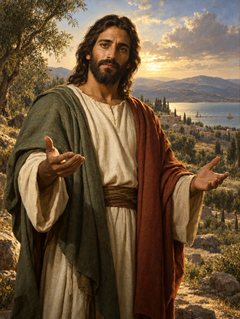 Jesus of NazarethTeacher, healer, and the ChristThomasApostle and subject of a non-canonical sayings collection
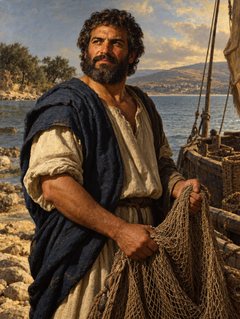 PeterApostle, fisherman, and rock of the early churchJohnApostle, beloved disciple, and witness to the Word
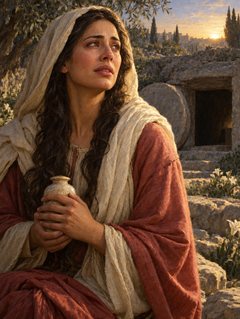 Mary MagdaleneFollower of Jesus and first witness of the resurrection
Places
- 1Bethany (al-Eizariya) · Home and traditional tomb
- 2Jordan River crossing · Where Jesus was when word arrived
- 3Jerusalem · Council plotted; triumphal entry
- 4Kition (Larnaca), Cyprus · Eastern tradition of his later life
- Bethany (al-Eizariya): his home, on the road to Jerusalem; the traditional tomb is still shown there.
- Beyond the Jordan: where Jesus was when the sisters sent word.
- Jerusalem: where the council plotted, and where Jesus entered in triumph.
- Kition (Larnaca), Cyprus: the Eastern tradition of his later life.
- Marseille: the Western medieval legend of his later life.
Timeline
- 30Falls ill and dies; raised after four daysJohn 11:1-44
- 30Council plots against Jesus and LazarusJohn 11:45-53; 12:10-11
- 30Supper at BethanyJohn 12:1-2
- 890Relics said to be found at Kition and moved to ConstantinopleEastern tradition
- About AD 29 to 30: Lazarus falls ill and dies; four days later Jesus raises him.
- About AD 30, six days before Passover: the supper at Bethany.
- A few days later: the entry into Jerusalem; the council plots to kill Lazarus as well.
- About AD 30: the crucifixion and resurrection of Jesus.
- Fourth century onward: pilgrims visit the tomb at Bethany.
Watch
Go deeper
Read John 11 and 12 aloud, slowly. Then read Luke 16:19-31 to see the parable of the other Lazarus, and notice the line about someone rising from the dead. For early Christian art, search for "raising of Lazarus catacomb" in a museum collection. Edersheim's Life and Times of Jesus the Messiah devotes a chapter to the miracle, and Schaff's History of the Christian Church shows how early Christians used the story. The BibleProject overview of the Gospel of John, Part 1 explains the seven signs.
References and further reading
- Wikipedia: Lazarus of Bethany
- eBible.org: John 11
- eBible.org: John 20 (the empty tomb for comparison)
- eBible.org: John 11
- Edersheim, The Life and Times of Jesus the Messiah (CCEL)
- Schaff, History of the Christian Church, vol. 2 (CCEL)
- BibleProject
Public-domain books, free to read
- The Life and Times of Jesus the MessiahAlfred Edersheim
- History of the Christian Church, vol. 2Philip Schaff
- Church HistoryEusebius of Caesarea
- Ante-Nicene Fathers, vol. 8Various, ed. Roberts and Donaldson
Written by 508 Ministry. Scripture links open the public-domain World English Bible. Where Scripture, early church tradition and historians differ, this page says so.