

The world he was born into
Thomas lived under Roman rule. Palestine in the first century was a small, crowded, argumentative corner of a very large empire. Rome had taken control of the region in 63 BC. Herod the Great ruled as a client king until about 4 BC, and after his death his sons divided the territory. Herod Antipas governed Galilee and Perea through the whole of Jesus' ministry. Judea itself was run by Roman prefects, of whom Pontius Pilate is the best known. You can read about the men who shaped those years at Herod the Great, Herod Antipas and Pontius Pilate.
Most people in Galilee were farmers, fishermen, craftsmen and day laborers. Taxes went to Rome, to the Herods and to the Temple, and many families lived close to the edge. A man's trade and his village told you most of what you needed to know about him. The Gospels do not tell us what Thomas did for a living, and we should not guess. Some later writers speculated that he was a builder or carpenter, partly because of a legend in the Acts of Thomas that sends him to India as an architect. That story is a work of devotional fiction from a later age, and it belongs in the tradition layer, not the history layer.
Religion shaped every part of daily life. Jewish families in Galilee prayed, kept the Sabbath and made pilgrimage to Jerusalem for the great feasts. Many hoped that God would soon act to set Israel free and send the promised Messiah. That hope is the background to everything Thomas says. When Jesus talks about a kingdom, Thomas hears a word loaded with centuries of longing.
Greek was the common language of trade and government. Aramaic was the language of home. A man named Thomas, with a Greek nickname that translated it, probably moved easily between both. That detail matters later, because the Gospel of Thomas and the Acts of Thomas were written in Greek and Syriac, and the traditions about his travels run along the old trade routes where those languages were spoken.
What the Gospels tell us
Chosen as one of the Twelve
Thomas appears in all four lists of the apostles. Matthew 10:3 pairs him with Matthew the tax collector. Mark 3:18 and Luke 6:15 give the same pairing in the same part of the list. Acts 1:13 names him among the eleven who gathered in the upper room after the ascension. The lists always put him in the second group of four, alongside Philip, Bartholomew, Matthew, and sometimes James the son of Alphaeus. Luke tells us that Jesus spent a night in prayer on a mountain before choosing the Twelve (Luke 6:12-16). Thomas was not an afterthought. He was prayed over.
The synoptic Gospels (Matthew, Mark and Luke) then give him nothing to say. He is a name in a list. For his voice we have to turn to John.
"Let us also go, that we may die with him" (John 11)
John 11 begins with bad news. Lazarus, a friend of Jesus living in Bethany, has fallen sick. Jesus waits two days and then tells his disciples they are going back to Judea. The disciples are alarmed. Only recently, in Jerusalem, people had picked up stones to throw at Jesus (John 10:31). Going back looked like walking into a trap.
Thomas speaks up. "Let us also go, that we may die with him" (John 11:16). The sentence can be read two ways, and both readings probably belong. It may be gloom, a man who has already decided how this ends. It is also loyalty of a very plain kind. He does not want to go, he expects to be killed, and he says let us go anyway. The reader who thinks of Thomas only as a doubter should keep this verse close. The first thing John records him doing is volunteering to die.
The story that follows is the raising of Lazarus, the last and greatest of the signs in John before the final week. Thomas was there for it. Whatever he later demanded as proof, he had already seen a man walk out of a tomb.
"How can we know the way?" (John 14)
On the night before his arrest, Jesus gathered the Twelve for a last meal. John gives five chapters to that evening (John 13-17). Jesus washes their feet, tells them one of them will betray him, and says he is going away. Then he says, "Where I go, you know the way" (John 14:4).
Thomas answers: "Lord, we don't know where you are going. How can we know the way?" (John 14:5).
Every reader who has felt lost in a conversation with God should be grateful that Thomas said it out loud. He does not pretend to understand. He asks the plain question, and the answer he receives is one of the most quoted sentences in the Bible: "I am the way, the truth, and the life. No one comes to the Father, except through me" (John 14:6). Without Thomas's honest confusion, we would not have that answer. Christians through the centuries have drawn comfort from the fact that Jesus does not scold the question. He answers it.
Philip speaks next in the same scene ("Lord, show us the Father"), and "Judas (not Iscariot)," whom tradition identifies with Thaddaeus, follows him (John 14:22). John is showing us a room of men asking real questions at a frightening time.
The empty chair (John 20)
After the crucifixion, the disciples were hiding behind locked doors "for fear of the Jews" (John 20:19). On the evening of the first Easter, Jesus came and stood among them, showed them his hands and his side, and said, "Peace be to you." They were glad.
Thomas was not there. John does not say why. He may have been out getting food, or grieving alone, or simply unable to sit in that room. The text only says he "was not with them when Jesus came" (John 20:24). It is worth pausing on that. Of all the people who could have missed the most important evening in history, it was the man who had once volunteered to die with Jesus. He was probably the one least able to be in the room.
When the others told him, "We have seen the Lord," his answer is blunt: "Unless I see in his hands the print of the nails, and put my finger into the print of the nails, and put my hand into his side, I will not believe" (John 20:25).
Many people treat this as a failure. Read it again. Thomas is not asking for more than the others got. They had been shown the wounds. He asks to see what they saw. His grief is also visible in the details he picks: the nails, the side. He had watched, or heard, how Jesus died. He is not going to believe a nice story that skips the cross.
Eight days later, the disciples were in the house again, and this time Thomas was with them. The doors were shut. Jesus came and stood in the middle and said, "Peace be to you." Then he turned straight to Thomas: "Reach here your finger, and see my hands. Reach here your hand, and put it into my side. Don't be unbelieving, but believing" (John 20:27).
The Gospel does not say whether Thomas actually touched him. The text moves straight to his words: "My Lord and my God!" (John 20:28). It is the highest confession of Jesus' identity in John's whole Gospel, and it comes from the man known for doubt. Nobody else in John calls Jesus "God" so directly, apart from the opening verse of the book. John has been building toward this line for twenty chapters, and he puts it in the mouth of Thomas.
Jesus replies: "Because you have seen me, you have believed. Blessed are those who have not seen, and have believed" (John 20:29). Some readers hear rebuke in that. Others hear a blessing for every later generation, including ours. The very next verses explain why John wrote his book: "that you may believe that Jesus is the Christ, the Son of God; and that believing you may have life in his name" (John 20:31). That verse is in our verse index, and it is a good one to read right after this story.
The phrase "doubting Thomas" has been in English for centuries. It is not entirely fair to the man. He asked for the same evidence the others had received, and when he got it, he gave the strongest answer anyone in the Gospel gives. Perhaps a better nickname would be "honest Thomas."
By the lake (John 21)
The last mention of Thomas in the Gospels is in John 21:2. Seven disciples are together at the Sea of Tiberias (the Sea of Galilee), and Thomas, here called Didymus again, is the second one named, right after Simon Peter. They are fishing. They have gone back to the work they knew before Jesus called them. This is the scene where the risen Jesus cooks breakfast on the beach and restores Peter.
It tells us something that Thomas is there. After the Easter evening and the confession, he does not disappear. He is part of the inner circle that Jesus meets at the shore.
The upper room (Acts 1)
Luke's second book lists the eleven who stayed together in Jerusalem after the ascension, "all continued with one accord in prayer and supplication" (Acts 1:13-14). Thomas is on the list. Then Luke describes the choice of a replacement for Judas, which you can follow at Matthias. Thomas was one of the eleven who prayed over that decision, and one of the group on whom the Spirit fell at Pentecost.
After that, the New Testament says nothing more about him.
What the early church remembered
Here we leave Scripture and enter tradition. These stories are old, and some of them are very old, but they are not the same kind of evidence as the Gospels.
Parthia and India
The church historian Eusebius of Caesarea wrote his Ecclesiastical History around AD 325. In it he reports, citing the earlier scholar Origen, that the apostles divided the world by lot when they scattered from Jerusalem, and that Thomas received Parthia (Eusebius, Church History 3.1). Parthia was the empire to the east of Rome, covering much of modern Iran and Iraq. Eusebius also tells a story about Thomas sending Thaddeus (one of the seventy disciples, not the apostle) to King Abgar of Edessa after the ascension (1.13). That story is told with more confidence than modern historians usually allow, but it shows that Christians in Syria associated Thomas with their region.
The fullest tradition comes from a text called the Acts of Thomas, written probably in the early third century, perhaps in Syriac, and surviving in Syriac and Greek. In that book, the apostles divide the world and India falls to Thomas. He does not want to go. The risen Lord appears and sells him as a slave to an Indian merchant, who takes him by ship to the court of a king named Gondophares. There Thomas is asked to build a palace and instead gives the king's money to the poor, which leads to prison, a miracle, and the conversion of the court. Later the text sends Thomas to a second kingdom, where he is killed by spear for converting the king's wife and family.
Is any of it history? Scholars split. The story is full of romance and miracle, and the Acts of Thomas contains teaching that the wider church rejected. But a king named Gondophares did rule a large part of northwestern India and Afghanistan in the first half of the first century AD, and we know it from his coins. That an author in the third century knew the name of a real first-century ruler of that region gives some historians reason to think a real memory of Christian contact with India sits underneath the legend. Others think the author simply knew the name from trade stories. Honest scholarship admits it cannot settle the question.
The Thomas Christians
In the southwest Indian state of Kerala, there is an ancient Christian community that calls itself the Saint Thomas Christians (also called Nasranis or Syrian Christians of Malabar). They hold that Thomas landed on the Malabar coast in AD 52, founded seven churches, and later died near Mylapore, on the eastern coast near modern Chennai. The community has used Syriac liturgy for centuries and has had contact with the churches of Persia and Mesopotamia.
We can say with confidence that a Christian community has existed in South India for a very long time. Greek traders sailing between Egypt and India were active in the first century, and sea routes were well established. Cosmas Indicopleustes, a Greek merchant writing in the sixth century, mentions Christians in India. Whether the community goes back to Thomas himself is a matter of faith and tradition rather than demonstrable fact. The church there has held the belief for as long as records exist. The Catholic Church and several Eastern churches commemorate him, and the Basilica of San Thome in Chennai is built, by long tradition, over his tomb.
The relics
Another strand of tradition says that Thomas's bones were moved from India to Edessa in Mesopotamia, and that in 1258 they were moved again to Ortona, on the Adriatic coast of Italy, where the Cathedral of San Tommaso claims them today. Historians cannot confirm the chain. Christians who love the story will say that the places where the bones of a man were honored show how widely he was remembered.
His feast day
Thomas is commemorated on July 3 in the Roman Catholic calendar (moved from December 21 in 1969) and on that same date by many Eastern traditions. The Orthodox Churches also keep "Thomas Sunday" on the first Sunday after Easter, remembering the Gospel scene with the wounds.
The Gospel of Thomas
This section needs plain labels, so here they are: The Gospel of Thomas is not part of the Bible. It is an early Christian text, and our verse index prints twenty of its sayings under a clear non-canonical label.
What it is
In December 1945, farmers digging near the Egyptian town of Nag Hammadi found a sealed jar holding thirteen leather-bound books of papyrus, written in Coptic. They are now called the Nag Hammadi codices. One of them contained a complete copy of the Gospel of Thomas, a list of 114 sayings of Jesus with almost no story around them. Each begins with the words "Jesus said." Before this discovery, scholars knew that a work by that name existed, because early writers mentioned and rejected it. They also knew of three Greek papyrus fragments of sayings from Oxyrhynchus in Egypt, discovered in 1897 and 1903, and these turned out to be pieces of the same text in an earlier form.
The opening line of the Coptic text says: "These are the hidden sayings that the living Jesus spoke and Didymos Judas Thomas wrote down." The name matches the "twin" tradition, and some early Syriac Christians linked Thomas to a brother relationship with Jesus. It does not mean the apostle wrote the book. Nearly all scholars agree that the Gospel of Thomas was not written by the apostle Thomas.
When it was written
Dates range from the middle of the first century to the middle of the second. Some scholars propose that an early core of sayings circulated in the AD 50s or 60s. Others, a clear majority, put the collection in the early second century, because it seems to draw on the language of Matthew and Luke. The Greek fragments from Oxyrhynchus date to about AD 200, so the book was certainly in circulation by then. Reasonable historians disagree, and the disagreement is not about faith. It is about how to read the evidence.
Why the church did not include it
Early Christian writers knew the book and did not accept it. Hippolytus of Rome and Origen both mention it. Eusebius, listing the books Christians read in the early fourth century, put it among writings forged by heretics, books that, he says, no church writer in the line of tradition had thought worth quoting (Church History 3.25, paraphrased). The church was not hunting for obscure books to burn. It was asking what had been handed down from the apostles and what was safe to read in worship. The Gospel of Thomas had no apostolic pedigree and had a strand of thought that read the kingdom more as inward knowledge than as the coming reign of God in history.
What the sayings are like
Some sayings in the collection sound a lot like the Gospels. Number 26 is the speck and the beam: "You see the speck that's in your brother's eye, but you don't see the beam in your own eye. When you get the beam out of your own eye, then you'll be able to see clearly to get the speck out of your brother's eye." That is Matthew 7:3-5. Number 90 says, "Come to me, because my yoke is easy and my requirements are light. You'll be refreshed." That is close to Matthew 11:28-30.
Others are strange. Saying 22 says that children nursing are like those who enter the kingdom, and then speaks of making "the two into one" and making "the male and the female a single one." Saying 77 has Jesus say, "I am the All... Split a log; I'm there. Lift the stone, and you'll find me there." Saying 113 says the kingdom "is already spread out over the earth, and people don't see it." These sound much more like mystical teaching about inner knowledge than like the Jesus of the four Gospels, who speaks of a kingdom that is near, that will come, and that is entered through repentance and trust.
For the reader who wants to stay close to the Bible, here is a simple guide. The Gospel of Thomas can be read as a window into how some early Christians thought. It cannot be treated as a record of what Thomas himself taught. The four Gospels and the rest of the New Testament remain the church's foundation. Our verse index reproduces twenty of the sayings in Mark Mattison's translation, which the translator has dedicated to the public domain, and labels each one as non-canonical.
The sayings in our index
Each of these twenty is available on the site with audio. They are listed here by their number and title so a reader can find each one, and every one is marked non-canonical: 2 (Seek and find), 3 (Seeking within), 5 (Hidden and revealed), 22 (Making the two into one), 23 (Standing as a single one), 24 (Light within), 26 (Speck and beam), 48 (Two making peace), 49 (Those who are one), 51 (Already come), 70 (Salvation is within), 75 (The ones who are one), 77 (The All), 83 (Light and image), 84 (Our earlier images), 89 (Inside and outside), 90 (An easy yoke), 106 (Making the two into one, again), 108 (Becoming like him), and 113 (The kingdom is already here).
One more point about this list. The only words the apostle Thomas speaks in the Bible are three lines in John (11:16, 14:5 and 20:28), and they are quoted in the chapters above. The twenty indexed sayings are a different thing: they come from the later collection that carries his name.
Relationships
- Jesus called him, taught him, died, rose, and answered each of his three questions in the Gospel of John.
- Matthew is paired with him in the apostle lists (Matthew 10:3). The two could hardly be more different on paper. One collected taxes for Rome and the other asked for scars as proof.
- Philip speaks in the same room as Thomas on the night before the cross (John 14:8).
- Peter is the first name mentioned just before him at the lake in John 21:2, where the two of them are both fishing.
- Lazarus was raised in the scene where Thomas says, "Let us also go, that we may die with him."
- Thaddaeus, whom tradition identifies with the disciple John calls "Judas, not Iscariot," asks a question right after Thomas in John 14:22. The Eusebius tradition about a different Thaddeus, one of the seventy, ties his name to Thomas in the story of the Edessa mission.
- The Twelve is where to find the others.
Read their stories
 Jesus of NazarethTeacher, healer, and the Christ
 MatthewApostle, former tax collector, and Gospel writer
 PhilipApostle from Bethsaida
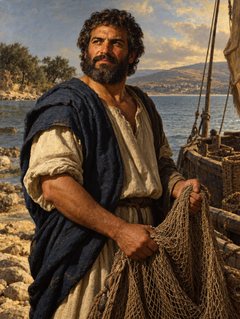 PeterApostle, fisherman, and rock of the early churchLazarusFriend of Jesus raised from the dead
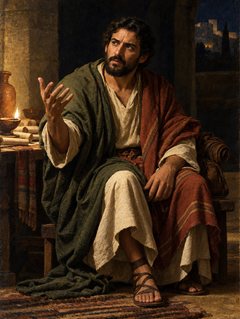 ThaddaeusApostle, also called Judas son of JamesThe Twelve ApostlesThe original disciples Jesus chose and sent outHerod AntipasRuler of Galilee and PereaPontius PilateRoman governor of JudeaHerod the GreatKing of Judea at the birth of Jesus
Death and legacy
The New Testament does not describe Thomas's death. Eastern and Western traditions agree that he was martyred, and the Acts of Thomas has him killed by spears. Mylapore, near Chennai, is where the Indian church says it happened, in AD 72. We should treat that date with caution. It comes from later Indian tradition rather than from any first-century source.
His legacy comes in four parts.
First, John's portrait of him gave generations of Christians permission to bring hard questions. The church has long spoken of him as a patron of those who struggle to believe, and also of builders, architects and the people of India. A man who could not simply accept the report of his friends became, in the end, a witness to every later reader that faith is not an enemy of honest questions.
Second, Thomas's confession, "My Lord and my God!", became the model of Christian worship. Many hymns and liturgies echo it. In the Eastern churches, the Sunday after Easter is called Thomas Sunday.
Third, the Thomas Christians of India gave the world one of the oldest continuous Christian communities outside the Mediterranean world. If their tradition is right, Thomas carried the gospel farther than any other apostle. If it is only partly right, the community still testifies that Christian faith moved east very early.
Fourth, art. Caravaggio painted The Incredulity of Saint Thomas around 1601 and 1602. In it, Jesus gently guides the apostle's finger into the wound while two other disciples lean in to look. The painting is one of the most reproduced in Western art, and it stays on the right side of the story: the point of the scene is the touching, and the touching leads to worship.
Places
- 1Galilee / Sea of Tiberias · John 21:2
- 2Bethany · John 11
- 3Jerusalem (upper room) · John 20; Acts 1:13
- 4Edessa (Sanliurfa) · Syrian tradition
- 5Ortona, Italy · Traditional relics since 1258
Beyond this map: Kodungallur (ancient Muziris) (Indian tradition of landing, AD 52); Mylapore (Chennai) (Indian tradition of death).
Map drawn by 508 Ministry from Natural Earth public-domain data. Locations of ancient sites are approximate; some identifications are traditional.- Galilee, where Jesus called the Twelve, and where Thomas fished with the others after the resurrection (John 21).
- Bethany, near Jerusalem, the home of Lazarus, Martha and Mary, where Thomas said he would die with Jesus (John 11).
- Jerusalem, the upper room, the locked doors, the two Sunday evenings (John 20).
- Edessa (modern Şanlıurfa in Turkey), tied to the Thomas tradition by the Syrian church.
- Muziris and the Malabar coast (Kerala), where Indian tradition says he landed.
- Mylapore (Chennai), where Indian tradition says he died.
A timeline
- c. AD 28Chosen among the TwelveLuke 6:12-16
- c. AD 30'Let us also go, that we may die with him'John 11:16
- c. AD 30-33'How can we know the way?'John 14:5
- c. AD 30-33Absent on Easter eveningJohn 20:24
- c. AD 30-33'My Lord and my God!'John 20:28
- c. AD 30-33At the lake with six othersJohn 21:2
- c. AD 30-33In the upper roomActs 1:13
- c. AD 52 (tradition)Landing on the Malabar coastIndian tradition
- c. AD 72 (tradition)Martyrdom at MylaporeIndian tradition
- c. AD 200Greek Thomas sayings copied at OxyrhynchusP.Oxy. 1, 654, 655
- 1945Coptic Gospel of Thomas found at Nag HammadiNag Hammadi codices
| Year | Event |
|---|---|
| c. AD 27-29 | Jesus calls the Twelve; Thomas is among them (Luke 6:12-16) |
| c. AD 30 | Lazarus raised; Thomas says, "Let us also go" (John 11:16) |
| c. AD 30-33 | The last supper; Thomas asks, "How can we know the way?" (John 14:5) |
| c. AD 30-33 | The first Easter evening; Thomas is absent (John 20:24) |
| c. AD 30-33 | Eight days later, Thomas confesses, "My Lord and my God!" (John 20:28) |
| c. AD 30-33 | Thomas at the Sea of Tiberias (John 21:2) |
| c. AD 30-33 | In the upper room after the ascension (Acts 1:13) |
| c. AD 52 (tradition) | Arrival on the Malabar coast, according to Indian tradition |
| c. AD 72 (tradition) | Martyrdom at Mylapore, according to Indian tradition |
| c. AD 200 | Greek fragments of the Gospel of Thomas written at Oxyrhynchus |
| 1945 | Complete Coptic Gospel of Thomas found at Nag Hammadi |
Why he matters
The shortest answer is that Thomas shows what happens when honest doubt meets the risen Christ. He did not stay in the dark. He came back to the room, and he did not pretend. A faith that cannot stand a question is fragile, and a faith that has met its question and been answered is strong. Thomas is the patron of that second kind.
For the ministry reader, it also offers a pattern for how we treat people who struggle. Jesus did not shut the door on Thomas for his answer. He came back for him, a week later, and met him on his own terms. If you know someone who has stepped away from the room, the story suggests that the door can open again.
Appendix: the twenty sayings in our verse index
These twenty sayings come from the Gospel of Thomas, not from the Bible and not from the apostle. They are printed here, with the same label as in our verse index, so you can read for yourself what that book says. Translation: Mark M. Mattison translation. Licence: Public domain (the translator dedicated it to the public domain).
- Saying 2, Seek and find. Jesus said, "Whoever seeks shouldn't stop until they find. When they find, they'll be disturbed. When they're disturbed, they'll be ... amazed, and reign over the All."
- Saying 3, Seeking within. Jesus said, "If your leaders tell you, 'Look, the kingdom is in heaven,' then the birds of heaven will precede you. If they tell you, 'It's in the sea,' then the fish will precede you. Rather, the kingdom is within you and outside of you. When you know yourselves, then you'll be known, and you'll realize that you're the children of the living Father. But if you don't know yourselves, then you live in poverty, and you are the poverty."
- Saying 5, Hidden and revealed. Jesus said, "Know what's in front of your face, and what's hidden from you will be revealed to you, because there's nothing hidden that won't be revealed."
- Saying 22, Making the two into one. Jesus saw some little children nursing. He said to his disciples, "These nursing children can be compared to those who enter the kingdom." They said to him, "Then we'll enter the kingdom as little children?" Jesus said to them, "When you make the two into one, and make the inner like the outer and the outer like the inner, and the upper like the lower, and so make the male and the female a single one so that the male won't be male nor the female female; when you make eyes in the place of an eye, a hand in the place of a hand, a foot in the place of a foot, and an image in the place of an image; then you'll enter the kingdom."
- Saying 23, Standing as a single one. Jesus said, "I'll choose you, one out of a thousand and two out of ten thousand, and they'll stand as a single one."
- Saying 24, Light within. His disciples said, "Show us the place where you are, because we need to look for it." He said to them, "Anyone who has ears to hear should hear! Light exists within a person of light, and they light up the whole world. If they don't shine, there's darkness."
- Saying 26, Speck and beam. Jesus said, "You see the speck that's in your brother's eye, but you don't see the beam in your own eye. When you get the beam out of your own eye, then you'll be able to see clearly to get the speck out of your brother's eye."
- Saying 48, Two making peace. Jesus said, "If two make peace with each other in a single house, they'll say to the mountain, 'Go away,' and it will."
- Saying 49, Those who are one. Jesus said, "Blessed are those who are one, those who are chosen, because you'll find the kingdom. You've come from there and will return there."
- Saying 51, Already come. His disciples said to him, "When will the dead have rest, and when will the new world come?" He said to them, "What you're looking for has already come, but you don't know it."
- Saying 70, Salvation is within. Jesus said, "If you give birth to what's within you, what you have within you will save you. If you don't have that within you, what you don't have within you will kill you."
- Saying 75, The ones who are one. Jesus said, "Many are waiting at the door, but those who are one will enter the bridal chamber."
- Saying 77, The All. Jesus said, "I'm the light that's over all. I am the All. The All has come from me and unfolds toward me. Split a log; I'm there. Lift the stone, and you'll find me there."
- Saying 83, Light and image. Jesus said, "Images are revealed to people, but the light within them is hidden in the image of the Father's light. He'll be revealed, but his image will be hidden by his light."
- Saying 84, Our earlier images. Jesus said, "When you see your likeness, you rejoice. But when you see your images that came into being before you did, which don't die, and aren't revealed, how much you'll have to bear!"
- Saying 89, Inside and outside. Jesus said, "Why do you wash the outside of the cup? Don't you know that whoever created the inside created the outside too?"
- Saying 90, An easy yoke. Jesus said, "Come to me, because my yoke is easy and my requirements are light. You'll be refreshed."
- Saying 106, Making the two into one, again. Jesus said, "When you make the two into one, you'll become Children of Humanity, and if you say 'Mountain, go away!', it'll go."
- Saying 108, Becoming like him. Jesus said, "Whoever drinks from my mouth will become like me, and I myself will become like them; then, what's hidden will be revealed to them."
- Saying 113, The kingdom is already here. His disciples said to him, "When will the kingdom come?" "It won't come by looking for it. They won't say, 'Look over here!' or 'Look over there!' Rather, the Father's kingdom is already spread out over the earth, and people don't see it."
By the numbers
Watch
Go deeper
Start with John 11, 14 and 20 in a good translation. Then read about him on the pages of the Wikipedia article and the Wikipedia article. For the church history, read Eusebius in the Christian Classics Ethereal Library. For the Gospel of Thomas, see the Wikipedia overview and the public-domain translation that our index uses. For the Indian church, see Saint Thomas Christians. For a visual walk through the Gospel of John, watch the BibleProject overview, part 2, which covers the Thomas scenes.
Every link on this page was checked when we built it, and the full list is in our file of verified sources.
References and further reading
- Wikipedia: Thomas the Apostle
- Wikipedia: Gospel of Thomas
- Wikipedia: Saint Thomas Christians
- Wikipedia: Acts of Thomas
- Wikipedia article on : Thomas (topical)
- eBible.org: John 20:24 (interlinear and commentaries)
- Blue Letter Bible: John 20:24-29 (KJV)
- Blue Letter Bible: John 14:1-14 (KJV)
- Bible Project
- Gospel of Thomas, public-domain translation (Mattison)
- Pew Research: Global Christianity
Public-domain books, free to read
- The Ecclesiastical History (Church History)Eusebius of Caesarea
- The Life and Times of Jesus the MessiahAlfred Edersheim
- The Life of ChristFrederic W. Farrar
- Antiquities of the JewsFlavius Josephus
- Fox's Book of MartyrsJohn Foxe
Written by 508 Ministry. Scripture links open the public-domain World English Bible. Where Scripture, early church tradition and historians differ, this page says so.