

The world Bartholomew was born into
If Nathanael is Bartholomew, he came from Cana of Galilee (John 21:2), a village in the hills about nine miles north of Nazareth. The location of ancient Cana is debated. Many scholars favor Khirbet Qana, a ruined site about eight miles north of Nazareth, over the modern town of Kafr Kanna, which is closer to Nazareth and has been the traditional pilgrim stop since the Middle Ages. Whichever one it was, Nathanael lived within a short walk of Nazareth. That fact explains the sting in his famous remark.
Galilee in his day was farmland, olive groves and fishing villages, governed by Herod Antipas, with Roman soldiers and tax collectors never far away. The Romans had ruled Judea directly since AD 6, and Pontius Pilate was governor from about AD 26 to 36. Tensions between ordinary Jews and the foreign power ran high. Fifty years earlier, in 4 BC, a rebellion in Galilee had been crushed at the nearby city of Sepphoris, only a few miles from Nazareth. Sepphoris, which Antipas rebuilt as his capital during Jesus' childhood, stood in sight of Nazareth and could be reached on foot in an hour. People in Cana and Nazareth knew each other and knew the same stories.
The name Bartholomew itself gives a clue about his family. A son of Talmai may have borne the name of a royal line: Talmai was the name of a king of Geshur in the days of David (2 Samuel 3:3), and David's wife Maacah was Talmai's daughter. The name was also a common one, from a Hebrew word that may mean furrow or ploughman. We should not make too much of the possible royal connection, and the Gospels do not. Whatever his family background, he was a man of Galilee who read the Scriptures and waited for God's promises.
Chapter one: Under the fig tree
John 1 supplies everything we directly know about Nathanael. The scene follows the days in which Andrew brought Peter to Jesus. "The day following Jesus would go forth into Galilee, and findeth Philip, and saith unto him, Follow me" (John 1:43). Philip then went looking for his friend. "Philip findeth Nathanael, and saith unto him, We have found him, of whom Moses in the law, and the prophets, did write, Jesus of Nazareth, the son of Joseph" (John 1:45).
Nathanael's answer is blunt: "Can there any good thing come out of Nazareth?" (John 1:46). This is not necessarily scorn. Nazareth was a small village of perhaps a few hundred people, never mentioned in the Old Testament, and Nathanael lived close enough to know it. Perhaps there was a little local rivalry between neighboring villages. Perhaps he doubted that the Messiah, described in Scripture as coming from Bethlehem, could come from such an obscure place. Whatever lay behind the question, it was honest. He said what he thought. Nathanael is a person who does not hide his doubts, and the Gospel does not fault him for them.
Philip's response was calm: "Come and see." Nathanael went. As he approached, Jesus said of him, "Behold an Israelite indeed, in whom is no guile!" (John 1:47). The word translated "guile" means deceit, craftiness or hidden motive. Jesus was saying that Nathanael was transparent, that what you saw was what you got. There may be an allusion to Jacob, the patriarch whose name was changed to Israel. Jacob, in the Old Testament, was famous for his trickery (Genesis 27:35 says his brother accused him of coming "with subtilty"), and Jesus calls Nathanael a true Israelite with none of that in him. We will return to the connection with Jacob in a moment, because the next lines depend on it.
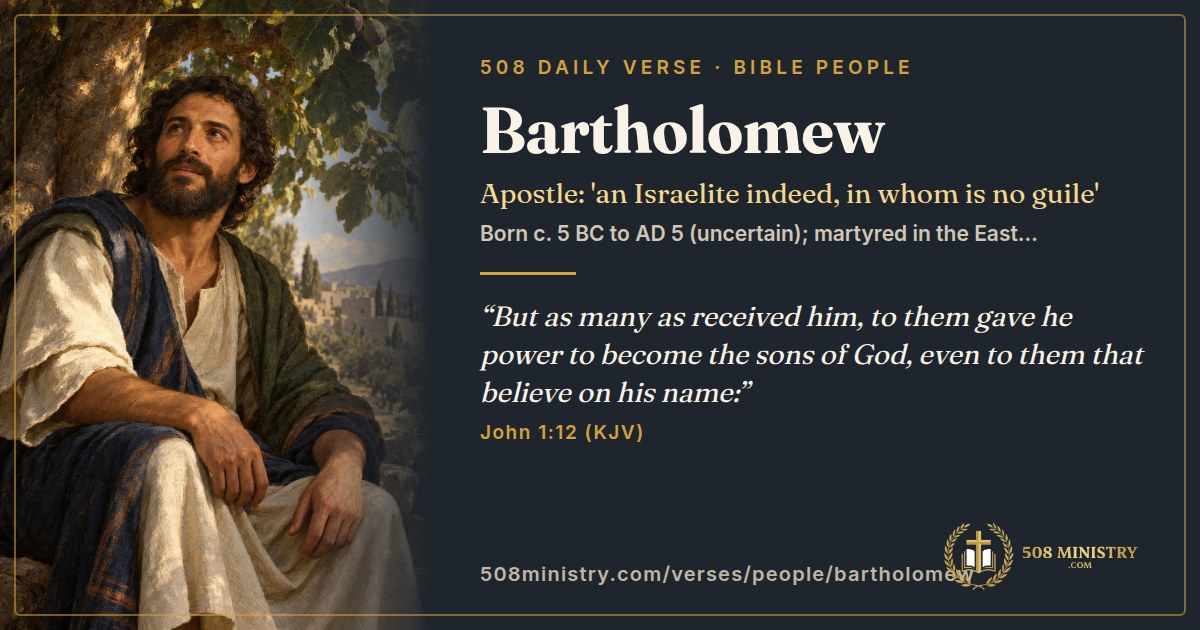
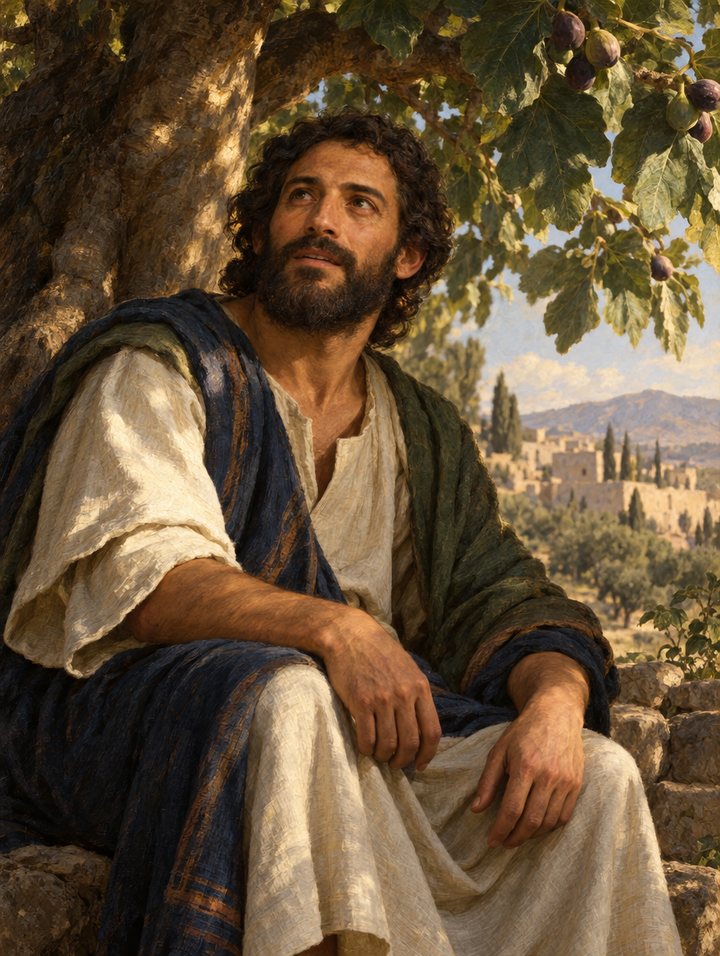
Nathanael, startled, asked: "Whence knowest thou me?" Jesus said, "Before that Philip called thee, when thou wast under the fig tree, I saw thee" (John 1:48). We do not know what Nathanael was doing under the fig tree. People sat in the shade of fig trees to rest, to talk and, in Jewish tradition, to study and pray. A later Jewish saying describes sitting under one's own vine and fig tree as the picture of peace and of studying Scripture. The prophet Micah had said that in the days of God's kingdom, "they shall sit every man under his vine and under his fig tree; and none shall make them afraid" (Micah 4:4). Perhaps Nathanael had been reading and praying about the coming Messiah. Perhaps something private had happened there that nobody else knew about. Whatever it was, Jesus' words hit home. The man who had been skeptical of Nazareth became, in an instant, the most confident confessor among the early disciples.
His reply is remarkable in its fullness: "Rabbi, thou art the Son of God; thou art the King of Israel" (John 1:49). In this first chapter, he says what takes Peter another two years of following to say at Caesarea Philippi. He names Jesus both as the Son of God and as the King of Israel. These are royal titles from Psalm 2, in which God says to his anointed king, "Thou art my Son," and the confession fits with a man who had been studying the Messianic hope.
Jesus' answer was gentle and generous. "Because I said unto thee, I saw thee under the fig tree, believest thou? thou shalt see greater things than these." Then he made a promise to Nathanael and the others standing there: "Verily, verily, I say unto you, Hereafter ye shall see heaven open, and the angels of God ascending and descending upon the Son of man" (John 1:50-51).
That last line is an allusion to Jacob's dream at Bethel, in Genesis 28:12, where Jacob saw a ladder or stairway set on the earth, its top reaching to heaven, with angels of God going up and down on it. It was the place where Jacob said, "Surely the LORD is in this place" and "this is the gate of heaven." Jesus, speaking to a true Israelite without Jacob's guile, said that he himself is the ladder, the meeting place between heaven and earth. In other words, what Jacob saw in a dream, Nathanael would see in the person of Jesus. It is a rich saying, and it fits the hidden thread of the whole Gospel of John, that in Jesus God has come near. Our verse index holds two lines from the same chapter that say as much: "And of his fulness have all we received, and grace for grace" (John 1:16), and "But as many as received him, to them gave he power to become the sons of God, even to them that believe on his name" (John 1:12).
Chapter two: Is Nathanael really Bartholomew?
The Synoptic Gospels (Matthew, Mark and Luke) never mention Nathanael, and John's Gospel never mentions Bartholomew. Why do most readers treat them as the same man?
Several lines of evidence point the same way. First, Bartholomew is not really a name, but a patronymic ("son of Talmai"), and people with only a patronymic in the lists usually had a personal name that appears elsewhere. Second, in the three Synoptic lists, Bartholomew is placed directly after Philip (Matthew 10:3, Mark 3:18, Luke 6:14), and in John 1, Philip brings Nathanael to Jesus, so the pairing fits. Third, John's Gospel names Nathanael among those who followed Jesus from the beginning, yet Nathanael is not listed among the Twelve by name in John, and he must be someone, since a man who confessed Jesus so strongly at the start would surely have been chosen. Fourth, in John 21:2, Nathanael of Cana is named with the seven disciples who went fishing: "There were together Simon Peter, and Thomas called Didymus, and Nathanael of Cana in Galilee, and the sons of Zebedee, and two other of his disciples." Nathanael is among the inner circle there, a person of weight. If Nathanael was one of the Twelve, then Bartholomew is the likeliest match.
This identification goes back at least to the early Middle Ages and is accepted by most commentators, though not all. A few have suggested Nathanael was a different person, perhaps a disciple outside the Twelve. The evidence cannot be called conclusive. We think the identification is strong enough to work with, and we flag it as an inference. In this profile we treat John 1 as the main source for what we know of his character.
Chapter three: Among the Twelve
The Gospels' lists of the Twelve name Bartholomew in the same place each time, in the middle group, next to Philip. Matthew 10:3 reads "Philip, and Bartholomew; Thomas, and Matthew the publican." Mark 3:18 reads "And Andrew, and Philip, and Bartholomew, and Matthew, and Thomas." Luke 6:14 and Acts 1:13 are similar. That is all the Synoptic Gospels give us. He is never quoted, never questioned, never criticized, and never singled out.
It is worth sitting with this. Not every great person in the Bible has a long story. Bartholomew was one of the twelve men Jesus chose to be with him (Mark 3:14), and the Gospels count him as one of them and nothing more. He heard everything. He was sent out two by two (Mark 6:7), probably with Philip, to preach and to heal. He was among those to whom Jesus said, "Fear ye not therefore, ye are of more value than many sparrows" (Matthew 10:31), a saying in our index in the passage that runs from Matthew 10:29 to 31, spoken when the Twelve were sent out. He ate the Passover with Jesus, fled in the garden with the others, and met the risen Lord. Acts 1:13 places him among the eleven in the upper room, praying and waiting for the Spirit.
John's Gospel gives one more scene. After the resurrection, seven disciples, including Nathanael of Cana, went back to fishing on the Sea of Galilee (John 21:1-14). That night they caught nothing. At dawn a figure on the shore told them to cast the net on the right side, and they caught 153 large fish. The beloved disciple said, "It is the Lord," and Peter plunged into the water. The others came in the boat dragging the net. Nathanael was there, the man who had said "Can any good thing come out of Nazareth?", now eating breakfast with the risen Jesus on the shore of his own lake. His doubts had been answered on the first day, and that confession had stood the test of the cross.
The meaning of a quiet life
There is a lesson in the fact that we know so little about him. Early Christians cared enough about every one of the twelve to preserve their names, even when they did not preserve stories. The church has always held that the foundation was laid by twelve men, and that each was essential: "And the wall of the city had twelve foundations, and in them the names of the twelve apostles of the Lamb" (Revelation 21:14). The names are on the foundations. They did not all preach famous sermons or write books, but all of them bore the weight.
There is a kind of faithfulness that never makes the news. Many people spend their whole lives doing quiet work that holds other things up. Bartholomew is the patron of that kind of life. His one big moment came at the very start, in a short conversation, and after that he simply stayed.
What tradition says about his later life
For Bartholomew's later years, the evidence is thin, and we should say that plainly.
The earliest tradition comes from Eusebius, in his Church History (5.10). He reports that Pantaenus, a Christian teacher in Alexandria around AD 180, traveled to "India," a term that in that period could mean southern Arabia, Ethiopia or the Indian subcontinent. Pantaenus found there that "Bartholomew, one of the apostles, had preached to them and left them the writing of Matthew in the Hebrew language, which was preserved to the time mentioned." Jerome repeats the story. The reliability of this is uncertain. Whether it refers to India proper, to Arabia Felix in the south of the Arabian Peninsula, or to somewhere else, historians cannot say. It is the oldest outside claim that Bartholomew traveled east, and it is no more than a reported memory from about a century after his death, so we treat it as an early but unconfirmed tradition.
Another body of tradition places him in Armenia. The Armenian Apostolic Church holds that Armenia received the gospel from two apostles, Thaddaeus (Jude) and Bartholomew, and venerates both as its "first enlighteners." This tradition appears in Armenian sources from the early Middle Ages, along with accounts of Bartholomew's missionary work in Armenia and of his martyrdom there. According to some versions, he converted the sister of the king and the king himself, and the pagan priests, enraged, persuaded the king's brother Astyages to have him killed at a city named Albanopolis (identified by some with the later Derbent or Baku, though the location is uncertain). Some versions say he was beheaded. Others say he was crucified upside down. The best-known version says he was flayed alive and then beheaded, and this is what the church's art has made famous: Bartholomew in medieval and Renaissance paintings and carvings holds a knife, or the skin of his own body draped over his arm. In Michelangelo's Last Judgment in the Sistine Chapel, painted between 1536 and 1541, Bartholomew holds his flayed skin, and art historians have long noted that the face on the skin is thought to be a self-portrait of Michelangelo. These details come from late sources, such as the Armenian martyr accounts and the Greek and Latin Passion stories from the fifth century and later. Historians do not consider them reliable. They preserve a memory that Bartholomew was a martyr in the East, and they decorate it.
A text called the Gospel of Bartholomew, or the Questions of Bartholomew, exists, probably dating from the third to fifth century. It is not in the New Testament and was not written by Bartholomew. It describes imaginary dialogues in which Bartholomew questions Jesus and Mary, and conversations about the underworld. The church did not accept it as Scripture, and historians treat it as a later work that borrowed an apostle's name.
Armenia and the first Christian nation
Whether or not Bartholomew himself reached Armenia, the Armenian church has always claimed him, and the claim matters for history. Armenia is traditionally said to be the first nation to adopt Christianity as its state religion, around AD 301, when King Tiridates III was converted by Gregory the Illuminator, after Gregory had spent thirteen years in prison. (Some historians date the conversion a little later, up to AD 314, and some regard the exact date as uncertain.) The Armenian Apostolic Church calls itself "apostolic" because it traces its origin to Bartholomew and Thaddaeus. Armenian tradition names a monastery near Başkale, in the highlands of the Armenian homeland, as a site connected with his memory, and the church keeps his feast each year. The Armenian people have kept their faith through centuries of foreign rule, invasion and, in the twentieth century, genocide. Their devotion to the early apostolic witness is part of how they have understood their identity.
The relics and the name
According to Western tradition, Bartholomew's relics were moved several times. A tradition recorded in the early Middle Ages says that his body was sealed in a lead coffin and cast into the sea by his enemies, and that it floated to the island of Lipari, off the north coast of Sicily. Later, in AD 809 by the traditional date, the relics were brought to Benevento in southern Italy. In 983, Emperor Otto III brought a portion to Rome, to the church of San Bartolomeo all'Isola on the Tiber Island, where they are said to rest still. The legend has a touch of tidy completeness that makes historians cautious. We do not know whose bones these are.
His feast is kept on 24 August in the West and on 11 August in the East. The date has a dark memory attached to it in the history of Europe: on St. Bartholomew's Day, 24 August 1572, a wave of violence began in Paris in which thousands of French Protestants (Huguenots) were killed by Catholic mobs, and the killing spread to other cities over the following weeks, with estimates of the dead ranging from several thousand to tens of thousands. The name of the apostle was borne by a massacre in which Christians killed Christians. Historians treat it as one of the worst episodes of the religious wars of the sixteenth century. The apostle who was told he had no guile might have wept.
The name has had a happier life elsewhere. St. Bartholomew's Hospital in London, founded in 1123 by Rahere, a courtier turned monk, is the oldest hospital in Britain still on its original site and has treated the sick for nearly nine hundred years. Churches, towns and islands carry the name in many countries. Bartholomew, Bartolomé, Barthélemy, Bartolomeo, Bartek and Bart are all versions of Bar-Talmai.
The ripple effect
Bartholomew's ripple is quiet, like his life. It comes through two things. First, the church he is said to have planted in the East, which survived against enormous odds. The Pew Research Center estimated about 2.2 billion Christians worldwide in 2010 and projected about 2.9 billion in 2050. Those numbers include people in places where Bartholomew's tradition runs, from Armenia to the churches of the East. Many of the oldest Christian communities in the world live there.
Second, the pattern of the honest skeptic. Bartholomew's scene shows that Jesus welcomes questions. A man who said "Can any good thing come out of Nazareth?" was told he had no guile. Many believers have felt that their doubts disqualified them. This is the answer from the beginning: Jesus does not require us to hide our hesitations. He asks us to come and see.
What Bartholomew teaches us
First, that honest doubt is not unbelief. Nathanael's question was blunt and was never held against him. Jesus called him a man without guile because he said what he thought. Faith that has been through honest questions is stronger than faith that has never been asked.
Second, that a person can go from skepticism to confession in a single conversation. "Whence knowest thou me?" led in a few lines to "Thou art the Son of God." It takes only one real meeting. That is why "come and see" is such a powerful invitation.
Third, that being known matters. Jesus told Nathanael he had seen him under the fig tree, and that changed everything. To be known is to be loved. It is one of the oldest comforts of faith, found in many places: "Are not two sparrows sold for a farthing? and one of them shall not fall on the ground without your Father" (Matthew 10:29). "Fear ye not therefore, ye are of more value than many sparrows" (Matthew 10:31).
Fourth, that a faithful life does not need a long story. We have one scene and a name in a list. The foundation of the New Jerusalem has twelve names on it, and his is one of them.
Fifth, that integrity is a gift Christ names. "An Israelite indeed, in whom is no guile." If we could choose one sentence for Jesus to say about us, many of us might choose that one.
Relationships
- Philip, who brought him to Jesus and was his partner in the lists of the Twelve: Philip
- Andrew and Peter, who came to Jesus earlier the same week: Andrew, Peter
- Jesus, who saw him under the fig tree and named him a man without guile: Jesus
- Thomas, listed next to Matthew right after him in the lists, and a fellow fisherman in John 21: Thomas
- Matthew, whom he follows in the lists of the Twelve: Matthew
- John, whose Gospel is the only one to tell Nathanael's story: John
- Thaddaeus (Jude), who by Armenian tradition shared the mission to Armenia: Thaddaeus
- The rest of the Twelve: The Twelve
Read their stories
 PhilipApostle from Bethsaida
 AndrewApostle, fisherman, and brother of Simon Peter
 PeterApostle, fisherman, and rock of the early church
 Jesus of NazarethTeacher, healer, and the ChristThomasApostle and subject of a non-canonical sayings collection
 MatthewApostle, former tax collector, and Gospel writer
 ThaddaeusApostle, also called Judas son of James
 John the ApostleApostle and beloved discipleHerod AntipasRuler of Galilee and PereaPontius PilateRoman governor of JudeaThe Twelve ApostlesThe original disciples Jesus chose and sent out
A note on sources and honesty
We have one real scene, John 1:45-51, plus the mention in John 21:2, and the lists of the Twelve in Matthew 10:3, Mark 3:18, Luke 6:14 and Acts 1:13. The identification of Nathanael with Bartholomew is an inference supported by the pairing with Philip, though not stated outright. The reports of an eastern mission come from Eusebius (quoting a tradition about Pantaenus) and from Armenian and Greek sources of much later date. The manner of his death, the flaying and the knife, comes from late martyr accounts and later art. The relics and their travels are medieval tradition. We have said what we know, flagged what we infer, and declined to invent detail where the record is silent.
Our verse index holds no sayings of Bartholomew himself. The verses we list below from the scenes where he stood, among them John 1:12, John 1:16 and Matthew 10:29-31, are given because they were spoken in his presence and not because they were spoken by him.
Timeline
- 27Brought to Jesus by PhilipJohn 1:45-46
- 27Confesses Jesus as Son of God and King of IsraelJohn 1:49
- 30Named among the Twelve (Bartholomew)Matthew 10:3; Mark 3:18; Luke 6:14
- 30Breakfast on the shore with the risen JesusJohn 21:1-14
- 180Pantaenus reports Bartholomew's earlier mission and Matthew's Gospel in 'India'Eusebius, Church History 5.10
- 301Armenia adopts Christianity (traditional date)Armenian tradition
- 983Relics said to reach Rome under Otto IIIMedieval tradition
Places
- 1Cana of Galilee (Khirbet Qana) · home town
- 2Nazareth · 'Can any good thing come out of Nazareth?'
- 3Sea of Galilee · fishing lake
- 4Jerusalem · Pentecost, early church
- 5Armenian highlands (Lake Van region, approximate) · traditional mission, location approximate
- 6Rome, San Bartolomeo all'Isola · relics said to rest there
Watch
Go deeper
Read John 1:35-51 slowly, then John 21:1-14. Then read Genesis 28:10-17, Jacob's dream at Bethel, and watch how Jesus' words to Nathanael echo it. Read Eusebius, Church History, book 5, chapter 10, for the tradition of the eastern mission. The links at the bottom of the page lead to public-domain texts and reference articles.
References and further reading
- Wikipedia
- Wikipedia article
- Blue Letter Bible lexicon entry for the name
- Eusebius, Church History (CCEL)
- Schaff, History of the Christian Church vol. 1 (CCEL)
- Josephus, Antiquities of the Jews (Project Gutenberg)
- Edersheim, Life and Times of Jesus the Messiah (Internet Archive)
- Foxe, Book of Martyrs (Project Gutenberg)
- BibleProject
- Pew Research Center, Religious Projections 2010-2050
- Wikipedia: Nathanael
Public-domain books, free to read
- Church History (Eusebius), NPNF series 2 vol. 1Eusebius of Caesarea
- Antiquities of the JewsFlavius Josephus
- The Wars of the JewsFlavius Josephus
- The Life and Times of Jesus the MessiahAlfred Edersheim
- Fox's Book of MartyrsJohn Foxe
- History of the Christian Church, vol. 1: Apostolic ChristianityPhilip Schaff
- The Apostolic Fathers with Justin Martyr and Irenaeus (ANF vol. 1)Ante-Nicene Fathers
Every verse in our index linked to this life
None of our indexed verses were spoken by Bartholomew. These indexed verses come from scenes where he was present. John 1:12; John 1:16; Matthew 10:29-31.
Verses from our index
None of our indexed verses were spoken by Bartholomew. These indexed verses come from scenes where he was present
But as many as received him, to them gave he power to become the sons of God, even to them that believe on his name:
To all who received him he gave the right to become children of God.
And of his fulness have all we received, and grace for grace.
Out of his fullness we have all received grace upon grace. Grace stacking on grace.
Are not two sparrows sold for a farthing? and one of them shall not fall on the ground without your Father. But the very hairs of your head are all numbered. Fear ye not therefore, ye are of more value than many sparrows.
Two sparrows sell for a penny, and not one falls without your Father. You are worth more.
Written by 508 Ministry. Scripture links open the public-domain World English Bible. Where Scripture, early church tradition and historians differ, this page says so.