

A king nobody wanted
When wise men from the east came to Jerusalem asking where the newborn King of the Jews could be found, "Herod the king was troubled, and all Jerusalem with him" (Matthew 2:3). It is an odd sentence if you do not know the man. The whole city shared his anxiety, because everyone knew what an alarmed Herod might do.
Herod was, by any measure, one of the most capable and one of the most terrifying rulers in the ancient world. He governed Judea for more than thirty years, kept Rome's favor through two civil wars, built some of the grandest buildings in the Mediterranean, and fed his people in a famine. He also murdered his wife, three of his sons, his brother-in-law, and a number of other rivals. The Jewish people who lived under him never fully accepted him. He was not from the family of David. He was not even fully Jewish by their standards. His ancestors came from Idumea, whose people had been forced to convert to Judaism about a century earlier, and some of his subjects despised him as a half-Jew put on the throne by foreign power.
From Idumea to the throne
Herod's father, Antipater, was a clever Idumean official who had made himself indispensable to the last Hasmonean rulers of Judea and then to Julius Caesar's side in the Roman civil wars. Antipater made his son Herod governor of Galilee while still a young man. There Herod won a reputation for toughness by capturing and executing a gang of bandits, which provoked the Jerusalem council, the Sanhedrin, to summon him for killing without trial. He appeared in royal robes with a bodyguard, and the council backed down.
The political storms after Julius Caesar's death, in 44 BC, nearly ruined Herod. In 40 BC the Parthians, Rome's great rival to the east, invaded and installed a Hasmonean prince as ruler of Jerusalem. Herod fled to Rome. There, with the backing of Mark Antony and Octavian (the future Augustus), the Roman Senate named Herod king of Judea. It took him three years of hard fighting to take the throne he had been given. He captured Jerusalem in 37 BC, with Roman help, after a bloody siege (Josephus, Jewish War 1.282 to 357; Antiquities 14.370 to 491). He had married Mariamne, a Hasmonean princess, in order to join his own family to the old royal line. When he took the throne, he ordered executions of the leading members of the council who had opposed him.
After Antony and Cleopatra were defeated by Octavian at Actium in 31 BC, Herod faced a crisis, since he had been Antony's ally. He went to Octavian at Rhodes and, without begging, offered a clear account of his loyalty. He told the new master of the Roman world that he had been faithful to Antony and would be just as faithful to him. Octavian confirmed his crown and enlarged his territory. For the next twenty-seven years Herod was a favored client king of Augustus.
The great builder
Herod's building program is one of the wonders of the ancient world, and archaeology has confirmed much of what Josephus says.
The Temple. Around 20 or 19 BC Herod began rebuilding the Temple in Jerusalem on a scale that no one had attempted. He doubled the size of the platform on which it stood, creating the vast Temple Mount that still dominates the Old City. Huge stones from his work, some weighing many tons, are still visible in the Western Wall. Josephus says that the sanctuary itself was completed in about a year and a half, with the courts and surrounding works taking much longer (Antiquities 15.380 to 425). When Jesus's first disciples were later impressed, they pointed out the beauty of the stones (Mark 13:1). During Jesus's ministry, people could still say, "It has taken forty-six years to build this temple" (John 2:20), and in fact the work was not finished until about AD 63, only a few years before the Romans destroyed it.
Caesarea Maritima. On a coast that had no natural harbor, Herod built an enormous port, which he called Sebastos, the Greek form of "Augustus," and a city around it with a theater, a palace, an amphitheater, a temple to Rome and Augustus, and an aqueduct. This became the seat of Roman government in Judea, where later Pilate lived and where Paul was held for two years (Acts 23 to 26; Pontius Pilate; Paul).
Fortresses and palaces. Herod rebuilt the old fortress of Masada, high above the Dead Sea, into a fortified palace with storerooms and cisterns. He built Herodium, a fortress shaped like a hill with a palace inside, near Bethlehem. He built a fortress called the Antonia on the corner of the Temple Mount, named for Mark Antony, and a great palace in Jerusalem with three towers. He enclosed the tombs of Abraham, Isaac, and Jacob at Hebron with a massive wall that still stands.
Care for the people. In 25 BC a famine struck Judea. Josephus says Herod melted down the gold and silver in his own palace to buy grain from Egypt and distributed it, and he provided clothing to those who needed it (Antiquities 15.299 to 316). He also remitted taxes at times. So the man who could be cruel could also be generous, and some of the generosity was surely political. The picture is complicated, as it often is with powerful rulers.
The murderer of his own family
The dark side of Herod grew worse with age. His court was a nest of intrigue, partly because he had ten wives and the sons of different mothers competed for the succession, with their mothers and relatives stirring the quarrel.
His beloved Mariamne, the Hasmonean princess, was accused of adultery and treachery by his sister Salome and his mother-in-law, and Herod had her executed in 29 BC. Josephus says he was shattered by grief afterward and called out her name in the palace (Antiquities 15.222 to 239). He had her brother Aristobulus, the young high priest, drowned in a pool at Jericho in 35 BC, and had her grandfather Hyrcanus executed in 30 BC. In 7 BC he had two of Mariamne's sons, Alexander and Aristobulus, strangled in Sebaste on charges of plotting against him. Just days before he died, he had another son, Antipater, executed after Augustus approved.
The emperor Augustus is said to have remarked on this. According to a Roman writer named Macrobius, writing about four hundred years later, Augustus joked that it was better to be Herod's pig than his son. The pun works in Greek, where the words for pig and son sound alike, and the point is that as a Jew Herod would not kill and eat a pig, but he would kill his sons. This story survives from a late source and we cannot be sure it is exact, but it captures how the Roman world thought about him.
The wise men and the slaughter at Bethlehem
This is the part of Herod's life that most people know, and it appears only in one place: Matthew 2. Please read the chapter in full (Matthew 2).
Matthew says that after Jesus was born in Bethlehem "in the days of Herod the king," wise men, or magi, came from the east, following a star, to ask where the king of the Jews had been born. Magi were scholars and priests, probably from Persia or Mesopotamia, who studied the heavens. Herod gathered the chief priests and scribes and asked where the Messiah was to be born. They quoted the prophet Micah: "But you, O Bethlehem Ephrathah, who are too little to be among the clans of Judah, from you shall come forth for me one who is to be ruler in Israel" (Micah 5:2; Matthew 2:6).
Herod told the magi to find the child and report back, "that I too may come and worship him" (Matthew 2:8). He did not mean it. The wise men found Jesus, gave their gifts of gold, frankincense, and myrrh, and were warned in a dream to go home another way. Joseph was also warned in a dream and took Mary and Jesus to Egypt (see Jesus).
When Herod saw that he had been tricked, he "became furious, and he sent and killed all the male children in Bethlehem and in all that region who were two years old or under, according to the time that he had ascertained from the wise men" (Matthew 2:16). Matthew sees in this the fulfillment of the prophet Jeremiah: "A voice was heard in Ramah, weeping and loud lamentation, Rachel weeping for her children; she refused to be comforted, because they are no more" (Jeremiah 31:15; Matthew 2:17 to 18). The family stayed in Egypt until Herod died, and then returned to settle in Nazareth rather than in Judea, because Herod's son Archelaus ruled there (Matthew 2:19 to 23).
Is the story historical? Honest readers have raised questions. Josephus, who tells many of Herod's crimes in great detail, never mentions the killing of the children of Bethlehem. Some scholars take this silence as evidence that the story is a literary creation modeled on the story of Moses and Pharaoh in Exodus 1 and 2. Others point out that Bethlehem was a tiny village. A town of a few hundred people would have had perhaps ten to twenty boys under two, a small event by the standards of a ruler who executed his own sons, and one that a historian focused on court politics might not record. Josephus also does not mention Jesus's birth or the wise men. A later writer, Macrobius, includes a version of the pig saying right after the story of Herod's slaying of children under two, though he may be mixing it up with the executions of Herod's sons. We say plainly that the evidence outside Matthew is thin, and that the story fits what we know of Herod's character. For Christians, Matthew's Gospel is Scripture and the story stands on that authority. For a careful reader of any background, it is at least entirely believable of the man Josephus describes.
Herod's last illness and death
Josephus describes Herod's final illness in a long and grim passage (Antiquities 17.168 to 170; Jewish War 1.656 to 658). He suffered from a burning fever, intense itching, intestinal pain, swollen feet, and a rotting of the body, and he found it hard to breathe. He went to hot springs across the Jordan for relief and found none. Modern doctors have guessed at kidney disease or a rare infection, but no one knows for certain.
Josephus also reports one last act of cruelty, though he writes that it was not carried out. Knowing that no one would mourn him, Herod ordered prominent Jewish men from all over the country to be brought to the hippodrome at Jericho and ordered his sister Salome to have them killed when he died, so that there would be weeping in Judea on that day. After his death, Salome released them (Antiquities 17.173 to 179; Jewish War 1.659 to 660). We do not know whether this is exact history or a story told by Herod's enemies, but it shows how he was remembered.
Herod died in 4 BC, a date established from Josephus's report of a lunar eclipse shortly before his death and the timing of the Passover after it. This means that Jesus must have been born before 4 BC, which is why many scholars place his birth between about 6 and 4 BC. The reckoning of years from Christ's birth was worked out centuries later by a monk named Dionysius Exiguus, who was off by a few years.
Herod was buried at Herodium. In 2007 the Israeli archaeologist Ehud Netzer announced that he had found the tomb, on the hillside of the fortress, with fragments of a decorated sarcophagus. Not every scholar agrees with the identification, but it is widely accepted.
The kingdom divided
Herod left a will, and Augustus confirmed it with changes. His kingdom was split among three of his sons. Archelaus received Judea, Samaria, and Idumea, and was soon removed for misrule (AD 6). Philip received the northeast regions and ruled well until AD 34. Herod Antipas received Galilee and Perea (see Herod Antipas). Antipas was the Herod who killed John the Baptist and met Jesus before the crucifixion. A later Herod, Agrippa I, a grandson of Herod the Great, executed the apostle James and jailed Peter (Acts 12; James; Peter).
So the family appears at both ends of the New Testament story: a baby threatened at its start, an apostle beheaded and a church persecuted in its first generation.
Herod in the Bible beyond Matthew 2
Luke begins his Gospel by dating the story "in the days of Herod, king of Judea," and introducing a priest named Zechariah (Luke 1:5), whose son John would grow up to prepare the way for Jesus. John and Jesus were both born in the shadow of a ruler who guarded his throne against any hint of rivalry. The idea of a baby king was a mortal threat to such a man.
What Herod teaches us
Herod is a case study in fear. He had everything an ancient man could want: wealth, power, palaces, the favor of Caesar, and a name still known two thousand years later. Yet he could not rest for fear that someone would take it. The Bible gives the opposite picture in the child he tried to destroy, a king who did not grasp at power and who said, "My kingdom is not of this world" (John 18:36).
Herod built the grandest Temple the Jewish people ever saw, yet he did not worship the God of that Temple. He gave beautiful gifts to pagan temples abroad and to the Jewish sanctuary at home, which suggests that his public religion was a political tool. His work still stands in the stones of Jerusalem. The kingdom of the child is said to have no end (Luke 1:33).
For those who read Matthew carefully, the contrast is meant to be sharp. Matthew shows two kings at the start of his Gospel. One is old, rich, terrified, and violent. The other is a helpless infant who is worshiped by foreigners. Matthew's whole Gospel then tells which kind of king lasts.
Sayings in our verse collection
The daily verse index does not include anything spoken by Herod the Great. Matthew 2, the chapter about him, has no verse selected in the daily collection. The nearest verses are those from the Gospel account of Jesus's own words. For Herod's own words in Scripture, the main ones are: "Go and search diligently for the child, and when you have found him, bring me word, that I too may come and worship him" (Matthew 2:8). Notice that a verse of pure deception is part of Scripture, because the Bible shows its characters as they were.
Places
- 1Jerusalem · Rebuilt the Temple and built his palace
- 2Bethlehem · Slaughter of the infant boys (Matthew 2:16)
- 3Herodium · Fortress-palace and tomb
- 4Jericho · Winter palace; place of his death
- 5Caesarea Maritima · Harbor city of Sebastos
- 6Masada · Desert fortress-palace
- 7Hebron · Wall around the tombs of the patriarchs
- Jerusalem, where Herod rebuilt the Temple and his palace
- Bethlehem, where the infant boys were killed
- Herodium, the fortress-palace south of Bethlehem where he was buried
- Jericho, his winter palace and the place of his death
- Caesarea Maritima, his great harbor city
- Masada, his desert fortress
- Egypt, where the holy family took refuge
By the numbers
Timeline
- -73Born in Idumea (approximate)Josephus, Ant. 14
- -40Named king of Judea by the Roman SenateJosephus, Ant. 14.381-385
- -37Captures JerusalemJosephus, War 1.343-357
- -29Executes his wife MariamneJosephus, Ant. 15.222-239
- -25Famine reliefJosephus, Ant. 15.299-316
- -20Begins rebuilding the Temple (c. 20-19 BC)Josephus, Ant. 15.380; John 2:20
- -7Executes sons Alexander and AristobulusJosephus, Ant. 16.394
- -5Magi come to Jerusalem; birth of Jesus near the end of his reign (c. 6-4 BC)Matthew 2:1-12
- -4Dies at Jericho; kingdom dividedJosephus, Ant. 17.168-205
People in this story
 Jesus of NazarethTeacher, healer, and the ChristHerod AntipasRuler of Galilee and PereaPontius PilateRoman governor of JudeaCaiaphasHigh priest during the trial of Jesus
 PaulApostle to the nations and writer of the church's earliest lettersJamesBrother of Jesus and leader of the Jerusalem church
 PeterApostle, fisherman, and rock of the early church
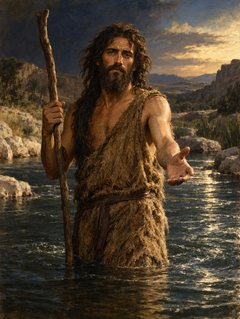 John the BaptistProphet who prepared the way for Jesus
Go deeper
Josephus's Jewish War and Antiquities are the main source for Herod's reign, and both are free to read online. The Roman writer Macrobius preserves the "pig and son" remark. Modern archaeology at Caesarea, Herodium, and the Temple Mount confirms the scale of his building. Wikipedia's article on Herod the Great is thorough and well sourced, Bible Hub has the verses, and Edersheim's The Temple describes the rebuilt sanctuary.
Related people: Jesus, Herod Antipas, Pontius Pilate, Caiaphas, Paul, James, Peter, John the Baptist.
References and further reading
- Wikipedia: Herod the Great
- Wikipedia article on : Herod
- Blue Letter Bible lexicon: Herodes (Herod)
- Josephus, Antiquities of the Jews (Project Gutenberg)
- Josephus, The Wars of the Jews (Project Gutenberg)
- Edersheim, The Temple: Its Ministry and Services (CCEL)
- Schaff, History of the Christian Church vol. 1: Apostolic Christianity (CCEL)
- Bible text: Matthew 2 (eBible.org, ESV)
Public-domain books, free to read
- Antiquities of the JewsFlavius Josephus
- The Wars of the JewsFlavius Josephus
- The Temple: Its Ministry and ServicesAlfred Edersheim
- The Life and Times of Jesus the MessiahAlfred Edersheim
Written by 508 Ministry. Scripture links open the public-domain World English Bible. Where Scripture, early church tradition and historians differ, this page says so.