
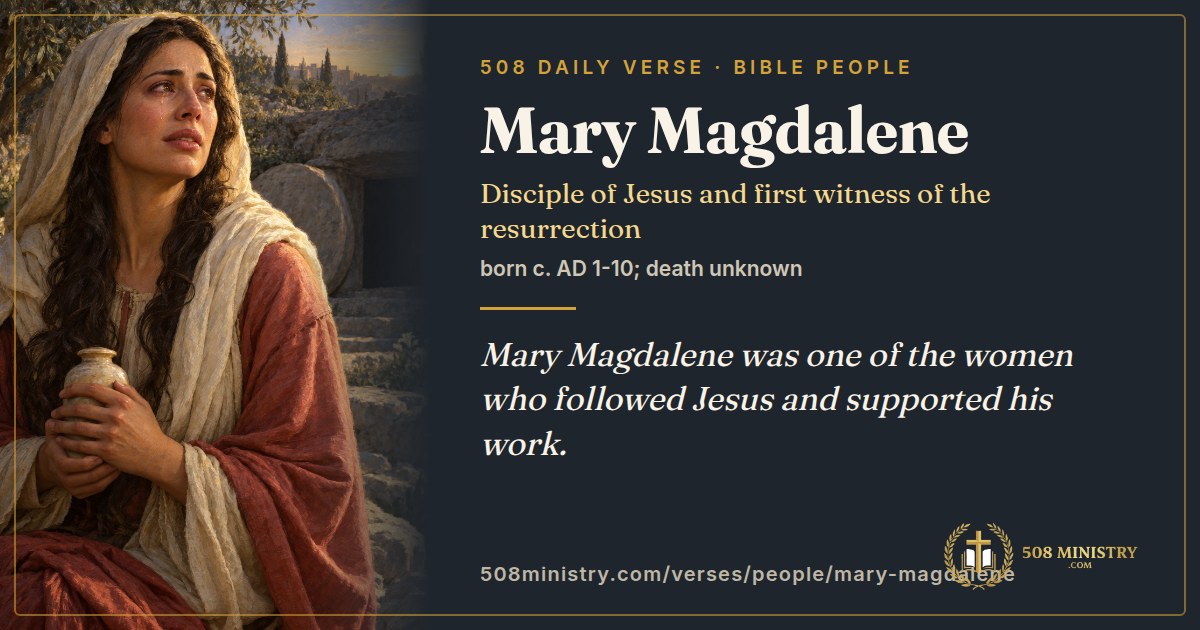

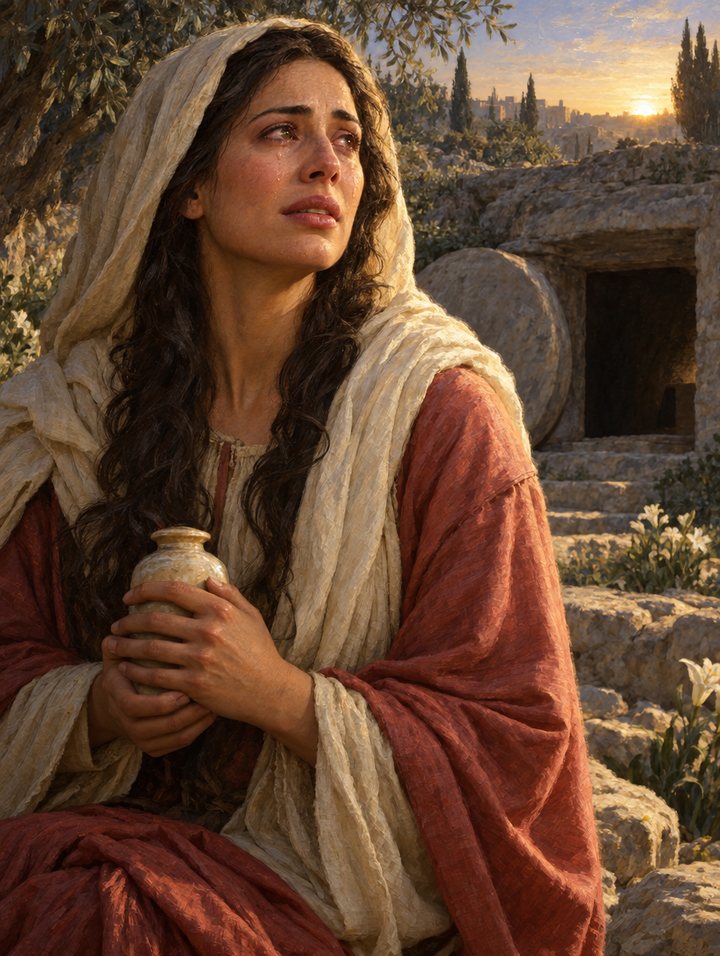
The world she lived in
Magdala sat on the shore of the Sea of Galilee, a few miles north of Tiberias, which Herod Antipas was building in her lifetime. The Greek name of the town was Tarichaeae, which means "salted fish," and the name tells us what the town was known for. Fish from the lake were salted, dried and shipped across the region. Excavations at Magdala since 2009 have uncovered a first-century synagogue, one of the oldest known in Galilee, with a carved stone table decorated with a seven-branched lampstand. They have also uncovered a harbor, fish pools and ritual baths. That does not prove any particular detail of Mary's life. But it shows that she came from a busy, prosperous trading town where Jewish life was strong.
A woman in Mary's world had few public rights. She could not be a witness in a Jewish court in the usual way, according to later rabbinic rules, and she would normally be identified by a male relative, as "daughter of" or "wife of" or "mother of." Mary is identified by her town, which suggests she was unmarried or widowed, and likely had her own means. That fits Luke's note that she and other women supported Jesus "of their substance."
Her first appearance: healed and following
Mary first appears in Luke 8:1-3. Jesus was traveling through towns and villages, preaching the good news of the kingdom of God, and with him were the twelve and "certain women, which had been healed of evil spirits and infirmities, Mary called Magdalene, out of whom went seven devils, And Joanna the wife of Chuza Herod's steward, and Susanna, and many others, which ministered unto him of their substance."
Three facts stand out. First, Mary was healed of what Luke calls seven demons. Seven is a number that suggests completeness in the Bible, so the phrase probably means severe and long-lasting affliction. Luke does not say what her trouble was. People in the first century used the language of demons for mental illness, epilepsy and spiritual oppression. We should not guess further than the text.
Second, she became a follower. The Gospel does not say how she responded, but the verb "ministered" (Greek diakoneō) is the same word used for what angels did for Jesus after the temptation and for the later office of deacon. She was serving, not just watching.
Third, she traveled with the group and paid for their needs. Joanna, one of the other women, was the wife of an official in Herod Antipas's household. That means the traveling company included at least one woman from the ruling class. The women funded a movement that men are more often credited with leading.
What the Bible does not say about her
It is worth stating plainly what Mary Magdalene is not in the New Testament. She is not called a prostitute. She is not the woman who anointed Jesus' feet in Luke 7:36-50, whom Luke calls "a woman in the city, which was a sinner" without naming her. She is not Mary of Bethany, the sister of Martha and Lazarus, who anointed Jesus in John 12. She is not the woman caught in adultery in John 8.
How did this confusion start? In AD 591, Pope Gregory the Great preached a sermon in which he identified Mary Magdalene with the sinful woman of Luke 7 and with Mary of Bethany, treating them as one person. Gregory was a pastor, not a historian, and his purpose was to illustrate repentance. The identification spread through the Western church and shaped art, preaching, and popular imagination for over a thousand years. In 1969, the Roman Catholic liturgical reform stopped treating the three women as one person in its readings, and in 2016 Pope Francis raised her feast day, July 22, to the same rank as that of the apostles. The Eastern churches never merged these women; they have always treated Mary Magdalene as one of the myrrh-bearing women, honored for her witness to the resurrection.
The Catholic Encyclopedia article on St. Mary Magdalen records the debate among earlier scholars and shows how divided they were. Reading it is a good way to see how the traditions developed.
At the cross
All four Gospels agree that Mary Magdalene was present at the crucifixion. Mark says that there were "also women looking on afar off: among whom was Mary Magdalene, and Mary the mother of James the less and of Joses, and Salome; (Who also, when he was in Galilee, followed him, and ministered unto him;) and many other women which came up with him unto Jerusalem" (Mark 15:40-41). Matthew's list is similar. John places the women closer: "Now there stood by the cross of Jesus his mother, and his mother's sister, Mary the wife of Cleophas, and Mary Magdalene" (John 19:25).
Think about what that meant. The male disciples had scattered. Peter had denied Jesus, and the rest were in hiding. The women stayed. They watched him die and saw where he was laid. Mark records that "Mary Magdalene and Mary the mother of Joses beheld where he was laid" (Mark 15:47). They knew the exact location, and that would matter on Sunday morning. If someone later claimed the disciples went to the wrong tomb, the women could answer.
Chapter one: the empty tomb
Jewish law forbade work on the Sabbath, so the women waited until it was over. Early on the first day of the week, while it was still dark, Mary Magdalene went to the tomb. Matthew says she went with another Mary. Mark names Mary Magdalene, Mary the mother of James, and Salome, and says they brought spices to anoint the body. Luke mentions Mary Magdalene, Joanna and Mary the mother of James, "and other women that were with them." John names only Mary Magdalene, though her words, "we know not where they have laid him," suggest she was not alone (John 20:2).
The four accounts differ in details: who was present, how many angels, who said what. These differences are the kind you expect from independent memories of a chaotic, emotional morning. What they share is more important: women went to the tomb, found the stone rolled away and the body gone, and were told that Jesus had risen. In Mark 16:6, the young man at the tomb says, "Be not affrighted: Ye seek Jesus of Nazareth, which was crucified: he is risen; he is not here: behold the place where they laid him." That verse is in our collection as Mark 16:6.
Historians have noted something about this detail. In the first-century world, a woman's testimony was not highly valued in court. If the early Christians had invented the story, they would hardly have made women the first witnesses. The fact that all the Gospels name women suggests that they preserved what really happened, even when it was embarrassing.
Chapter two: "Rabboni"
John's account is the most detailed and moving (John 20:1-18). Mary came to the tomb, saw the stone removed, and ran to tell Peter and the other disciple, probably John. "They have taken away the Lord out of the sepulchre, and we know not where they have laid him." The two men ran to the tomb, looked in, saw the linen cloths lying there and believed, or at least wondered, and went home.
Mary stayed. She stood outside the tomb weeping. When she stooped to look in, she saw two angels in white sitting where the body had been. They asked, "Woman, why weepest thou?" She said, "Because they have taken away my Lord, and I know not where they have laid him." Then she turned around and saw a man standing there. She did not recognize him. He asked the same question and added, "Whom seekest thou?" She thought he was the gardener and said, "Sir, if thou have borne him hence, tell me where thou hast laid him, and I will take him away."
Then Jesus said one word: "Mary." She turned and said in Hebrew, "Rabboni," which means Teacher.
That is one of the most tender scenes in the Gospels. Notice how it works. She did not recognize his face or his voice in ordinary speech. She recognized her name spoken by him. A few chapters earlier, Jesus had said that the good shepherd "calleth his own sheep by name... and the sheep follow him: for they know his voice" (John 10:3-4). Here, at the tomb, that sentence becomes a scene.
Jesus then said, "Touch me not; for I am not yet ascended to my Father: but go to my brethren, and say unto them, I ascend unto my Father, and your Father, and to my God, and your God" (John 20:17). The Greek verb is better understood as "do not keep holding on to me." Mary had grabbed him, as anyone would, and Jesus told her that the relationship had changed. He was not going to remain with them in the old way. She had a job to do.
The job is the point. Jesus sent her to tell the apostles. "Mary Magdalene came and told the disciples that she had seen the Lord, and that he had spoken these things unto her" (John 20:18). Since the early centuries, some church writers have called her the "apostle to the apostles," a title used by Hippolytus of Rome in the early third century and by many later writers. The title does not mean she was one of the Twelve. It means she was the one sent to the Twelve with the news that changed everything.
How the others reacted
Luke reports that when the women told the eleven apostles what they had seen, "their words seemed to them as idle tales, and they believed them not" (Luke 24:11). Mark's longer ending says the same: Jesus appeared first to Mary Magdalene, "out of whom he had cast seven devils," and she told those who had been with him, "as they mourned and wept. And they, when they had heard that he was alive, and had been seen of her, believed not" (Mark 16:9-11). Note that this longer ending is absent from the earliest manuscripts and is likely a later addition, so treat it with some caution.
Their disbelief is part of the evidence. The disciples did not expect a resurrection, and they did not accept it from a rumor. They needed to see for themselves. Over the next weeks, Jesus appeared to Peter, to two disciples on the road to Emmaus, to the Eleven, and later to more than five hundred people at once, according to Paul (1 Corinthians 15:5-6). Mary Magdalene was the first, but she was not the only one.
Mary Magdalene in early tradition
After the resurrection accounts, Mary Magdalene drops out of the New Testament. She is not mentioned in Acts, though the women who had followed Jesus are among those in the upper room (Acts 1:14). What happened next comes from tradition, and it is mixed.
Eastern tradition holds that she went to Ephesus with the apostle John and with Mary, the mother of Jesus, and died there. Her relics were said to have been moved to Constantinople in the ninth century. Western medieval legend, which began in France in the eleventh century, said that she sailed to Provence with Lazarus and Martha, preached to the people there, and spent her last thirty years in a cave at Sainte-Baume. Those stories gave rise to pilgrimage sites at Vézelay and at Saint-Maximin-la-Sainte-Baume, but modern historians regard them as legend. There is no evidence for them before the Middle Ages.
Some writings outside the New Testament, such as the Gospel of Mary, the Gospel of Philip and Pistis Sophia, give Mary Magdalene a prominent role. These texts date from the second century and later, and they belong to groups often called Gnostic, whose teaching differed sharply from the apostolic message. Scholars read them for what they show about early Christian diversity. They are not reliable sources for her life. The popular claim in recent novels that she was Jesus' wife and bore his child has no support in any early source. It is fiction. The Gospel of Philip has a damaged line about Jesus kissing Mary, but the text is broken and its meaning is uncertain, and in any case, it was composed generations after her lifetime.
If you want to see how the early Fathers treated the story of the resurrection and its first witnesses, the Ante-Nicene Fathers collection includes some of the earliest writings that circulated outside the New Testament, and the contrast with the canonical Gospels is instructive.
Relationships
Mary's closest companions in the Gospels are the other women: Joanna, Susanna, Salome, Mary the mother of James, and the mother of Jesus, Mary. She is often confused with Mary of Bethany, who belongs on a different page, Martha and Mary of Bethany. Among the apostles, she is linked with Peter and John, who ran to the tomb on her word. The Gospel writers Matthew, Mark and Luke all name her, and John tells her story best. Thomas, who doubted, shows how the first apostles reacted to the news. She appears throughout the life of Jesus.
Read their stories
 Jesus of NazarethTeacher, healer, and the Christ
 Mary, mother of JesusMother of Jesus and followerMartha and Mary of BethanySisters and friends of Jesus
 PeterApostle, fisherman, and rock of the early churchJohnApostle, beloved disciple, and witness to the WordThomasApostle and subject of a non-canonical sayings collection
 MatthewApostle, former tax collector, and Gospel writerLukePhysician, companion of Paul, and historian of the early church
The ripple effect
For two thousand years, Mary Magdalene has been a figure that people in the church and outside it have used to talk about faith and gender. Preachers have held her up as an example of repentance, and she is the patron of penitents, though that tradition rests on the confusion with the sinner in Luke 7. Painters have shown her with a jar of ointment, long hair and a skull, and Titian, Donatello and Caravaggio each painted her in memorable ways. Orders of nuns have taken her name, and so have hospitals, colleges and shelters for women. At Oxford and Cambridge, Magdalen College (pronounced "maudlin") bears her name.
More important is the example she sets. In a world that discounted women's voices, the first words of the Easter gospel were spoken by a woman. The earliest creed of the church, which Paul quotes in 1 Corinthians 15, lists the men who saw the risen Jesus, but the four Gospels, written from different angles, all remember the women. Christians of every tradition have found reasons to give her the honor the Gospels give her.
Her words in our verse collection
Mary Magdalene's recorded words are few: "They have taken away my Lord, and I know not where they have laid him" (John 20:13), and "I have seen the Lord" (John 20:18). They are not currently among our daily verses. The nearest entry is Mark 16:6, the angel's announcement at the tomb that she heard. Read her whole story at John 20.
Sayings in our verse index
And he saith unto them, Be not affrighted: Ye seek Jesus of Nazareth, which was crucified: he is risen; he is not here: behold the place where they laid him.
He is risen. He is not here. The story did not end where they thought.
Places
- 1Magdala · Her hometown; first-century synagogue excavated
- 2Galilee (Capernaum) · Region where she followed Jesus
- 3Jerusalem · Cross, tomb, resurrection appearance
- 4Ephesus · Eastern tradition of her later life
- Magdala: her hometown on the western shore of the Sea of Galilee.
- Galilee: where she followed and served Jesus.
- Jerusalem and Golgotha: where she stood at the cross.
- The garden tomb: the place of the burial and the resurrection appearance.
- Ephesus: where Eastern tradition says she died.
- Provence: the setting for a medieval French legend.
Timeline
- 28Healed and begins following JesusLuke 8:1-3
- 30Stands at the crossJohn 19:25
- 30Finds the empty tomb; sees the risen JesusJohn 20:1-18
- 591Gregory the Great merges her with other women in a sermonHomily 33
- 1969Catholic liturgical reform stops treating the three women as oneRoman calendar revision
- 2016Feast day raised to the rank of an apostle's feastDecree of 2016
- About AD 1 to 10: Mary born in Magdala.
- About AD 28 to 29: healed by Jesus; follows him through Galilee.
- About AD 30: present at the crucifixion and burial; first to see the risen Jesus.
- 591: Gregory the Great's sermon merges her with other women.
- 1969: the Catholic calendar drops the merged identification.
- 2016: her feast day is raised to the rank of an apostle's feast.
Watch
Go deeper
Read John 20 slowly, then Luke 8:1-3 and Mark 15 to 16. Next read the Catholic Encyclopedia article to see the traditional views, and the Wikipedia article for a modern summary. Edersheim's Life and Times of Jesus the Messiah describes the setting of the resurrection morning. The BibleProject overview of the Gospel of John, Part 2 covers John 13 to 21, including this scene.
References and further reading
- Wikipedia: Mary Magdalene
- Catholic Encyclopedia: St. Mary Magdalen
- eBible.org: John 20
- eBible.org: John 20
- Blue Letter Bible: John 3 (KJV with study tools)
- Edersheim, The Life and Times of Jesus the Messiah (CCEL)
- Ante-Nicene Fathers, vol. 8 (CCEL)
- BibleProject
Public-domain books, free to read
- The Life and Times of Jesus the MessiahAlfred Edersheim
- History of the Christian Church, vol. 2Philip Schaff
- Church HistoryEusebius of Caesarea
- Ante-Nicene Fathers, vol. 8Various, ed. Roberts and Donaldson
Written by 508 Ministry. Scripture links open the public-domain World English Bible. Where Scripture, early church tradition and historians differ, this page says so.