

The world he was born into
Matthew's story begins with money, and money begins with Rome.
By the time Jesus began his public work, Judea had been a Roman province for more than thirty years, and Galilee was ruled by Herod Antipas, a son of Herod the Great. Antipas ruled from about 4 BC to AD 39. He was a client of Rome, which means he held power by Rome's permission and had to send money upward. Taxes paid for his palaces, including the lakeside city of Tiberias that he built and named for the emperor. For a good account of the man himself, see Herod Antipas.
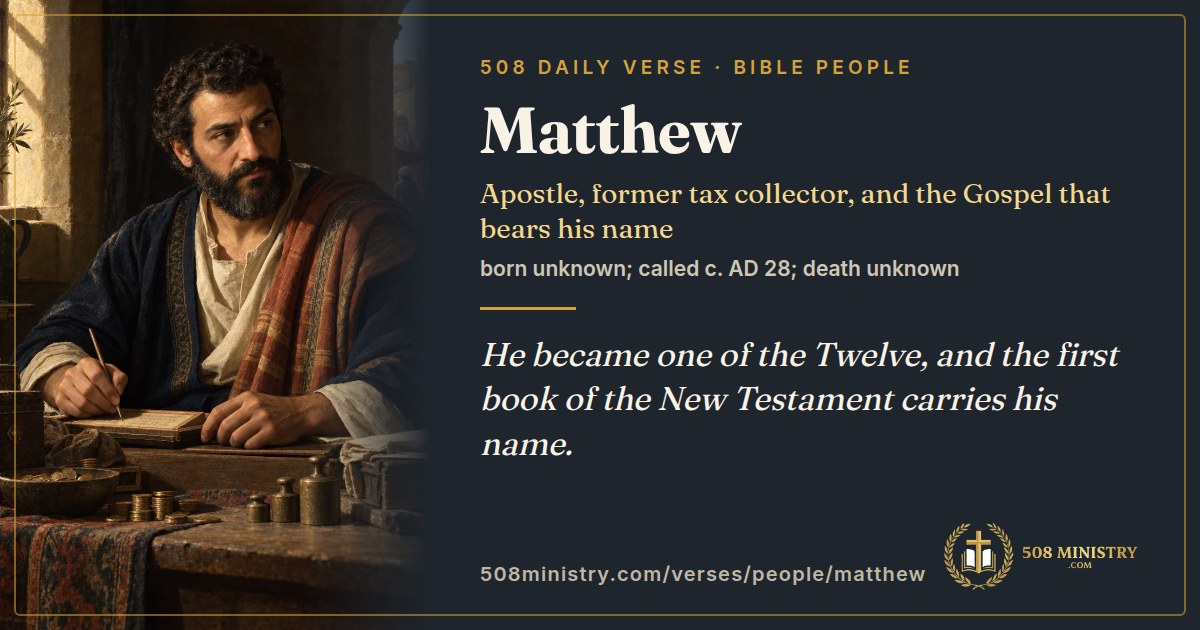
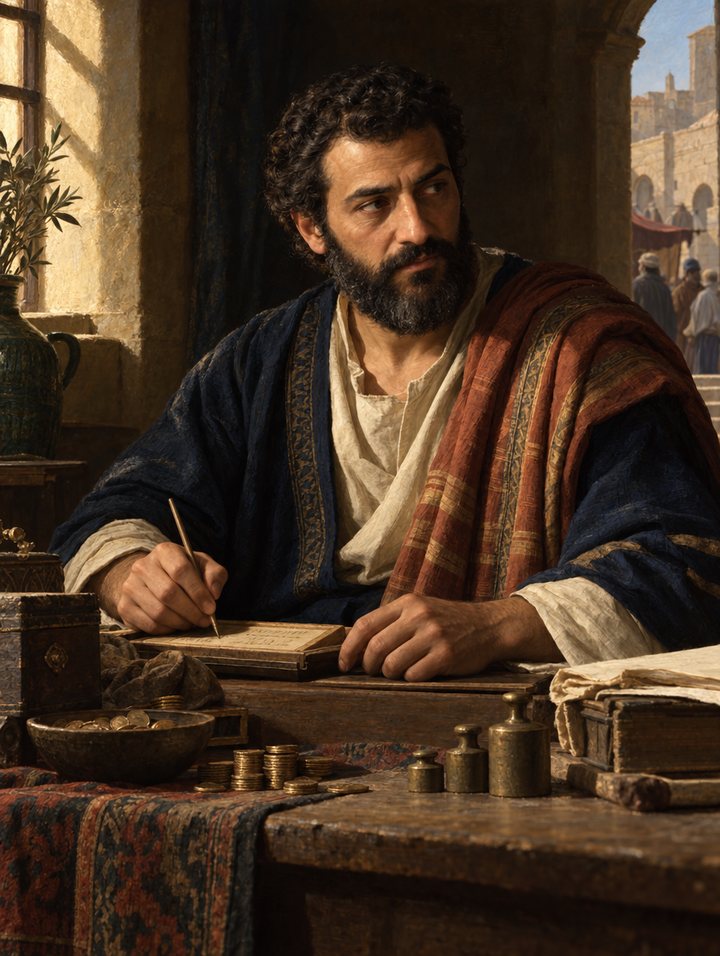
Tax collecting in that world was not a government job in the modern sense. In Galilee, the tolls and customs on goods moving along the roads and across the lake were handled by local men who paid for the right to collect them, or worked for those who did. Their income came from whatever they collected beyond what they owed. The system rewarded greed and invited abuse, and the men who ran it were naturally unpopular. Fellow Jews saw them as collaborators working for the occupier and as cheats who profited from their neighbors. In the Gospels, "tax collectors and sinners" is a stock phrase, as if the two groups were one.
Capernaum, where Matthew worked, sat on the northwestern shore of the Sea of Galilee, on a main road that ran from Damascus toward the Mediterranean coast. Goods, fish and travelers passed through it. A customs post there made practical sense. Capernaum also became Jesus' base in Galilee. Matthew's booth was a short walk from the homes of fishermen like Peter and Andrew, and from the synagogue where Jesus taught. The two worlds were close neighbors long before they met.
A man in Matthew's position would have been literate and numerate. He had to write receipts, count coins and keep accounts, likely in Greek and Aramaic both. Those habits are important for what comes later. When the church asked who could have kept a careful record of what Jesus said, a man trained to keep careful records was an obvious candidate.
What the Gospels tell us
The call (Matthew 9:9; Mark 2:14; Luke 5:27-28)
All three of the first Gospels tell this story, and the telling is short. Matthew gives it in a single verse: "As Jesus passed by from there, he saw a man called Matthew sitting at the tax collection office. He said to him, 'Follow me.' He got up and followed him" (Matthew 9:9).
Mark and Luke use the name Levi. Mark says "Levi the son of Alphaeus" (Mark 2:14). Luke adds a detail: "He left everything, and rose up and followed him" (Luke 5:28). Why two names? Many Jews of the time had more than one, a Hebrew name and a Greek or Aramaic one, or a second name given for some reason. Simon became Peter, and Joseph of Cyprus became Barnabas. "Matthew" is a form of a Hebrew name meaning "gift of the Lord." Whether Jesus gave the name, or whether it was a second name Matthew already carried, the Gospels do not say. Most readers have always taken Levi and Matthew to be the same man, since all three Gospels place the same call, the same dinner, and the same controversy in the same order, and since Matthew 10:3 and Mark 3:18 list Matthew among the Twelve while Levi never appears in the lists.
One detail is easy to pass over. Mark says Levi was "the son of Alphaeus." Another apostle, James, is also called "the son of Alphaeus" in the lists of the Twelve. Some readers have wondered if the two were brothers. The text never says so. Alphaeus was a common name, and we should leave the question open.
Consider how much Matthew gave up. A fisherman who left his boat could, in theory, return to it. A tax collector who walked away from his booth probably had no such way back. He had been paid by a system he now walked out on, and the same system would not take him back. When Luke says "he left everything," it is not a figure of speech.
The dinner (Matthew 9:10-13; Mark 2:15-17; Luke 5:29-32)
Luke says Levi "made a great feast for him in his house." Matthew's own account is shorter: "As he sat in the house, behold, many tax collectors and sinners came and sat down with Jesus and his disciples" (Matthew 9:10).
This is the first thing Matthew does after leaving his booth, and it says a great deal about him. He does not hold a sermon or a ceremony. He throws a party and invites his friends, the people nobody else would sit with, so they can meet the man who has just changed his life. A dinner table was one of the most serious social acts in that world. Who sat with whom told everyone who counted as respectable. The Pharisees saw it and asked the disciples, "Why does your teacher eat with the tax collectors and sinners?"
Jesus answered them himself. "Those who are healthy have no need for a physician, but those who are sick do" (Matthew 9:12; the same saying is in Mark 2:17 and Luke 5:31, and Mark 2:17 is in our verse index). Then, in Matthew's version only, he added a line from the prophet Hosea: "But you go and learn what this means: 'I desire mercy, and not sacrifice,' for I came not to call the righteous, but sinners to repentance" (Matthew 9:13; compare Hosea 6:6).
That verse from Hosea is one of the keys to the whole Gospel. Matthew quotes it again in chapter 12 when the Pharisees object to the disciples picking grain on the Sabbath (Matthew 12:7). It is as though the man who had been the village outsider heard something in those words that he never wanted anyone to forget.
Among the Twelve (Matthew 10:1-4; Luke 6:12-16; Acts 1:13)
The lists of the Twelve are not identical, but all four agree on the core names, and Matthew always appears in the second group of four, next to Thomas. In his own list he adds a small phrase that nobody else adds: "Thomas, and Matthew the tax collector" (Matthew 10:3). Mark and Luke, who name him without the label, leave out the old trade. Matthew keeps it. Whoever wrote that Gospel did not want the reader to forget what Jesus did with a man like him.
That is a quiet argument for the traditional author. A later writer inventing a story about an apostle might have been inclined to polish him. The Gospel does not.
Beyond the call, the dinner and the lists, the New Testament gives Matthew no spoken words and no actions. He does not appear in the book of Acts except in the list of the eleven in the upper room (Acts 1:13). After that, he disappears from Scripture. For the rest of the story, we go to the Gospel that bears his name and to the early church's memory of him.
The Gospel of Matthew
What the church said about it
The earliest report about who wrote this Gospel comes from Papias, bishop of Hierapolis in Asia Minor, writing in the first part of the second century. His books are lost, but Eusebius preserves his report in the Church History (3.39). In paraphrase: Matthew put the sayings of the Lord together in the Hebrew language, and each person interpreted them as best he could. Irenaeus of Lyons, around AD 180, says in Against Heresies (3.1.1) that Matthew issued a written Gospel among the Hebrews in their own language while Peter and Paul were preaching in Rome. Origen, as quoted by Eusebius (Church History 6.25), says the first Gospel was written by Matthew, "who was once a tax collector, but afterwards an apostle of Jesus Christ, [and] published it for those who from Judaism came to believe."
Notice the three claims in these reports. First, Matthew wrote. Second, he wrote in a Hebrew or Aramaic dialect. Third, he wrote for Jewish believers. The early church held to all three. You can read Eusebius' full account in the Christian Classics Ethereal Library.
What modern readers notice
Here a puzzle appears. The Gospel of Matthew we have is written in Greek, and in a Greek that does not read like a translation. Most scholars also think that Matthew used the Gospel of Mark as one of his main sources, copying and expanding much of it, and drew a large body of Jesus' sayings from a source shared with Luke. If the author was an eyewitness apostle, why would he lean so heavily on a book by Mark, who was not one of the Twelve? That question has led most critical scholars to conclude that the final Gospel was put together by an educated Jewish Christian in the generation after the apostles, perhaps around Antioch in Syria, using material that reached back to Matthew and the other eyewitnesses.
Others answer that an apostle could have borrowed from Mark if Mark's Gospel carried Peter's firsthand memory, as church tradition says it did, and that the "Hebrew sayings" Papias mentions could have been an early collection that Matthew later folded into a Greek Gospel. These are respectable positions. Neither can be proved from the evidence we have. What everyone agrees on is that the book is shaped by a Jewish mind steeped in the Hebrew Scriptures, writing for readers who knew them.
A Gospel built in five parts
Matthew arranges the teaching of Jesus into five long discourses, and each one ends with nearly the same sentence. After the Sermon on the Mount, "When Jesus had finished saying these things..." (7:28). The phrase returns at 11:1, 13:53, 19:1 and 26:1. Many readers think this is deliberate. Five blocks of teaching, like the five books of Moses, would present Jesus as the one who gives God's teaching to his people, in the way Moses once gave the Law.
The five are:
- The Sermon on the Mount (chapters 5-7), on the character of life in God's kingdom.
- The mission discourse (chapter 10), on the work of the Twelve.
- The parables of the kingdom (chapter 13).
- Life in the community of disciples (chapter 18), on humility, forgiveness and restoring a brother.
- The teaching on the end of the age (chapters 24-25), including the parables of the ten bridesmaids, the talents and the sheep and the goats.
Around them are the stories: the birth and the visit of the magi (chapters 1-2), the baptism and temptation (3-4), the healings and miracles (8-9), the opposition (11-12), the confession at Caesarea Philippi (16), the road to Jerusalem (19-23), and the passion and resurrection (26-28).
The Gospel for readers who knew their Bible
Matthew's Gospel opens with a genealogy, and the first line announces its aim: "The book of the genealogy of Jesus Christ, the son of David, the son of Abraham" (Matthew 1:1). David was Israel's great king and Abraham was the father of the nation. By starting there, Matthew tells his readers that Jesus fulfills the promises given to both. Look closely at the list of names, and you find four women, which was unusual for a Jewish genealogy: Tamar, Rahab, Ruth and "her who had been the wife of Uriah" (Bathsheba). All four have complicated stories, and several are outsiders. A tax collector who had been a social outcast knew what that meant.
The Gospel returns again and again to a refrain: this happened "that it might be fulfilled which was spoken through the prophet." The formula appears more than a dozen times, including at the virgin birth (1:22-23, quoting Isaiah 7:14), at the flight to Egypt (2:15, quoting Hosea 11:1) and at the healing ministry (8:17, quoting Isaiah 53:4). That last verse, Matthew 8:17, is in our verse index. For Matthew, the story of Jesus was not a surprise to Israel's Scriptures. It was where they were heading.
A Gospel for a worried community
Matthew is also the only Gospel that uses the word "church" (Matthew 16:18; 18:17). It has more to say than the others about how a community should handle sin, forgiveness and leadership, and it carries some of the sharpest warnings in the New Testament about hypocrisy, especially in chapter 23. Many scholars think the book was written to a community of Jewish Christians who were working out how to live faithfully after the destruction of the Temple in AD 70 and in tension with the synagogues around them. The sharpest passages should be read in that setting: a family argument inside Judaism, carried on by people who were themselves Jews, and not a charge against a people.
The ending
The Gospel ends on a mountain in Galilee. The eleven meet the risen Jesus, "but some doubted" (28:17). He does not wait for the doubt to clear. He gives them an assignment: "Go and make disciples of all nations, baptizing them in the name of the Father and of the Son and of the Holy Spirit, teaching them to observe all things that I commanded you. Behold, I am with you always, even to the end of the age" (Matthew 28:19-20).
This Great Commission has driven Christian mission for twenty centuries. It fits the book's opening, where foreigners come from the east to worship the infant Jesus, and the book's central figure, a man who once collected taxes for an empire and now carries a message for every nation. Both Matthew 28:19 and 28:20 are in our verse index.
The sayings in our verse index
Our daily verse index holds 45 passages from the Gospel of Matthew. A caution is needed here. These are not words that Matthew himself spoke. Nearly all of them are the words of Jesus as the Gospel records them, and the rest are the Gospel's own narration. They are listed here because they come from the book traditionally credited to him.
The Sermon on the Mount (chapters 5-7). The Beatitudes in 5:3-9 (poor in spirit, those who mourn, the gentle, those who hunger for righteousness, the merciful, the pure in heart, the peacemakers), "You are the light of the world" (5:14), "love your enemies" (5:44), the call to pray in secret (6:6), the Lord's Prayer (6:9-10) and "Give us today our daily bread" (6:11), forgiveness (6:14), treasures on earth and in heaven (6:19-21), two masters (6:24), the birds of the air (6:26), "seek first God's Kingdom" (6:33), do not be anxious for tomorrow (6:34), "Ask, and it will be given you" (7:7), the Golden Rule (7:12), and the wise builder (7:24).
Healing, compassion and mission (chapters 8-12). The fulfillment of Isaiah in the healing ministry (8:17), "Those who are healthy have no need for a physician" (9:12), compassion for the crowds (9:36), the sparrows (10:29-31), "Come to me, all you who labor" with the easy yoke (11:28-30), and the good treasure of the heart (12:35).
Teaching on the road (chapters 14-19). "Cheer up! It is I! Don't be afraid" (14:27), what defiles a person (15:18-19), "What will it profit a man if he gains the whole world" (16:26), two or three gathered in his name (18:20), forgiving "seventy times seven" in Peter's question (18:21-22), marriage (19:5-6), and "Allow the little children" (19:14).
Jerusalem and the last days (chapters 21-26). Faith in prayer (21:22), the great commandment (22:37-39), "Heaven and earth will pass away, but my words will not pass away" (24:35), "Well done, good and faithful servant" (25:21), the sheep and the goats (25:35-36 and 25:40), and "Watch and pray" in Gethsemane (26:41).
The Great Commission (chapter 28). Matthew 28:19 and 28:20.
That is 45 passages, and it does not exhaust the Gospel. It is a sampling for daily reading. The best way to take it in is to read chapters 5 to 7 straight through in one sitting, which takes about fifteen minutes.
Verses from our index
Passages from the Gospel of Matthew, mostly words of Jesus as recorded there; not words spoken by Matthew himself
Blessed are the poor in spirit: for theirs is the kingdom of heaven.
Blessed are the poor in spirit, for theirs is the kingdom of heaven.
Blessed are they that mourn: for they shall be comforted.
Blessed are those who mourn, for they will be comforted. Grief gets company.
Blessed are the meek: for they shall inherit the earth.
Blessed are the meek, for they will inherit the earth. Gentleness wins in the end.
Blessed are they which do hunger and thirst after righteousness: for they shall be filled.
Blessed are those who hunger and thirst for what is right, for they will be filled.
Blessed are the merciful: for they shall obtain mercy.
Blessed are the merciful, for they will be shown mercy. It comes back around.
Blessed are the pure in heart: for they shall see God.
Blessed are the pure in heart, for they will see God.
Blessed are the peacemakers: for they shall be called the children of God.
Blessed are the peacemakers, for they will be called children of God.
Ye are the light of the world. A city that is set on an hill cannot be hid.
You are the light of the world. A city on a hill cannot be hidden.
But I say unto you, Love your enemies, bless them that curse you, do good to them that hate you, and pray for them which despitefully use you, and persecute you;
Love your enemies and pray for those who use you badly. That is a different kind of strength.
But thou, when thou prayest, enter into thy closet, and when thou hast shut thy door, pray to thy Father which is in secret; and thy Father which seeth in secret shall reward thee openly.
When you pray, go into your room and shut the door. Quiet is a place to meet.
After this manner therefore pray ye: Our Father which art in heaven, Hallowed be thy name. Thy kingdom come. Thy will be done in earth, as it is in heaven.
Our Father in heaven, may your name be honoured and your kingdom come.
Give us this day our daily bread.
Give us this day our daily bread. Ask for today's portion, not a decade of it.
For if ye forgive men their trespasses, your heavenly Father will also forgive you:
If you forgive others their wrongs, your Father will forgive yours.
Lay not up for yourselves treasures upon earth, where moth and rust doth corrupt, and where thieves break through and steal: But lay up for yourselves treasures in heaven, where neither moth nor rust doth corrupt, and where thieves do not break through nor steal: For where your treasure is, there will your heart be also.
Do not pile up treasure on earth. Put your treasure where it cannot rust.
No man can serve two masters: for either he will hate the one, and love the other; or else he will hold to the one, and despise the other. Ye cannot serve God and mammon.
You cannot serve God and money. One of them will take the lead.
Behold the fowls of the air: for they sow not, neither do they reap, nor gather into barns; yet your heavenly Father feedeth them. Are ye not much better than they?
Look at the birds. Your heavenly Father feeds them, and you matter more.
But seek ye first the kingdom of God, and his righteousness; and all these things shall be added unto you.
Seek first the kingdom of God, and the other things will be added.
Take therefore no thought for the morrow: for the morrow shall take thought for the things of itself. Sufficient unto the day is the evil thereof.
Do not worry about tomorrow. Today has enough of its own to carry.
Ask, and it shall be given you; seek, and ye shall find; knock, and it shall be opened unto you:
Ask and it will be given, seek and you will find, knock and it will open.
Therefore all things whatsoever ye would that men should do to you, do ye even so to them: for this is the law and the prophets.
Treat people the way you want to be treated. That sums up a lot of law.
Therefore whosoever heareth these sayings of mine, and doeth them, I will liken him unto a wise man, which built his house upon a rock:
The one who hears these words and does them is like a house built on rock.
That it might be fulfilled which was spoken by Esaias the prophet, saying, Himself took our infirmities, and bare our sicknesses.
He took our weaknesses and carried our diseases. Healing was personal to him.
But when Jesus heard that, he said unto them, They that be whole need not a physician, but they that are sick.
The healthy do not need a doctor, but the sick do. Asking for help is not weakness.
But when he saw the multitudes, he was moved with compassion on them, because they fainted, and were scattered abroad, as sheep having no shepherd.
He was moved with compassion because they were worn out and scattered like sheep.
Are not two sparrows sold for a farthing? and one of them shall not fall on the ground without your Father. But the very hairs of your head are all numbered. Fear ye not therefore, ye are of more value than many sparrows.
Two sparrows sell for a penny, and not one falls without your Father. You are worth more.
Come unto me, all ye that labour and are heavy laden, and I will give you rest.
Come to me, all who are tired and carrying too much, and I will give you rest.
Take my yoke upon you, and learn of me; for I am meek and lowly in heart: and ye shall find rest unto your souls.
Take my yoke and learn from me, for I am gentle and humble in heart.
For my yoke is easy, and my burden is light.
My yoke is easy and my burden is light. Following should not break your back.
A good man out of the good treasure of the heart bringeth forth good things: and an evil man out of the evil treasure bringeth forth evil things.
A good person brings good things out of the good stored in their heart.
But straightway Jesus spake unto them, saying, Be of good cheer; it is I; be not afraid.
Be of good cheer. It is I. Do not be afraid.
But those things which proceed out of the mouth come forth from the heart; and they defile the man. For out of the heart proceed evil thoughts, murders, adulteries, fornications, thefts, false witness, blasphemies:
What comes out of the mouth starts in the heart. Change the heart, change the life.
For what is a man profited, if he shall gain the whole world, and lose his own soul? or what shall a man give in exchange for his soul?
What does it profit a person to gain the whole world and lose their own soul?
For where two or three are gathered together in my name, there am I in the midst of them.
Where two or three are gathered in my name, there I am among them.
Then came Peter to him, and said, Lord, how oft shall my brother sin against me, and I forgive him? till seven times? Jesus saith unto him, I say not unto thee, Until seven times: but, Until seventy times seven.
Not seven times, but seventy times seven. Forgiveness is not a tally.
And said, For this cause shall a man leave father and mother, and shall cleave to his wife: and they twain shall be one flesh? Wherefore they are no more twain, but one flesh. What therefore God hath joined together, let not man put asunder.
The two become one flesh. What God has joined together, let no one pull apart.
But Jesus said, Suffer little children, and forbid them not, to come unto me: for of such is the kingdom of heaven.
Let the children come to me. The kingdom belongs to people like them.
And all things, whatsoever ye shall ask in prayer, believing, ye shall receive.
Whatever you ask in prayer, believing, you will receive.
Jesus said unto him, Thou shalt love the Lord thy God with all thy heart, and with all thy soul, and with all thy mind. This is the first and great commandment. And the second is like unto it, Thou shalt love thy neighbour as thyself.
Love God with everything you are, and love your neighbor as yourself.
Heaven and earth shall pass away, but my words shall not pass away.
Heaven and earth will pass away, but my words will not pass away.
His lord said unto him, Well done, thou good and faithful servant: thou hast been faithful over a few things, I will make thee ruler over many things: enter thou into the joy of thy lord.
Well done, good and faithful servant. Faithfulness, not fame, gets the welcome.
For I was an hungred, and ye gave me meat: I was thirsty, and ye gave me drink: I was a stranger, and ye took me in: Naked, and ye clothed me: I was sick, and ye visited me: I was in prison, and ye came unto me.
I was hungry and you fed me, thirsty and you gave me a drink, sick and you visited.
And the King shall answer and say unto them, Verily I say unto you, Inasmuch as ye have done it unto one of the least of these my brethren, ye have done it unto me.
Whatever you did for the least of these, you did for me. Small kindness counts as worship.
Watch and pray, that ye enter not into temptation: the spirit indeed is willing, but the flesh is weak.
The spirit is willing but the flesh is weak. Watch and pray, and be gentle with yourself.
Go ye therefore, and teach all nations, baptizing them in the name of the Father, and of the Son, and of the Holy Ghost:
Go and make disciples of all nations, teaching them what I commanded.
Teaching them to observe all things whatsoever I have commanded you: and, lo, I am with you alway, even unto the end of the world. Amen.
And surely I am with you always, to the very end of the age.
Relationships
- Jesus called him from the booth, ate at his table, and named him one of the Twelve.
- Thomas is paired with him in Matthew 10:3, and in Mark and Luke the two names also stand side by side.
- James the son of Alphaeus shares a father's name with him in Mark 2:14 and Mark 3:18, though Scripture never says they were brothers.
- Peter has the largest part in Matthew's Gospel of any disciple: the walk on the water (14:28-31), the confession at Caesarea Philippi (16:13-20), the question about forgiveness (18:21-22), and the denial (26:69-75).
- Mark and Luke wrote the other two Gospels that cover the same story from a related point of view. Matthew shares much of his material with them.
- Judas Iscariot is the one disciple whose end Matthew describes at length, in 27:3-10.
- John the Baptist opens Jesus' ministry in Matthew 3.
- Herod the Great and Herod Antipas appear in the birth story and in the account of the Baptist's death. Pontius Pilate and Caiaphas appear in the passion story.
- The Twelve lists the rest.
Read their stories
 Jesus of NazarethTeacher, healer, and the ChristThomasApostle and subject of a non-canonical sayings collection
 James, son of AlphaeusApostle, one of the twelve
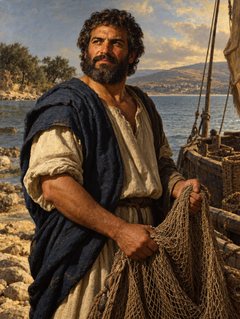 PeterApostle, fisherman, and rock of the early churchJohn MarkCompanion of Peter and Paul, and Gospel writerLukePhysician, companion of Paul, and historian of the early church
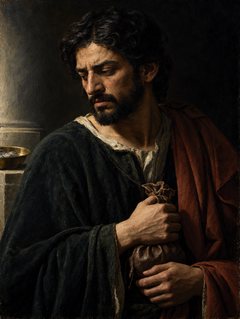 Judas IscariotApostle who betrayed Jesus
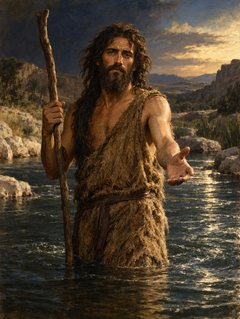 John the BaptistProphet who prepared the way for JesusHerod the GreatKing of Judea at the birth of JesusHerod AntipasRuler of Galilee and PereaPontius PilateRoman governor of JudeaCaiaphasHigh priest during the trial of JesusThe Twelve ApostlesThe original disciples Jesus chose and sent out
Death and legacy
The New Testament does not say how Matthew died. Early writers disagreed. Clement of Alexandria describes him as a man of strict habits who ate seeds, nuts and vegetables and no meat (Paedagogus 2.1), and quotes a Gnostic writer named Heracleon who treated Matthew as one of the apostles who had not died as a martyr (Stromata 4.9). Later traditions, much more colorful, send him to Ethiopia or Persia and have him killed by a sword or spear. Those stories first appear in texts written centuries after his death, and historians treat them with caution. His feast is kept on September 21 in the Western church and on November 16 in the East.
The best evidence of his legacy is the book. The Gospel of Matthew sits first in the New Testament, and for most of Christian history it has been the most-read and most-quoted of the four. The earliest church manual outside the New Testament, the Didache, quotes it. Its Lord's Prayer became the church's prayer. Its Beatitudes shaped the Christian idea of character. Its sheep-and-goats parable stood behind the Christian practice of feeding the hungry, visiting the prisoner and caring for the sick, one reason hospitals and relief work grew out of Christian communities. Its Great Commission is where much of the church's missionary work began.
Art kept pace. Caravaggio's The Calling of Saint Matthew (1599-1600), in the church of San Luigi dei Francesi in Rome, shows Jesus pointing from the edge of the dark room while Matthew, surrounded by men counting coins, points at his own chest as if to ask, "Me?" It is one of the great paintings of the call. Music followed: Bach's St Matthew Passion sets chapters 26 and 27 of the Gospel to some of the most moving music ever written.
Places
- 1Capernaum · Matthew 9:9
- 2Sea of Galilee · trade route
- 3Jerusalem · Acts 1:13
- 4Antioch on the Orontes · likely home of the Gospel's first readers (scholarly view)
- 5Hierapolis · Papias' city
- 6Rome, San Luigi dei Francesi · Caravaggio's Calling of Saint Matthew
- Capernaum, Matthew's tax booth, and Jesus' base in Galilee (Matthew 4:13; 9:9).
- The Sea of Galilee, the trade route and the road beside the booth.
- Matthew's house, in or near Capernaum, where the dinner was held (Matthew 9:10).
- Jerusalem, the upper room and Pentecost (Acts 1:13).
- Antioch in Syria, the likely home of the community that produced the Gospel, if the usual critical view is right.
- Hierapolis, in Asia Minor, where Papias wrote the first report about the book.
A timeline
- c. AD 28Called from the tax boothMatthew 9:9
- c. AD 28Dinner with tax collectors and sinnersMatthew 9:10-13
- c. AD 29Named among the TwelveMatthew 10:1-4
- c. AD 30-33Great Commission on a Galilean mountainMatthew 28:16-20
- c. AD 30-33In the upper roomActs 1:13
- AD 70Temple destroyedJosephus, Jewish War
- c. AD 80-90Greek Gospel of Matthew composed (common scholarly date)Gospel of Matthew
- c. AD 110-130Papias: Matthew compiled the sayings in HebrewEusebius, Church History 3.39
- c. AD 180Irenaeus names Matthew as authorAgainst Heresies 3.1.1
- 1599-1600Caravaggio paints The Calling of Saint MatthewSan Luigi dei Francesi
| Year | Event |
|---|---|
| c. AD 28 | Matthew called from the tax booth at Capernaum (Matthew 9:9) |
| c. AD 28 | The dinner with tax collectors and sinners (Matthew 9:10-13) |
| c. AD 29 | The Twelve are named and sent out (Matthew 10:1-4) |
| c. AD 30-33 | The final week; Matthew is among the Twelve at the last supper |
| c. AD 30-33 | The Great Commission on a mountain in Galilee (Matthew 28:16-20) |
| c. AD 30-33 | In the upper room (Acts 1:13) |
| AD 70 | The Temple destroyed by Rome |
| c. AD 80-90 | Most scholars date the Greek Gospel of Matthew to this period |
| c. AD 110-130 | Papias reports that Matthew compiled the sayings in Hebrew |
| c. AD 180 | Irenaeus names Matthew as author of the Gospel |
| 1599-1600 | Caravaggio paints The Calling of Saint Matthew |
Why he matters
Matthew's story is the one the church tells when someone asks whether it is too late for them. A man from the wrong side of every line, in the wrong job, among the wrong people, gets one sentence from Jesus and gets up from the table. His first move is to bring his friends. He keeps the label "tax collector" attached to his name for the rest of his life, and he lets his Gospel say what Jesus said at his table: "I desire mercy."
The Gospel he is credited with remains the most complete single record of Jesus' teaching. If you want to know what Jesus asked of people, start with chapters 5 to 7. If you want to know why he asked it, read the genealogy and the passion. If you want to know who he sent them to, read the last two verses.
By the numbers
| chapters | |
|---|---|
| Sermon on the Mount | 5-7 |
| Mission discourse | 10 |
| Parables of the kingdom | 13 |
| Community discourse | 18 |
| End of the age | 24-25 |
Watch
Go deeper
Read the Gospel in one sitting if you can; it takes about two hours aloud. For the story of the call, see Blue Letter Bible, Matthew 9:9-13. For the lists of the Twelve, see Matthew 10:1-4. Background reading: the Wikipedia article on Matthew, the Wikipedia article on the apostle, and the Wikipedia article on the Gospel. For the early church's witness, read Eusebius at the Christian Classics Ethereal Library. For a visual walk through the book, watch the BibleProject's animated overviews of Matthew, part 1 and part 2, and their short film on the Sermon on the Mount.
Every link on this page was checked when we built it, and the full list is in our file of verified sources.
References and further reading
- Wikipedia: Matthew the Apostle
- Wikipedia: Gospel of Matthew
- Wikipedia article on : Matthew (topical)
- Blue Letter Bible: Matthew 9:9-13 (KJV)
- Blue Letter Bible: Matthew 10:1-4 (KJV)
- Blue Letter Bible: Luke 6:12-16 (KJV)
- Bible Project
- Eusebius, Church History (CCEL)
Public-domain books, free to read
- The Ecclesiastical History (Church History)Eusebius of Caesarea
- The Life and Times of Jesus the MessiahAlfred Edersheim
- The Life of ChristFrederic W. Farrar
- Antiquities of the JewsFlavius Josephus
- Fox's Book of MartyrsJohn Foxe
Written by 508 Ministry. Scripture links open the public-domain World English Bible. Where Scripture, early church tradition and historians differ, this page says so.