
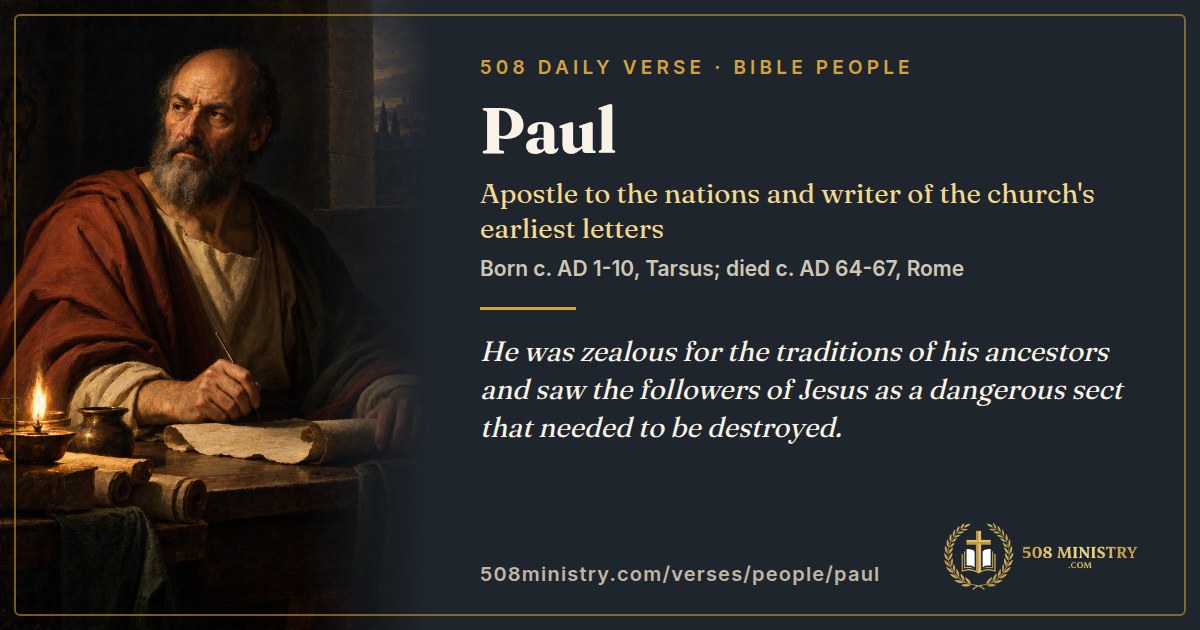

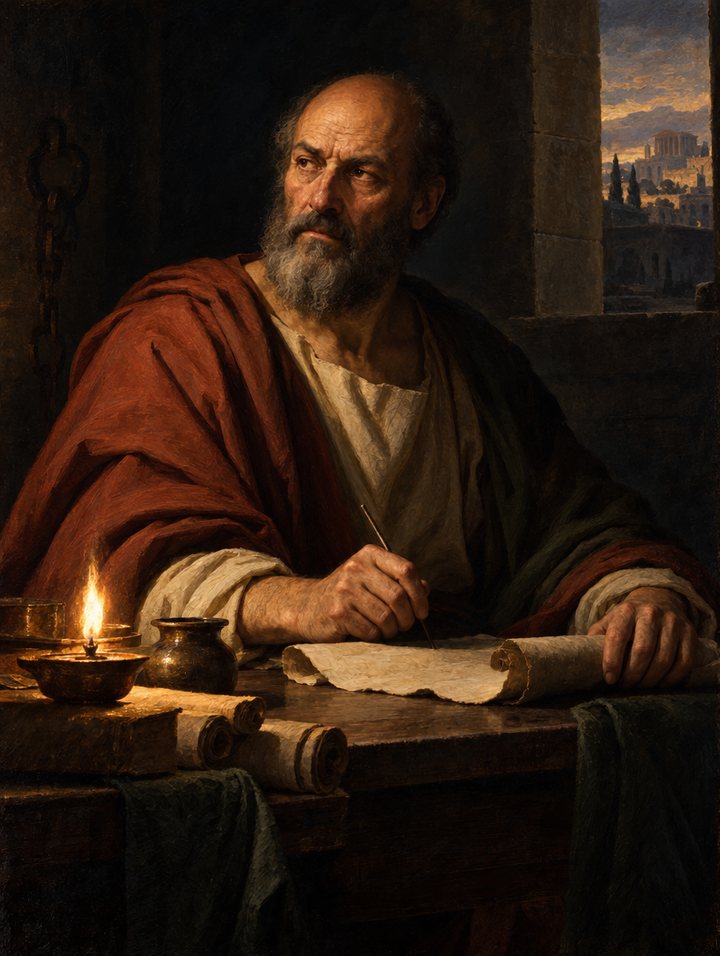
The world of Paul
Paul grew up between three worlds. He was a Jew, the son of a family that kept the law of Moses and spoke Aramaic and Hebrew at home. He was a Greek-speaking citizen of one of the great cultural centers of the eastern Mediterranean. And he was a Roman, a citizen by birth (Acts 22:28), a status that gave him legal protections few Jews of his time had. That mix shaped everything he did later.
Tarsus was a bustling city on the plain of Cilicia, on the river Cydnus, with a university tradition that ancient geographers compared to Athens and Alexandria. Paul called it "no obscure city" (Acts 21:39). He was raised in its streets, learned its Greek language, and probably absorbed a good deal of its philosophy and rhetoric, which is clear from how comfortably he quotes Greek poets, as he did on the Areopagus in Athens (Acts 17:28). He also learned a trade. In Corinth he stayed with Aquila and Priscilla, "and because he was of the same trade he stayed with them and worked, for they were tentmakers" (Acts 18:3). The word may also mean leatherworker. Paul used that work to support himself, refusing payment from the churches he founded so that no one could say he preached for money (1 Corinthians 9:12 to 18; 1 Thessalonians 2:9).
As a young man he went to Jerusalem to study "at the feet of Gamaliel," the most respected Pharisee teacher of his generation (Acts 22:3; Acts 5:34). He describes himself in his letter to the Philippians: "circumcised on the eighth day, of the people of Israel, of the tribe of Benjamin, a Hebrew of Hebrews; as to the law, a Pharisee; as to zeal, a persecutor of the church; as to righteousness under the law, blameless" (Philippians 3:5 to 6). He was a man who believed with his whole heart that he was serving God.
Saul the persecutor
Our first sight of Saul in Acts is a grim one. When the first Christian martyr, Stephen, was dragged out of Jerusalem and stoned, "the witnesses laid down their garments at the feet of a young man named Saul," and Saul "was consenting to his death" (Acts 7:58; 8:1). A great persecution broke out against the church in Jerusalem. Acts says Saul "was ravaging the church, and entering house after house, he dragged off men and women and committed them to prison" (Acts 8:3).
Why was he so fierce? In his own letters he does not hide that he was convinced the early Christians were dangerous. A crucified Messiah was, for a zealous Pharisee, a contradiction in terms, since the law said that anyone hanged on a tree was under God's curse (Deuteronomy 21:23; Galatians 3:13). To claim that such a man was the Messiah, and that God had raised him from the dead, seemed to Saul to be a blasphemy that threatened the nation. Years later he wrote, "I was formerly a blasphemer, persecutor, and insolent opponent. But I received mercy because I had acted ignorantly in unbelief" (1 Timothy 1:13), and, "I am the least of the apostles, unworthy to be called an apostle, because I persecuted the church of God" (1 Corinthians 15:9). The memory never left him.
The road to Damascus
Armed with letters from the high priest, Saul set off for Damascus, about 135 miles north of Jerusalem, to arrest believers and bring them back for trial (Acts 9:1 to 2; see Caiaphas). The story is told three times in Acts, once by Luke (Acts 9:1 to 19), and twice by Paul himself in speeches (Acts 22:1 to 21 and Acts 26:9 to 23). Paul also refers to it in his letters (Galatians 1:11 to 17; 1 Corinthians 9:1; 15:8).
Near Damascus, at midday, "suddenly a light from heaven shone around him. And falling to the ground he heard a voice saying to him, 'Saul, Saul, why are you persecuting me?' And he said, 'Who are you, Lord?' And he said, 'I am Jesus, whom you are persecuting'" (Acts 9:3 to 5). Notice the phrase: "persecuting me." Jesus identified himself with his people so completely that to harm them was to harm him. Saul was blinded, and his companions led him by the hand into the city. For three days he neither ate nor drank.
God then sent a believer named Ananias, who was afraid to go, since he knew Saul's reputation. The Lord told him, "Go, for he is a chosen instrument of mine to carry my name before the Gentiles and kings and the children of Israel. For I will show him how much he must suffer for the sake of my name" (Acts 9:15 to 16). Ananias laid his hands on Saul and called him "Brother Saul." Something like scales fell from his eyes, and he could see again. He was baptized, and he began to preach in the synagogues of Damascus that Jesus is the Son of God.
What makes this story so powerful is the speed and completeness of the reversal. Within days the hunter had become the hunted. When the Jews in Damascus plotted to kill him, the believers lowered him over the city wall in a basket at night (Acts 9:23 to 25; 2 Corinthians 11:32 to 33). The man who had come as a conqueror left as a fugitive.
Paul's own account in Galatians adds a detail Acts does not mention: after his conversion he went away into Arabia, probably the Nabatean desert region east and south of Damascus, and then returned to Damascus (Galatians 1:17). Only after three years did he go up to Jerusalem to meet Peter, staying fifteen days, and he met James, the Lord's brother (Galatians 1:18 to 19; Peter; James). The Jerusalem believers were frightened of him until Barnabas took him in and vouched for him (Acts 9:26 to 27; Barnabas).
The first journey: Cyprus and Galatia
The church at Antioch, while worshiping and fasting, heard the Holy Spirit say, "Set apart for me Barnabas and Saul for the work to which I have called them" (Acts 13:2). That verse is in our daily verse collection. They sailed to Cyprus, Barnabas's home island, and traveled across it. At Paphos, the Roman governor Sergius Paulus believed the message, and from this point Luke begins to call Saul by his Roman name, Paul (Acts 13:9). The Roman name suited the work ahead. He was going to the Gentile world.
From Cyprus the missionaries sailed to the southern coast of Asia Minor (modern Turkey) and traveled inland to cities in the region called Galatia: Pisidian Antioch, Iconium, Lystra, and Derbe (Acts 13 to 14). At Pisidian Antioch Paul gave the first sermon of his that Acts records in full. He told the story of Israel from the exodus to David and then to Jesus, whom God raised from the dead, and he declared, "Through this man forgiveness of sins is proclaimed to you, and by him everyone who believes is freed from everything from which you could not be freed by the law of Moses" (Acts 13:38 to 39). In Lystra, after Paul healed a man who had been lame from birth, the people thought the missionaries were gods, calling Barnabas Zeus and Paul Hermes, and Paul had to stop them from sacrificing to them (Acts 14:8 to 18). Not long after, Jews from nearby cities stirred up the crowds, and Paul was stoned and dragged out of the city and left for dead. He got up, went back into the city, and left for Derbe the next day (Acts 14:19 to 20).
After revisiting the new churches and appointing elders in each, they returned to Antioch and told how God "had opened a door of faith to the Gentiles" (Acts 14:27).
The council in Jerusalem
The success among the Gentiles raised a hard question. Must non-Jews who believe in Jesus be circumcised and keep the law of Moses in order to belong to God's people? Some men from Judea said yes: "Unless you are circumcised according to the custom of Moses, you cannot be saved" (Acts 15:1). Paul and Barnabas strongly disagreed, and the church sent them to Jerusalem to discuss it with the apostles and elders (around AD 49).
This meeting, often called the Jerusalem Council, is told in Acts 15, and Paul gives his own account in Galatians 2. Peter spoke first, reminding the council that God had already given the Holy Spirit to Gentiles in the house of Cornelius, "cleansing their hearts by faith" (Acts 15:9). Then Barnabas and Paul told of the signs God had done among the Gentiles. Finally James, the brother of Jesus, summed up from the prophets and gave the judgment: "my judgment is that we should not trouble those of the Gentiles who turn to God" (Acts 15:19). They sent a letter asking Gentile believers only to avoid idolatry, sexual immorality, and certain food practices that would offend Jewish believers living beside them. Circumcision was not required. In Galatians 2:9, Paul says that James, Peter (Cephas), and John gave him and Barnabas "the right hand of fellowship," agreeing that Paul and Barnabas would go to the Gentiles and they to the Jews. John.
It was one of the great turning points in history. If the council had decided differently, Christianity might have remained a small branch of Judaism. Because it decided as it did, the message went out freely across the Roman world.
The agreement was not the end of tension. In Galatians 2:11 to 14, Paul describes how, when Peter came to Antioch, he first ate freely with Gentile believers and then pulled back when some men from James arrived, and Barnabas also was "led astray." Paul opposed Peter to his face "because he stood condemned." The incident shows that even the apostles had to keep learning what the gospel demands. Not long afterward, Paul and Barnabas had a sharp disagreement over whether to take John Mark on their next trip, and they separated (Acts 15:36 to 41). Paul chose Silas, and Barnabas took Mark. We will return to that story in Barnabas's profile.
The second journey: Europe
With Silas, and soon with young Timothy from Lystra (Timothy), Paul traveled west through Asia Minor. At Troas, he had a vision of a man from Macedonia saying, "Come over to Macedonia and help us" (Acts 16:9). Here the narrative of Acts shifts from "they" to "we," suggesting that the author, Luke, had joined the party. They crossed the Aegean Sea. This was the first time the gospel is recorded entering Europe.
At Philippi, the first church in Europe was planted, beginning with a businesswoman named Lydia, a dealer in purple cloth, "whose heart the Lord opened to pay attention to what was said by Paul" (Acts 16:14). After Paul cast a spirit out of a slave girl whose owners made money from her fortune-telling, he and Silas were beaten and thrown into prison. At midnight they were praying and singing hymns, "and the prisoners were listening to them" when an earthquake opened the doors. The jailer, about to kill himself, asked, "Sirs, what must I do to be saved?" They answered, "Believe in the Lord Jesus, and you will be saved, you and your household" (Acts 16:30 to 31). In the morning Paul, to the magistrates' alarm, revealed that he was a Roman citizen who had been beaten without a trial, a serious offense (Acts 16:37 to 39). The verse "about midnight Paul and Silas were praying and singing hymns to God" (Acts 16:25) is also in our collection.
At Thessalonica a riot forced them out after only a few weeks, but the little church they left behind became the recipient of the earliest letter in the New Testament, 1 Thessalonians, probably written from Corinth about AD 50 or 51. At Berea, the Jews "were more noble than those in Thessalonica; they received the word with all eagerness, examining the Scriptures daily to see if these things were so" (Acts 17:11).
At Athens, Paul walked through a city full of idols and was "provoked" by what he saw. He talked in the marketplace with Epicurean and Stoic philosophers and was invited to speak to the council on the Areopagus, the Hill of Ares. Standing before some of the best-educated people in the world, he did not begin by quoting Moses. He began with their own altar "to the unknown god" and said, "What therefore you worship as unknown, this I proclaim to you." He quoted Greek poets, "In him we live and move and have our being," and told them that God "commands all people everywhere to repent, because he has fixed a day on which he will judge the world in righteousness by a man whom he has appointed" (Acts 17:22 to 31). Some mocked when he mentioned the resurrection, some wanted to hear more, and a few believed.
At Corinth, a wealthy, rough port city notorious for its vice, Paul stayed a year and a half (Acts 18:11). A Greek inscription found at Delphi mentions the Roman proconsul Gallio, who appears in Acts 18:12 to 17, and dates his term to about AD 51 to 52. That gives one of the firmest anchor points for the timeline of Paul's life. From Corinth Paul wrote letters to the Thessalonians, and afterward to the Corinthians themselves, a church full of gifts and problems.
The third journey and Ephesus
On his third journey, around AD 53 to 57, Paul settled in Ephesus, a major commercial and religious center, home of the temple of Artemis, one of the seven wonders of the ancient world. He taught there for about three years, first in the synagogue and then in a lecture hall, "so that all the residents of Asia heard the word of the Lord, both Jews and Greeks" (Acts 19:10). Acts reports that unusual miracles were done through him and that many who had practiced magic burned their books, worth fifty thousand pieces of silver (Acts 19:19). The success threatened the trade in silver shrines of Artemis, and a silversmith named Demetrius stirred up a riot in the theater, where the crowd shouted for two hours, "Great is Artemis of the Ephesians!" (Acts 19:28 to 34).
During these years Paul wrote 1 Corinthians, probably from Ephesus, and the sorrowful letters and the reconciliation that make up 2 Corinthians. Galatians may also come from this period, though its date is debated, and the great letter to the Romans, written from Corinth about AD 57, in which he sets out the gospel in its fullest form.
Paul's own list of what he suffered during all this is one of the most arresting passages in the New Testament:
"Five times I received at the hands of the Jews the forty lashes less one. Three times I was beaten with rods. Once I was stoned. Three times I was shipwrecked; a night and a day I was adrift at sea; on frequent journeys, in danger from rivers, danger from robbers, danger from my own people, danger from Gentiles, danger in the city, danger in the wilderness, danger at sea, danger from false brothers; in toil and hardship, through many a sleepless night, in hunger and thirst, often without food, in cold and exposure" (2 Corinthians 11:24 to 27).
This is the same man who wrote to the Philippians from prison, "Rejoice in the Lord always; again I will say, rejoice" (Philippians 4:4). And that is the deepest mark of Paul's life: joy in the middle of suffering.
The collection, arrest, and appeal to Caesar
Paul planned to bring to Jerusalem a large gift of money, collected from the Gentile churches of Macedonia, Achaia, and Galatia for the poor believers in Judea. For him it was a sign that Jews and Gentiles had become one family (Romans 15:25 to 27; 2 Corinthians 8 to 9). He was warned by prophets along the way that he would face imprisonment in Jerusalem, and he went anyway, saying, "I am ready not only to be imprisoned but even to die in Jerusalem for the name of the Lord Jesus" (Acts 21:13).
In the Temple, Jews from Asia saw him and accused him of bringing Gentiles into the sacred courts. A mob dragged him out and tried to kill him, and Roman soldiers rescued him from the Antonia fortress just above the courtyard. When the tribune was about to examine him with a whip, Paul said, "Is it lawful for you to flog a man who is a Roman citizen and uncondemned?" (Acts 22:25). The tribune backed off. Paul spent two years in custody at Caesarea under the governors Felix and Festus (Acts 24:27). When Festus wanted to send him back to Jerusalem to be tried there, Paul exercised his right as a Roman citizen: "I appeal to Caesar" (Acts 25:11). He also gave a famous defense before King Agrippa, telling again the story of his conversion and ending with the wish "that not only you but also all who hear me this day might become such as I am, except for these chains" (Acts 26:29). Agrippa remarked that Paul could have been set free had he not appealed to Caesar.
Shipwreck and Rome
The voyage to Rome, told in Acts 27 and 28 in vivid detail by Luke, who was aboard, is one of the great sea stories of ancient literature. A violent storm struck for fourteen days. Paul, a prisoner, stood up and told the crew that an angel had assured him that none of them would be lost. The ship ran aground at Malta, where the islanders treated them kindly, and Paul was bitten by a snake and shook it off into the fire. After three months they went on to Italy, and "the brothers there... came as far as the Forum of Appius and Three Taverns to meet us. On seeing them, Paul thanked God and took courage" (Acts 28:15).
Acts ends with Paul in Rome, under house arrest, for two years, "proclaiming the kingdom of God and teaching about the Lord Jesus Christ with all boldness and without hindrance" (Acts 28:30 to 31). From these years come the letters often called the Prison Letters: Ephesians, Philippians, Colossians, and Philemon. In Philemon, a short note, Paul pleads with a Christian slaveholder to receive back his runaway slave Onesimus "no longer as a slave but more than a slave, as a beloved brother" (Philemon 16).
How did Paul die?
The New Testament does not record Paul's death. The best early evidence comes from outside it. A letter from the church in Rome to the church in Corinth, written about AD 96 and known as 1 Clement, says that Paul, after preaching in the east and the west, "reached the limits of the West" and gave his testimony before the rulers, and so passed from the world (1 Clement 5). That might mean Spain, as Paul had hoped to go (Romans 15:24, 28), or might simply mean Rome. In the second and third centuries, the church in Rome claimed the graves of both Peter and Paul. The historian Eusebius, in the early fourth century, wrote that Paul was beheaded in Rome under Nero, and that Peter was crucified, citing a church leader named Dionysius of Corinth and a Roman presbyter named Gaius (Church History 2.25). Because Paul was a Roman citizen, beheading, not crucifixion, was the expected form of execution. The date is probably between AD 64 and 67, during or just after Nero's persecution that followed the great fire of Rome in AD 64.
We should be honest about what is early and what is later. That Paul died a martyr in Rome under Nero is the strong, consistent tradition of the early church. The details, including the exact place of execution, belong to later accounts. The traditional tomb lies beneath the Basilica of St. Paul Outside the Walls in Rome. In 2006 the Vatican announced that a marble sarcophagus beneath the altar, inscribed with the words "Paulo apostolo mart" (Paul, apostle and martyr), had been examined by drilling a small hole. In 2009 Pope Benedict XVI reported that fragments of purple and blue cloth, grains of incense, and small bone fragments were found, and that the bone had been carbon-dated to the first or second century. This is a matter of church tradition and cannot be proven, but it is consistent with it.
In his last letter, written near the end, Paul wrote to Timothy: "I have fought the good fight, I have finished the race, I have kept the faith. Henceforth there is laid up for me the crown of righteousness, which the Lord, the righteous judge, will award to me on that day, and not only to me but also to all who have loved his appearing" (2 Timothy 4:7 to 8). The verse about fighting the good fight (2 Timothy 4:7) is in our collection.
The letters of Paul
Paul's letters are the earliest Christian writings we have. 1 Thessalonians, written about AD 50 or 51, is probably the oldest book of the New Testament, written some fifteen to twenty years before the first Gospel was written. Thirteen letters carry his name in the New Testament. Scholars agree that seven are certainly his: Romans, 1 Corinthians, 2 Corinthians, Galatians, Philippians, 1 Thessalonians, and Philemon. The authorship of Ephesians, Colossians, and 2 Thessalonians is debated, with some scholars believing they were written by close followers using his name, though many hold that Paul wrote them himself. The letters to Timothy and Titus, known as the Pastoral Letters, are the most debated, with many modern scholars thinking a follower wrote them soon after his death, while others argue they are authentic late letters. We note the debate honestly, and we trust our readers to follow the evidence where it leads. The church has received all thirteen as Scripture from the beginning.
The letters are occasional writings, meaning each was written to a particular church facing particular problems. Yet they contain some of the deepest thought in the history of religion. A few of the great themes:
Grace. "For by grace you have been saved through faith. And this is not your own doing; it is the gift of God, not a result of works, so that no one may boast" (Ephesians 2:8 to 9). Paul never tired of saying that we are accepted by God as a gift and not as a wage.
Faith. "For I am not ashamed of the gospel, for it is the power of God for salvation to everyone who believes, to the Jew first and also to the Greek. For in it the righteousness of God is revealed from faith for faith, as it is written, 'The righteous shall live by faith'" (Romans 1:16 to 17).
Love. In 1 Corinthians 13, the great chapter on love, Paul says that without love, the greatest gifts are nothing, and ends: "So now faith, hope, and love abide, these three; but the greatest of these is love" (1 Corinthians 13:13).
New life in Christ. "I have been crucified with Christ. It is no longer I who live, but Christ who lives in me. And the life I now live in the flesh I live by faith in the Son of God, who loved me and gave himself for me" (Galatians 2:20). This verse is in our collection, as is "If anyone is in Christ, he is a new creation. The old has passed away; behold, the new has come" (2 Corinthians 5:17).
Unity. "There is neither Jew nor Greek, there is neither slave nor free, there is no male and female, for you are all one in Christ Jesus" (Galatians 3:28). The sentence was revolutionary in a world divided by ethnicity, status, and gender.
Hope. "For I am sure that neither death nor life, nor angels nor rulers, nor things present nor things to come, nor powers, nor height nor depth, nor anything else in all creation, will be able to separate us from the love of God in Christ Jesus our Lord" (Romans 8:38 to 39).
Teaching and sayings from our verse collection
Our daily verse collection contains 242 verses drawn from the letters Paul wrote, or that are traditionally attributed to him. Among them are some of the best-loved passages in the Bible: "I can do all things through him who strengthens me" (Philippians 4:13), "Do not be anxious about anything" (Philippians 4:6), "All Scripture is breathed out by God" (2 Timothy 3:16), and "God gave us a spirit not of fear but of power and love and self-control" (2 Timothy 1:7). Use the verse bar on this site to read them, and use the audio button to hear each one.
Verses from our index
All verses in the daily index drawn from the thirteen letters that bear Paul's name (242 verses).
Or despisest thou the riches of his goodness and forbearance and longsuffering; not knowing that the goodness of God leadeth thee to repentance?
The goodness of God is what leads a person to turn around.
God is faithful, by whom ye were called unto the fellowship of his Son Jesus Christ our Lord.
God is faithful, and he called you into fellowship with his Son. He keeps his calls.
Who comforteth us in all our tribulation, that we may be able to comfort them which are in any trouble, by the comfort wherewith we ourselves are comforted of God.
He comforts us in all our trouble so we can comfort others with the same comfort.
For ye are all the children of God by faith in Christ Jesus.
You are all children of God through faith in Christ Jesus.
In whom we have redemption through his blood, the forgiveness of sins, according to the riches of his grace;
In him we have redemption through his blood, the forgiveness of our wrongs.
For to me to live is Christ, and to die is gain.
For me, to live is Christ and to die is gain. One centre for both.
For by him were all things created, that are in heaven, and that are in earth, visible and invisible, whether they be thrones, or dominions, or principalities, or powers: all things were created by him, and for him:
All things were created by him and for him, and in him all things hold together.
For this cause also thank we God without ceasing, because, when ye received the word of God which ye heard of us, ye received it not as the word of men, but as it is in truth, the word of God, which effectually worketh also in you that believe.
We thank God constantly that when you received his word, you accepted it as his word.
Now our Lord Jesus Christ himself, and God, even our Father, which hath loved us, and hath given us everlasting consolation and good hope through grace, Comfort your hearts, and stablish you in every good word and work.
May our Lord and Father, who loved us, give you eternal comfort and good hope.
I exhort therefore, that, first of all, supplications, prayers, intercessions, and giving of thanks, be made for all men;
Pray for all people, with requests, petitions, and thanksgiving.
For the which cause I also suffer these things: nevertheless I am not ashamed: for I know whom I have believed, and am persuaded that he is able to keep that which I have committed unto him against that day.
I know whom I have believed, and I am sure he is able to guard what I have entrusted to him.
In all things shewing thyself a pattern of good works: in doctrine shewing uncorruptness, gravity, sincerity,
In everything set an example by doing what is good. Example teaches louder than words.
Yea, brother, let me have joy of thee in the Lord: refresh my bowels in the Lord.
Let me have joy from you in the Lord and refresh my heart.
Saying, Blessed are they whose iniquities are forgiven, and whose sins are covered.
Blessed are those whose wrongs are forgiven and whose sins are covered.
But God hath chosen the foolish things of the world to confound the wise; and God hath chosen the weak things of the world to confound the things which are mighty;
God chose the weak things of the world to shame the strong. Weakness is not disqualified.
For all the promises of God in him are yea, and in him Amen, unto the glory of God by us.
Every promise of God is yes in him. No fine print on the promises.
There is neither Jew nor Greek, there is neither bond nor free, there is neither male nor female: for ye are all one in Christ Jesus.
There is neither slave nor free, male nor female, for you are all one in Christ.
The eyes of your understanding being enlightened; that ye may know what is the hope of his calling, and what the riches of the glory of his inheritance in the saints,
May the eyes of your heart be opened to the hope of his calling.
Let nothing be done through strife or vainglory; but in lowliness of mind let each esteem other better than themselves.
Do nothing out of selfish ambition. In humility, count others better than yourself.
Set your affection on things above, not on things on the earth.
Set your mind on things above, not only on things on the earth.
For what is our hope, or joy, or crown of rejoicing? Are not even ye in the presence of our Lord Jesus Christ at his coming?
What is our hope, our joy, our crown? It is you, standing firm.
But the Lord is faithful, who shall stablish you, and keep you from evil.
The Lord is faithful, and he will strengthen you and guard you from evil.
For bodily exercise profiteth little: but godliness is profitable unto all things, having promise of the life that now is, and of that which is to come.
Training the body helps a little, but godliness helps in every way, for now and later.
And the things that thou hast heard of me among many witnesses, the same commit thou to faithful men, who shall be able to teach others also.
Entrust what you have heard to faithful people who can teach others too. Pass it on.
For the grace of God that bringeth salvation hath appeared to all men, Teaching us that, denying ungodliness and worldly lusts, we should live soberly, righteously, and godly, in this present world;
The grace of God has appeared, teaching us to say no to what is wrong and live wisely.
He staggered not at the promise of God through unbelief; but was strong in faith, giving glory to God; And being fully persuaded that, what he had promised, he was able also to perform.
He did not waver, but grew strong in faith and was fully persuaded God could do it.
For I determined not to know any thing among you, save Jesus Christ, and him crucified.
I decided to know nothing among you except Jesus Christ and him crucified. Pick your centre.
Now thanks be unto God, which always causeth us to triumph in Christ, and maketh manifest the savour of his knowledge by us in every place.
Thanks be to God, who always leads us in triumph in Christ.
And because ye are sons, God hath sent forth the Spirit of his Son into your hearts, crying, Abba, Father.
God sent the Spirit of his Son into our hearts, crying Abba, Father. Family language.
But God, who is rich in mercy, for his great love wherewith he loved us,
God is rich in mercy, and because of his great love we are not consumed.
Look not every man on his own things, but every man also on the things of others.
Look not only to your own interests, but also to the interests of others.
Put on therefore, as the elect of God, holy and beloved, bowels of mercies, kindness, humbleness of mind, meekness, longsuffering;
Put on compassion, kindness, humility, gentleness, and patience, as God's chosen people.
And the Lord make you to increase and abound in love one toward another, and toward all men, even as we do toward you:
May the Lord make your love increase and overflow for each other and for everyone.
And the Lord direct your hearts into the love of God, and into the patient waiting for Christ.
May the Lord direct your hearts into God's love and into patient endurance.
But if any provide not for his own, and specially for those of his own house, he hath denied the faith, and is worse than an infidel.
Whoever does not provide for their own family has denied the faith. Care is faith in action.
If we believe not, yet he abideth faithful: he can not deny himself.
If we are faithless, he remains faithful, because he cannot deny himself.
Not by works of righteousness which we have done, but according to his mercy he saved us, by the washing of regeneration, and renewing of the Holy Ghost;
He saved us, not because of righteous things we had done, but because of his mercy.
Therefore being justified by faith, we have peace with God through our Lord Jesus Christ:
Being made right with God by faith, we have peace with God.
That your faith should not stand in the wisdom of men, but in the power of God.
Your faith should not rest on human wisdom but on the power of God.
Not that we are sufficient of ourselves to think any thing as of ourselves; but our sufficiency is of God;
Our sufficiency is from God. We are not enough on our own, and we do not have to be.
Stand fast therefore in the liberty wherewith Christ hath made us free, and be not entangled again with the yoke of bondage.
Stand firm in the freedom Christ gave you, and do not get tied up again.
For by grace are ye saved through faith; and that not of yourselves: it is the gift of God:
By grace you are saved through faith, and this is a gift. Not a wage.
Let this mind be in you, which was also in Christ Jesus:
Let this mind be in you that was also in Christ Jesus.
Forbearing one another, and forgiving one another, if any man have a quarrel against any: even as Christ forgave you, so also do ye.
Bear with each other and forgive whatever grievance you have. Forgive as the Lord forgave you.
And that ye study to be quiet, and to do your own business, and to work with your own hands, as we commanded you;
Make it your aim to live a quiet life, mind your own business, and work with your hands.
But ye, brethren, be not weary in well doing.
Never tire of doing what is right.
But godliness with contentment is great gain.
Godliness with contentment is great gain. Two things together, not one.
Study to shew thyself approved unto God, a workman that needeth not to be ashamed, rightly dividing the word of truth.
Work hard to present yourself approved, a worker who has no need to be ashamed.
And not only so, but we glory in tribulations also: knowing that tribulation worketh patience; And patience, experience; and experience, hope:
Trouble makes patience, patience makes character, and character makes hope.
But as it is written, Eye hath not seen, nor ear heard, neither have entered into the heart of man, the things which God hath prepared for them that love him.
Eye has not seen and ear has not heard what God has prepared for those who love him.
For God, who commanded the light to shine out of darkness, hath shined in our hearts, to give the light of the knowledge of the glory of God in the face of Jesus Christ.
The God who said let light shine out of darkness has shone in our hearts.
For, brethren, ye have been called unto liberty; only use not liberty for an occasion to the flesh, but by love serve one another.
You were called to freedom. Use it to serve one another in love.
For we are his workmanship, created in Christ Jesus unto good works, which God hath before ordained that we should walk in them.
We are God's workmanship, created for good works he prepared for us to walk in.
For it is God which worketh in you both to will and to do of his good pleasure.
It is God who works in you, both to will and to act, for his good purpose.
And above all these things put on charity, which is the bond of perfectness.
Above all these, put on love, which binds everything together in harmony.
But I would not have you to be ignorant, brethren, concerning them which are asleep, that ye sorrow not, even as others which have no hope.
Do not grieve like people who have no hope. Grief with hope is still grief.
And having food and raiment let us be therewith content.
If we have food and clothing, we will be content with that.
All scripture is given by inspiration of God, and is profitable for doctrine, for reproof, for correction, for instruction in righteousness:
All Scripture is breathed out by God and is useful for teaching and for setting things right.
And hope maketh not ashamed; because the love of God is shed abroad in our hearts by the Holy Ghost which is given unto us.
Hope does not disappoint, because God's love has been poured into our hearts.
I have planted, Apollos watered; but God gave the increase.
I planted, Apollos watered, but God gave the growth. Do your part and leave the increase.
But we have this treasure in earthen vessels, that the excellency of the power may be of God, and not of us.
We have this treasure in clay jars. Ordinary containers can carry holy things.
For all the law is fulfilled in one word, even in this; Thou shalt love thy neighbour as thyself.
The whole law is fulfilled in one word: love your neighbor as yourself.
For he is our peace, who hath made both one, and hath broken down the middle wall of partition between us;
He himself is our peace, who made both groups one and broke the wall.
Do all things without murmurings and disputings:
Do everything without grumbling or arguing. Watch the tone.
And let the peace of God rule in your hearts, to the which also ye are called in one body; and be ye thankful.
Let the peace of Christ rule in your hearts, and be thankful.
Wherefore comfort yourselves together, and edify one another, even as also ye do.
Encourage each other and build each other up. Keep doing it.
For the love of money is the root of all evil: which while some coveted after, they have erred from the faith, and pierced themselves through with many sorrows.
The love of money is a root of all kinds of evil. Love of it, not the money itself.
Preach the word; be instant in season, out of season; reprove, rebuke, exhort with all longsuffering and doctrine.
Preach the word, be ready in season and out of season.
But God commendeth his love toward us, in that, while we were yet sinners, Christ died for us.
God showed his love in this: while we were still sinners, Christ died for us.
For we are labourers together with God: ye are God's husbandry, ye are God's building.
We are workers together with God. You are his field and his building.
We are troubled on every side, yet not distressed; we are perplexed, but not in despair; Persecuted, but not forsaken; cast down, but not destroyed;
Pressed but not crushed, puzzled but not in despair, knocked down but not out.
This I say then, Walk in the Spirit, and ye shall not fulfil the lust of the flesh.
Walk in the Spirit, and you will not carry out the desires of the flesh.
Now therefore ye are no more strangers and foreigners, but fellowcitizens with the saints, and of the household of God;
You are no longer strangers or outsiders, but fellow citizens and family.
Yea doubtless, and I count all things but loss for the excellency of the knowledge of Christ Jesus my Lord: for whom I have suffered the loss of all things, and do count them but dung, that I may win Christ,
I count everything as loss compared with knowing Christ. That is a strong exchange rate.
Let the word of Christ dwell in you richly in all wisdom; teaching and admonishing one another in psalms and hymns and spiritual songs, singing with grace in your hearts to the Lord.
Let the word of Christ dwell in you richly, teaching and singing with gratitude.
Rejoice evermore. Pray without ceasing. In every thing give thanks: for this is the will of God in Christ Jesus concerning you.
Rejoice always, pray continually, and give thanks in all circumstances.
Fight the good fight of faith, lay hold on eternal life, where unto thou art also called, and hast professed a good profession before many witnesses.
Fight the good fight of faith and take hold of the eternal life you were called to.
I have fought a good fight, I have finished my course, I have kept the faith:
I have fought the good fight, finished the race, and kept the faith.
Moreover the law entered, that the offence might abound. But where sin abounded, grace did much more abound:
Where sin piled up, grace overflowed even more. Grace is not outnumbered.
Know ye not that ye are the temple of God, and that the Spirit of God dwelleth in you?
You are God's temple, and his Spirit lives in you. Treat the house with care.
For which cause we faint not; but though our outward man perish, yet the inward man is renewed day by day.
Though the outside wears down, the inside is renewed day by day.
But the fruit of the Spirit is love, joy, peace, longsuffering, gentleness, goodness, faith, Meekness, temperance: against such there is no law.
The fruit of the Spirit is love, joy, peace, patience, kindness, goodness, faithfulness, gentleness, and self control.
That he would grant you, according to the riches of his glory, to be strengthened with might by his Spirit in the inner man; That Christ may dwell in your hearts by faith; that ye, being rooted and grounded in love,
May you be strengthened in the inner person, with Christ dwelling in your heart.
Brethren, I count not myself to have apprehended: but this one thing I do, forgetting those things which are behind, and reaching forth unto those things which are before, I press toward the mark for the prize of the high calling of God in Christ Jesus.
Forgetting what lies behind and reaching forward, I press on toward the goal.
And what soever ye do in word or deed, do all in the name of the Lord Jesus, giving thanks to God and the Father by him.
Whatever you do, in word or deed, do it all in the name of the Lord, giving thanks.
Prove all things; hold fast that which is good.
Test everything and hold on to what is good.
Charge them that are rich in this world, that they be not highminded, nor trust in uncertain riches, but in the living God, who giveth us richly all things to enjoy;
Do not be arrogant or put hope in wealth, but in God, who richly provides.
Notwithstanding the Lord stood with me, and strengthened me; that by me the preaching might be fully known, and that all the Gentiles might hear: and I was delivered out of the mouth of the lion.
The Lord stood at my side and gave me strength, so the message would be fully told.
Therefore we are buried with him by baptism into death: that like as Christ was raised up from the dead by the glory of the Father, even so we also should walk in newness of life.
We were buried with him so that we could walk in a new kind of life.
Moreover it is required in stewards, that a man be found faithful.
It is required of a steward that they be found faithful. Faithful is the whole job.
For our light affliction, which is but for a moment, worketh for us a far more exceeding and eternal weight of glory;
Our light and momentary trouble is producing a glory that outweighs it all.
If we live in the Spirit, let us also walk in the Spirit.
If we live by the Spirit, let us also walk by the Spirit. Keep the two together.
Now unto him that is able to do exceeding abundantly above all that we ask or think, according to the power that worketh in us,
He is able to do far more than we ask or imagine, by the power at work in us.
For our conversation is in heaven; from whence also we look for the Saviour, the Lord Jesus Christ:
Our citizenship is in heaven, and from there we wait for a Saviour.
Wives, submit yourselves unto your own husbands, as it is fit in the Lord. Husbands, love your wives, and be not bitter against them.
Wives and husbands, care for each other, and let no bitterness grow in the house.
That they do good, that they be rich in good works, ready to distribute, willing to communicate;
Be rich in good deeds, generous and ready to share.
For the wages of sin is death; but the gift of God is eternal life through Jesus Christ our Lord.
Sin pays wages, but God gives a free gift: eternal life.
For the kingdom of God is not in word, but in power.
The kingdom of God is not a matter of talk but of power.
While we look not at the things which are seen, but at the things which are not seen: for the things which are seen are temporal; but the things which are not seen are eternal.
We fix our eyes not on what is seen but on what is unseen. Seen things are temporary.
Bear ye one another's burdens, and so fulfil the law of Christ.
Carry each other's burdens, and so fulfil the law of Christ.
With all lowliness and meekness, with longsuffering, forbearing one another in love;
Be humble and gentle, patient, bearing with one another in love.
Rejoice in the Lord alway: and again I say, Rejoice.
Rejoice in the Lord always. I will say it again: rejoice.
Fathers, provoke not your children to anger, lest they be discouraged.
Parents, do not embitter your children, or they will become discouraged.
For that which I do I allow not: for what I would, that do I not; but what I hate, that do I.
I do not understand my own actions. What I want to do, I do not do. Paul knew this too.
And God hath both raised up the Lord, and will also raise up us by his own power.
God raised the Lord and will also raise us by his power. Bodies matter to him.
(For we walk by faith, not by sight:)
We walk by faith, not by sight. Some steps are taken in the dark.
Be not deceived; God is not mocked: for whatsoever a man soweth, that shall he also reap.
Whatever a person sows, that is what they will reap. Seeds are honest.
But speaking the truth in love, may grow up into him in all things, which is the head, even Christ:
Speak the truth in love, and grow up in every way into him.
Let your moderation be known unto all men. The Lord is at hand.
Let your gentleness be evident to everyone. The Lord is near.
And what soever ye do, do it heartily, as to the Lord, and not unto men;
Whatever you do, work at it with all your heart, as working for the Lord.
For I know that in me (that is, in my flesh,) dwelleth no good thing: for to will is present with me; but how to perform that which is good I find not.
I know that nothing good lives in me by myself. Wanting is there, doing is the problem.
What? know ye not that your body is the temple of the Holy Ghost which is in you, which ye have of God, and ye are not your own? For ye are bought with a price: therefore glorify God in your body, and in your spirit, which are God's.
Your body is a temple of the Holy Spirit. You were bought at a price, so honour God with it.
For the love of Christ constraineth us; because we thus judge, that if one died for all, then were all dead:
The love of Christ compels us. Love is a better engine than obligation.
And let us not be weary in well doing: for in due season we shall reap, if we faint not.
Do not grow tired of doing good. In due season we will reap if we do not give up.
Be ye angry, and sin not: let not the sun go down upon your wrath:
Do not let the sun go down on your anger. Deal with it before you sleep.
Be careful for nothing; but in every thing by prayer and supplication with thanksgiving let your requests be made known unto God.
Do not be anxious about anything. Instead, pray about everything with thanksgiving.
Continue in prayer, and watch in the same with thanksgiving;
Devote yourselves to prayer, keeping alert in it with thanksgiving.
For the good that I would I do not: but the evil which I would not, that I do.
The good I want, I do not do, and the wrong I hate, I end up doing. Honest and common.
Let the husband render unto the wife due benevolence: and likewise also the wife unto the husband. The wife hath not power of her own body, but the husband: and likewise also the husband hath not power of his own body, but the wife.
Married people belong to each other. Give and do not withhold.
Therefore if any man be in Christ, he is a new creature: old things are passed away; behold, all things are become new.
If anyone is in Christ, they are a new creation. The old has gone.
As we have therefore opportunity, let us do good unto all men, especially unto them who are of the household of faith.
As we have opportunity, let us do good to everyone, especially the family of faith.
Let no corrupt communication proceed out of your mouth, but that which is good to the use of edifying, that it may minister grace unto the hearers.
Let no bad talk come out of your mouth, only what builds people up.
And the peace of God, which passeth all understanding, shall keep your hearts and minds through Christ Jesus.
The peace of God, which passes understanding, will guard your heart and mind.
I find then a law, that, when I would do good, evil is present with me.
I find this pattern: when I want to do right, wrong is right there with me.
For the unbelieving husband is sanctified by the wife, and the unbelieving wife is sanctified by the husband: else were your children unclean; but now are they holy.
The believing partner makes the home holy. One faithful life blesses a household.
Now then we are ambassadors for Christ, as though God did beseech you by us: we pray you in Christ's stead, be ye reconciled to God.
We are ambassadors for Christ. You represent something bigger than yourself.
But God forbid that I should glory, save in the cross of our Lord Jesus Christ, by whom the world is crucified unto me, and I unto the world.
May I never boast except in the cross of our Lord Jesus Christ.
And be ye kind one to another, tenderhearted, forgiving one another, even as God for Christ's sake hath forgiven you.
Be kind and tenderhearted, forgiving each other as God forgave you.
Finally, brethren, whatsoever things are true, whatsoever things are honest, whatsoever things are just, whatsoever things are pure, whatsoever things are lovely, whatsoever things are of good report; if there be any virtue, and if there be any praise, think on these things.
Whatever is true, noble, right, pure, lovely, and admirable, think about those things.
O wretched man that I am! who shall deliver me from the body of this death?
What a worn out person I am. Who will rescue me from this body of death?
But as God hath distributed to every man, as the Lord hath called every one, so let him walk. And so ordain I in all churches.
Let each person walk in the calling they had when God called them.
(For he saith, I have heard thee in a time accepted, and in the day of salvation have I succoured thee: behold, now is the accepted time; behold, now is the day of salvation.)
Now is the accepted time. Now is the day of salvation. Today counts.
And walk in love, as Christ also hath loved us, and hath given himself for us an offering and a sacrifice to God for a sweetsmelling savour.
Walk in love, just as Christ loved us and gave himself for us.
Those things, which ye have both learned, and received, and heard, and seen in me, do: and the God of peace shall be with you.
Whatever you have learned and received, put it into practice, and the God of peace will be with you.
I thank God through Jesus Christ our Lord. So then with the mind I myself serve the law of God; but with the flesh the law of sin.
Thanks be to God, the rescue comes through Jesus Christ. The answer has a name.
To the weak became I as weak, that I might gain the weak: I am made all things to all men, that I might by all means save some.
I became all things to all people, so that by every means I might save some.
For ye know the grace of our Lord Jesus Christ, that, though he was rich, yet for your sakes he became poor, that ye through his poverty might be rich.
Though he was rich, for your sake he became poor, so you could become rich.
Husbands, love your wives, even as Christ also loved the church, and gave himself for it;
Husbands, love your wives as Christ loved the church and gave himself for her.
Not that I speak in respect of want: for I have learned, in whatsoever state I am, therewith to be content.
I have learned to be content whatever the circumstances. Learned, not born with.
There is therefore now no condemnation to them which are in Christ Jesus, who walk not after the flesh, but after the Spirit.
There is now no condemnation for those who are in Christ Jesus. None.
Know ye not that they which run in a race run all, but one receiveth the prize? So run, that ye may obtain. And every man that striveth for the mastery is temperate in all things. Now they do it to obtain a corruptible crown; but we an incorruptible.
Run in such a way that you may win the prize. Train like it matters.
For if there be first a willing mind, it is accepted according to that a man hath, and not according to that he hath not.
If the willingness is there, the gift is accepted by what a person has, not what they lack.
So ought men to love their wives as their own bodies. He that loveth his wife loveth himself.
A husband should love his wife as his own body. Care for her as you care for yourself.
I know both how to be abased, and I know how to abound: every where and in all things I am instructed both to be full and to be hungry, both to abound and to suffer need.
I know what it is to have plenty and to have little. I have learned the secret of both.
For the law of the Spirit of life in Christ Jesus hath made me free from the law of sin and death.
The law of the Spirit of life has set you free from the law of sin and death.
Wherefore let him that thinketh he standeth take heed lest he fall.
Whoever thinks they are standing should be careful not to fall. Confidence needs watching.
But this I say, He which soweth sparingly shall reap also sparingly; and he which soweth bountifully shall reap also bountifully. Every man according as he purposeth in his heart, so let him give; not grudgingly, or of necessity: for God loveth a cheerful giver.
Whoever sows sparingly reaps sparingly. God loves a cheerful giver.
Nevertheless let every one of you in particular so love his wife even as himself; and the wife see that she reverence her husband.
Each one of you should love your wife as yourself, and the wife should respect her husband.
I can do all things through Christ which strengtheneth me.
I can do all things through him who strengthens me.
For what the law could not do, in that it was weak through the flesh, God sending his own Son in the likeness of sinful flesh, and for sin, condemned sin in the flesh: That the righteousness of the law might be fulfilled in us, who walk not after the flesh, but after the Spirit.
What the law could not do because we were weak, God did by sending his Son.
There hath no temptation taken you but such as is common to man: but God is faithful, who will not suffer you to be tempted above that ye are able; but will with the temptation also make a way to escape, that ye may be able to bear it.
God is faithful and will not let you be tested beyond what you can bear. He makes a way out.
And God is able to make all grace abound toward you; that ye, always having all sufficiency in all things, may abound to every good work:
God is able to make all grace abound toward you, so you always have enough for every good work.
And, ye fathers, provoke not your children to wrath: but bring them up in the nurture and admonition of the Lord.
Parents, do not provoke your children. Bring them up with care and good teaching.
But my God shall supply all your need according to his riches in glory by Christ Jesus.
My God will supply every need of yours according to his riches in glory.
For to be carnally minded is death; but to be spiritually minded is life and peace.
A mind set on the Spirit is life and peace. Attention decides the weather inside.
Let no man seek his own, but every man another's wealth.
Nobody should seek only their own good, but the good of others too.
Thanks be unto God for his unspeakable gift.
Thanks be to God for his indescribable gift. Some gifts leave you speechless.
Finally, my brethren, be strong in the Lord, and in the power of his might. Put on the whole armour of God, that ye may be able to stand against the wiles of the devil.
Be strong in the Lord and in his mighty power. Put on the whole armour.
But if the Spirit of him that raised up Jesus from the dead dwell in you, he that raised up Christ from the dead shall also quicken your mortal bodies by his Spirit that dwelleth in you.
The Spirit who raised Jesus will also give life to your mortal body.
Whether therefore ye eat, or drink, or whatsoever ye do, do all to the glory of God.
Whatever you do, eating or drinking or anything, do it all for the glory of God.
And he said unto me, My grace is sufficient for thee: for my strength is made perfect in weakness. Most gladly therefore will I rather glory in my infirmities, that the power of Christ may rest upon me.
My grace is sufficient for you, for my strength is made perfect in weakness.
Praying always with all prayer and supplication in the Spirit, and watching thereunto with all perseverance and supplication for all saints;
Pray in the Spirit on all occasions, with every kind of prayer and request. Keep alert.
For as many as are led by the Spirit of God, they are the sons of God.
All who are led by the Spirit of God are children of God.
Now there are diversities of gifts, but the same Spirit. And there are differences of administrations, but the same Lord. And there are diversities of operations, but it is the same God which worketh all in all.
There are different gifts, different service, different workings, but the same Spirit.
Therefore I take pleasure in infirmities, in reproaches, in necessities, in persecutions, in distresses for Christ's sake: for when I am weak, then am I strong.
When I am weak, then I am strong. The math of grace runs backwards.
For ye have not received the spirit of bondage again to fear; but ye have received the Spirit of adoption, whereby we cry, Abba, Father.
You did not receive a spirit of fear, but the Spirit of adoption, crying Abba, Father.
And whether one member suffer, all the members suffer with it; or one member be honoured, all the members rejoice with it.
If one part suffers, every part suffers with it. Nobody hurts alone in a body.
Finally, brethren, farewell. Be perfect, be of good comfort, be of one mind, live in peace; and the God of love and peace shall be with you.
Be of good comfort, be of one mind, live in peace, and the God of love will be with you.
The Spirit itself beareth witness with our spirit, that we are the children of God:
The Spirit himself testifies with our spirit that we are God's children.
Now ye are the body of Christ, and members in particular.
You are the body of Christ, and each of you is a part of it.
For I reckon that the sufferings of this present time are not worthy to be compared with the glory which shall be revealed in us.
The sufferings of this present time are not worth comparing with the glory coming.
But covet earnestly the best gifts: and yet shew I unto you a more excellent way.
Earnestly desire the best gifts, and I will show you a better way still.
For we are saved by hope: but hope that is seen is not hope: for what a man seeth, why doth he yet hope for?
We are saved in hope. Hope that is seen is not hope at all.
Though I speak with the tongues of men and of angels, and have not charity, I am become as sounding brass, or a tinkling cymbal.
Without love I am only noise. A loud gift with no love is just sound.
Likewise the Spirit also helpeth our infirmities: for we know not what we should pray for as we ought: but the Spirit itself maketh intercession for us with groanings which cannot be uttered.
The Spirit helps us in our weakness. We do not even know how to pray as we should.
And though I have the gift of prophecy, and understand all mysteries, and all knowledge; and though I have all faith, so that I could remove mountains, and have not charity, I am nothing.
Faith that moves mountains without love is nothing. Love is the measure.
And we know that all things work together for good to them that love God, to them who are the called according to his purpose.
All things work together for good for those who love God. Together, not separately.
And though I bestow all my goods to feed the poor, and though I give my body to be burned, and have not charity, it profiteth me nothing.
Giving everything away without love profits me nothing. The heart is the gift.
What shall we then say to these things? If God be for us, who can be against us?
If God is for us, who can be against us? That question has an easy answer.
Charity suffereth long, and is kind; charity envieth not; charity vaunteth not itself, is not puffed up,
Love is patient and kind. It does not envy and does not boast. Start with patient.
He that spared not his own Son, but delivered him up for us all, how shall he not with him also freely give us all things?
He did not spare his own Son, so how will he not also give us all things?
Doth not behave itself unseemly, seeketh not her own, is not easily provoked, thinketh no evil;
Love is not rude, does not insist on its own way, and is not easily angered.
Who shall separate us from the love of Christ? shall tribulation, or distress, or persecution, or famine, or nakedness, or peril, or sword?
Who will separate us from the love of Christ? Trouble cannot do it.
Rejoiceth not in iniquity, but rejoiceth in the truth;
Love does not enjoy wrong, but rejoices with the truth. It likes what is real.
Nay, in all these things we are more than conquerors through him that loved us.
In all these things we are more than conquerors through him who loved us.
Beareth all things, believeth all things, hopeth all things, endureth all things.
Love bears all things, believes all things, hopes all things, endures all things.
For I am persuaded, that neither death, nor life, nor angels, nor principalities, nor powers, nor things present, nor things to come, Nor height, nor depth, nor any other creature, shall be able to separate us from the love of God, which is in Christ Jesus our Lord.
Neither death nor life nor anything else can separate us from the love of God.
Charity never faileth: but whether there be prophecies, they shall fail; whether there be tongues, they shall cease; whether there be knowledge, it shall vanish away.
Love never fails. Gifts stop, but love does not run out.
That if thou shalt confess with thy mouth the Lord Jesus, and shalt believe in thine heart that God hath raised him from the dead, thou shalt be saved.
Say it with your mouth and believe it in your heart, and you will be saved.
When I was a child, I spake as a child, I understood as a child, I thought as a child: but when I became a man, I put away childish things.
When I was a child I spoke and thought like a child. Growing up is allowed.
For whosoever shall call upon the name of the Lord shall be saved.
Everyone who calls on the name of the Lord will be saved. Everyone means everyone.
For now we see through a glass, darkly; but then face to face: now I know in part; but then shall I know even as also I am known.
Now we see through a glass darkly, but then face to face. Partial sight is still sight.
And how shall they preach, except they be sent? as it is written, How beautiful are the feet of them that preach the gospel of peace, and bring glad tidings of good things!
How beautiful are the feet of those who bring good news.
And now abideth faith, hope, charity, these three; but the greatest of these is charity.
Faith, hope, and love remain, and the greatest of these is love.
So then faith cometh by hearing, and hearing by the word of God.
Faith comes by hearing, and hearing by the word of God.
But by the grace of God I am what I am: and his grace which was bestowed upon me was not in vain; but I laboured more abundantly than they all: yet not I, but the grace of God which was with me.
By the grace of God I am what I am. That sentence carries a whole life.
O the depth of the riches both of the wisdom and knowledge of God! how unsearchable are his judgments, and his ways past finding out!
Oh the depth of the riches of the wisdom and knowledge of God. His judgments are deep.
If in this life only we have hope in Christ, we are of all men most miserable.
If our hope is only for this life, we are to be pitied. Hope reaches further.
I beseech you therefore, brethren, by the mercies of God, that ye present your bodies a living sacrifice, holy, acceptable unto God, which is your reasonable service.
Offer your bodies as a living sacrifice. Ordinary days can be holy.
It is sown in dishonour; it is raised in glory: it is sown in weakness; it is raised in power:
Sown in weakness, raised in power. The weakness is not the ending.
And be not conformed to this world: but be ye transformed by the renewing of your mind, that ye may prove what is that good, and acceptable, and perfect, will of God.
Do not let the world shape you. Be changed by a renewed mind, then test what is good.
O death, where is thy sting? O grave, where is thy victory?
O death, where is your sting? The thing we feared lost its teeth.
For I say, through the grace given unto me, to every man that is among you, not to think of himself more highly than he ought to think; but to think soberly, according as God hath dealt to every man the measure of faith.
Think of yourself with sober judgment. Not too high, not too low.
But thanks be to God, which giveth us the victory through our Lord Jesus Christ.
Thanks be to God, who gives us the victory through our Lord Jesus Christ.
So we, being many, are one body in Christ, and every one members one of another.
We are many members, but one body in Christ, and each belongs to all the others.
Therefore, my beloved brethren, be ye stedfast, unmoveable, always abounding in the work of the Lord, forasmuch as ye know that your labour is not in vain in the Lord.
Be steady and unmovable, always abounding in the work, knowing your labour is not empty.
Let love be without dissimulation. Abhor that which is evil; cleave to that which is good.
Love must be sincere. Hate what is evil and hold on to what is good.
Watch ye, stand fast in the faith, quit you like men, be strong.
Watch, stand firm in the faith, be brave, be strong.
Be kindly affectioned one to another with brotherly love; in honour preferring one another;
Be devoted to one another in love, and outdo each other in showing honour.
Let all your things be done with charity.
Let everything you do be done in love. That includes the boring things.
Rejoicing in hope; patient in tribulation; continuing instant in prayer;
Be joyful in hope, patient in trouble, and faithful in prayer.
Distributing to the necessity of saints; given to hospitality.
Share what you have with people who need it, and open your home.
Rejoice with them that do rejoice, and weep with them that weep.
Rejoice with those who rejoice and weep with those who weep. Presence is the gift.
Be of the same mind one toward another. Mind not high things, but condescend to men of low estate. Be not wise in your own conceits.
Live in harmony with one another and do not be too proud for ordinary people.
Recompense to no man evil for evil. Provide things honest in the sight of all men.
Be careful to do what is right in the eyes of everybody. Reputation is built quietly.
If it be possible, as much as lieth in you, live peaceably with all men.
If it depends on you, live at peace with everyone. Do your part and leave the rest.
Be not overcome of evil, but overcome evil with good.
Do not be overcome by evil, but overcome evil with good.
Owe no man any thing, but to love one another: for he that loveth another hath fulfilled the law.
Owe nothing to anyone except the debt of love. That one is never paid off.
Love worketh no ill to his neighbour: therefore love is the fulfilling of the law.
Love does no harm to a neighbor. Love is the whole law in one word.
For none of us liveth to himself, and no man dieth to himself. For whether we live, we live unto the Lord; and whether we die, we die unto the Lord: whether we live therefore, or die, we are the Lord's.
None of us lives to ourselves, and none dies to ourselves. We belong to the Lord.
For the kingdom of God is not meat and drink; but righteousness, and peace, and joy in the Holy Ghost.
The kingdom of God is not food and drink, but righteousness, peace, and joy.
Let us therefore follow after the things which make for peace, and things wherewith one may edify another.
Go after the things that make for peace and build each other up.
We then that are strong ought to bear the infirmities of the weak, and not to please ourselves.
The strong should carry the weak and not please themselves. Strength has a job.
For whatsoever things were written aforetime were written for our learning, that we through patience and comfort of the scriptures might have hope.
Whatever was written before was written for our learning, so we could have hope.
Now the God of patience and consolation grant you to be likeminded one toward another according to Christ Jesus:
May the God of patience and comfort give you a spirit of unity with each other.
Now the God of hope fill you with all joy and peace in believing, that ye may abound in hope, through the power of the Holy Ghost.
May the God of hope fill you with all joy and peace as you trust him.
Now the God of peace be with you all. Amen.
May the God of peace be with you all. That is a full blessing in a short line.
And the God of peace shall bruise Satan under your feet shortly. The grace of our Lord Jesus Christ be with you. Amen.
The God of peace will soon crush trouble under your feet. Peace goes on the offensive.
For I am not ashamed of the gospel of Christ: for it is the power of God unto salvation to every one that believeth; to the Jew first, and also to the Greek.
I am not ashamed of the good news. It is power for everyone who believes.
That in every thing ye are enriched by him, in all utterance, and in all knowledge;
In everything you were enriched in him, in all speech and all knowledge.
Blessed be God, even the Father of our Lord Jesus Christ, the Father of mercies, and the God of all comfort;
The Father of mercies and the God of all comfort. All comfort, not some.
I am crucified with Christ: nevertheless I live; yet not I, but Christ liveth in me: and the life which I now live in the flesh I live by the faith of the Son of God, who loved me, and gave himself for me.
I am crucified with Christ, and yet I live. The life I live now, I live by faith.
Blessed be the God and Father of our Lord Jesus Christ, who hath blessed us with all spiritual blessings in heavenly places in Christ:
Blessed be God, who has blessed us with every spiritual blessing in Christ.
Being confident of this very thing, that he which hath begun a good work in you will perform it until the day of Jesus Christ:
He who began a good work in you will carry it on to completion.
Strengthened with all might, according to his glorious power, unto all patience and longsuffering with joyfulness;
Be strengthened with all power for endurance and patience, and keep giving thanks.
But we were gentle among you, even as a nurse cherisheth her children:
We were gentle among you, like a nursing mother caring for her children.
We are bound to thank God always for you, brethren, as it is meet, because that your faith groweth exceedingly, and the charity of every one of you all toward each other aboundeth;
We ought to thank God for you, because your faith is growing more and more.
This is a faithful saying, and worthy of all acceptation, that Christ Jesus came into the world to save sinners; of whom I am chief.
Christ Jesus came into the world to save sinners. That includes the worst of us.
For God hath not given us the spirit of fear; but of power, and of love, and of a sound mind.
God has not given us a spirit of fear, but of power, love, and a sound mind.
That they may teach the young women to be sober, to love their husbands, to love their children,
Teach younger women to love their husbands and their children. Love can be taught.
For we have great joy and consolation in thy love, because the bowels of the saints are refreshed by thee, brother.
The hearts of God's people have been refreshed by you. That is a real ministry.
Having the understanding darkened, being alienated from the life of God through the ignorance that is in them, because of the blindness of their heart:
A darkened understanding comes from a closed heart. Light begins with surrender.
A thorn in the flesh
One of the most personal moments in Paul's letters is his account of a "thorn" in his flesh, which he asked God three times to remove. We do not know what it was: an illness, an eye problem, a person, a temptation. He tells us only what God said: "My grace is sufficient for you, for my power is made perfect in weakness." And Paul concludes: "For when I am weak, then I am strong" (2 Corinthians 12:7 to 10). The point is not that suffering is good. The point is that God's strength is found in the places where ours gives out.
The ripple effect
It is hard to overstate how much the life of Paul changed the world. In about thirty years, from the Damascus road to his death, a Jewish religious movement in a corner of the empire became a community in dozens of cities of the Mediterranean, with a message that Gentiles could belong to God's people on equal terms. Paul's letters shaped the thinking of Augustine, who was converted by reading Romans 13:13 to 14 in a garden in Milan in AD 386. They shaped Martin Luther, whose study of Romans in the early 1500s led to the Protestant Reformation, and John Wesley, who felt his heart "strangely warmed" while hearing Luther's preface to Romans read in 1738. Paul's phrase that "the greatest of these is love" is read at weddings in languages he never imagined.
Paul also gave the church a pattern of travel, letters, and local leadership that outlasted him. His method was to plant a church in a major city, train local leaders, and move on, keeping in touch by letter and by sending trusted coworkers like Timothy, Titus, Silas, and Luke. He did not work alone. His letters greet dozens of people by name, many of them women, among them Phoebe, a deacon of the church at Cenchreae who carried the letter to the Romans, and Priscilla, who taught with her husband Aquila (Romans 16:1 to 5).
Places
- 1Tarsus · Birthplace
- 2Jerusalem · Studied under Gamaliel; arrested in the Temple
- 3Damascus · Conversion and first preaching
- 4Antioch in Syria · Base for his missions
- 5Paphos, Cyprus · Sergius Paulus believes (Acts 13)
- 6Lystra · Stoned; met Timothy
- 7Philippi · First church in Europe
- 8Thessalonica · Letters 1-2 Thessalonians
- 9Athens · Speech on the Areopagus
- 10Corinth · Eighteen months; Gallio inscription
- 11Ephesus · About three years of teaching
- 12Caesarea Maritima · Held two years under Felix and Festus
- 13Malta · Shipwreck
- 14Rome · House arrest and death
- Tarsus, his birthplace
- Jerusalem, where he studied and later was arrested
- Damascus, where he met the risen Lord
- Antioch in Syria, the base for his missions
- Cyprus, Galatia, Philippi, Thessalonica, Athens, Corinth, Ephesus, the key stops of his journeys
- Caesarea, where he was held two years
- Malta, where he was shipwrecked
- Rome, where he was imprisoned and died
A timeline
- 34Stephen stoned; Saul approvesActs 7:58-8:1
- 35Conversion near Damascus (c. AD 33-36)Acts 9:1-19; Galatians 1:15-17
- 38First visit to Jerusalem; Barnabas vouches for him (c. AD 35-38)Acts 9:26-27; Galatians 1:18
- 47First missionary journey with Barnabas (c. AD 46-48)Acts 13-14
- 49Jerusalem CouncilActs 15; Galatians 2
- 50Second journey: Philippi, Athens, Corinth (c. AD 49-52)Acts 16-18
- 51Gallio proconsul at Corinth (inscription at Delphi, AD 51-52)Acts 18:12
- 54Third journey; about three years at Ephesus (c. AD 53-57)Acts 19
- 57Arrested in Jerusalem; held at CaesareaActs 21-26
- 60Voyage to Rome; two years under house arrest (c. AD 59-62)Acts 27-28
- 65Executed in Rome under Nero (c. AD 64-67)1 Clement 5; Eusebius, HE 2.25
The dates for Paul are approximate and scholars debate them. We offer a framework that most accept as reasonable: his conversion about AD 33 to 36; the first visit to Jerusalem about three years later; the first journey about AD 46 to 48; the Council about AD 49; the second journey about AD 49 to 52, with Gallio's term at Corinth about AD 51 to 52; the third journey about AD 53 to 57; arrest in Jerusalem about AD 57; Caesarea about AD 57 to 59; the voyage to Rome about AD 59 to 60; Rome about AD 60 to 62; and death about AD 64 to 67.
People in this story
 Jesus of NazarethTeacher, healer, and the ChristBarnabasApostle, encourager, and companion of PaulTimothyCompanion of Paul and leader at EphesusStephenDeacon and first Christian martyr
 PeterApostle, fisherman, and rock of the early churchJamesBrother of Jesus and leader of the Jerusalem churchJohnApostle, beloved disciple, and witness to the WordLukePhysician, companion of Paul, and historian of the early churchJohn MarkCompanion of Peter and Paul, and Gospel writerSilas (Silvanus)Prophet, Jerusalem church leader, and Paul's travel companionGamalielPharisee, teacher of the Law, and teacher of PaulCaiaphasHigh priest during the trial of JesusHerod AntipasRuler of Galilee and Perea
Go deeper
The best place to begin is Paul's own letters, then the book of Acts. Frederic Farrar's The Life and Work of St. Paul (1879) is a classic, readable biography in the public domain, linked below. Josephus fills in the world of Herod Agrippa and the Roman governors, and Eusebius's Church History gives the traditions about Paul's death. For modern summaries, see Wikipedia and Bible Hub. BibleProject has excellent short animated overviews of Acts and of Paul's letters to the Romans, Galatians, Philippians, and Philemon.
Related people: Jesus, Barnabas, Timothy, Stephen, Peter, James, John, Luke, Mark, Silas, Gamaliel, Caiaphas, Herod Antipas.
References and further reading
- Wikipedia: Paul the Apostle
- Wikipedia article on : Paul
- Blue Letter Bible lexicon: Paulos (Paul)
- Eusebius, Church History (CCEL, NPNF series 2 vol. 1)
- Schaff, History of the Christian Church vol. 1: Apostolic Christianity (CCEL)
- Farrar, The Life and Work of St. Paul (Internet Archive)
- Josephus, Complete Works (CCEL)
- Bible text: Acts 9 (eBible.org, ESV)
- Bible text: 2 Corinthians 11 (eBible.org, ESV)
Public-domain books, free to read
- The Life and Work of St. PaulFrederic W. Farrar
- Church HistoryEusebius of Caesarea
- History of the Christian Church, vol. 1Philip Schaff
- Foxe's Book of MartyrsJohn Foxe
Written by 508 Ministry. Scripture links open the public-domain World English Bible. Where Scripture, early church tradition and historians differ, this page says so.