

A man named for encouragement
Nicknames in the Bible are usually earned. Jesus gave Simon the name Peter, "rock," and he gave James and John the name "sons of thunder." Joseph, a Levite from Cyprus, received his new name from the apostles. They called him Barnabas, which Luke explains means "son of encouragement" (Acts 4:36). The Greek word behind "encouragement" is paraklesis, a rich word that can also mean comfort, exhortation, and the work of one who comes alongside. It is related to the title Jesus gave the Holy Spirit, the Paraclete, the Helper (John 14:16). So the apostles looked at this man and saw someone who did, in a small way, what the Spirit does: he came alongside and strengthened people.
When you trace Barnabas through the book of Acts, you find that the name fits every scene. Every time he appears, someone is being lifted, welcomed, or given a second chance.
Joseph the Levite
Acts first introduces him in the middle of a description of the early church's generosity. After Pentecost, the believers shared what they owned. "There was not a needy person among them." Then Luke picks out one example: "Joseph, who was also called by the apostles Barnabas (which means son of encouragement), a Levite, a native of Cyprus, sold a field that belonged to him and brought the money and laid it at the apostles' feet" (Acts 4:36 to 37).
Three details matter. First, he was a Levite, a member of the tribe from which Israel's Temple servants came. Levites had no inheritance of land in the old covenant (Numbers 18:20, Deuteronomy 10:9), but by the first century some owned property, and Cyprus, a large island south of Turkey, had a large Jewish population. Barnabas might have been a man of some means. Second, he was a Hellenistic Jew, a Greek-speaking Jew from the dispersion, like Stephen and the others who would soon be central in the church. Third, his gift was not forced. The sin of Ananias and Sapphira in the next chapter was lying about their gift, not keeping some of it (Acts 5:1 to 11). Barnabas shows what the real thing looks like: an open hand with no show.
Later tradition tells us that Barnabas was related to John Mark, the author of the second Gospel, as his cousin (Colossians 4:10, where the Greek word anepsios means cousin). Mark's mother, Mary, had a house in Jerusalem where believers gathered to pray (Acts 12:12). So Barnabas had a family connection to one of the main meeting places of the early church (see Mark).
The man who stood by Saul
The most important single act of Barnabas's life may be the quietest. After Saul's conversion on the road to Damascus, he went to Jerusalem and tried to join the disciples. "And they were all afraid of him, for they did not believe that he was a disciple" (Acts 9:26). It is easy to understand. This was the man who had held the coats at Stephen's stoning and had dragged believers out of their houses. Maybe it was a trick. No one stepped forward.
"But Barnabas took him and brought him to the apostles and declared to them how on the road he had seen the Lord, who spoke to him, and how at Damascus he had preached boldly in the name of Jesus" (Acts 9:27). He took the risk of vouching for a man everyone feared. Without that moment, the world might never have heard of Paul. Barnabas saw the work of the Spirit in a person the others could only see as a threat.
Barnabas and Antioch
The persecution after Stephen's death scattered believers into Phoenicia, Cyprus, and Antioch in Syria. Some from Cyprus and Cyrene, men who may well have been Barnabas's own acquaintances, began to speak to Greeks, not only to Jews, "and the hand of the Lord was with them, and a great number who believed turned to the Lord" (Acts 11:19 to 21). When the news reached the Jerusalem church, they chose a man to investigate. They sent Barnabas.
It was a wise choice. A suspicious inspector might have shut the movement down. Barnabas "came and saw the grace of God, he was glad, and he exhorted them all to remain faithful to the Lord with steadfast purpose, for he was a good man, full of the Holy Spirit and of faith. And a great many people were added to the Lord" (Acts 11:23 to 24). The first thing he did was rejoice. He saw grace, and he said so.
Then he did something that shaped history. The work was now larger than he could manage, and he thought of Saul, who had been living in Tarsus for several years. "So Barnabas went to Tarsus to look for Saul, and when he had found him, he brought him to Antioch. For a whole year they met with the church and taught a great many people" (Acts 11:25 to 26; see Paul). A leader who knew his own limits, and who was willing to share the stage with someone more gifted, is rare. Notice that the list of leaders in Antioch in Acts 13:1 begins with Barnabas and ends with Saul. The order would change, but at the start, Barnabas was the senior partner.
When a famine hit the empire in the days of Claudius, the Antioch church took up a collection and sent it with Barnabas and Saul to the believers in Judea (Acts 11:27 to 30; 12:25). The partnership had begun.
The first journey
In Acts 13, the leaders at Antioch were worshiping and fasting when the Holy Spirit said, "Set apart for me Barnabas and Saul for the work to which I have called them" (Acts 13:2). That verse is part of our daily collection. After more prayer and fasting, "they laid their hands on them and sent them off."
The two men, with John Mark as their assistant, sailed to Cyprus, Barnabas's home, and crossed the island to Paphos, where the Roman governor, Sergius Paulus, "summoned Barnabas and Saul and sought to hear the word of God" (Acts 13:7). The Roman governor of Cyprus believed. From that moment, Acts calls Saul "Paul," and from then on, the order of names changes. Before Paphos it is "Barnabas and Saul." After Paphos it is usually "Paul and his company" or "Paul and Barnabas." Paul had become the main speaker. Barnabas let it happen without complaint. There is no hint of jealousy anywhere.
At Perga in Pamphylia, John Mark left them and returned to Jerusalem (Acts 13:13). We don't know why. Possibilities include homesickness, fear of the dangerous road into the mountains, or a disagreement over the new direction toward the Gentiles. Whatever the cause, Paul took it as a desertion.
In the cities of Galatia, Pisidian Antioch, Iconium, Lystra, and Derbe, they preached in synagogues, and Gentiles believed. At Lystra, the people thought the two missionaries were gods and called Barnabas Zeus, the father of the gods, and Paul Hermes, the messenger (Acts 14:12). The detail is revealing. People looked at Barnabas and saw a dignified, kingly presence. Paul, the one who did the talking, was Hermes. Barnabas had the look of a leader even when he was not the speaker.
They returned to Antioch and reported "all that God had done with them, and how he had opened a door of faith to the Gentiles" (Acts 14:27). The verse "he did not leave himself without witness, for he did good by giving you rains from heaven and fruitful seasons" (Acts 14:17), spoken at Lystra by both men, is also in our collection.
The Jerusalem Council
The success of the mission raised a question that could have split the church. Must Gentile believers be circumcised? Some men from Judea said yes. "And when Paul and Barnabas had no small dissension and debate with them, Paul and Barnabas and some of the others were appointed to go up to Jerusalem" (Acts 15:2). At the council, Peter spoke, and then "all the assembly fell silent, and they listened to Barnabas and Paul as they related what signs and wonders God had done through them among the Gentiles" (Acts 15:12). Here Barnabas is named first. He had standing in Jerusalem that Paul, the newcomer, did not yet have. The council agreed with the two missionaries, and sent them back with a letter and two representatives, Judas and Silas (Silas).
It was Barnabas's finest hour as a church statesman. He helped keep the door open for all peoples. A different decision might have made the church a small Jewish sect.
The argument with Paul
After the council, Paul suggested a return visit to the churches they had started. "And Barnabas wanted to take with them John called Mark. But Paul thought best not to take with them one who had withdrawn from them in Pamphylia and had not gone with them to the work. And there arose a sharp disagreement, so that they separated from each other. Barnabas took Mark with him and sailed away to Cyprus, but Paul chose Silas and set out" (Acts 15:37 to 40).
It is one of the most honest passages in the Bible. Two good men, both full of the Spirit, disagreed sharply, and they parted. The Bible does not say who was right. Acts does not tell us that either of them sinned. Luke simply reports it.
We can see both sides. Paul believed in a mission that could not afford a person who dropped out under pressure. Barnabas believed in a person who deserved another chance. They were each being true to their nature: Paul, the driven apostle, and Barnabas, the encourager.
The story did not end there, and what happened afterward vindicates Barnabas. Mark grew into a trusted worker. Paul later writes from prison, mentioning "Mark the cousin of Barnabas" with a note that the Colossians should welcome him if he comes (Colossians 4:10). In his last letter, written near the end of his life, Paul asks Timothy: "Get Mark and bring him with you, for he is very useful to me for ministry" (2 Timothy 4:11). The young man whom Paul would not take became useful to Paul. And according to the early church, Mark became Peter's interpreter in Rome and wrote the Gospel that bears his name (see Mark and Peter). A second chance from Barnabas gave the church one of its four Gospels. We cannot prove that line, but it seems true to Barnabas's character.
Paul also never spoke ill of Barnabas. Writing to the Corinthians, he mentions him with respect, as a fellow worker who, like him, supported himself and did not take pay from the churches (1 Corinthians 9:6). In Galatians 2, when he describes the time Peter pulled away from eating with Gentiles at Antioch, Paul notes sadly that "even Barnabas was led astray by their hypocrisy" (Galatians 2:13). Even the encourager could be swayed. It is a sign of how human these men were, and how deeply Paul had counted on Barnabas.
The rest of his life
After the separation, Acts follows Paul and does not mention Barnabas again. Barnabas and Mark sailed to Cyprus, and from there we lose sight of him in the New Testament. But we know he did not give up his work, because Paul, writing from Ephesus some years later, still speaks of Barnabas as a minister who works with his hands like himself (1 Corinthians 9:6), which suggests Barnabas was still traveling and teaching.
After that the record is tradition, and we must treat it with care. An early Christian writing called the Acts of Barnabas, from the fifth century, says that Barnabas was killed by a mob of Jews at Salamis in Cyprus, in about AD 61 or later, and that Mark buried him. The Church of Cyprus claims that the body of Barnabas was found in AD 488, with a copy of the Gospel of Matthew on his chest. This led the emperor Zeno to grant the Cypriot church its independence, according to the tradition. A monastery to St. Barnabas stands near Salamis today. Whether these stories are true cannot be known, but the veneration of Barnabas on Cyprus has been constant for centuries.
A letter called the Epistle of Barnabas, written about AD 70 to 135, bears his name, but nearly all scholars believe it was not written by him. The same is true of a later book called the Gospel of Barnabas, which dates from the late medieval or early modern period and is not an ancient work. Some early Christians, notably Tertullian, thought Barnabas was the author of the letter to the Hebrews, since he was a Levite and an "encourager," and the letter calls itself a "word of exhortation" (Hebrews 13:22). That is a thoughtful guess from the third century, not a proven fact (see the author of Hebrews).
What Barnabas teaches
The Bible does not give Barnabas a single recorded sermon. What he leaves is a way of being.
He saw potential in people others feared. The church in Jerusalem saw a persecutor. Barnabas saw a future apostle. Many who have gone on to great things began with someone who vouched for them when no one else would.
He gave up the spotlight without bitterness. He started as the senior partner and ended as the supporting figure. He never competed. He understood that the work of God is larger than any one person's name.
He believed in second chances. The break with Paul cost him his best friend and partner, and he accepted that cost for Mark's sake. When we are tempted to write someone off after a failure, Barnabas tells us to give them another chance.
He rejoiced in grace wherever he found it. When he came to Antioch he was not afraid of what was new and unfamiliar. He saw that God was at work, and he was glad.
He gave generously. A field sold, a gift laid down. This is the mark of the first and last verse Luke writes about him. He was "a good man, full of the Holy Spirit and of faith" (Acts 11:24).
In a world of louder voices, Barnabas shows a quieter kind of leadership. Many of the Christians whose names are remembered owe their start to someone like him, someone who stepped forward with a word of welcome, a recommendation, or a gift.
Sayings in our verse collection
The daily verse index holds no verses spoken by Barnabas alone, but four verses from the journeys he shared with Paul are included:
- Acts 13:2: "While they were worshiping the Lord and fasting, the Holy Spirit said, 'Set apart for me Barnabas and Saul for the work to which I have called them.'"
- Acts 14:17: God "did not leave himself without witness, for he did good by giving you rains from heaven and fruitful seasons, satisfying your hearts with food and gladness."
- Acts 15:8: "And God, who knows the heart, bore witness to them, by giving them the Holy Spirit just as he did to us."
- Galatians 2:20: "I have been crucified with Christ. It is no longer I who live, but Christ who lives in me." Paul wrote this in the letter that also mentions Barnabas (Galatians 2:1, 9, 13).
Verses from our index
Verses from episodes Barnabas shared with Paul. None is spoken by Barnabas alone.
As they ministered to the Lord, and fasted, the Holy Ghost said, Separate me Barnabas and Saul for the work whereunto I have called them.
Set apart for me Barnabas and Saul for the work I have called them to.
Nevertheless he left not himself without witness, in that he did good, and gave us rain from heaven, and fruitful seasons, filling our hearts with food and gladness.
He gives rain from heaven and fills your hearts with food and gladness.
And God, which knoweth the hearts, bare them witness, giving them the Holy Ghost, even as he did unto us;
God, who knows the heart, accepted them. He sees past what people read.
I am crucified with Christ: nevertheless I live; yet not I, but Christ liveth in me: and the life which I now live in the flesh I live by the faith of the Son of God, who loved me, and gave himself for me.
I am crucified with Christ, and yet I live. The life I live now, I live by faith.
Places
- 1Cyprus (Salamis) · Homeland; first stop; tradition of death
- 2Jerusalem · Sold his field; vouched for Saul; Council
- 3Antioch in Syria · Led the first mixed church
- 4Tarsus · Where he found Saul
- 5Paphos · Sergius Paulus believes
- 6Pisidian Antioch · First sermon recorded in Acts 13
- 7Lystra · Called Zeus by the crowd
- Cyprus, his homeland, and the first stop of the first journey
- Jerusalem, where he sold his field, vouched for Saul, and took part in the council
- Antioch in Syria, where he led the first mixed church and brought Saul to join him
- Tarsus, where he found Saul
- Galatia, the cities of the first journey
- Salamis, where tradition says he died
By the numbers
Timeline
- 33Sells a field and gives to the apostles (c. AD 33)Acts 4:36-37
- 36Vouches for Saul in JerusalemActs 9:26-27
- 43Sent to Antioch; fetches Saul from TarsusActs 11:22-26
- 46Famine relief to JudeaActs 11:27-30
- 47First missionary journey (c. AD 46-48)Acts 13-14
- 49Jerusalem CouncilActs 15:1-35
- 50Splits with Paul; sails to Cyprus with MarkActs 15:36-41
People in this story
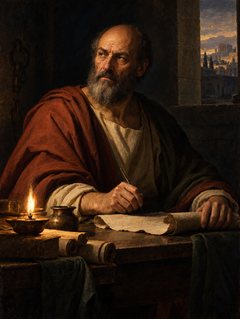 PaulApostle to the nations and writer of the church's earliest lettersJohn MarkCompanion of Peter and Paul, and Gospel writer
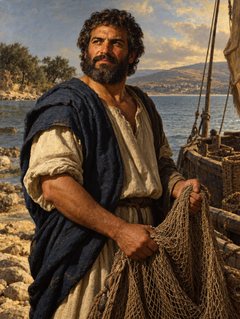 PeterApostle, fisherman, and rock of the early churchStephenDeacon and first Christian martyrSilas (Silvanus)Prophet, Jerusalem church leader, and Paul's travel companionTimothyCompanion of Paul and leader at EphesusJamesBrother of Jesus and leader of the Jerusalem churchLukePhysician, companion of Paul, and historian of the early churchThe Author of HebrewsUnknown writer of the letter to the Hebrews
Go deeper
The story of Barnabas is told in Acts 4, 9, and 11 to 15, with a few lines in Galatians, 1 Corinthians, and Colossians. Wikipedia and Bible Hub give summaries of the later traditions. Foxe's Book of Martyrs and the church histories collected at CCEL touch on the tradition of his death. BibleProject's overview of Acts places his work in the movement of the gospel from Jerusalem to the nations.
Related people: Paul, Mark, Peter, Stephen, Silas, Timothy, James, Luke, the author of Hebrews.
References and further reading
- Wikipedia: Barnabas
- Wikipedia article on : Barnabas
- Blue Letter Bible lexicon: Barnabas
- Schaff, History of the Christian Church vol. 1: Apostolic Christianity (CCEL)
- Eusebius, Church History (CCEL, NPNF series 2 vol. 1)
- Foxe, Book of Martyrs (CCEL)
- Bible text: Acts 11 (eBible.org, ESV)
- Bible text: Acts 13-15 (eBible.org, ESV)
Public-domain books, free to read
- History of the Christian Church, vol. 1Philip Schaff
- Church HistoryEusebius of Caesarea
- Foxe's Book of MartyrsJohn Foxe
- The Life and Work of St. PaulFrederic W. Farrar
Written by 508 Ministry. Scripture links open the public-domain World English Bible. Where Scripture, early church tradition and historians differ, this page says so.