

A boy from Lystra
Timothy's story begins in a small city where something strange had happened. On the first journey, Paul and Barnabas had come to Lystra, healed a man lame from birth, and been mistaken for the gods Zeus and Hermes. Not long afterward, enemies from the cities Paul had just left arrived, turned the crowd against him, and stoned him, dragging him outside the city and leaving him for dead (Acts 14:8 to 20). "But when the disciples gathered about him, he rose up and entered the city" (Acts 14:20).
Timothy may well have been among those disciples. The Bible does not say so. But when Paul returned to Lystra several years later, he found Timothy there, and by then Timothy was a respected young believer, and Paul called him "my beloved and faithful child in the Lord" (1 Corinthians 4:17). Calling someone a child in the faith suggests that Paul himself had brought Timothy to faith. It fits the picture of a man who watched Paul's suffering, heard his message, and believed.
Timothy's background was mixed, like so much of the early church. "A disciple was there, named Timothy, the son of a Jewish woman who was a believer, but his father was a Greek" (Acts 16:1). In Jewish law a child follows the mother, so by Jewish reckoning Timothy was a Jew. But his father was Greek, and apparently the boy had not been circumcised. That meant he was a member of two worlds, and not fully at home in either.
His faith, however, came from his family. Paul later reminded him: "I am reminded of your sincere faith, a faith that dwelt first in your grandmother Lois and your mother Eunice and now, I am sure, dwells in you as well" (2 Timothy 1:5). And a few chapters later: "from childhood you have been acquainted with the sacred writings, which are able to make you wise for salvation through faith in Christ Jesus" (2 Timothy 3:15). Here is a quiet picture of a household in a provincial town, where a mother and a grandmother taught a boy the Hebrew Scriptures, and where the Spirit of God used those lessons to prepare him for a larger life.
Paul's invitation
By the time Paul reached Lystra again, at the start of his second journey (about AD 49 to 50), his companion Barnabas was gone and he had Silas beside him (Silas). The believers in Lystra and nearby Iconium spoke well of Timothy (Acts 16:2). "Paul wanted Timothy to accompany him" (Acts 16:3). It was an invitation that would change the young man's life. He would leave his home, his mother, and his small town for a life of travel, hardship, and responsibility.
Then Acts reports something that surprises many readers: "and he took him and circumcised him because of the Jews who were in those places, for they all knew that his father was a Greek" (Acts 16:3). Paul had just come from the Jerusalem Council, where he had won the argument that Gentiles need not be circumcised, and he had refused to circumcise Titus, a Greek, when pressed to do so (Galatians 2:3 to 5). Why, then, circumcise Timothy? The difference is that Titus was a Gentile, and the demand to circumcise him was made as a requirement for salvation. Timothy was, by Jewish law, a Jew, and Paul was going to preach in synagogues across the Greek world. An uncircumcised Jew would have been a scandal and a stumbling block, and no one would have listened. Paul did it as a practical step for the sake of the message. He explained his approach elsewhere: "To the Jews I became as a Jew, in order to win Jews" (1 Corinthians 9:20). It is not a matter of principle but of wisdom, and it cost Timothy a painful operation as an adult. It also shows how seriously the young man took the call.
Years on the road
From that point Timothy is almost always at Paul's side, and then, when needed, sent out ahead as his representative. He traveled with Paul and Silas through Asia Minor, across the Aegean to Philippi (see Acts 16), and on to Thessalonica and Berea. When a riot drove Paul out of Berea, "Silas and Timothy remained there" while Paul went on to Athens (Acts 17:14). Paul sent word that they should join him quickly. Then, anxious about the young church in Thessalonica, which he had left after only a few weeks, Paul sent Timothy back to see how they were doing: "we sent Timothy, our brother and God's coworker in the gospel of Christ, to establish and exhort you in your faith, that no one be moved by these afflictions" (1 Thessalonians 3:2 to 3). When Timothy returned to Corinth with good news, Paul wrote: "But now that Timothy has come to us from you, and has brought us the good news of your faith and love... for now we live, if you are standing fast in the Lord" (1 Thessalonians 3:6 to 8). That is part of the earliest letter in the New Testament.
During Paul's long stay in Corinth, and again in Ephesus, Timothy continued to serve. Paul sent him to Corinth with the words: "I sent you Timothy, my beloved and faithful child in the Lord, to remind you of my ways in Christ" (1 Corinthians 4:17). He told the Corinthians, with a note of concern: "When Timothy comes, see that you put him at ease among you, for he is doing the work of the Lord, as I am. So let no one despise him" (1 Corinthians 16:10 to 11). The words suggest something about Timothy. He was probably not a bold or forceful man, and Paul felt he needed to be protected from the people who might look down on him.
Timothy was with Paul in Corinth when he wrote Romans, and Paul sent his greetings: "Timothy, my fellow worker, greets you" (Romans 16:21). He traveled with Paul as part of the group that carried the collection for the poor believers in Jerusalem (Acts 20:4). After that, when Paul was arrested, he disappeared for a time from Acts, but not from Paul's life.
Named in six letters
One striking fact tells us how close Timothy was to Paul. In the opening lines of six letters, Paul names Timothy as co-sender: 2 Corinthians ("Paul, an apostle of Christ Jesus by the will of God, and Timothy our brother," 2 Corinthians 1:1), Philippians ("Paul and Timothy, servants of Christ Jesus," Philippians 1:1), Colossians (Colossians 1:1), 1 Thessalonians and 2 Thessalonians (with Silvanus, that is, Silas, in 1 Thessalonians 1:1 and 2 Thessalonians 1:1), and the short letter to Philemon (Philemon 1). In two more letters he is addressed directly, and those are the letters to Timothy himself. Taken together, Timothy appears in fully eight of the thirteen letters that carry Paul's name. For a young man from a small town, it was a remarkable place to hold.
Paul's finest tribute to him comes in the letter to the Philippians, written from prison: "I hope in the Lord Jesus to send Timothy to you soon... For I have no one like him, who will be genuinely concerned for your welfare. For they all seek their own interests, not those of Jesus Christ. But you know Timothy's proven worth, how as a son with a father he has served with me in the gospel" (Philippians 2:19 to 22). In a letter full of warnings and affection, this is one of the warmest passages. Timothy's character is described in three words: genuine, concerned, proven. The word for "genuine" in Greek means "of the same soul," and Paul says there is no one else who shares his heart as Timothy does.
The letters to Timothy
The two letters to Timothy, with the letter to Titus, are called the Pastoral Epistles because they give guidance to those who care for churches. They are written to a young leader who had been left in charge of the church at Ephesus (1 Timothy 1:3). As we explain in the profile of Paul, many scholars doubt that Paul himself wrote them, thinking that a close follower may have put together his teaching soon after his death, while others defend Pauline authorship, placing the letters after the end of Acts, in a period of release and further travel. The church has accepted them as Scripture from the start. Whoever the writer, they show us the picture of Timothy that the early church held, and they have shaped Christian thinking about leadership for nearly two thousand years.
The picture we get is of a young man with many gifts and some weaknesses. "Let no one despise you for your youth, but set the believers an example in speech, in conduct, in love, in faith, in purity" (1 Timothy 4:12). Paul tells Timothy, "Do not neglect the gift you have, which was given you by prophecy when the elders laid their hands on you" (1 Timothy 4:14). He tells him to be careful with his health: "No longer drink only water, but use a little wine for the sake of your stomach and your frequent ailments" (1 Timothy 5:23). The comment shows that Timothy was often ill, and that Paul cared about the detail of his life.
Some of the most quoted lines in the New Testament come from these letters, and many are in our daily verse collection. Our collection contains twenty verses from the letters to Timothy and from the stories of his journeys with Paul. Among them:
- "The saying is trustworthy and deserves full acceptance, that Christ Jesus came into the world to save sinners" (1 Timothy 1:15)
- "Godliness with contentment is great gain" (1 Timothy 6:6)
- "For the love of money is a root of all kinds of evils" (1 Timothy 6:10)
- "Fight the good fight of the faith" (1 Timothy 6:12)
- "God gave us a spirit not of fear but of power and love and self-control" (2 Timothy 1:7)
- "I know whom I have believed, and I am convinced that he is able to guard until that Day what has been entrusted to me" (2 Timothy 1:12)
- "What you have heard from me in the presence of many witnesses entrust to faithful men, who will be able to teach others also" (2 Timothy 2:2)
- "Do your best to present yourself to God as one approved, a worker who has no need to be ashamed, rightly handling the word of truth" (2 Timothy 2:15)
- "All Scripture is breathed out by God and profitable for teaching, for reproof, for correction, and for training in righteousness" (2 Timothy 3:16)
- "Preach the word; be ready in season and out of season" (2 Timothy 4:2)
- "I have fought the good fight, I have finished the race, I have kept the faith" (2 Timothy 4:7)
Paul also points Timothy to the courage of Jesus himself: "I charge you in the presence of God... and of Christ Jesus, who in his testimony before Pontius Pilate made the good confession, to keep the commandment unstained" (1 Timothy 6:13 to 14; see Pontius Pilate). Look at 2 Timothy 2:2. Paul describes four generations in one sentence: Paul, Timothy, faithful men, others. It is the church's plan for handing on the faith, and it asks every believer to think about the next person.
The last letter
Second Timothy is the most personal and moving of the three. Paul is in prison again, in Rome, expecting to die. "For I am already being poured out as a drink offering, and the time of my departure has come" (2 Timothy 4:6). He is lonely. "Demas, in love with this present world, has deserted me... Luke alone is with me" (2 Timothy 4:10 to 11). He asks for his cloak, which he left in Troas, and his books, "especially the parchments" (2 Timothy 4:13). And he asks Timothy to come: "Do your best to come to me soon" (2 Timothy 4:9), and again, "Do your best to come before winter" (2 Timothy 4:21).
Reading it, one feels the warmth of the relationship. "I thank God whom I serve, as did my ancestors, with a clear conscience, as I remember you constantly in my prayers night and day. As I remember your tears, I long to see you, that I may be filled with joy" (2 Timothy 1:3 to 4). Timothy had wept at some farewell, and Paul remembers it. Whoever wrote the letter, whether Paul himself or someone close to him, it preserves the sense of a bond that held across years of danger.
The letter does not tell us whether Timothy arrived in time. One more note comes from the letter to the Hebrews, whose closing words say, "You should know that our brother Timothy has been released, with whom I shall see you if he comes soon" (Hebrews 13:23). The verse suggests that Timothy was himself imprisoned at some point and set free. We do not know the details, and we do not know who wrote Hebrews (see the author of Hebrews). But it shows that Timothy was known and respected in the next generation of the church.
What happened to Timothy
After the New Testament, our information is tradition. The church historian Eusebius, in the fourth century, writes that Timothy was the first bishop of Ephesus, "as it is recorded" (Church History 3.4). A later writing, the Acts of Timothy, from the fifth century, says that Timothy was martyred at Ephesus in the reign of Domitian or Nerva, about AD 97, when he tried to stop a pagan festival and was beaten and stoned to death. The late date and the legendary character of that account mean we should not treat it as established fact. But it is consistent with the picture of a man who spent his life as a faithful shepherd and may well have died for it.
Tradition places his relics in Constantinople, brought there in AD 356 by the emperor Constantius II. He is honored as a saint in both the Eastern and Western churches. In the Latin church his feast is shared with Titus on January 26, and in the Orthodox church he is remembered on January 22.
What Timothy teaches
Timothy is the pattern of the second-generation believer. He did not see Jesus or meet him, and he did not have a dramatic conversion like Paul's. He had a grandmother, a mother, and an apostle. He was brought up in the faith and then given a task. Many Christians today are in his position, and his story speaks to them in several ways.
Faith is often passed from person to person. Lois, Eunice, and Paul each handed Timothy something. Parents, grandparents, teachers, and friends are God's chosen way to hand on the faith. We should not undervalue the long, quiet work of teaching a child the Scriptures.
Youth is no excuse and no disqualification. Paul tells Timothy not to let anyone despise him because he is young, and tells him in the same breath to live in a way that gives no reason for it. A young person can lead, if he or she leads by example.
Weakness does not disqualify. Timothy was apparently shy, was often sick, and may have been afraid. Paul writes, "God gave us a spirit not of fear but of power and love and self-control" (2 Timothy 1:7), which suggests that Timothy was tempted to be timid. Paul does not drop him. He encourages him and entrusts him with great tasks.
The work is handed on. Paul's chief concern at the end of his life was that the gospel would continue. "Follow the pattern of the sound words that you have heard from me... Guard the good deposit entrusted to you" (2 Timothy 1:13 to 14). The answer to the question of whether the faith will survive is found in people like Timothy.
Friendship is part of ministry. The affection between Paul and Timothy is one of the most moving stories in the New Testament. Ministry was not a lonely job for either of them. They did it together.
Places
- 1Lystra · Home town
- 2Derbe · Nearby city of the first journey
- 3Philippi · Second journey
- 4Thessalonica · Sent back to strengthen the church
- 5Corinth · Carried Paul's message; with Paul when Romans was written
- 6Ephesus · Led the church there
- 7Rome · Paul's last imprisonment; 2 Timothy
- Lystra, his home
- Derbe and Iconium, nearby cities of the first journey
- Philippi, Thessalonica, Berea, Athens, Corinth, stops on the second journey
- Ephesus, where he led the church and, by tradition, died
- Rome, where Paul was imprisoned and wrote 2 Timothy
- Constantinople, where his relics were reputedly taken
By the numbers
Timeline
- 48Paul's first visit to Lystra; stoned and left for dead (c. AD 47-48)Acts 14:19-20
- 50Timothy joins Paul and Silas (c. AD 49-50)Acts 16:1-5
- 51Sent from Athens to Thessalonica; 1 Thessalonians written (c. AD 50-51)1 Thessalonians 3:1-6
- 55Sent to Corinth from Ephesus (c. AD 53-57)1 Corinthians 4:17; Acts 19:22
- 57With Paul in Corinth when Romans is writtenRomans 16:21
- 62Named with Paul in Philippians, Colossians and Philemon from prison (c. AD 60-62)Philippians 1:1; Colossians 1:1
- 652 Timothy (traditional date, AD 64-67)2 Timothy 4
In our verse index
Verses from our index
Verses in the index from 1 and 2 Timothy (written to Timothy) and Acts 16:25 (Paul and Silas at Philippi).
I exhort therefore, that, first of all, supplications, prayers, intercessions, and giving of thanks, be made for all men;
Pray for all people, with requests, petitions, and thanksgiving.
For the which cause I also suffer these things: nevertheless I am not ashamed: for I know whom I have believed, and am persuaded that he is able to keep that which I have committed unto him against that day.
I know whom I have believed, and I am sure he is able to guard what I have entrusted to him.
For bodily exercise profiteth little: but godliness is profitable unto all things, having promise of the life that now is, and of that which is to come.
Training the body helps a little, but godliness helps in every way, for now and later.
And the things that thou hast heard of me among many witnesses, the same commit thou to faithful men, who shall be able to teach others also.
Entrust what you have heard to faithful people who can teach others too. Pass it on.
But if any provide not for his own, and specially for those of his own house, he hath denied the faith, and is worse than an infidel.
Whoever does not provide for their own family has denied the faith. Care is faith in action.
If we believe not, yet he abideth faithful: he can not deny himself.
If we are faithless, he remains faithful, because he cannot deny himself.
But godliness with contentment is great gain.
Godliness with contentment is great gain. Two things together, not one.
Study to shew thyself approved unto God, a workman that needeth not to be ashamed, rightly dividing the word of truth.
Work hard to present yourself approved, a worker who has no need to be ashamed.
And having food and raiment let us be therewith content.
If we have food and clothing, we will be content with that.
All scripture is given by inspiration of God, and is profitable for doctrine, for reproof, for correction, for instruction in righteousness:
All Scripture is breathed out by God and is useful for teaching and for setting things right.
For the love of money is the root of all evil: which while some coveted after, they have erred from the faith, and pierced themselves through with many sorrows.
The love of money is a root of all kinds of evil. Love of it, not the money itself.
Preach the word; be instant in season, out of season; reprove, rebuke, exhort with all longsuffering and doctrine.
Preach the word, be ready in season and out of season.
Fight the good fight of faith, lay hold on eternal life, where unto thou art also called, and hast professed a good profession before many witnesses.
Fight the good fight of faith and take hold of the eternal life you were called to.
I have fought a good fight, I have finished my course, I have kept the faith:
I have fought the good fight, finished the race, and kept the faith.
Charge them that are rich in this world, that they be not highminded, nor trust in uncertain riches, but in the living God, who giveth us richly all things to enjoy;
Do not be arrogant or put hope in wealth, but in God, who richly provides.
Notwithstanding the Lord stood with me, and strengthened me; that by me the preaching might be fully known, and that all the Gentiles might hear: and I was delivered out of the mouth of the lion.
The Lord stood at my side and gave me strength, so the message would be fully told.
That they do good, that they be rich in good works, ready to distribute, willing to communicate;
Be rich in good deeds, generous and ready to share.
This is a faithful saying, and worthy of all acceptation, that Christ Jesus came into the world to save sinners; of whom I am chief.
Christ Jesus came into the world to save sinners. That includes the worst of us.
For God hath not given us the spirit of fear; but of power, and of love, and of a sound mind.
God has not given us a spirit of fear, but of power, love, and a sound mind.
And at midnight Paul and Silas prayed, and sang praises unto God: and the prisoners heard them.
At midnight Paul and Silas were singing. Praise in a prison cell is loud.
People in this story
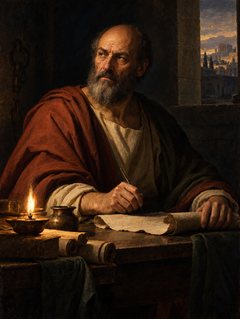 PaulApostle to the nations and writer of the church's earliest lettersBarnabasApostle, encourager, and companion of PaulSilas (Silvanus)Prophet, Jerusalem church leader, and Paul's travel companionLukePhysician, companion of Paul, and historian of the early churchJohn MarkCompanion of Peter and Paul, and Gospel writerPontius PilateRoman governor of JudeaThe Author of HebrewsUnknown writer of the letter to the Hebrews
Go deeper
Read the letters to Timothy slowly, one chapter at a time, noting how each connects to the situation Timothy faced. For the setting in Acts, read Acts 16 to 20. Wikipedia and Bible Hub offer summaries, and BibleProject has short animated overviews of 1 Timothy and 2 Timothy that make the structure of each letter clear.
Related people: Paul, Barnabas, Silas, Luke, Mark, Pontius Pilate, the author of Hebrews.
References and further reading
- Wikipedia: Saint Timothy
- Wikipedia article on : Timothy
- Blue Letter Bible lexicon: Timotheos (Timothy)
- Eusebius, Church History (CCEL, NPNF series 2 vol. 1)
- Schaff, History of the Christian Church vol. 1: Apostolic Christianity (CCEL)
- Farrar, The Life and Work of St. Paul (Internet Archive)
- Bible text: Acts 16 (eBible.org, ESV)
- Bible text: 1 Timothy 4 (eBible.org, ESV)
Public-domain books, free to read
- The Life and Work of St. PaulFrederic W. Farrar
- Church HistoryEusebius of Caesarea
- History of the Christian Church, vol. 1Philip Schaff
- Foxe's Book of MartyrsJohn Foxe
Written by 508 Ministry. Scripture links open the public-domain World English Bible. Where Scripture, early church tradition and historians differ, this page says so.