
A viral Facebook post says Jensen Huang moved more than $10.5 billion of Nvidia stock into a family trust. Most of it holds up. A few details are off, and the real story is a better lesson in how trusts work.
What the post said
The post came from the page Cryptos R Us. It reads: "JUST IN: Former #Nvidia CEO Jensen Huang transferred over $10.5 BILLION in $NVDA stock to a family trust months before his resignation and the company's recent selloff." It adds that the shares went into an irrevocable trust in March 2026, that they came from trusts funded with about $51 million in 2016, and that the structure could pass billions to heirs without federal estate tax.
Before we use a story like this to teach anything, we check it. We read the filings first and the news second.
What we checked
What the post leaves out
The shares were not handed over in one fresh move in March. They came out of two older trusts called grantor retained annuity trusts, or GRATs, when those trusts reached the end of their ten-year terms. The Form 4 says the transfer happened "upon termination." Barron's reports that the Huangs set up four GRATs, two with the usual four-year term and two lasting ten years. (Form 4; Yahoo Finance; Polymarket made the same point)
That changes the timing story. The end date traces back to when the trusts were set up in 2016. The transfer came about eight months before the resignation, and the selloff began in early November. We found nothing showing the trust was timed to either event, and we will not guess.
Three other things are not public. The filings do not name the people who will benefit. They do not show what tax was paid. And Nvidia's filing gives no reason for the resignation. We leave all of that alone.
How the trust works, in plain words
A trust is a legal box with written rules. A trustee looks after what is in the box and follows the rules. "Irrevocable" means the person who fills the box cannot simply take things back out. That is the point. Once the stock is in, it is no longer counted as part of the giver's own estate, in most cases.
A GRAT adds a twist. Think of a small orchard. You put it in the trust for a set number of years, and the trust pays you a fixed amount of fruit each year. When the term ends, whatever is left goes to the people you named. Here that was another trust for the family.
The tax office assumes the orchard will grow at a modest rate, set each month by the IRS. If the trees grow faster than that, the extra growth goes to the family and does not use up the giver's lifetime gift exemption. Planners often set the yearly payments so the gift on day one is worth about zero. That version is called a zeroed-out GRAT. (NerdWallet; Journal of Accountancy)
It can fail. If the stock does not beat the assumed rate, little or nothing passes on, and the giver is out only the cost of setting it up. Barron's says ten-year GRATs are less common because they carry more risk. (Yahoo Finance)
Why timing matters
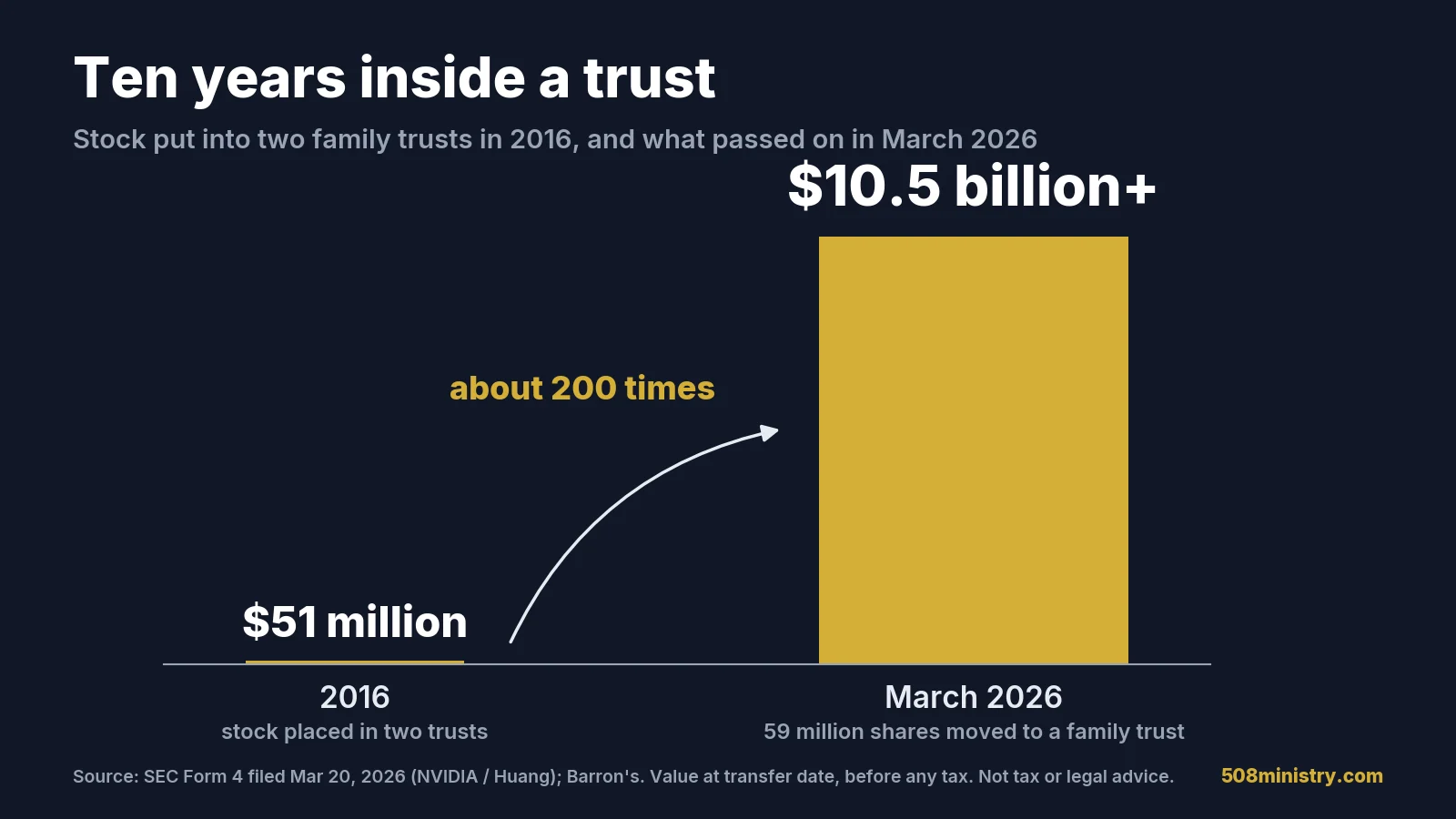
The value that counts for the gift is measured when the trust is created. Growth after that happens inside the trust, outside the giver's estate. In this case about $51 million of stock became more than $10.5 billion, roughly 200 times as much, over ten years. That is one famous company in an unusually strong decade, and no family should plan around it.
The lesson is about order. Set the structure up first, then let time do the work. Moving the same shares after they had already multiplied would have left much less growth to move.
Is this for you?
Probably not this exact tool. The 2026 federal estate and gift tax exclusion is $15,000,000 per person, so most families are far below the line. (IRS) GRATs are built for very large estates. The idea underneath still scales down: write the plan on paper while things are small, because growth is easier to direct before it happens.
What this means for families
A trust lets you say in writing who gets what, and when. You decide the rules, not a court and not the default rules of your state. If you own a home, savings or a family business, a licensed estate attorney can tell you which kind of trust fits.
What this means for ministries
A 508(c)(1)(A) ministry is built around a governing trust document, named trustees and clean records. That structure keeps the mission steady when leaders change. It does a different job than a GRAT, and we are not saying a 508 trust avoids estate tax. What it does give a ministry is a written foundation, set up before the congregation, the giving and the property grow. 508 Ministry is an administration service, not a law firm.
What this means for small business owners
A new company is worth the least on its first day. That makes the first year a good time to decide who owns it, how it is organized and what happens if the owner steps away. Start My Business helps owners form and organize companies. Before you move ownership into any trust, talk to your attorney and your tax advisor.
Keeping trust records in order
Trusts only work if the paperwork is right and easy to find. My Trust Software gives trustees one place for trust documents, trustee details and records.
Sources
- SEC Form 4, NVIDIA / Huang, filed March 20, 2026
- NVIDIA Form 8-K, CEO transition, November 12, 2026
- Barron's original report (paywalled)
- Yahoo Finance summary of the Barron's report, November 16, 2026
- PANews summary of the Barron's report, November 17, 2026
- 24/7 Wall St., "Nvidia just had its worst day since DeepSeek," November 6, 2026
- Motley Fool, "Why Nvidia stock is getting punished today," November 5, 2026
- NerdWallet, "What is a grantor retained annuity trust?"
- Journal of Accountancy, "Wealth transfer with grantor retained annuity trusts" (2019)
- IRS, "What's new: Estate and gift tax" (2026 exclusion amount)
- Polymarket on X, noting the March filing was a scheduled GRAT termination
Fact check completed November 16, 2026, against the SEC filings and news reports listed above.